





What IQ Is a Moron? Idiot, Imbecile and Moron as Old IQ Labels
In the old clinical scheme a moron had an IQ of roughly 50 to 70, an imbecile about 20 or 25 to 50 and an idiot below that, according to Lewis Terman in 1916. See who coined the words, how the cut-offs moved, what the 1913 UK Act said and why the labels were dropped.

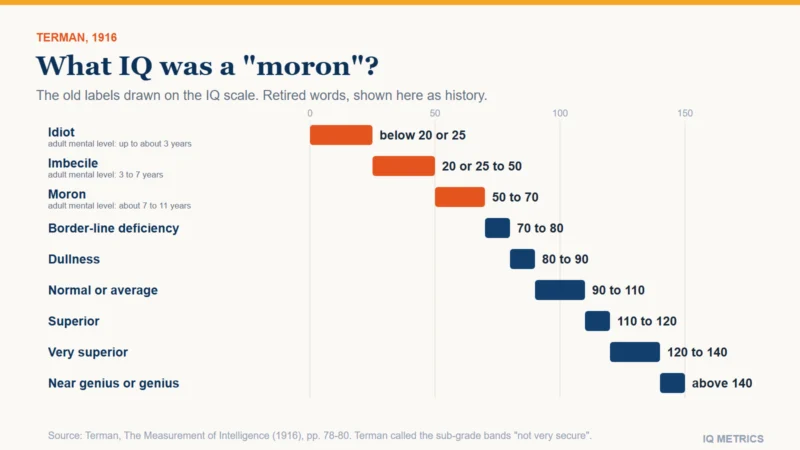
What IQ is a moron? In the old clinical scheme, a “moron” was someone with the mildest form of what is now called intellectual disability, and in Lewis Terman’s 1916 Stanford-Binet tables the group sat at an IQ of roughly 50 to 70. An “imbecile” sat at about 20 or 25 up to 50, and an “idiot” below that. These were never official cut-offs. The original 1910 definitions counted mental age, not IQ; different authorities drew the lines in different places; and Terman himself called the sub-grade bands “not very secure.” This guide covers who defined each word, how the lines moved, what a 1913 UK Act said, why the words were dropped and what replaced them. All three words are offensive today and are quoted here only as history.
- Moron: an IQ of roughly 50 to 70 in Terman’s 1916 tables; a mental age of about 7 or 8 up to 12 in the 1910 scheme.
- Imbecile: an IQ of about 20 or 25 to 50; a mental age of 3 to 7.
- Idiot: an IQ below about 20 or 25; a mental age of up to about 2 or 3.
- Origin: “moron” was coined as a new technical term in 1910, from a Greek word for foolish; “idiot” and “imbecile” are far older.
- Retired: Rosa’s Law (2010) replaced “mental retardation” with “intellectual disability” in US federal law, and DSM-5 (2013) bases severity on everyday functioning, not IQ bands.
What IQ was a moron, an imbecile and an idiot?
The nearest thing to an original IQ table comes from Lewis Terman’s 1916 The Measurement of Intelligence, which introduced the Stanford-Binet in the United States (see our guide to the Stanford-Binet). Terman labeled every IQ below 70 “definite feeble-mindedness” and then subdivided the group: those between 50 and 70 “include most of the morons,” those between 20 or 25 and 50 are “ordinarily to be classed as imbeciles,” and those below 20 or 25 are idiots. He also translated the three grades into the mental level of an adult, shown next to the 1910 mental-age bands in the table.
| Old label | IQ band (Terman, 1916) | Adult mental level (Terman) | Mental age (1910 scheme, as Goddard reported it) |
|---|---|---|---|
| Idiot | below 20 or 25 | up to about 3 years | up to and including 2 years |
| Imbecile | 20 or 25 to 50 | 3 to 7 years | 3 to 7 years, inclusive |
| Moron | 50 to 70 (“most of the morons”) | about 7 to 11 years | 7 to 12 years; some sources say 8 to 12 |
The tidy version that circulates online — idiot 0 to 25, imbecile 26 to 50, moron 51 to 70 — is a later simplification, and we found no primary source that prints it. Terman’s own version has “or” boundaries at 20 or 25, says 50 to 70 covers most morons, and adds that the lines between such groups are “absolutely arbitrary, a matter of definition only.” Sources also disagree by a year at each end of the mental-age bands: Goddard’s 1914 book gives the moron range as 7 to 12, the Online Etymology Dictionary gives 8 to 12, and Terman’s adult figure is about 7 to 11.
Where did the words come from?
Two of the three are far older than IQ testing. Idiot comes from the Greek idiotes, a “private person” or layman, and by the early fourteenth century English used it for a person unable to reason. Imbecile comes from the Latin imbecillus, “weak, feeble,” and first described bodily weakness in the 1540s; the mental sense arrived in the mid-eighteenth century. Moron is different: it was invented for the job.
In 1910 the American Association for the Study of the Feeble-Minded adopted a three-grade scheme, and the psychologist Henry H. Goddard supplied a new word for the top grade, taken from the Greek moros, “foolish, dull.” Goddard’s 1914 book Feeble-Mindedness: Its Causes and Consequences reports the scheme in mental-age years: idiots up to and including two, imbeciles three to seven and, in his words, “for those from seven to twelve a new term has been invented; they are now called morons.” He added that the new word “designates almost exactly what is meant by ‘feeble-minded’ in England.” Coined as a clinical term in 1910, “moron” was in print as an insult by 1918 and was later dropped from technical use, according to the Online Etymology Dictionary.
How did mental ages become IQ bands?
Mental age is the age at which an average child performs like the person tested. A ratio IQ divides it by chronological age and multiplies by 100, so a child of 10 with a mental age of 5 scores 50. Adults cause a problem, because mental age stops rising in the mid-teens. Terman handled it by ignoring age above 16; his case notes give scores such as “approximately 65 (not counting age beyond 16).” Using 16 as the divisor (our arithmetic), a mental age of 8 is an IQ of 50 and a mental age of 11 is about 69. That is why “IQ 50 to 70” and “an adult mental age of about 7 to 11” describe nearly the same people, and why Goddard’s upper limit of 12 works out nearer to IQ 75. Modern tests no longer report mental age at all. Our guides to IQ and mental age and deviation IQ versus ratio IQ explain why, and the piece on standard deviation 15 versus 16 explains why older scales do not line up with today’s.
Who drew the line where?
The words disappeared, but the underlying question — where does the line sit? — kept moving. The table shows how far the cut-off wandered over a century.
| Authority and year | Term used | Where the line sat |
|---|---|---|
| Goddard and the American Association, 1910 (as reported in 1914) | idiot, imbecile, moron | mental age up to 2; 3 to 7; 7 to 12. No IQ figures. |
| Terman, Stanford-Binet, 1916 | “definite feeble-mindedness” | IQ below 70; morons mostly 50 to 70 |
| Kuhlmann (as quoted by Wechsler) | mental defectives | IQ below 75 |
| Wechsler-Bellevue, 1944 | defective; borderline | 65 and below; 66 to 79 |
| WAIS, as tabulated in Wechsler’s 1958 book | defective; borderline | 69 and below; 70 to 79 |
| AAMD manual, 1959 | mental retardation, borderline included | one standard deviation below the mean (about 85 on today’s scale of 15); “almost 15 percent” of the US population |
| AAMD manual, 1973 | mental retardation | back to about 70; the ceiling may extend to 75 |
| DSM-IV-TR, 2000 (as quoted in Atkins v. Virginia) | “mild” mental retardation | an IQ of 50–55 to approximately 70 |
| DSM-5, 2013 | intellectual disability | about two standard deviations below the mean (an IQ of about 70 or below), plus limits in everyday functioning |
| AAIDD, current definition | intellectual disability | “around 70 or as high as 75,” plus adaptive limits and onset before age 22 |
The 1959 row is the striking one. The American Association on Mental Deficiency moved the line to one standard deviation below the mean, a step its own 1973 manual says could take in almost 15 percent of the US population, and then reversed it. On a normal curve the share of people below 85 is 15.9 percent (our calculation). A cut-off is a decision, not a discovery, and the same person could sit inside or outside a diagnosis depending on which manual was in force. Note that Wechsler’s tables never used the three words at all; his labels were “defective” and “borderline.”
What did UK law say? The Mental Deficiency Act 1913
British law used the same vocabulary and defined it differently. Section 1 of the Mental Deficiency Act 1913 named four classes, each by what a person could do rather than by any test score: idiots, unable “to guard themselves against common physical dangers”; imbeciles, “incapable of managing themselves or their affairs”; feeble-minded persons, who needed “care, supervision, and control”; and “moral imbeciles,” defined by a permanent mental defect coupled with “strong vicious or criminal propensities.” The statute contains no IQ or mental-age figure. Goddard himself observed that his new American word “moron” covered almost exactly what the English called “feeble-minded.” The Mental Health Act 1959 later replaced the four classes with “severe subnormality” and “subnormality,” and British services now say “learning disability,” which means what the United States calls intellectual disability — a terminology trap covered in our guide to low IQ, intellectual disability and learning disability.
Where would your own score land?
Take the IIF-certified assessment and get your score with the scale it was measured on, the percentile it corresponds to and the confidence range around it — the three figures most online tests leave out.
Find your IQ score now! →Why were the words dropped?
A clinical word for a stigmatized condition tends to turn into an insult, and its replacement then absorbs the stigma. “Moron” made the jump within about eight years of its coinage. The field’s response was to keep changing the label: by 1973 the American Association on Mental Deficiency’s manual was titled Manual on Terminology and Classification in Mental Retardation, and in 2010 Congress passed Rosa’s Law (Public Law 111-256, signed 5 October 2010), which replaced “mental retardation” with “intellectual disability” in a list of federal education, health and rehabilitation statutes. The law renamed rather than redefined: its own text says the new term means a condition previously referred to as mental retardation. The Social Security Administration made the same substitution in its disability listings from 3 September 2013, and DSM-5 renamed the diagnosis the same year.
What were the labels used to justify? Buck v. Bell
The categories were not harmless bookkeeping. In Buck v. Bell (1927) the US Supreme Court upheld Virginia’s compulsory sterilization law, and Justice Holmes closed the opinion with the line “Three generations of imbeciles are enough.” The opinion itself describes Carrie Buck, her mother and her daughter as “feeble-minded” and states no IQ or mental age; “imbeciles” appears only in that sentence. Lutz Kaelber of the University of Vermont counts compulsory sterilization laws in over 30 US states that led to more than 60,000 sterilizations of disabled people. The wider story of how IQ testing was bent to that agenda, and where the popular version overreaches, is in our guide to eugenics and the history of IQ testing.
How is intellectual disability defined today?
Modern diagnosis is not “an IQ below 70.” DSM-5 requires limits in intellectual functioning and in adaptive functioning across conceptual, social and practical skills, and describes the intellectual limit as roughly two standard deviations below the population mean, an IQ of about 70 or below. The American Association on Intellectual and Developmental Disabilities says a score “around 70 or as high as 75” indicates a significant limitation and places onset before age 22. The World Health Organization’s ICD-11 describes the mild range as roughly two to three standard deviations below the mean. Severity is now set by everyday functioning rather than by an IQ band. Our guide to what an IQ of 70 means explains the measurement-error zone around the line, and our news pieces on the Hamm v. Smith decision and the Social Security score rules show how courts and benefit rules handle the same numbers.
The bell curve helps here, with one warning. On a normal model with a mean of 100 and a standard deviation of 15, about 2.3 percent of people would score below 70 (roughly 1 in 44), 0.04 percent below 50 (roughly 1 in 2,300) and almost nobody below 25. Those are model figures, not prevalence counts: the American Psychiatric Association puts intellectual disability at about 1 percent of the population, well under the 2.3 percent the curve implies, because a diagnosis also needs limits in daily functioning. Our IQ percentile calculator and IQ bell curve pages let you check any score. One more confusion worth clearing: dyslexia and other specific learning disorders are not intellectual disability and occur at any IQ, as our guide to dyslexia and IQ explains.
Quick answers
- What IQ is a moron? Roughly 50 to 70 in Terman’s 1916 tables; a mental age of about 7 or 8 up to 12 in the 1910 scheme.
- What IQ is an imbecile? About 20 or 25 to 50 in Terman’s tables; a mental age of 3 to 7.
- What IQ is an idiot? Below about 20 or 25; a mental age of up to about 2 or 3.
- Who invented the word “moron”? Henry H. Goddard proposed it in 1910, from the Greek moros, and the American Association for the Study of the Feeble-Minded adopted it.
- Was there ever an official IQ table for the three words? No. The 1910 scheme used mental age, and Terman’s IQ bands were approximate suggestions he called “not very secure.”
- Are the words still used in diagnosis? No. Current manuals say intellectual disability (UK services say learning disability), and the old words survive only as insults.
- Is IQ 70 the modern cut-off? It is a guide, not a line: about 70 to 75, plus limits in everyday functioning that begin in the developmental period.
The bottom line
“Moron,” “imbecile” and “idiot” began as the three grades of one clinical scale, defined first by mental age in 1910 and then given approximate IQ bands by Terman in 1916: about 50 to 70, 20 or 25 to 50, and below that. The bands were soft from the start, the cut-off for the whole group moved by a full standard deviation within living memory, and the words turned into insults within a decade. What replaced them is not a new set of IQ labels but a two-part test — a low score plus limits in everyday life — that no online quiz can apply.
Sources
- Terman, L.M. (1916): The Measurement of Intelligence. Houghton Mifflin, pp. 78-80.
- Goddard, H.H. (1914): Feeble-Mindedness: Its Causes and Consequences. Macmillan, pp. 3-4.
- Wechsler, D. (1958): The Measurement and Appraisal of Adult Intelligence, 4th ed. Williams & Wilkins.
- Grossman, H.J., ed. (1973): Manual on Terminology and Classification in Mental Retardation. American Association on Mental Deficiency.
- Online Etymology Dictionary: entries for moron, idiot and imbecile.
- Mental Deficiency Act 1913 (3 & 4 Geo. 5 c. 28), section 1, transcription.
- Buck v. Bell, 274 U.S. 200 (1927).
- Atkins v. Virginia, 536 U.S. 304 (2002), footnote 3 (DSM-IV-TR).
- Rosa's Law, Public Law 111-256 (2010).
- Social Security Administration (2013): Change in terminology, mental retardation to intellectual disability, 78 FR 46499.
- American Psychiatric Association: DSM-5 fact sheet, Intellectual Disability.
- AAIDD: Definition of intellectual disability.
- Kaelber, L.: Eugenics, compulsory sterilization in 50 American states, University of Vermont.
- World Health Organization: ICD-11, code 6A00.0, mild disorder of intellectual development.
Keep reading
All articles →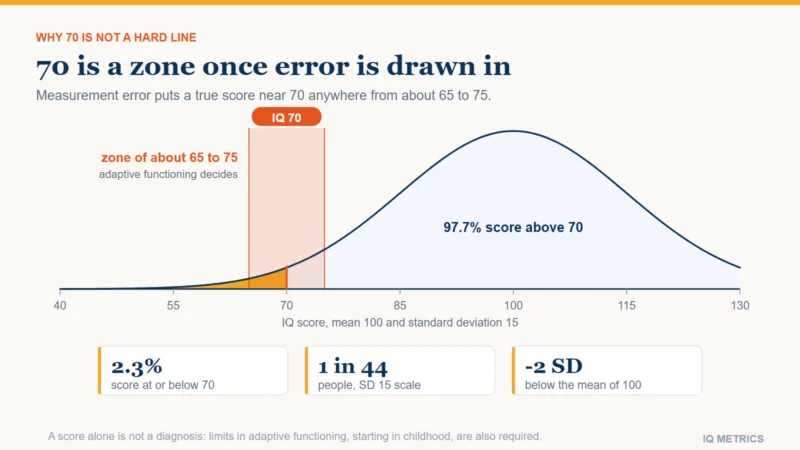 Scores & Scales
What an IQ of 70 Means
An IQ of 70 sits two standard deviations below the mean, at about the 2nd percentile. It is the score most often linked with intellectual disability, but a diagnosis never rests on the number alone: measurement error turns the line into a zone, and adaptive functioning decides who is inside it.
 Understanding IQ
IQ Testing and Eugenics
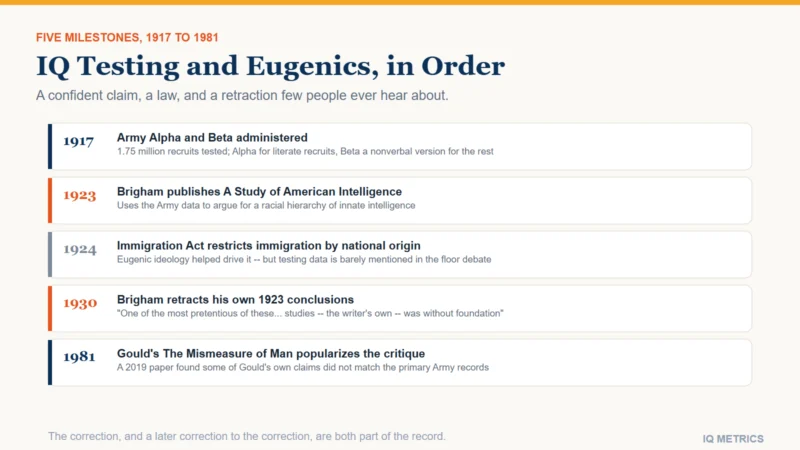
Between 1917 and 1919, the United States Army tested roughly 1.75 million recruits in the largest intelligence-testing program the world had yet seen. Within a decade, one psychologist had turned that data into a case for restricting immigration by race. Thirteen years after that, the same psychologist published a retraction few people have ever heard of.
 Understanding IQ
Dyslexia and IQ
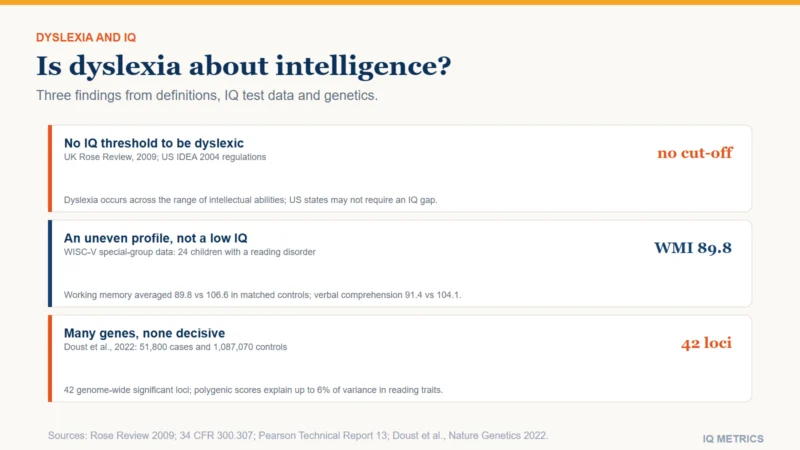
Dyslexia is a reading and spelling difficulty that occurs at every level of IQ, and the IQ-gap rule was dropped as a US requirement in 2004 and from the IDA definition in 2025. See what IQ tests show for readers with dyslexia, and what the genetics and myths add.