





Dyslexia and IQ: Is There a Link? What the Research Shows
Dyslexia is a reading and spelling difficulty that occurs at every level of IQ, and the IQ-gap rule was dropped as a US requirement in 2004 and from the IDA definition in 2025. See what IQ tests show for readers with dyslexia, and what the genetics and myths add.

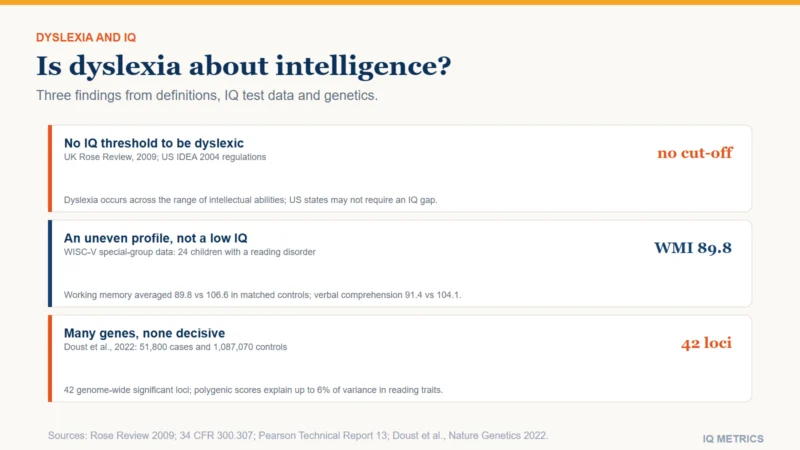
Dyslexia and IQ are separate things. Dyslexia is a difficulty with accurate, fluent word reading and spelling, not a measure of intelligence, and the UK Rose Review states that it “occurs across the range of intellectual abilities.” A person does not need a high, average or any particular IQ to be dyslexic. The old requirement for a gap between IQ and reading was dropped from US special-education rules in 2004, and in October 2025 the International Dyslexia Association replaced its 2002 definition, which had called the difficulty “unexpected” relative to other abilities. This guide covers what changed, what IQ tests show for readers with dyslexia, whether dyslexia lowers IQ scores, what genetics adds, and two popular myths.
- Definition: difficulties with accurate and/or fluent word reading and spelling, on a continuum of severity, not a yes-or-no condition.
- IQ needed? No. The UK Rose Review says dyslexia occurs across the range of intellectual abilities, and under US IDEA 2004 states “must not require” a severe IQ-achievement discrepancy.
- Lower IQ? Not as such, but group profiles are uneven: in Pearson data for 24 children with a reading disorder, working memory averaged 89.8 and verbal comprehension 91.4, against 106.6 and 104.1 in matched controls.
- How common? It depends on the cut-off: about 7% at 1.5 standard deviations below the mean, and roughly one in ten children in a 2022 genetics paper.
- Genes: a 2022 study found 42 genome-wide significant loci; polygenic scores explained up to 6% of the variance in reading traits.
What is dyslexia, and what changed in 2025?
For two decades most articles quoted the International Dyslexia Association’s 2002 definition, which said the difficulty was “often unexpected in relation to other cognitive abilities and the provision of effective classroom instruction.” That is no longer the current wording. The IDA board adopted a revised definition on 22 October 2025, and the text no longer contains the word “unexpected.” The IDA page keeps the 2002 version only as a historical reference. In the UK, the British Dyslexia Association now presents a 2025 definition agreed by a panel of experts through the Delphi method, which accepted 42 statements. Neither new definition requires an IQ gap, though the UK wording still relates literacy to a person’s “other attainments.”
| Source and year | What it says |
|---|---|
| International Dyslexia Association, 2002 | A neurobiological learning disability with accurate and/or fluent word recognition problems that are “often unexpected in relation to other cognitive abilities” |
| International Dyslexia Association, 22 October 2025 | Difficulties in word reading and/or spelling involving accuracy, speed or both; a continuum of severity; difficulties persist even with instruction that is effective for peers. Phonological and morphological difficulties are “common but not universal.” No mention of unexpectedness. |
| Rose Review, UK, 2009 | “A learning difficulty that primarily affects the skills involved in accurate and fluent word reading and spelling”; occurs across the range of intellectual abilities; a continuum with no clear cut-off points |
| British Dyslexia Association, 2025 Delphi definition | “A set of processing difficulties that affect the acquisition of reading and spelling,” with literacy weak in relation to age, teaching and other attainments |
| DSM-5, 2013 | Specific learning disorder with impairment in reading; academic skills well below the average range on appropriate tests; not better explained by other disorders. Dyslexia stays in the descriptive text. |
The debate is still live. Snowling, Hulme and Nation (2020) note that the failure to find qualitative differences between poor readers with and without an IQ gap led the discrepancy definition to “fall from favour,” but that loosening the criteria also caused “diagnostic confusion.” Elliott and Grigorenko (2024) argue that diagnosing by the IDA definition then in force “often results in scientifically questionable diagnoses.” Treat any 2002-era definition, and any IQ-gap rule of thumb, as out of date.
Do you need a certain IQ to be dyslexic?
No, and the history explains why people think you do. A 1968 World Federation of Neurology definition described children who fail to attain reading skills “commensurate with their intellectual abilities.” Rutter and Yule’s 1975 paper on Isle of Wight data seemed to support the discrepancy idea, on the strength of a “hump” in the distribution of reading achievement. When US regulations for Public Law 94-142 arrived in 1977, specific learning disability was identified by a significant discrepancy between IQ and achievement. Later studies questioned the original finding because it applied no exclusion criteria, so its no-discrepancy group included many children with brain injury or intellectual disability.
The evidence then accumulated against the gap rule:
- Stuebing and colleagues (2002) meta-analyzed 46 studies of the IQ-discrepancy classification and found “little evidence in support of the validity” of it.
- Fletcher and colleagues (1994) compared discrepancy and low-achievement definitions in 199 elementary school students and found no support for the discrepancy version; Stanovich and Siegel (1994) reached a similar conclusion with 907 children.
- Stuebing and colleagues (2009) pooled 22 studies and found IQ explained very little of how well children responded to reading instruction (R² = 0.03).
- IDEA 2004 (34 CFR 300.307) says states “must not require” a severe discrepancy between intellectual ability and achievement, and must permit a process based on response to research-based intervention.
Two nuances keep this from being an absolute. US rules still exclude reading problems that are primarily the result of intellectual disability, and evaluators may still look for a pattern of strengths and weaknesses relative to age, grade-level standards or intellectual development. And a 2012 Lancet review by Peterson and Pennington found that research does not support the external validity of the distinction between age-based and IQ-based definitions, yet recommends that children meeting either one be identified and treated. Dyslexia is also not all-or-nothing. In Shaywitz’s 1992 study of 414 Connecticut children, which defined dyslexia by an IQ-reading discrepancy score, it “occurs in degrees,” and the model predicted, and the data indicated, that only 7 of 25 children classed as dyslexic in grade 1 would be classed as dyslexic in grade 3. For the wider picture of how learning disabilities relate to scores, see our guides to low IQ, intellectual disability and learning disability and ADHD, autism and dyslexia test scores.
Does dyslexia lower IQ scores?
Not as a single number, but the profile is often uneven. The clearest public data come from Pearson’s technical report on the WISC-V in 24 children aged 6 to 16 with a specific learning disorder in reading. Their averages, next to matched controls, show where the gaps sit:
| Index | Reading-disorder group | Matched controls |
|---|---|---|
| Verbal Comprehension | 91.4 | 104.1 |
| Visual Spatial | 98.4 | 106.6 |
| Fluid Reasoning | 97.6 | 105.7 |
| Working Memory | 89.8 | 106.6 |
| General Ability Index | 95.1 | 107.2 |
| Naming Speed Literacy | 80.0 | 103.8 |
Read this with care. It is a small group, the controls averaged 104 to 107, so the gaps overstate the distance from the norm of 100, and the report excluded the processing-speed subtests, so there is no Full Scale IQ. A much larger clinical sample points the same way: Toffalini and colleagues (2017) studied 1,049 Italian children diagnosed with a specific learning disorder on the WISC-IV and found that all subgroups shared weaknesses in working memory and processing speed, with the working-memory and processing-speed composite about one standard deviation below the general ability composite. Among adults, Callens and colleagues (2012) compared 100 Dutch-speaking students with dyslexia and 100 without learning disabilities and found no significant difference in fluid intelligence, and slightly lower crystallized scores, which they attributed to retrieving verbal information from long-term memory. The authors also warn that university samples may be selected by admission criteria. Our guides to WISC-V index scores, full-scale IQ versus index scores and reading an IQ test report explain why one number can hide an uneven profile, and the Woodcock-Johnson guide covers the achievement tests that measure reading directly.
Can reading itself change IQ scores?
It may, which is one reason group averages need care. Ferrer and colleagues (2010) reported that in typical readers reading and IQ develop in a dynamically linked way over time, a pattern “not perceptible in dyslexic readers,” suggesting the two develop more independently. In a general-population twin sample of 1,890 identical pairs tested from age 7 to 16, Ritchie, Bates and Plomin (2015) found that earlier within-pair differences in reading were associated with later differences in intelligence, not explained by reading exposure and not limited to verbal tasks. That study did not examine dyslexia, and Stanovich’s 1986 “Matthew effect” idea that reading experience feeds cognitive growth has been contested, but together they raise the possibility that less reading practice could hold back vocabulary-heavy scores over time. Our guides to reading and IQ and verbal versus non-verbal scores cover the same ground from other angles.
What do genes have to do with it?
A great deal, and it is polygenic. Family studies put heritability at up to 70%. A genome-wide study by Doust and colleagues (2022) in Nature Genetics, compared 51,800 adults who reported a dyslexia diagnosis with 1,087,070 controls and found 42 independent genome-wide significant loci, 15 of them in genes linked to cognitive ability or educational attainment and 27 new. Polygenic scores explained up to 6% of the variance in reading traits, so they are nowhere near a diagnostic test. Genetic correlations with cognitive measures were negative but partial, ranging from −0.19 for childhood and adolescent performance IQ to −0.50 for adult verbal-numerical reasoning, none beyond 0.5. Of 75 previously reported dyslexia associations, none reached genome-wide significance in the new analysis. The authors note the limits: self-reported diagnosis in a consumer-genetics cohort, with potential collider bias. Our guide to whether IQ is genetic covers the parallel debate for intelligence.
Where would your own score land?
Take the IIF-certified assessment and get your score with the scale it was measured on, the percentile it corresponds to and the confidence range around it — the three figures most online tests leave out.
Find your IQ score now! →Are dyslexic people more intelligent, or more likely to be entrepreneurs?
No source we reviewed reports higher IQ in dyslexia. The British Dyslexia Association says many dyslexic people show strengths in reasoning and in visual and creative fields, but its page gives no citation for that sentence, and Callens found no difference in fluid intelligence. The most repeated statistic is that 35% of US entrepreneurs are dyslexic. It traces to Julie Logan’s 2009 survey, in which 102 entrepreneurs and 37 corporate managers responded, a 7.0% response rate. Of the entrepreneurs, 36 (35%) scored four or more traits on a dyslexia checklist, against 3 of 37 managers (8%). A checklist is a trait screen, not a diagnosis, and Logan cautioned that the corporate sample was too small to test for an effect. The result is an association in a small, low-response, self-selected sample, and it says nothing about IQ or about whether dyslexia causes business success.
Claims that Einstein, Edison or da Vinci were dyslexic are posthumous labels. A diagnosis rests on standardized reading and spelling tests that cannot be given to historical figures, and a 1987 paper in the Journal of Learning Disabilities asked whether such figures were really learning disabled at all. For a related myth about a different condition, see ADHD and IQ.
How is dyslexia identified, and where does IQ fit?
Assessment focuses on word reading, spelling and decoding, plus phonological awareness and rapid naming. In the Pearson data above, the largest gap of all was on naming speed for literacy (80.0 against 103.8). Peterson and Pennington note that diagnosis “requires setting a somewhat arbitrary cutoff on a continuous variable,” which is why prevalence depends on the definition: about 7% at a cut-off of 1.5 standard deviations below the mean, and roughly one in ten children in Doust’s genetics paper. US law lists dyslexia among the conditions that can be a specific learning disability; in the UK, the British Dyslexia Association reads the Equality Act 2010 as covering dyslexia as a disability, although whether a particular person is covered depends on the Act’s “substantial” and “long-term” test. Only a qualified assessor can diagnose, and an online IQ quiz cannot. Timed, text-heavy online tests were not evaluated in the research we reviewed, so a low score on one is not a finding. IQ is a weak predictor of how children respond to reading instruction (the 2009 meta-analysis above), which is why identification leads to teaching rather than to an IQ verdict; for what persistence traits add on top, see our guide to grit vs IQ. The idea of being gifted and having a learning difficulty at once (twice-exceptional) is covered in our guide to high IQ and ADHD, and IQ testing for children covers the assessments themselves.
Quick answers
- Does dyslexia lower IQ? Not as such. Group averages on some index scores, especially working memory and verbal comprehension, run lower, but individuals vary widely.
- Can you be dyslexic with a high IQ? Yes. The Rose Review says dyslexia occurs across the range of intellectual abilities.
- Do you need an IQ score to be diagnosed? No. US rules say states must not require a severe IQ-achievement discrepancy, and UK definitions have no IQ criterion.
- Did the definition of dyslexia change? Yes. The IDA adopted a new definition on 22 October 2025 that drops “unexpected,” and the British Dyslexia Association now presents a 2025 Delphi definition.
- How common is dyslexia? About 7% at a cut-off of 1.5 standard deviations below the mean, roughly one in ten children in a 2022 study; the figure depends on the definition.
- Is dyslexia genetic? Partly. Family studies suggest heritability up to 70%, and a 2022 study found 42 associated loci, but polygenic scores explain up to 6% of variance in reading traits.
- Are 35% of entrepreneurs dyslexic? No. 36 of 102 survey respondents scored four or more traits on a checklist, at a 7.0% response rate.
The bottom line
Dyslexia is a reading-and-spelling difficulty that occurs at every level of IQ. The idea that you need an IQ gap to qualify has been dropped from US special-education rules and, as of October 2025, from the International Dyslexia Association’s own definition. What IQ tests can add is a profile: in the data above, lower working-memory and verbal scores than reasoning scores, with wide variation between individuals. That is a description of strengths and weaknesses, not a verdict on intelligence, and it cannot come from an online quiz.
Sources
- International Dyslexia Association: Definition of dyslexia (adopted 22 October 2025), with the 2002 definition as a historical reference.
- British Dyslexia Association: What is dyslexia? (Delphi definition, 2025).
- Carroll, J.M. et al. (2025): Toward a consensus on dyslexia: findings from a Delphi study, Journal of Child Psychology and Psychiatry, 66(7), 1065-1076.
- Snowling, M.J., Hulme, C. and Nation, K. (2020): Defining and understanding dyslexia: past, present and future, Oxford Review of Education, 46(4), 501-513.
- 34 CFR 300.307: Specific learning disabilities (IDEA 2004 regulations).
- Stuebing, K.K. et al. (2002): Validity of IQ-discrepancy classifications of reading disabilities: a meta-analysis, American Educational Research Journal, 39(2), 469-518.
- Stuebing, K.K. et al. (2009): IQ is not strongly related to response to reading instruction: a meta-analytic interpretation, Exceptional Children, 76(1), 31-51.
- Peterson, R.L. and Pennington, B.F. (2012): Developmental dyslexia, The Lancet, 379(9830), 1997-2007.
- Shaywitz, S.E. et al. (1992): Evidence that dyslexia may represent the lower tail of a normal distribution of reading ability, New England Journal of Medicine, 326(3), 145-150.
- Pearson (2016): Q-interactive Technical Report 13, WISC-V in children with specific learning disorder in reading and in mathematics.
- Toffalini, E., Giofrè, D. and Cornoldi, C. (2017): Strengths and weaknesses in the intellectual profile of different subtypes of specific learning disorder, Clinical Psychological Science, 5(2), 402-409.
- Callens, M., Tops, W. and Brysbaert, M. (2012): Cognitive profile of students who enter higher education with an indication of dyslexia, PLoS ONE, 7(6), e38081.
- Ferrer, E. et al. (2010): Uncoupling of reading and IQ over time: empirical evidence for a definition of dyslexia, Psychological Science, 21(1), 93-101.
- Ritchie, S.J., Bates, T.C. and Plomin, R. (2015): Does learning to read improve intelligence? Child Development, 86(1), 23-36.
- Doust, C. et al. (2022): Discovery of 42 genome-wide significant loci associated with dyslexia, Nature Genetics, 54(11), 1621-1629.
- Logan, J. (2009): Dyslexic entrepreneurs: the incidence; their coping strategies and their business skills, Dyslexia, 15(4), 328-346.
- Adelman, K.A. and Adelman, H.S. (1987): Rodin, Patton, Edison, Wilson, Einstein: were they really learning disabled? Journal of Learning Disabilities, 20(5), 270-279.
Keep reading
All articles →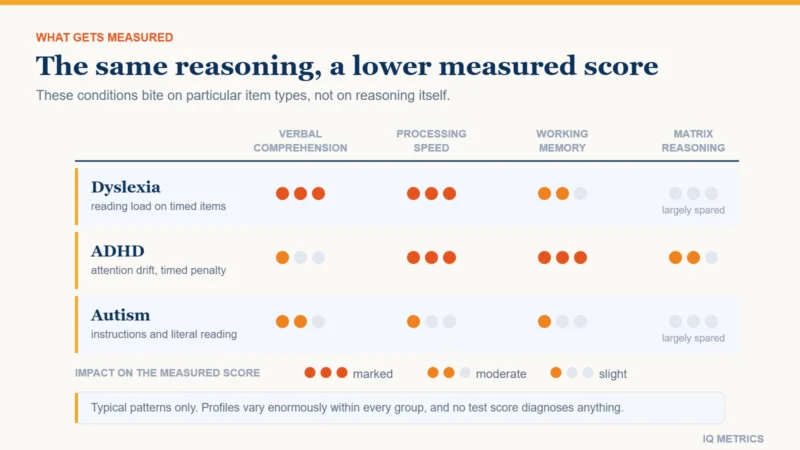 Taking a Test
ADHD, Autism and Dyslexia in IQ Testing
A test score is a measurement, and a measurement can be biased by the conditions under which it is taken. ADHD, autism and dyslexia each depress performance on particular kinds of item without lowering the reasoning underneath. Here is what actually interferes, condition by condition, and what to do next.
 Understanding IQ
Low IQ vs Learning Disability
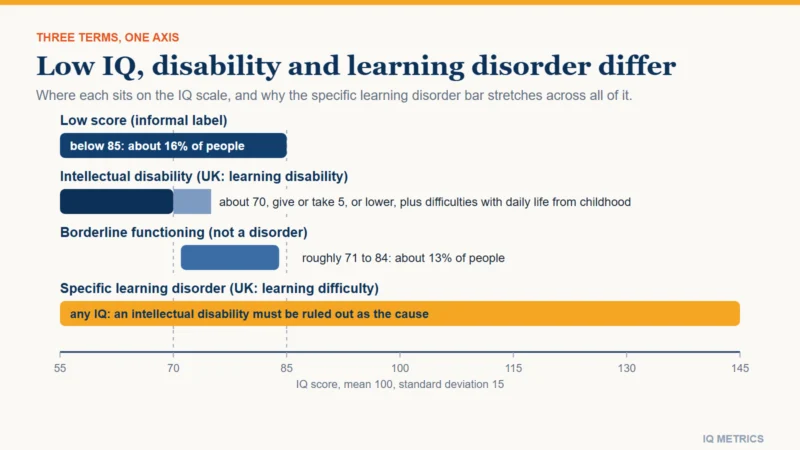
A low IQ, an intellectual disability and a specific learning disability are three different things, and the UK uses "learning disability" for the second. What each requires, how each is assessed, the US and UK terms, and what to do if you are worried.
 Understanding IQ
Grit vs IQ
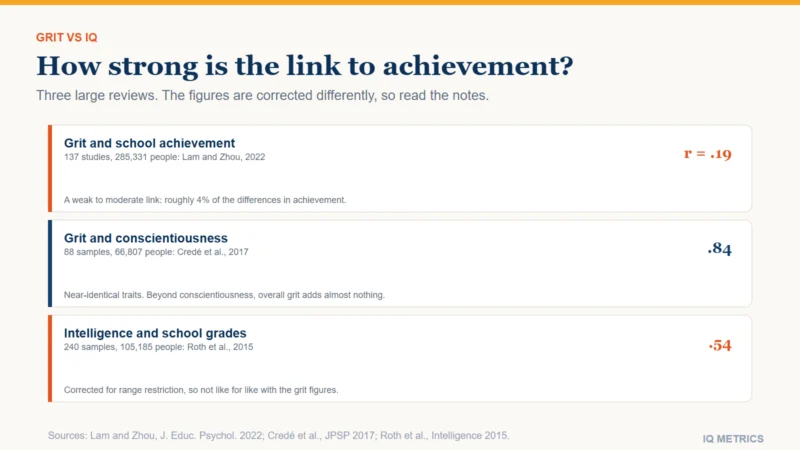
Grit is weakly to moderately linked to school achievement and overlaps almost completely with conscientiousness. See what the original grit studies, two large meta-analyses, the marshmallow test and a retracted test-motivation paper really show about grit vs IQ.