





Grit vs IQ: Which Predicts Success More? What the Studies Found
Grit is weakly to moderately linked to school achievement and overlaps almost completely with conscientiousness. See what the original grit studies, two large meta-analyses, the marshmallow test and a retracted test-motivation paper really show about grit vs IQ.

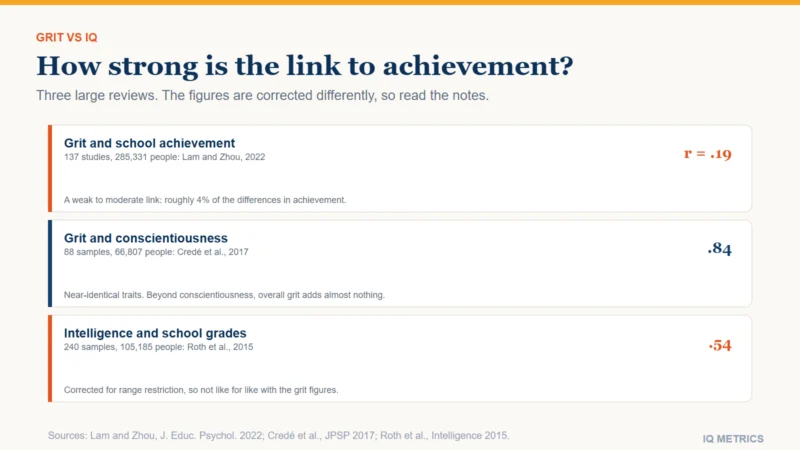
Grit vs IQ: does perseverance beat intelligence? In the research, no. Two large reviews find that grit correlates only weakly to moderately with school achievement (a weighted correlation of .19 across 137 studies), while a review of 240 samples puts intelligence tests and school grades at .54 after corrections. Grit also overlaps almost completely with the Big Five trait of conscientiousness (.84) and is nearly unrelated to cognitive ability (.05). It behaves like a separate effort trait that adds a little to IQ, not a replacement for it. This guide walks through the original grit studies, the meta-analyses, the marshmallow test, and a widely repeated claim about paying people to raise their IQ scores that was retracted in 2025.
- Grit and school achievement: a weighted correlation of .19 across 137 studies and 285,331 people, roughly 4% of the differences in achievement.
- Grit and conscientiousness: a corrected correlation of .84, so close to the same trait; overall grit adds almost nothing once conscientiousness is counted.
- Grit and cognitive ability: about .05 corrected, meaning grittier people are not systematically smarter or less smart.
- Marshmallow test: the link to teenage achievement shrank by about two thirds once family background and early cognitive ability were controlled.
- Retraction: the 2011 paper behind “paying people adds 10 IQ points” was retracted by its journal on 1 May 2025.
What is grit, and how is it measured?
Grit is defined as perseverance and passion for long-term goals. The psychologist Angela Duckworth and colleagues introduced it in a 2007 paper in the Journal of Personality and Social Psychology, along with a questionnaire. The original Grit Scale has 12 items split into two factors of six: consistency of interests and perseverance of effort. People rate each item from 1 to 5, and a short 8-item version, the Grit-S, was published in 2009. Both are scored by averaging, so the maximum is 5. Everything rests on self-report, which matters later. If you are weighing effort against ability in a wider sense, our guides to growth mindset and intelligence and talent versus practice cover the neighboring evidence.
What did the original grit studies find?
The 2007 paper reported six studies. Its abstract says grit “accounted for an average of 4% of the variance in success outcomes” and showed incremental predictive validity over IQ and conscientiousness. Incremental means it added something on top, not that it outranked anything. The table shows what each sample actually found, including the parts that rarely make it into popular summaries.
| Sample | What grit predicted | How IQ-type scores compared |
|---|---|---|
| Adults aged 25 and older (N = 1,545 and 690) | More schooling than same-age peers; one standard deviation of extra grit meant 35% lower odds of being a frequent career changer | No IQ measure; analyses controlled for age and the Big Five |
| Psychology majors at an Ivy League university (N = 138) | GPA, r = .25 (and .34 with SAT held constant) | SAT and GPA r = .30; grit and SAT r = −.20, so the grittier students had slightly lower SAT scores |
| West Point cadets (N = 1,218 and 1,308) | Finishing the first summer of training; about 1 in 20 cadets dropped out, and one standard deviation of grit meant more than 60% higher odds of finishing (Study 4) | West Point’s own Whole Candidate Score, built from SAT, class rank, leadership and fitness, did not predict who finished |
| Spelling Bee finalists aged 7 to 15 (N = 175) | Reaching a later round, with age controlled | With verbal IQ and age in the model, grit was no longer statistically significant; verbal IQ was |
Two details deserve emphasis. Grit did not relate positively to IQ in these samples, so it is not a proxy for intelligence; at the Ivy League school it was slightly negatively related to SAT scores, and the authors speculated that smarter students “may be slightly less gritty.” But the Spelling Bee result cuts the other way from how grit is often described: once verbal IQ entered the model, grit stopped being a significant predictor, though the authors noted that missing IQ data cut the degrees of freedom by more than half. The samples are also highly selected, which shrinks IQ correlations as well as grit ones.
What do the big reviews say about grit?
Two large meta-analyses give the clearest picture. Credé, Tynan and Harms (2017) pooled 88 independent samples and 66,807 people. Grit correlated .18 with academic performance after correction for measurement error (.15 uncorrected), and .84 with conscientiousness, but only .05 with cognitive ability. After conscientiousness was accounted for, overall grit explained no additional variance in overall academic performance or high-school GPA and almost none for college GPA. Only the perseverance-of-effort half of grit added a small amount, and the meta-analysis did not confirm the two-part structure the scale assumes. Lam and Zhou (2022) covered 137 studies and 285,331 people and found a weighted correlation of .19 between grit and academic achievement, .21 for perseverance of effort and .08 for consistency of interest.
A UK twin study points the same way. Rimfeld and colleagues studied 4,642 sixteen-year-olds from the Twins Early Development Study. The Big Five personality traits explained 5.6% of the variance in GCSE grades, and adding grit raised that by only 0.5 percentage points. Perseverance of effort was 37% heritable, and its genetic correlation with conscientiousness was .86. That study used no intelligence measure, so it tests grit against personality rather than against IQ.
| Relationship | Correlation | Study and sample |
|---|---|---|
| Grit and academic performance | .18 corrected (.15 observed) | Credé et al. 2017: 88 samples, 66,807 people |
| Grit and academic achievement | .19 weighted, observed | Lam and Zhou 2022: 137 studies, 285,331 people |
| Grit and cognitive ability | .05 corrected | Credé et al. 2017: 21 samples, 11,513 people |
| Intelligence tests and school grades | .54 corrected, incl. range restriction | Roth et al. 2015: 240 samples, 105,185 people |
| Cognitive tests and job performance | .31 (2022 re-estimate; .51 in 1998) | Sackett et al. 2022, employees |
| Conscientiousness and job performance | .19 (2022; .31 in 1998) | Sackett et al. 2022, employees |
These are not like-for-like comparisons, so read the table as a map, not a scoreboard. The .54 is corrected for measurement error and range restriction and comes from school grades; grit’s .18 is corrected for measurement error only; the .19 is an uncorrected average. Job-performance validity for cognitive tests is itself contested: the older .51 figure was re-estimated at .31 in 2022 after Sackett and colleagues argued that earlier range-restriction corrections were too generous, and structured interviews now top that table. Even so, the direction is consistent: in these reviews cognitive ability shows a larger correlation with outcomes than grit or conscientiousness does, which fits our guides to whether IQ predicts school success and what a cognitive test at work predicts. For personality more broadly, see IQ versus personality.
What about self-control and the marshmallow test?
Self-control is a nearby idea with better evidence behind it. The Dunedin study followed a complete birth cohort of 1,037 children in New Zealand to age 32, with 96% still taking part. Childhood self-control, rated from nine measures between ages 3 and 11, predicted adult health, substance dependence, finances and criminal convictions “even after accounting for social class origins and IQ,” and the pattern held in a sibling comparison of about 500 pairs. It is not a contest with IQ, though: in that cohort self-control and IQ correlated .44, and the design is observational, so it shows self-control adds prediction beyond IQ, not that it exceeds it.
The marshmallow test is weaker than its reputation. Watts, Duncan and Quan (2018) ran a conceptual replication on a larger, more varied sample: 918 US children with valid delay data, with the main analyses on 552 whose mothers had not completed college. An extra minute of waiting at age 4 went with about a tenth of a standard deviation in achievement at 15, an association about half the size of the original. It fell by two thirds with controls for family background, early cognitive ability and the home environment, and became non-significant once early cognitive and behavioral measures were added (standardized coefficient .24, then .08, then .05). Most of the variation came from whether a child could wait at least 20 seconds. How much a home can shape such traits at all is a different question; see our guide to adoption and IQ.
Where would your own score land?
Take the IIF-certified assessment and get your score with the scale it was measured on, the percentile it corresponds to and the confidence range around it — the three figures most online tests leave out.
Find your IQ score now! →Does motivation change IQ test scores? A retracted claim
A popular argument runs that IQ tests mostly measure motivation, because paying people raises their scores by about 10 points. It traces to a 2011 paper by Duckworth and colleagues in PNAS, which reported a meta-analytic effect of 0.64 standard deviations (about 9.6 points on a scale with a standard deviation of 15, our conversion; the paper reports standard-deviation units only). That paper was retracted on 1 May 2025. The journal issued an expression of concern in February 2025, and in the retraction notice the authors explained that a retracted 1978 article had contributed three large effect sizes and 24% of the meta-analytic sample. Without it the effect fell to 0.47; after adjusting for publication bias it was 0.16, with a confidence interval (−0.02 to 0.34) that includes zero. All four publication-bias tests now indicated bias, and the authors decided to retract the article.
What survives is narrower. Effort and engagement plausibly affect any test performance, which is why conditions matter, as covered in our guide to the factors that affect IQ test results and the news piece on what practice actually changes. But a ten-point payment bonus is not an established fact, and it should not be repeated as one.
What should you take from grit vs IQ?
- Treat it as both, not either. IQ predicts school and job outcomes moderately; grit and conscientiousness add a small, real increment on top.
- Ask which half of grit you mean. Perseverance of effort carries the prediction; consistency of interest adds little.
- Do not use grit scores to judge people or schools. Duckworth wrote in 2016 that she worried she had “contributed, inadvertently,” to high-stakes character testing, and a 2015 review by her and Yeager concluded that no available measure suits between-school accountability.
- Expect self-report bias. High-performing charter-school students rated themselves lower on grit than district-school peers in Duckworth’s own data.
- Be cautious about grit interventions. The correlations are modest and observational, and we did not review any trial showing that raising grit raises achievement.
For a wider view of what predicts success beyond a single score, see our guides to IQ versus EQ and whether IQ predicts income, and for a condition where persistence and instruction interact, dyslexia and IQ.
Quick answers
- Is grit more important than IQ? No source we reviewed supports that. Grit adds a small amount to prediction; cognitive ability predicts school grades more strongly in the largest reviews, though the figures are not like for like.
- Is grit the same as conscientiousness? Almost. The corrected correlation is .84, and the twin study found a genetic correlation of .86 for perseverance of effort.
- Are gritty people smarter? No. Grit and cognitive ability correlate about .05.
- Does the marshmallow test predict success? Weakly. The link to age-15 achievement shrank by two thirds with controls and lost significance with early cognitive measures.
- Does paying people raise IQ scores by 10 points? Not established: the paper that claimed it was retracted in 2025.
- Can you measure grit reliably? Mostly by self-report, and its author says character questionnaires are not ready for high-stakes use.
The bottom line
Grit is real enough as a label for sustained effort, but the evidence does not support the claim that it beats intelligence. Across the largest reviews it correlates weakly to moderately with achievement, overlaps almost completely with conscientiousness, and adds very little once that trait is counted. The best-supported version of the grit story is modest: talent and sustained effort both matter, effort is hard to measure, and neither a marshmallow nor a payment can be read as a shortcut to a score.
Sources
- Duckworth, A.L., Peterson, C., Matthews, M.D. and Kelly, D.R. (2007): Grit: perseverance and passion for long-term goals, Journal of Personality and Social Psychology, 92(6), 1087-1101.
- Duckworth, A.L. and Quinn, P.D. (2009): Development and validation of the Short Grit Scale (Grit-S), Journal of Personality Assessment, 91(2), 166-174.
- Credé, M., Tynan, M.C. and Harms, P.D. (2017): Much ado about grit: a meta-analytic synthesis of the grit literature, Journal of Personality and Social Psychology, 113(3), 492-511.
- Lam, K.K.L. and Zhou, M. (2022): Grit and academic achievement: a comparative cross-cultural meta-analysis, Journal of Educational Psychology, 114(3), 597-621.
- Rimfeld, K., Kovas, Y., Dale, P.S. and Plomin, R. (2016): True grit and genetics: predicting academic achievement from personality, Journal of Personality and Social Psychology, 111(5), 780-789.
- Roth, B. et al. (2015): Intelligence and school grades: a meta-analysis, Intelligence, 53, 118-137.
- Sackett, P.R., Zhang, C., Berry, C.M. and Lievens, F. (2022): Revisiting meta-analytic estimates of validity in personnel selection: addressing systematic overcorrection for restriction of range, Journal of Applied Psychology, 107(11), 2040-2068.
- Moffitt, T.E. et al. (2011): A gradient of childhood self-control predicts health, wealth, and public safety, PNAS, 108(7), 2693-2698.
- Watts, T.W., Duncan, G.J. and Quan, H. (2018): Revisiting the marshmallow test: a conceptual replication investigating links between early delay of gratification and later outcomes, Psychological Science, 29(7), 1159-1177.
- PNAS (2025): Retraction for Duckworth et al., “Role of test motivation in intelligence testing,” PNAS, 122(18), e2508040122.
- Duckworth, A.L. and Yeager, D.S. (2015): Measurement matters: assessing personal qualities other than cognitive ability for educational purposes, Educational Researcher, 44(4), 237-251.
- Duckworth, A.L. (2016): Don’t grade schools on grit, The New York Times, 26 March 2016.
Keep reading
All articles →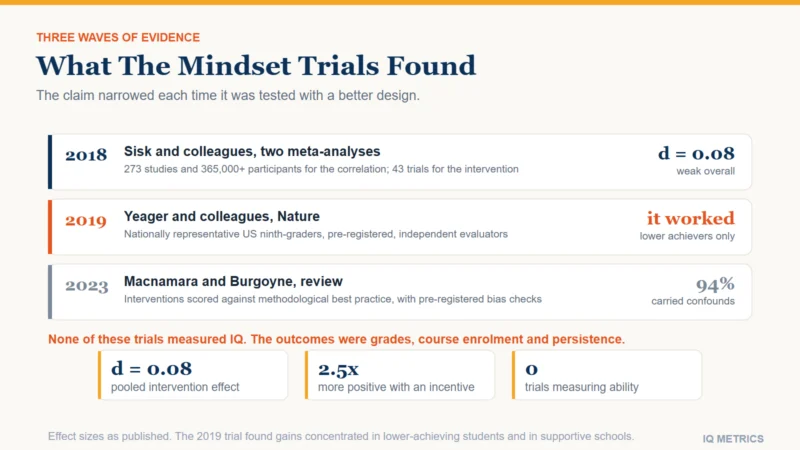 Research & Evidence
Growth Mindset and Intelligence
The claim that believing intelligence is malleable makes you achieve more is one of the most widely taught ideas in education, and one of the most heavily contested in the research literature. Three waves of evidence have now landed. Here is what each found, and the question none of them actually answered.
 Research & Evidence
Talent vs Practice
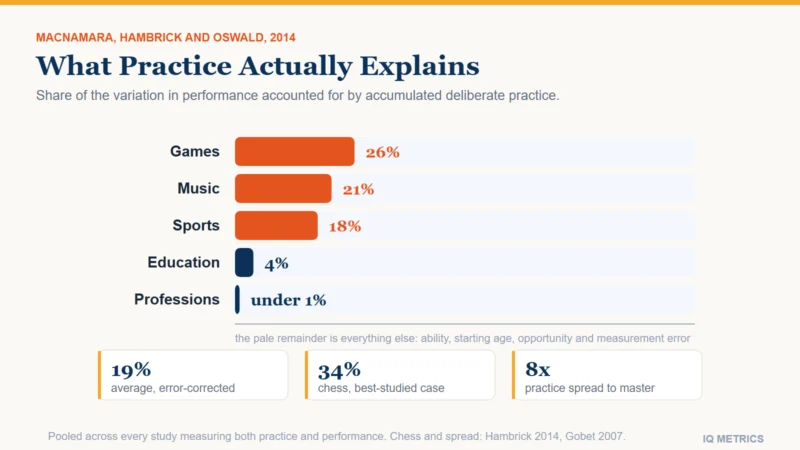
The 10,000-hour rule made a strong claim: expert performance is built by practice, not given by talent. When researchers pooled the studies that had actually measured it, practice explained about a quarter of the difference between people in games and almost none in professional work. Here is what fills the rest of the gap.
 Research & Evidence
Adoption and IQ
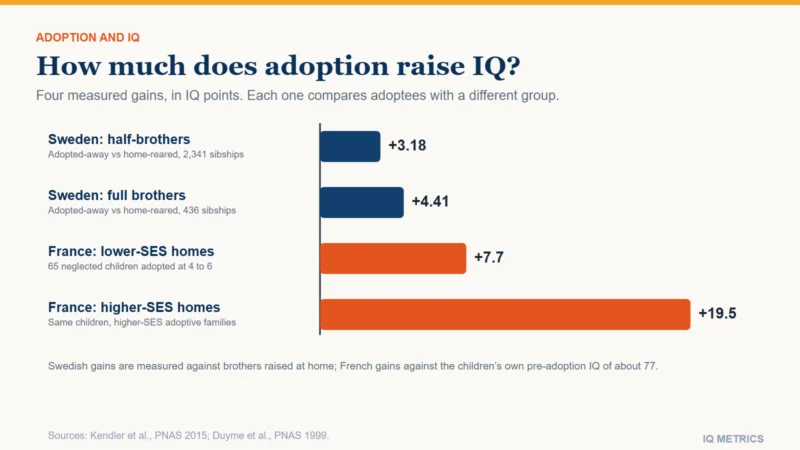
Adoption can raise average IQ by about 3 to 4 points in a large Swedish sibling study and by 8 to 20 in a French study of neglected children, yet adoptees come to resemble their birth parents. See what adoption and twin studies show, and what they cannot.