



HSPT Scores Explained: Percentiles, Composites and the Cognitive Skills Quotient
The HSPT gives each of five subtests a 200 to 800 standard score and a national percentile, adds three composites, and reports a Cognitive Skills Quotient on an IQ-style scale. Its publisher sets no pass mark and says the quotient is not limited to innate ability.


What you need to know
- The HSPT has five multiple-choice subtests and 298 items. Each gets a standard score from 200 to 800 (mean 500, standard deviation 100) and a national percentile from 1 to 99. The three composites are scaled from summed raw scores, not averaged, and the publisher, Scholastic Testing Service (STS), sets no pass mark.
- STS says its Cognitive Skills Quotient (CSQ) "replaces the traditional IQ score". It is built from the Verbal and Quantitative subtests plus the student's age, on a scale with a mean of 100, a standard deviation of 15 and an operational range of 55 to 145.
- The percentile base is not the general population: STS calls it "a more selective base" built from students who go on to graduate. STS's guide rounds the 2.3% of scores above CSQ 130 up to "approximately the upper 3%".
- STS recommends taking the test once and leaves retests to each school; Washington's archdiocese counts only the first score and Baltimore's allows no retake. Some online guides say the lower score counts, but we found no such rule. The sample one-page family report we read does not show the CSQ at all.
The HSPT (High School Placement Test) is a 298-question exam that high schools, many of them Catholic, give to eighth graders applying for ninth grade. Its publisher, Scholastic Testing Service (STS), reports each of the five subtests as a standard score from 200 to 800 and a national percentile from 1 to 99, adds three composite scores, and also reports a Cognitive Skills Quotient (CSQ), which STS says "replaces the traditional IQ score". STS sets no pass mark: each school decides what a score means. This guide explains what each number is, where the CSQ comes from, what STS says about its comparison group, retests and test preparation, and why an HSPT percentile is not an IQ percentile.
What is on the HSPT?
STS's Interpretive Manual (2021 edition) calls the HSPT "a norm-referenced, standardized test designed for high schools to administer to 8th graders entering high school". It has five multiple-choice subtests that were "designed to be taken in its entirety":
- Verbal Skills: 60 items (synonyms, antonyms, verbal analogies, verbal classifications and logical reasoning)
- Quantitative Skills: 52 items (number series, number manipulations and quantitative comparisons)
- Reading: 62 items
- Mathematics: 64 items
- Language: 60 items (punctuation, capitalization, spelling, grammar, usage and composition)
- Total: 298 items
The first two are the "cognitive skills" subtests, which "require the use of reasoning skills". The other three are "basic skills" subtests, designed "to assess learned skills". Calculators are not allowed on the Quantitative Skills or Mathematics subtests, and there is no penalty for guessing, so every question is worth answering. A school may add one 40-item optional test, Science or Catholic Religion, which is not part of any composite. STS's own pages give no times for the subtests. The Archdiocese of Washington, which runs a diocesan testing program, lists 16, 30, 25, 45 and 25 minutes for the five subtests (141 minutes of testing) and about 3 hours for the whole session, including two short breaks and 30 minutes for handing out and collecting materials. STS's overview page says the HSPT has provided measures "since 1955", while the 2021 manual says it has been "in continuous use since 1958"; STS does not explain the difference.
How are HSPT scores calculated?
Each subtest starts as a raw score, the number of correct answers. STS converts it to a standard score on a scale from 200 to 800, "with a mean of 500 and standard deviation of 100", and to a national percentile, which a sample STS report describes as "the percentage of students in the national sample who had scores lower than yours". The three composites take the same route, but they are not averages. In STS's words, "the raw scores are added together from the subtests that comprise each composite score and are then converted to standard scores and national percentiles". They are Total Cognitive Skills (Verbal plus Quantitative), Total Basic Skills (Reading, Mathematics and Language) and the battery Composite (all five). STS recommends the Composite: research has "demonstrated repeatedly that the battery Composite score is the best single measure for predicting subsequent academic performance".
A standard score of 500 is average on that scale and each 100 points is one standard deviation, a measure of spread explained in our guide to IQ z-scores. If the scores were spread as a normal curve, 600 would sit near the 84th percentile and 700 near the 98th. STS reports the percentile from its own norm sample, though, so read the percentile printed on the report rather than computing one.
What do HSPT percentiles, stanines and grade equivalents mean?
Percentiles run from 1 to 99 and compare a student with others in the same grade. STS calls 50 "exactly average" and treats the 33rd to 66th percentiles as the average band, the middle third of the national sample. The top 10% are rated "High" and the bottom 10% "Low". Stanines, which run from 1 to 9 with a mean of 5 and a standard deviation of 2, give the same information in coarser bands. STS's table puts stanine 9 at percentiles 96 to 99, stanine 7 at 76 to 87 and stanine 5 at 41 to 59.
The comparison group is the catch. The manual says the norm base "is intended to be a more selective base than general population norms". It is built from students "entering high school who would subsequently graduate with a diploma", which STS says "could be called a high school graduate norm base". STS says it conducts norming studies every year, and that the HSPT is normed on eighth graders only: "Other grade level norms are not available". A national percentile of 50 therefore marks the middle of a graduate-bound group, not the middle of all students. A local percentile is narrower again: it ranks a student only against the others a school sent in for scoring.
Grade equivalents appear for Reading, Language and Mathematics only. STS warns against reading a grade equivalent as a placement: an eighth grader with a Reading grade equivalent of 10.7 "was not tested on 10th grade material", and the figure shows only that the student did better than the average eighth grader in the sample.
What is the Cognitive Skills Quotient (CSQ)?
The CSQ is the HSPT's IQ-style number. The manual says: "This measure replaces the traditional IQ score, but its purpose within the school setting remains the same: to function as a predictive index of a student's future academic performance in order to assess learning potential." It is based on the Verbal and Quantitative subtests "as well as his or her age at the time of testing", which is why the answer sheet has to carry a birth date. STS says the scale "has an operational range of 55 to 145 with a mean of 100 and a standard deviation of 15", the convention most IQ tests use. Our guide to standard deviation 15 versus 16 shows why that detail decides whether two tests mean the same thing by the same number.
STS's own guide to reading a CSQ is below. The percentages are STS's wording for the "school population":
- Above 130: approximately the upper 3%
- 110 and above: the upper 25%
- 100 to 109: the 50th to 75th percentiles
- 90 to 99: the 25th to 49th percentiles
- 89 and below: the lower 25%
- Below 70: approximately the lower 3%
Run those cut points through a normal curve with a mean of 100 and a standard deviation of 15 and most agree. A CSQ of 110 is the 74.8th percentile and 90 is the 25.3rd, so STS's quartile boundaries match. A CSQ of 130 is the 97.7th percentile, so 2.3% of scores fall above it, and 70 is the 2.3rd percentile. STS's "approximately 3%" at both ends is either a rounding up or a feature of its own norm group, and its pages do not say which. At the extremes of the scale, 145 is the 99.87th percentile and 55 the 0.13th. Our percentile calculator converts any other value.
Many families never see the CSQ. STS lists it as a standard feature of its school-side reports, the student score labels and the alphabetical lists, but the sample one-page Student Score Report for parents shows standard scores, percentiles and a performance graph, and describes the HSPT as "a measure of basic skills and educational achievement". Which reports a family receives is the school's choice, according to STS's FAQ.
The CSQ is built to read like an IQ score, but it rests on 112 group-test questions and a comparison group its maker calls more selective than the population.
Is the HSPT an IQ test?
No. STS describes the CSQ as a measure of "learning potential" and adds that "unlike pure intelligence tests, however, these subtests do not restrict themselves to measure only innate abilities". The items were designed to measure "the cognitive skills (i.e., skills related to learning) whether such skills are innate or acquired". That is a fair description of most school ability tests, and our guide to achievement tests and IQ tests explains why the line between the two is blurrier than the names suggest.
The CSQ also rests on far less than a clinical IQ test. It comes from 112 multiple-choice items (60 verbal and 52 quantitative) taken in a group, whereas an individually given battery such as the Wechsler scales uses a psychologist and many task types (see WAIS index scores explained). STS says reliability, validity and correlations with other standardized tests are in its annual HSPT Technical Report, which we could not find online, so we cannot say how closely a CSQ tracks an IQ score. Treat it as a school score on an IQ-shaped scale.
What is a good HSPT score?
STS gives no passing score. Its parent page says: "Each school evaluates your scores in its own way. Criteria determined by one school to assist with academic decisions may not be the same for another school." The manual adds that most schools use two or more subtest scores for course placement, with the Quantitative and Mathematics scores considered for math courses and the Verbal, Reading and Language scores for English, alongside "elementary school grades and teacher recommendations". Some reports also carry a predicted ACT (pACT) and an estimated SAT (eSAT) score, "only reported for grade 8 students who take all of the subtests".
For orientation, STS's labels are the safest guide: a national percentile of 50 is average, the middle third is "Average", and the top 10% is "High". A high percentile says a student is ahead of most of a graduate-bound group. It does not say the student has an IQ above 100 in the general population, and the Composite is the figure STS recommends for admissions and scholarships. Our guide to gifted cutoff scores shows how schools often set such thresholds without any single national rule.
Can you retake the HSPT, and does test prep help?
STS "recommends that the HSPT should only be taken once by each student". It adds that "under extenuating circumstances a school may decide to allow a student to retest", case by case. Dioceses can be stricter than STS. The Archdiocese of Washington says a student may not take the exam more than once and that "only the first score will be considered by admissions committees", and the Archdiocese of Baltimore says the test "cannot be repeated under any circumstances". Some online guides say STS uses the lower score if a student sits twice; we found no such rule on STS's pages or on those two diocesan pages, so ask your school directly. On preparation, STS says it "is in no way affiliated with" commercial test-prep products and "believes that parents and teachers are best advised to avoid expensive preparation materials". Its own tips are to pace yourself, read each question, answer every question and check your work. How much practice moves an ability-type score is a separate question, covered in our guide to the practice effect on cognitive ability tests.
How does the HSPT compare with the ISEE and the UK tests?
The ISEE reports four section scores of 760 to 940 with no total and ranks students against recent private-school applicants (see ISEE scores explained). The HSPT ranks students against a national sample built from students expected to graduate, and it reports composites. In the UK, the ISEB Common Pre-Test and CAT4 report standard age scores, which sit on a scale closer to the CSQ's.
Where would your own score land?
Want a result on the standard IQ scale, with its percentile and a full report? Take the IQ Metrics test, or the kids test for younger children.
Find your IQ score now! →To see how an IQ-scale result compares with the population, take the IQ Metrics test, or try the kids IQ test for a child, then read the result against the IQ bell curve.
Common questions
What is a good HSPT score?
STS sets no passing score and says each school evaluates scores in its own way. A national percentile of 50 is average, STS's average band is the 33rd to 66th percentiles, and the top 10% is rated High. STS recommends the battery Composite for admissions.
What is the HSPT scoring scale?
Each subtest and composite gets a standard score from 200 to 800 (mean 500, standard deviation 100) and a national percentile from 1 to 99. Composites are scaled from summed raw scores, so they are not the average of their parts.
Is the HSPT an IQ test?
No. It measures basic skills and cognitive skills. STS's Cognitive Skills Quotient is set to a mean of 100 and a standard deviation of 15, but STS says its subtests do not measure only innate ability.
Can you take the HSPT more than once?
STS recommends taking it once and leaves any retest to the school, case by case. Dioceses vary: the Archdiocese of Washington counts only the first score and the Archdiocese of Baltimore allows no retake. We found no rule saying the lower score is used.
Sources for this story
- HSPT Interpretive Manual (2021 edition, 36 pages) — Scholastic Testing Service (STS)
- High School Placement Test overview and Reports and Scoring pages — Scholastic Testing Service (STS)
- HSPT parent pages: Major Test Areas and Performance Scores, How Are Tests Scored, How Schools Use Your Scores, Preparing for the HSPT — Scholastic Testing Service (STS)
- HSPT frequently asked questions by families (retesting, score reports, ability versus achievement) — Scholastic Testing Service (STS)
- HSPT sample reports: Student Score Report, Performance Profile, student labels, list and group summary reports — Scholastic Testing Service (STS)
- About the HSPT and frequently asked questions (Archdiocese of Washington); High School Placement Test page (Archdiocese of Baltimore) — Catholic dioceses
Corrections: spotted an error? Email corrections@iqmetrics.org and we will update this story and note the change here.
Related stories
All news →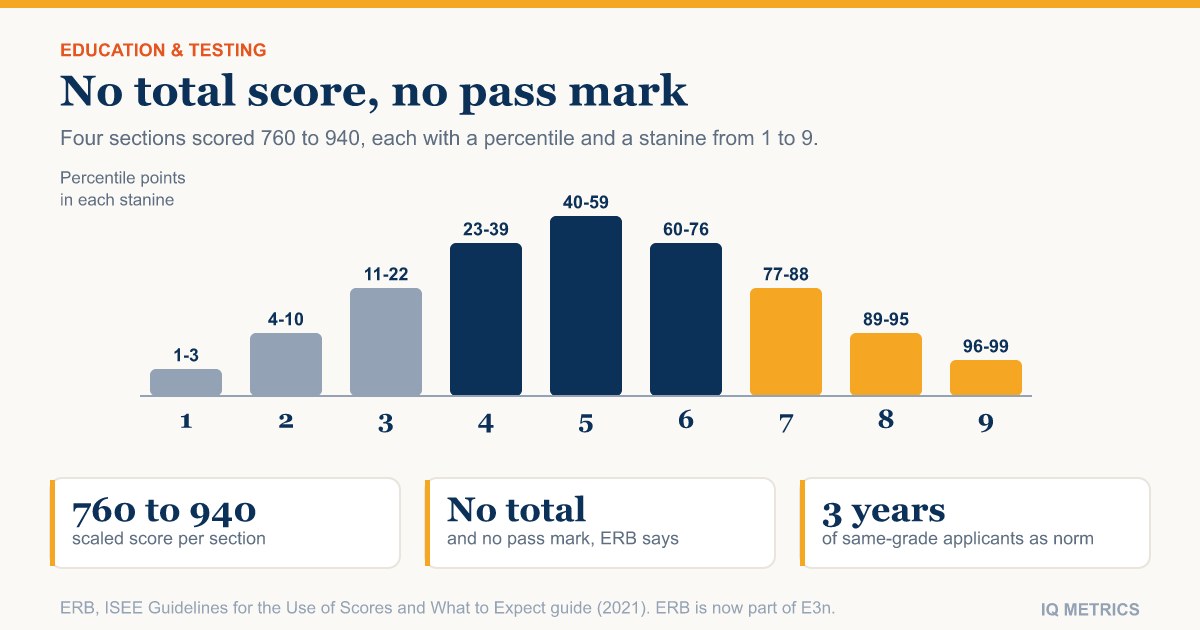
ISEE Scores Explained: Scaled Scores, Stanines and the IQ Question
The ISEE reports four section scores of 760 to 940, a percentile and a stanine for each, and no total or pass mark. Its maker never calls it an IQ test, and its percentiles compare a child with other private-school applicants.
Falling Reading Scores Are Not Falling IQ. Here Is the Difference
National reading results have dropped again, and around forty per cent of American fourth-graders are now below the NAEP Basic level. That is a fact about an achievement test, and achievement tests are built to show exactly the movement an IQ score is built to hide.

WISC-6 Release Date: What Pearson Has Said and What Is Still Unknown
Pearson is still standardizing the sixth edition of the Wechsler children's scale and has published no release date, sample size or score structure. Its own notices show a research edition with new subtests, a $100 bonus to fill the last gaps, and timelines that do not agree.
Read the research.
Then find your own number.
Our IIF-certified assessment reports your score with its scale, percentile and confidence range — and a breakdown of the cognitive domains behind it.
Start IQ Test →