



ISEB Common Pre-Test Scores Explained: SAS, Percentiles and IQ
The ISEB Pre-Tests report a Standardised Age Score with an average of 100, but the comparison group is independent-school applicants, there is no pass mark, and ISEB does not send results to parents. An SAS is not an IQ, and ISEB publishes no conversion.


What you need to know
- The ISEB Common Pre-Tests are four online, adaptive, multiple-choice tests (English, mathematics, verbal reasoning and non-verbal reasoning) that take 2 hours 15 minutes in all: 40, 40, 30 and 25 minutes at standard time. They are designed for pupils in Years 6 and 7, and some senior schools use them for Year 9 entry. ISEB publishes no question counts, because each test adapts.
- Results are a Standardised Age Score (SAS) on a scale with an average of 100 and a standard deviation of 15, adjusted for age. ISEB says about 67% of pupils score between 85 and 115, 16% above 115 and under 5% above 130. On a normal curve the real figures would be 68.3%, 15.9% and 2.3% (our arithmetic), so "under 5%" is a loose statement.
- There is no pass mark. ISEB says the Pre-Tests "do not have grades or even a pass mark" because that depends on the school, and ISEB does not release results to parents: families must ask the senior school. Schools see the SAS, a stanine, a percentile rank and a group rank, and the first sitting in an academic year is the one that counts.
- The norm group is "a standardisation sample taken from the independent schools' sector", not the general population. An SAS of 100 therefore means average among independent-school applicants, which is a selected group. ISEB says nothing about IQ, publishes no norm size, norming year or reliability figure, and describes the tests as measuring attainment and potential.
The ISEB Common Pre-Test is a set of four adaptive online tests that many independent senior schools use as part of admissions, and its score is a Standardised Age Score (SAS) with an average of 100. Parents who search for "what is a good ISEB score" find no answer from ISEB, because the organisation publishes no pass mark and does not release results to families. This guide sets out what ISEB does say in its own documents, how the score is built, why the average of 100 does not mean the same thing as an IQ of 100, and what a family can reasonably do with a number.
What is the ISEB Common Pre-Test?
ISEB Limited describes the Pre-Tests as a set of four online, adaptive entrance assessments: English, mathematics, verbal reasoning (VR) and non-verbal reasoning (NVR), all multiple choice. Its 2026-27 framework says they are designed for pupils in Years 6 and 7. Most children sit them once in Year 6 for Year 7 entry (11+), and ISEB's families page says some senior schools, such as Eton and Harrow, use them as a precursor to Year 9 entry (13+). They can be taken at the pupil's current school, at the senior school applied to, or at an approved independent invigilation centre anywhere in the world, and a pupil can sit them only once in an academic year.
The full sitting takes 2 hours 15 minutes. At standard time the invigilation script gives English 40 minutes, mathematics 40, non-verbal reasoning 30 and verbal reasoning 25, which adds to 135 minutes; with 25% extra time the figures become 50, 50, 37.5 and 31.25 minutes. Live testing for the 2026-27 session starts on 1 September 2026 and ends in late May 2027, although the framework PDF says tests can be taken between the beginning of October and the end of June, so check dates with the school.
Adaptive means the next question depends on the last answers. ISEB says each test section has several question pools, each with a minimum and a maximum number of questions, and that pupils who answer correctly are tracked to harder content. It publishes no question totals. It also says the tests are not speed tests: "Pupils do not achieve a higher score for answering more questions", and the result comes from accuracy and consistency. The system does not let a pupil go back and change an answer. For practice material with the same kinds of items on this site, see our verbal and spatial IQ tests.
How is the ISEB Pre-Test scored?
The headline result is the Standardised Age Score. ISEB's school page defines it as a score based on the accuracy of a pupil's answers and their consistency, "adjusted for age and placed on a scale which makes a comparison with a standardisation sample taken from the independent schools' sector (the average is 100)". A support article adds that the scale has an average of 100 and a standard deviation of 15, so that around 67% of pupils score between 85 and 115, 16% score over 115 and under 5% score more than 130. Comparisons are made with pupils of the same age, which ISEB says means no disadvantage for younger children or those who test earlier in the window.
Schools see more than the SAS. Each applicant's report includes a stanine, a percentile rank and a group rank, together with a mean SAS, and ISEB says the percentile rank and stanine are based on the SAS, using different numeric ranges. If the SAS is roughly normal within its norm group, as the stated mean and standard deviation imply, then within that group (our arithmetic):
- SAS 85: about the 16th percentile
- SAS 100: the 50th percentile
- SAS 115: about the 84th percentile
- SAS 130: about the 98th percentile (97.7)
Two details are worth noticing. A normal curve puts 68.3% of people between 85 and 115 and 15.9% above 115, close to ISEB's statements, but only 2.3% above 130, so "under 5%" is true but loose. And the percentile rank applies to the independent-school sample, which brings us to the main question. For the same kind of score on a different test, see CAT4 scores explained, and for the US counterpart, ISEE scores explained.
What is a good ISEB Pre-Test score?
There is no ISEB answer. Its support page says that the Pre-Tests "do not have grades or even a pass mark (as all of this is dependent on the school which uses the tests)", and ISEB recommends parents ask the school for context. ISEB does not release results to parents, so a family sees a result only if the school chooses to share it. We found no published cut-off for any school. The pages say schools use the results as part of their admissions process; we found nothing on how any particular school weights the score against interviews, references or other tests. For a US high-school entrance exam that reports an IQ-style quotient, see HSPT scores explained.
An SAS of 100 means average among independent-school applicants, not an average person, and there is no pass mark to aim at.
Is the ISEB Pre-Test an IQ test?
ISEB does not call it one. The words IQ, intelligence and CAT4 do not appear in the ISEB pages and PDFs we read. It says the Pre-Tests are designed to identify attainment and potential: English and mathematics follow topics taught in class, while verbal and non-verbal reasoning let pupils show "academic potential" through question types that may be unfamiliar to them. That is the same split we describe for achievement tests and IQ tests.
The score scale looks like an IQ scale, with a mean of 100 and a standard deviation of 15, which invites the comparison. It does not carry over, for a reason ISEB states itself: the reference group is a sample from the independent schools' sector. A pupil at the 50th percentile of a group of applicants to selective schools would sit above the 50th percentile of all children of that age, and ISEB does not say by how much. It also publishes no size or year for its standardisation sample and no reliability figure that we could find. We found no ISEB comparison with CAT4 or with 11+ scores, and there is no published conversion to IQ. If you want to read an SAS against the whole population, treat any such figure as a guess, and use our IQ percentile calculator only to translate a score into a percentile on a normal curve. The same warning applies to 11+ standardised scores.
Practice, retakes and invalid sittings: what ISEB says
ISEB says a pupil can sit the tests only once in an academic year, and that in the very unlikely event of a second sitting, "the first set of results will stand". A test that is abandoned is recorded by the invigilation centre on a Centre Declaration Form, and ISEB says this makes senior schools aware when they view the results. For practice, ISEB says it cannot guarantee the accuracy of third-party practice resources that it does not endorse, and that such material may not reflect the presentation, difficulty, content and scoring of the live tests. It names Bond Online Premium Plus as the only preparation platform it endorses. If you are weighing the value of practising at all, our report on the practice effect on cognitive ability tests reviews what repetition does to scores, and ISEB publishes separate SEND guidance for adjustments.
What should a family do with an ISEB result?
- Ask the senior school what the result means for its own admissions, because ISEB sets no pass mark
- Read the SAS as a position among independent-school applicants, not among all children
- Remember the score is age-adjusted and based on accuracy and consistency, not on how many questions were answered
- Do not convert the SAS to an IQ; ISEB publishes no conversion, norm size or reliability figure
- Treat any single score as an estimate with a margin of error, as described in our guide to the margin of error
Where would your own score land?
Want an IQ-scale score with a percentile against the whole population, for a child or an adult? Take the IQ Metrics test and get a full report.
Find your IQ score now! →The IQ Metrics test reports on the standard IQ scale against the general population, which is a different comparison from an admissions sample. For a child, see the kids IQ test and our guide to IQ testing for children, and for how selective programmes use scores, universal screening in gifted programmes.
Common questions
What is a good ISEB Pre-Test score?
ISEB sets no pass mark; its support page says the Pre-Tests do not have grades or a pass mark because that depends on the school. The score is a Standardised Age Score with an average of 100 and a standard deviation of 15, and each school decides what it wants. ISEB does not release results to parents.
What is the ISEB Common Pre-Test?
It is a set of four adaptive online multiple-choice tests (English, mathematics, verbal reasoning and non-verbal reasoning) used by independent senior schools in admissions. It takes 2 hours 15 minutes and is designed for pupils in Years 6 and 7, with some schools using it for Year 9 entry.
Is the ISEB Pre-Test an IQ test?
ISEB describes it as measuring attainment and potential, and does not use the word IQ. The SAS has a mean of 100 and an SD of 15, but it is compared with a sample from the independent schools sector, not the general population, so it does not convert to an IQ.
Can you retake the ISEB Pre-Test?
A pupil can sit the tests only once in an academic year, and if a second sitting happens, ISEB says the first set of results will stand. An abandoned sitting is recorded by the centre and visible to senior schools when they view results.
Sources for this story
- The ISEB Common Pre-Tests Framework 2026-27 (PDF, created 1 June 2026) — ISEB Limited
- ISEB Pre-Tests for families and for schools pages (updated 1 June 2026) — ISEB Limited
- How are the results calculated? (support article, modified 30 October 2023) — ISEB Pre-Tests support portal
- Why can't I see my child's results? (support article, 4 December 2025); What are the tests like? (17 October 2025) — ISEB Pre-Tests support portal
- Common Pre-Tests Invigilation Script and Guide to Administering the tests (PDF and support article, 2024 to 2025) — ISEB Limited
Corrections: spotted an error? Email corrections@iqmetrics.org and we will update this story and note the change here.
Related stories
All news →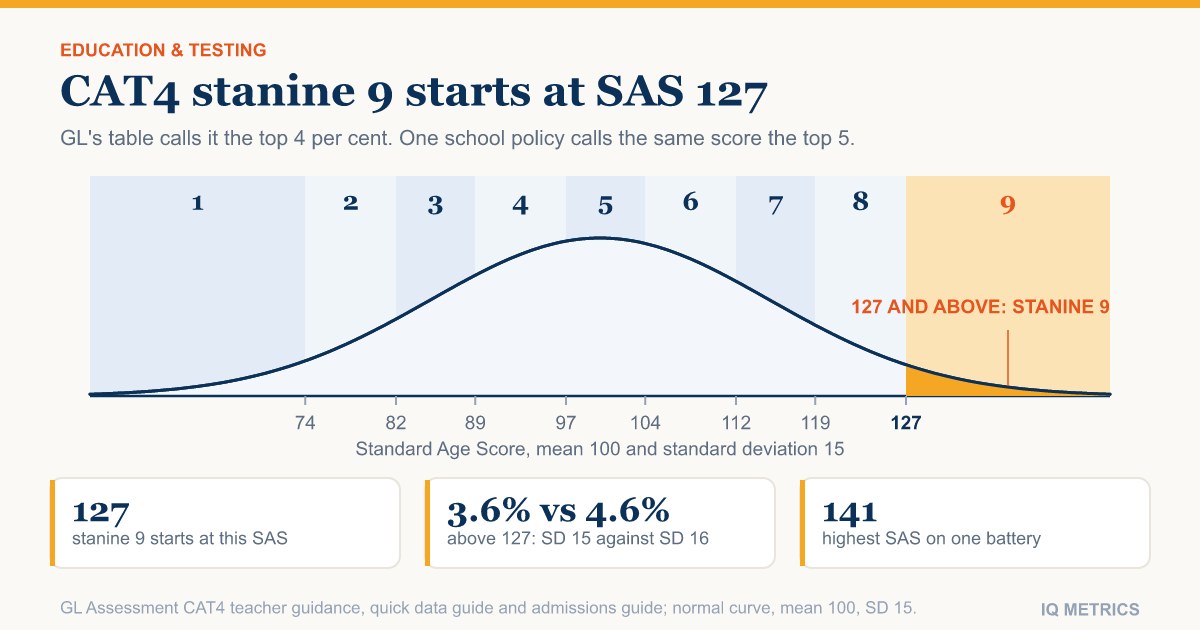
CAT4 Scores Explained: SAS, Stanines and What a Good Score Is
GL Assessment prints CAT4 results as a Standard Age Score with an average of 100 and a standard deviation of 15, then folds them into stanines. Its own table starts the top 4 per cent at 127, while one school policy calls the same score the top 5.
ISEE Scores Explained: Scaled Scores, Stanines and the IQ Question
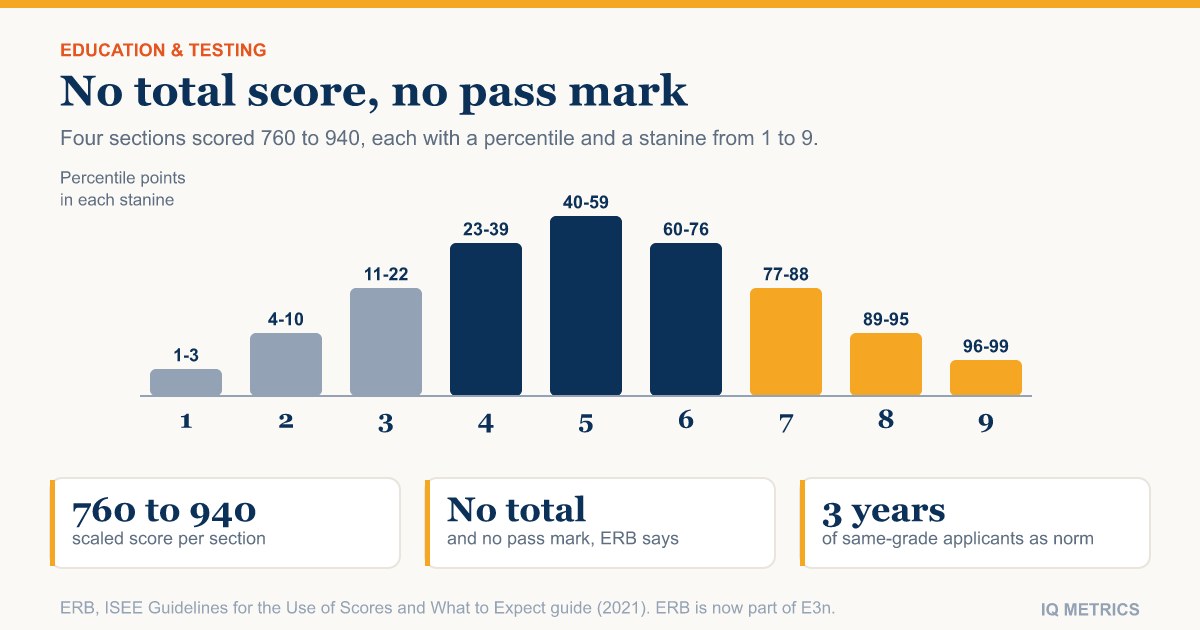
The ISEE reports four section scores of 760 to 940, a percentile and a stanine for each, and no total or pass mark. Its maker never calls it an IQ test, and its percentiles compare a child with other private-school applicants.

HSPT Scores Explained: Percentiles, Composites and the Cognitive Skills Quotient
The HSPT gives each of five subtests a 200 to 800 standard score and a national percentile, adds three composites, and reports a Cognitive Skills Quotient on an IQ-style scale. Its publisher sets no pass mark and says the quotient is not limited to innate ability.
Read the research.
Then find your own number.
Our IIF-certified assessment reports your score with its scale, percentile and confidence range — and a breakdown of the cognitive domains behind it.
Start IQ Test →