





What Does an IQ of 115 Mean? Is It a Good IQ?
An IQ of 115 is one standard deviation above average: the 84th percentile, roughly 1 person in 6. It is High Average on the Wechsler children's scale and means the same at any age. See how accurate a single 115 is, why labels differ, and what a printed 115 means on other scales.

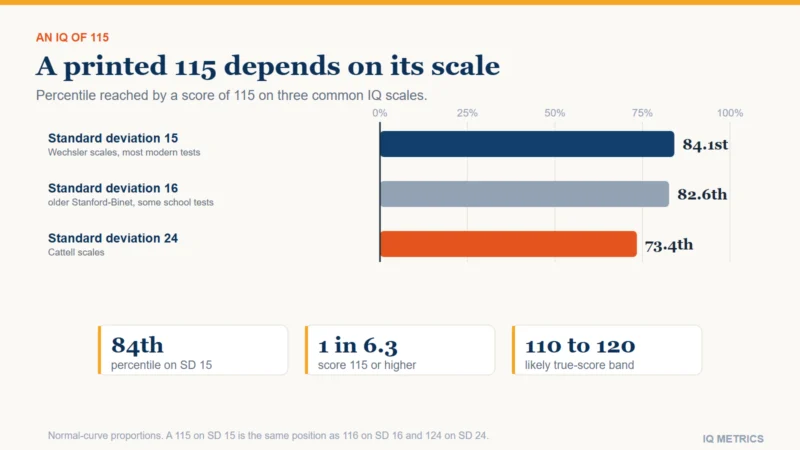
An IQ of 115 is one standard deviation above average. On the standard scale (mean 100, standard deviation 15) it is the 84th percentile, so about 1 person in 6 scores 115 or higher. It is a good, above-average result, labelled High Average on the Wechsler children's scale, and it sits well short of the 130 cut-off used for gifted programs and Mensa. The same number means the same thing at 10, 14 or 40, because the score compares you with people of your own age. This guide shows where 115 falls on the bell curve, why different charts call it different things, how accurate a single 115 is, and what happens when the printed number comes from a different scale.
- Percentile: 84.1st on a standard deviation 15 scale (our arithmetic from the normal curve); 82.6th if the 115 was printed on a standard deviation 16 scale; 73.4th on the standard deviation 24 Cattell scale.
- Rarity: 15.9% of people score 115 or higher, about 1 in 6.3. Only 13.6% score between 115 and 130.
- Label: High Average on the WISC-V (110 to 119), and exactly the line between the average and above-average bands on the simpler three-band chart.
- Age: the meaning does not change with age, but scores are less stable in children than in adults.
- Precision: with a typical standard error of 2 to 3 points, a reported 115 fits a true standing of roughly 110 to 120.
To check any score yourself, enter it into our IQ percentile calculator, or turn it into another test's scale with the IQ score converter. The sections below cover the neighbouring pages in our series: an IQ of 110, whether 120 is high and an IQ of 125.
Where does an IQ of 115 sit on the bell curve?
Modern IQ scores are deviation scores. A test is given to a large reference sample, the results are placed on a scale whose average is set to 100, and the spread is fixed so that one standard deviation equals 15 points. An IQ of 115 is therefore exactly one standard deviation above the mean. On a normal curve that is the 84.13th percentile: 84.1% of the reference sample scored lower and 15.9% scored 115 or higher. The same arithmetic puts 68.3% of people between 85 and 115, which is why 115 is the upper edge of what many charts call the average band. Our page on the IQ bell curve shows the shape.
| IQ score | Percentile | Scoring this high or higher: about 1 in |
|---|---|---|
| 100 | 50.0th | 2 |
| 105 | 63.1st | 2.7 |
| 110 | 74.8th | 4 |
| 115 | 84.1st | 6.3 |
| 120 | 90.9th | 11 |
| 125 | 95.2nd | 21 |
| 130 | 97.7th | 44 |
Read the table as a ladder. Between 115 and 130 there are 13.6% of people, the stretch that is clearly above average without reaching the gifted band. That is the whole territory of 115, 120 and 125. If you scored 115 you are in the upper sixth of the population, and each step up thins the crowd quickly: about 9% of people score 120 or more, about 5% score 125 or more and about 2% score 130 or more.
Is 115 a good IQ? What the labels say
“Good” is not a word any test manual uses. The nearest thing to an official answer is the descriptive label printed on professional score reports, and the labels differ by publisher. The WISC-V, the most widely used children's Wechsler test, sorts scores into these bands: 130 and above Extremely High, 120 to 129 Very High, 110 to 119 High Average, 90 to 109 Average, 80 to 89 Low Average, 70 to 79 Very Low and 69 and below Extremely Low. On that chart 115 is squarely High Average.
A simpler three-band chart, the one our guide to IQ classifications uses, treats 85 to 115 as the average band holding about 68% of people and 115 to 130 as the next band up. On that chart 115 sits on the line itself. Same person, same score, two labels, which is why a label is a convention and not a finding.
| Scheme | Where 115 falls | What it is called |
|---|---|---|
| WISC-V descriptive bands | Inside 110 to 119 | High Average |
| Three-band chart (85 to 115, 115 to 130) | On the boundary | Top of average, or first step above it |
There is a second reason not to lean on labels. Popular pages claim that university students average 115 to 130. Our news desk traced that figure to mid-20th-century data from a time when few people went to university, and reports that a 2024 meta-analysis puts the average undergraduate near 102. If that estimate is right, a 115 is comfortably above the typical student. The details are in average IQ of college students: is it really 115 or higher.
Is a 115 IQ good for a 14-year-old, or any age?
Search suggestions show people asking this question for ages from 10 to 17 (checked 12 October 2026). The answer is the same for each: yes, 115 is a good, above-average score, and it means the same thing at every age. A deviation IQ compares your performance with other people of your own age. A 14-year-old with a 115 outperformed about 84% of 14-year-olds in the reference sample, not 84% of adults. That is also why scores do not simply rise as children grow older; see the IQ scale by age and IQ and age.
What does change with age is how firmly a score can be trusted to last. A 2024 meta-analysis in Psychological Bulletin (Breit and colleagues) pooled 205 longitudinal studies with 87,408 participants and 1,288 test-retest correlations. For a person aged 20 retested after 5 years, the average rank-order stability was rho = .76. Stability was low in preschool children, rose rapidly through childhood and stayed high from late adolescence onward. The authors estimate that a correlation of .80, the level needed for individual-level decisions, can only be expected over the age of 7 and for short intervals in children.
Here is what that means in practice, and it is our arithmetic, not the authors'. If two scores taken years apart correlate .76, then a person who scores 115 now is expected to score about 111 next time (100 plus .76 times 15), and roughly two thirds of such people would land between about 102 and 121. This is an illustration with one assumed correlation, not a forecast for any child, because real stability depends on age, test and gap. The sensible reading is that a 115 at 14 is a good snapshot of where a young person stands now, not a ceiling or a promise. Our news desk covers the same ground in can your IQ change over time.
How accurate is a reported 115?
Every IQ score comes with a margin of error. For a full-scale score on a well-built adult battery with a standard deviation of 15, the standard error of measurement is commonly 2 to 3 points, and a 95% interval is about 1.96 standard errors either side. With a standard error of 2.5 that is roughly 5 points either side: a reported 115 is compatible with a true standing of about 110 to 120. That band runs from the bottom of High Average to the first point of Very High on the WISC-V chart, so even the label is uncertain. Our news piece an IQ score is a range, not a number works through the arithmetic.
Regression to the mean pulls in the same direction. When a test has a reliability of .95, the best estimate of a person's true standing after seeing a 115 is 100 plus .95 times 15, or about 114 (our arithmetic). The shift is small, but it is why a very high first score tends to drift down on retest, as explained on our regression to the mean page. For a longer treatment of what makes a result dependable, see IQ test accuracy.
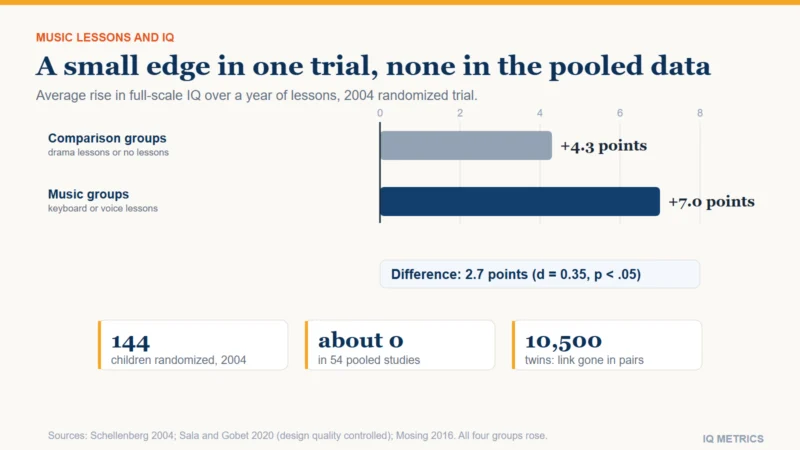
A small difference is easy to over-read. A well-known randomized trial of music lessons reported a gain of about 2.7 IQ points over comparison children, which is smaller than the 95% band around a single score; we look at it in music lessons and IQ.
Where would your own score land?
Take the IIF-certified assessment and get your score with the scale it was measured on, the percentile it corresponds to and the confidence range around it — the three figures most online tests leave out.
Find your IQ score now! →Does the scale matter? One position, three printed numbers
Not every test prints on a standard deviation of 15. The Wechsler scales and most modern professional tests do. Stanford-Binet forms up to the fourth edition and several school ability tests use 16, and the Cattell scales use 24. A position one standard deviation above average is printed as 115 on the first, 116 on the second and 124 on the third. Turn that around and a printed 115 means different things: 84.1st percentile on SD 15, 82.6th on SD 16 and only the 73.4th on SD 24. Check the scale before you compare. Our explainer why one percentile has three numbers has the full list.
| Scale | Standard deviation | Percentile for a printed 115 | Position |
|---|---|---|---|
| Wechsler and most modern tests | 15 | 84.1st | 1.00 SD above average |
| Older Stanford-Binet, some school tests | 16 | 82.6th | 0.94 SD above average |
| Cattell scales | 24 | 73.4th | 0.63 SD above average |
What does an IQ of 115 predict?
On average, scores in this range go with somewhat better school results and somewhat more years of education, but the spread around every average is wide, so a number alone predicts little about one person. Occupational averages are looser still: the best-known tables come from a 1945 Army dataset, covered in average IQ by occupation: what 80-year-old Army data shows, and they describe groups, not what a 115 can do. No job requires an IQ of 115, and plenty of people with higher and lower scores do the same work. If you are weighing where a score falls among the usual cut-offs, Mensa score requirements and gifted cut-off scores show the thresholds above it.
How to find a dependable score
A single online quiz is not a diagnosis. A full-length, norm-referenced test gives a score and a percentile you can interpret, and a clinical report from a psychologist adds the margin of error. Our IQ test reports a score and percentile together, and how to read an IQ test report explains what each part means.
Quick answers about an IQ of 115
- Is 115 a good IQ? Yes. It is above average and in the top 16% of the reference sample, labelled High Average on the WISC-V.
- What percentile is 115? The 84th on the standard deviation 15 scale.
- Is 115 a good IQ for a teenager? It means the same as for an adult, because the score compares you with people your own age. Teenage scores are fairly but not perfectly stable.
- Is 115 enough for Mensa? No. Mensa membership needs roughly the top 2%, about 130 on a standard deviation 15 scale.
- How accurate is it? A reported 115 is best read as roughly 110 to 120.
Sources
- Breit, M., Scherrer, V., Tucker-Drob, E.M. and Preckel, F. (2024): The stability of cognitive abilities: a meta-analytic review of longitudinal studies, Psychological Bulletin, 150(4), 399-439.
- Schellenberg, E.G. (2004): Music lessons enhance IQ, Psychological Science, 15(8), 511-514.
- Percentile figures are computed from the normal distribution; the standard error of measurement, the WISC-V bands and the scale comparison are those described in our own explainers linked above.
Keep reading
All articles →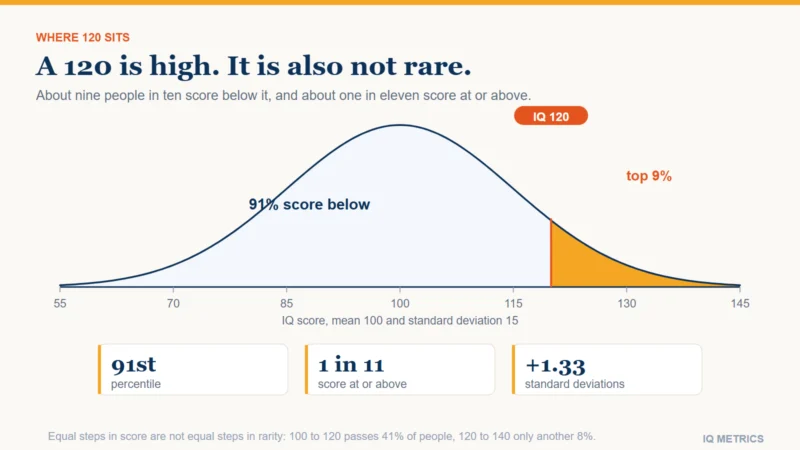 Scores & Scales
Is a 120 IQ High?
A score of 120 sits comfortably above average, and roughly nine people in ten score below it. But "high" is a comparison, not a property, and the honest answer depends on which scale produced the number, how much error is wrapped around it, and what you were hoping the score would tell you.
 Scores & Scales
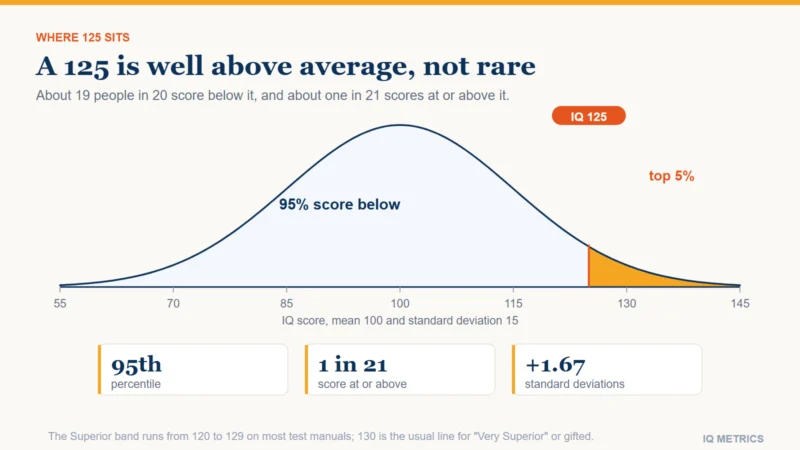
What an IQ of 125 Means
An IQ of 125 is about 1 person in 21 on a standard deviation 15 scale, the 95th percentile and one band below most gifted cutoffs. See how rare it is, what "Superior" means, how accurate a single score is, and what it predicts.
 Research & Evidence
Music Lessons and IQ
Do music lessons raise IQ? One 2004 trial of 144 children found a 2.7-point edge, but a meta-analysis of 54 studies finds no overall effect once study quality is controlled, and a study of more than 10,500 twins finds the link vanishes within pairs. Here is the evidence.