



How Much of Our Brain Do We Use? The 10% Myth and What Scans Show
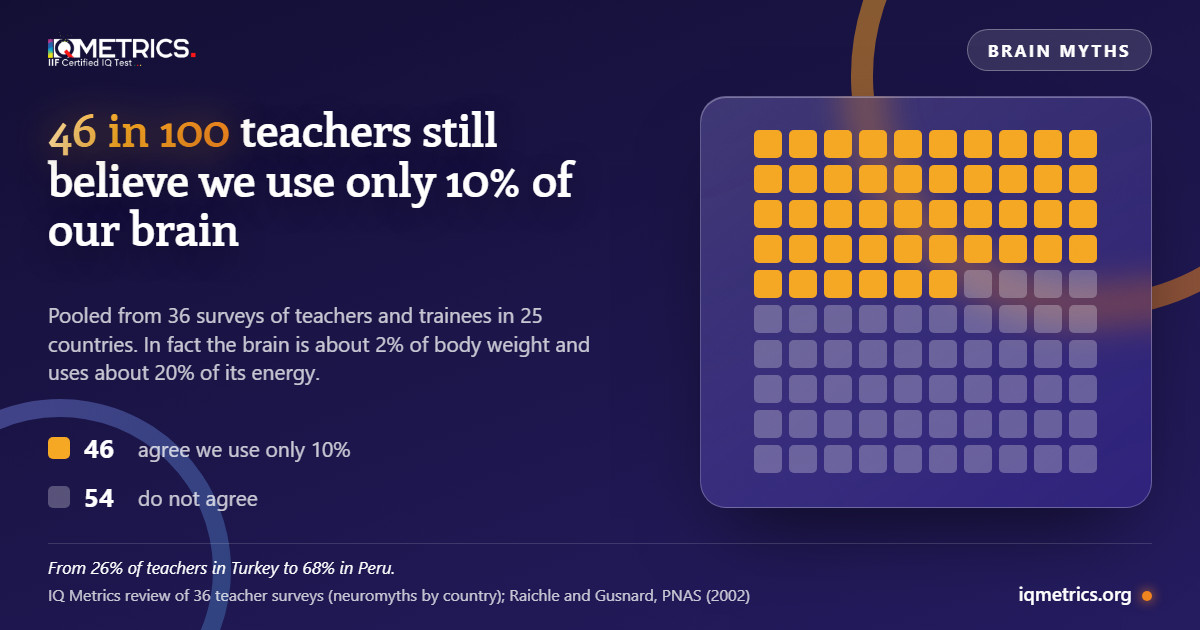
We use virtually all of our brain over a day. The 10% figure has no scientific source: it grew out of a 1907 essay that never mentioned brain tissue, yet about half of teachers in 36 surveys still agree with it.

What you need to know
- We use virtually all of our brain. Brain imaging has found no idle regions, and damage to almost any area leaves some deficit. The brain is about 2% of body weight but uses about 20% of the body's energy.
- The one true kernel: spikes cost so much energy that only a small share of neurons can fire strongly at the same instant, possibly under 1% in a 2003 estimate. That is about timing, not idle brain areas.
- William James wrote in 1907 that we use "only a small part of our possible mental and physical resources", with no number and no mention of brain tissue. The 10% was attached to his name in a 1936 book introduction.
- Belief is common: our pooled review of 36 surveys found 46% of teachers agree, from 26% in Turkey to 68% in Peru, and 65% of US adults agreed in a 2013 online poll.
How much of our brain do we use? Virtually all of it. Over a day every region does work, and damage to almost any area causes some problem. The brain is about 2% of body weight but uses about 20% of the body's energy, far too costly to leave 90% idle. The 10% figure has no scientific source, yet 46% of teachers in 36 surveys still agree with it.
Below: what brain scans and energy numbers show, the one true part of the myth, where the 10% came from, and how many people believe it.
Do we only use 10 percent of our brain?
Do we only use 10 percent of our brain? No. The neuroscientist Barry Beyerstein, who spent years tracing the claim, wrote in Scientific American that brain imaging has found "no quiet areas awaiting new assignments." Electrical stimulation of the brain during surgery has not found dormant areas either.
Strokes and injuries tell the same story. In Beyerstein's words, there does not seem to be any area of the brain that can be destroyed "without leaving the patient with some kind of functional deficit." If 90% were spare, most brain damage would go unnoticed. It does not.
The brain does not switch off at night either. "Even during sleep, the brain is active," writes Eric Chudler, a neuroscientist at the University of Washington.
What percentage of our brain do we use?
What percentage of our brain do we use? Over a day, close to all of it. At any single moment, though, only a small share of neurons fires strongly, and that is the one grain of truth inside the myth.
In 2003 Peter Lennie, a neuroscientist at the University of Rochester, worked out the energy cost of nerve signals in the human cortex. His estimate: because each spike is expensive, the brain's energy budget "severely limits, possibly to fewer than 1%, the number of neurons that can be substantially active concurrently."
Read that carefully. It is a model, it is hedged with "possibly", and it is about neurons firing at the same instant. It does not say that parts of the brain sit unused. Different neurons take turns, and over a day the whole brain works.
How much energy does the brain use?
About a fifth of the body's total in adults. Marcus Raichle and Debra Gusnard wrote in PNAS in 2002 that the brain is "about 2% of the body weight" but accounts for "about 20% of the oxygen and, hence, calories consumed by the body."
- Brain share of body weight: about 2% (Raichle and Gusnard, 2002)
- Brain share of the body's energy in adults: about 20% (the same paper)
- In children: nearer 50% (Lennie, 2003), and about 66% of resting energy at age 4 in a 2014 study by Kuzawa and colleagues
- Change in local blood flow during most thinking tasks: "often 5% or less" (Raichle and Gusnard)
That last line matters. The brain's energy use is "remarkably constant" whether you are solving a puzzle or resting, so hard thinking adds only a little on top of activity that never stops. Our brain statistics fact check tests these and other popular numbers against their sources.
Where did the 10% myth come from?
The 10% myth grew from a misreading of William James. In his 1907 essay "The Energies of Men", the Harvard psychologist wrote: "We are making use of only a small part of our possible mental and physical resources." He gave no percentage and said nothing about brain tissue.
The number came later. In his 1936 introduction to Dale Carnegie's How to Win Friends and Influence People, the journalist Lowell Thomas wrote that James used to say the average person develops only 10 percent of his latent mental ability. Beyerstein describes how "10 percent of our capacity" then "morphed into 10 percent of our brain."
Beyerstein also checked the popular claim that Albert Einstein said it. The Einstein archives could find no record of such a statement.
James wrote about unused potential, not unused brain. The 10% came later, and it never had a source.
Why does the 10% myth persist?
Partly because it was never pure invention. It sits close to three real ideas, each bent a little out of shape.
- Unused potential: James really did argue that most people work below their capacity. That is a claim about effort and habit, not about brain tissue.
- The "silent cortex": early researchers called large parts of the brain silent because stimulating them gave no obvious response. Beyerstein suspects this left the public thinking those areas did nothing; they are now known as association cortex.
- Few neurons firing at once: the energy limit Lennie described is real, and it is easy to turn "few neurons at once" into "a few per cent of the brain".
It also flatters us. A hidden 90% promises a bigger, better self, which is why the claim fits so well in a self-help book and in film plots. A claim that you are already using your whole brain sells nothing.
How many people believe we only use 10% of our brain?
About half of teachers, across many countries. Our review of neuromyths by country pooled 36 surveys of teachers and trainees in 25 countries: 46% agreed that "we only use 10% of our brain", from 26% in Turkey to 68% in Peru.
One well-known survey, by Sanne Dekker and colleagues in 2012, asked 242 teachers who were interested in brain science. Even so, 48% in the UK and 46% in the Netherlands agreed with the 10% statement.
The public is no better informed. In a 2013 online poll by Harris Interactive for the Michael J. Fox Foundation, 65% of 2,013 American adults agreed that "people only use 10 percent of their brains on a daily basis." The foundation notes that the poll was not a probability sample, so treat the exact figure with care.
Training helps. A 2017 US study by Macdonald and colleagues found 33% of educators but only 14% of adults with many neuroscience courses believed the myth.
Did the movies Lucy and Limitless get it wrong?
Yes, and Limitless did not even use 10%. A character in its script asks: "you know how they say you can only access like 20 percent of your brain?" Lucy (2014), with Scarlett Johansson, built its plot on a heroine who gains new powers as she passes 10%. Both are fiction, and they kept the idea alive.
Can you unlock more of your brain?
Not in the way the myth promises, because there is no idle 90% to switch on. What changes with practice is how well you do the things you practise. Our report on whether brain training apps work looks at what the long-running trials found, and our guide on whether you can improve your IQ covers what the evidence supports.
The 10% idea has company. The left-brain and right-brain split is another claim that scans do not support, as our article on the left brain, right brain myth explains. The Mozart effect grew from a ten-minute 1993 experiment with college students that never measured IQ at all.
Where would your own score land?
Curious how your reasoning compares with other people? Take the IQ Metrics test.
Find your IQ score now! →Take the IQ Metrics test to see your score, and use our percentile calculator to read what the number means.
Common questions
How much of our brain do we use?
Virtually all of it over a day. Imaging finds no idle regions and damage to almost any area causes a deficit. At any single instant only a small share of neurons fires strongly, because nerve signals cost a lot of energy.
Do we only use 10 percent of our brain?
No. The brain is about 2% of body weight but uses about 20% of the body's energy, and no silent 90% has ever been found in brain scans, surgery or studies of brain injury.
Who started the 10 percent brain myth?
No scientist. William James wrote in 1907 that we use only a small part of our mental resources, with no number. A 1936 introduction by Lowell Thomas to a Dale Carnegie book attached the 10% figure to his name.
What percentage of the brain is active at once?
A small share of neurons at any one instant. Peter Lennie estimated in 2003 that energy limits strong firing to possibly fewer than 1% of cortical neurons at the same time, but different neurons take turns.
Sources for this story
- Appraising the brain's energy budget (2002) — Proceedings of the National Academy of Sciences (PNAS)
- The cost of cortical computation (2003) — Current Biology
- The Energies of Men (1907) — William James, The American Magazine
- Do we really use only 10 percent of our brains? (2004) — Barry Beyerstein, Scientific American
- Neuromyths in education: prevalence and predictors of misconceptions among teachers (2012) — Frontiers in Psychology
- New survey finds Americans care about brain health, but misperceptions abound (2013) — Michael J. Fox Foundation
Corrections: spotted an error? Email corrections@iqmetrics.org and we will update this story and note the change here.
Related stories
All news →
The Left-Brain/Right-Brain Myth: What Brain Scans Actually Show
The idea that everyone leans on one dominant hemisphere — logical on the left, creative on the right — traces back to a real, Nobel Prize-winning discovery. It is not what that discovery found.
Do Brain Training Apps Work? One Trial Survived 20 Years
A follow-up published in February 2026 tracked 2,802 adults for two decades after five weeks of cognitive training. One of the three training arms showed a lower rate of dementia diagnosis. The other two showed nothing.

Trail Making Test Scores by Age: Normal Times for Part A and Part B
Tombaugh’s norms for 911 adults put the typical Trail Making Test time at 22 seconds on Part A and 47 on Part B at ages 18 to 24, and 52 and 133 at ages 80 to 84. The popular 78 and 273 second cut-offs are not in that paper.
Read the research.
Then find your own number.
Our IIF-certified assessment reports your score with its scale, percentile and confidence range — and a breakdown of the cognitive domains behind it.
Start IQ Test →