Can you live with half a brain? Every hemispherectomy IQ study
Nobody can live without a brain. People do live with half of one: we collected every published IQ result after one hemisphere was removed or disconnected, 23 series from 1988 to 2026, and every patient printed one by one.

By Leon Falkner, Data & Research Analyst · Reviewed by Aarav Vardhan, Editor-in-Chief · Published 9 November 2026 · 14 min read
About this study
- Report type
- Data study: our dataset of published IQ results after hemispherectomy
- Data
- 23 series (1988-2026, 891 patients) and 41 patients with printed values; 5 series count every patient's direction of change
- Sources
- Europe PMC search (1,052 records), 79 abstracts and open full texts read, PubMed abstracts, PubMed Central full texts
- Years
- Operations 1928 to 2026; IQ series 1988 to 2026; as of 9 November 2026
- Licence
- CC BY 4.0 (our dataset and charts)
- Version
- 2026.11
- Sources
- 45
No one can live without a brain, but people live, learn and work with half of one: in 129 children tested before and after hemispherectomy, IQ stayed about the same for 68, rose for 31 and fell for 18. Levels are often low: in the largest series (296 children) 11% scored above 85. IQ Metrics Research, 23 studies, 1988-2026.
01 Key findings
- Just over half keep the IQ they had. In 129 children tested before and after the surgery, 68 stayed about the same, 31 rose and 18 fell (12 not stated).IQ Metrics calculation, 5 series
- But the level is often low. In the largest series (296 children), 11% scored above 85 after surgery and 51% below 55.Ramantani et al. 2025
- Average changes are small. Printed averages range from +12.7 to -0.6 points; Denmark’s median change was 0.Five series
- Words outlast shapes. Verbal IQ beat performance IQ in 21 of 25 people with both scores: 12 of 12 after right-side and 9 of 13 after left-side surgery.IQ Metrics calculation
- Some adults with one hemisphere score in the average range. Six Caltech adults averaged 90.83; the best printed score is 105.Kliemann et al. 2019, 2021
- Nobody lives without a brain. Almost all babies born with anencephaly die shortly after birth.CDC
02 Statistics to quote
children tested before and after hemispherectomy kept about the same IQ (5 series, each by its own rule).
IQ Metrics calculationchildren had a lower IQ after the surgery; 31 had a higher one and 12 were not reported either way.
IQ Metrics calculationof 296 children in the largest series scored above 85 (normal range) at the last test after hemispherotomy; 51% scored below 55.
Ramantani et al. 2025published series with an IQ or DQ number after the surgery, 1988 to 2026, covering 891 patients.
IQ Metrics datasetmedian full-scale IQ after surgery in the 31 people printed one by one (range 47 to 105); most were recruited for brain scans.
IQ Metrics calculationpeople with one hemisphere scored higher in verbal IQ than in performance IQ (median gap +10 points).
IQ Metrics calculationJohns Hopkins children changed by less than 15 IQ points between surgery and follow-up; 11 declined and 8 improved (Pulsifer et al. 2004).
Pulsifer et al. 2004mean full-scale IQ of six adults living with one hemisphere, scanned at Caltech (Kliemann et al. 2019).
Kliemann et al. 2019median IQ or DQ change after hemispherectomy in all 16 Danish cases, 1996-2019 (IQR -10 to +4).
De Knegt et al. 2024mean IQ increase after functional hemispherectomy at Montreal when seizures stopped (Tinuper et al. 1988).
Tinuper et al. 1988US babies is born with anencephaly, missing parts of the brain and skull; almost all die shortly after birth (CDC).
CDCyear Walter Dandy reported removing a right cerebral hemisphere, for brain tumours; the first operation for seizures followed in 1938.
Dandy 1928; Lee et al. 201403 Can a human live without a brain?
No: a human cannot live without a brain, and almost all babies born without parts of the brain and skull (anencephaly) die shortly after birth; about 1 in every 4,762 US babies is born with it, according to the Centers for Disease Control and Prevention [43]. What people can live with is half a brain. Since 1928 surgeons have removed or disconnected one cerebral hemisphere, almost always to stop severe epilepsy that starts in one half, and many of those patients go on to school, work and family life [31] [40].
The human brain has two cerebral hemispheres, left and right, joined by the corpus callosum; below them sit the brainstem and cerebellum, which the operation leaves in place. Hemispherectomy removes most of one hemisphere; hemispherotomy leaves the tissue inside the skull but cuts every connection between it and the rest of the brain. Both leave a person thinking with one hemisphere, which is why the question “how much IQ do you keep with half a brain?” has an answer in the medical literature. Our page on how much of the brain we use explains why the “10% of the brain” idea is wrong, and the left-brain, right-brain myth explains what each half really does.
- Cerebral hemisphere
- One of the two halves of the cerebrum, the large outer part of the brain. The human brain has two hemispheres, left and right, linked by the corpus callosum.
- Hemispherectomy
- An operation that removes most of one cerebral hemisphere (anatomical hemispherectomy) or part of it while disconnecting the rest (functional hemispherectomy) [35].
- Hemispherotomy
- A newer operation that disconnects one hemisphere from the rest of the brain while removing very little tissue, for example by a vertical parasagittal approach [37].
- Full-scale IQ (FSIQ)
- The overall score of a Wechsler intelligence test, scaled so the population average is 100 and the standard deviation 15. Verbal IQ (VIQ) and performance IQ (PIQ) are its two older halves.
- Developmental quotient (DQ)
- A score from a developmental scale (Griffiths, Bayley, Vineland, Kyoto) for infants and for children who cannot take an IQ test. It is not the same scale as IQ, so we never mix the two.
- Rasmussen encephalitis
- A rare inflammatory disease that attacks one hemisphere in childhood, causing seizures and a slow loss of function on one side. It is one of the commonest reasons for the surgery.
- Hemimegalencephaly
- A malformation in which one hemisphere grows abnormally large and disorganised before birth, often with seizures from the first weeks of life [9].
- Anencephaly
- A serious birth defect in which a baby is born without parts of the brain and skull. It is fatal, and there is no cure or treatment [43].
Two popular stories are not about hemispherectomy at all. A 1980 news article in Science, “Is your brain really necessary?”, which PubMed indexes under hydrocephalus and intelligence, is widely cited as the source of the story of a student with very little visible cortex and a high IQ [29]; a one-page 2007 case report in The Lancet, “Brain of a white-collar worker”, is about an adult man with hydrocephalus [30]. Both are paywalled and carry no abstract, so we could not check an IQ figure and print none. They are single cases, reported, and we never pool them with the surgical series.
Single cases and a famous myth (never pooled)
Single case, reported. A single case shows what is possible, not what is typical; two of these are about hydrocephalus, not surgery.
| Report | Who | What was reported | Kind |
|---|---|---|---|
| Smith and Sugar, Neurology 1975 [28] | A boy who had his left hemisphere removed at 5 and a half years for seizures, followed for 21 years | superior language and intellectual abilities (no number in the abstract) | hemispherectomy, single case |
| Grosmaitre and colleagues, Neurocase 2015 [27] | A girl after left hemispherotomy at 7 for Rasmussen encephalitis | verbal comprehension index 155 at age 11 | hemispherotomy, single case |
| Moletto and colleagues, Child’s Nervous System 2018 [25] | A girl after right hemispherectomy at 5, tested at 17 | full-scale IQ 88, verbal IQ 120, performance IQ 71 | hemispherectomy, single case |
| Lewin, Science 1980, “Is your brain really necessary?” [29] | A three-page news article that PubMed indexes under hydrocephalus and intelligence; widely cited as the source of the story of a student with very little visible cortex and a high IQ | the article is paywalled and has no abstract, so we could not check the IQ figure and print none | hydrocephalus, not surgery; a news article |
| Feuillet and colleagues, The Lancet 2007, “Brain of a white-collar worker” [30] | A one-page case report about an adult man with hydrocephalus (PubMed subject terms: adult, male, hydrocephalus, ventriculostomy) | the paper is paywalled and has no abstract, so we could not check an IQ figure and print none | hydrocephalus, not surgery; single case |
04 Can you live with half a brain?
Yes: we count 23 published series, 1988 to 2026, that measured IQ or a developmental quotient in a total of 891 patients after one hemisphere was removed or disconnected, and every one of them describes people living with half a brain. Most were children with epilepsy that drugs could not control: Rasmussen encephalitis, a stroke before or around birth, or a malformation such as hemimegalencephaly. The operation usually stops the seizures but leaves weakness on one side of the body and loss of half the field of vision [19] [8].
We built our own dataset to answer the question with numbers. A single Europe PMC search found 1,052 records with hemispherectomy, hemispherotomy or hemidecortication in the title; a scripted rule kept 158 that name a thinking measure; we read 79 abstracts or open full texts by hand and kept every paper that prints an IQ or developmental-quotient result after surgery [44]. Four more series came from named leads and an open full-text search. Each number we use was then found by a script in the saved abstract or full text (151 checks).
From 1,052 records to 21 papers with an IQ result: how we built the dataset
Stage 1: every Europe PMC record with hemispherectomy, hemispherotomy, hemidecortication or a similar phrase in its title. Stage 2: the title or abstract names a thinking measure. Stage 3: abstracts read by hand. Stage 4: papers that print an IQ or developmental quotient result after surgery. Four more series came from named leads and an open full-text search. As of 9 November 2026.
Source: Europe PMC [44]; PubMed and PubMed Central [45]; screening by IQ Metrics (data/screen.py)
Data table
| stage | count | pct_of_first | pct_of_previous |
|---|---|---|---|
| Records found (Europe PMC, title words) | 1052 | 100 | 100 |
| Name a thinking measure | 158 | 15 | 15 |
| Read by hand | 79 | 7.5 | 50 |
| Print an IQ or DQ result after surgery | 21 | 2 | 26.6 |
Embed this chart
Paste this HTML into your page: it carries the numbers and the credit link to this figure.
The operation is almost a hundred years old. Walter Dandy removed the right hemisphere of patients with brain tumours in 1928 [31]; the first operation for seizures, in children with hemiplegia, followed in 1938, and Rowland Krynauw reported seizure control in 10 of 12 children in 1950 [40] [32]. Anatomical removal later caused late bleeding inside the skull in some patients [34], which pushed surgeons toward functional hemispherectomy [35] and then toward disconnection with little removal: keyhole, vertical parasagittal and endoscopic hemispherotomy [36] [37] [38].
A century of half-brain surgery: from tumours in 1928 to 23 IQ studies
Top: milestones of the operation, from Walter Dandy's 1928 removals for tumours to keyhole, vertical and endoscopic disconnection. Bottom: the first study of intellect after the surgery (1961), one adult case (1975), then the 23 series with an IQ or DQ number, 1988 to 2026. As of 9 November 2026.
Source: [31] [40] [32] [34] [35] [36] [37] [38] [33] [28]; the 23 series of our dataset; compiled by IQ Metrics
Data table
| lane | type | from | to | label | detail |
|---|---|---|---|---|---|
| Surgery | event | 1928 | Dandy: tumour surgery | Walter Dandy removed the right hemisphere of patients with brain tumours (1928) | |
| Surgery | event | 1938 | First for seizures | McKenzie introduced hemispherectomy for seizures in infantile hemiplegia (1938) | |
| Surgery | event | 1950 | Krynauw: 12 children | Krynauw: 12 children with infantile hemiplegia; seizure control in 10 of 12 (1950) | |
| Surgery | event | 1966 | Late bleeding | Late bleeding inside the skull described as a complication of removing the hemisphere (1966) | |
| Surgery | event | 1983 | Functional operation | Rasmussen: "hemispherectomy for seizures revisited", remove part, disconnect the rest (1983) | |
| Surgery | event | 2001 | Keyhole | Transsylvian keyhole functional hemispherectomy (2001) | |
| Surgery | event | 2007 | Vertical parasagittal | Vertical parasagittal hemispherotomy (2007) | |
| Surgery | event | 2019 | Endoscopic | Endoscope-assisted hemispherotomy compared with open surgery (2019) | |
| IQ studies | event | 1961 | McFie: first IQ study | The effects of hemispherectomy on intellectual functioning (1961) | |
| IQ studies | event | 1975 | Above-average adult | Superior language and intellectual abilities 21 years after a left hemispherectomy (single case, 1975) | |
| IQ studies | event | 1988 | Tinuper 1988 | Tinuper 1988: mean increase of 10 IQ points where seizures stopped | |
| IQ studies | event | 1997 | Vargha 1997 | Vargha-Khadem 1997: nine left-hemispherectomy patients with IQ 40 to 68 (comparison group of a case study) | |
| IQ studies | event | 2002 | Maehara 2002 | Maehara 2002: mean total DQ 25.5 before and 31.9 after | |
| IQ studies | event | 2004 | Pulsifer 2004 | Pulsifer 2004: 34 of 53 changed by less than 15 points; 11 declined, 8 improved | |
| IQ studies | event | 2004 | Jonas 2004 | Jonas 2004: Vineland DQ rose by 5 points or more in 57%; mean change +12.7 (cortical dysplasia) to -0.6 (infarct) | |
| IQ studies | event | 2009 | Cukiert 2009 | Cukiert 2009: adults with early stroke: mean IQ 84 before, 88 after | |
| IQ studies | event | 2010 | Boshuisen 2010 | Boshuisen 2010: under 55 after surgery: 90% with, 42% without contralateral MRI abnormalities; improved in 0% vs 38% | |
| IQ studies | event | 2012 | Ciliberto 2012 | Ciliberto 2012: no patient had a decrement in full-scale IQ | |
| IQ studies | event | 2013 | Honda 2013 | Honda 2013: after surgery mean DQ 31.3 (7 to 61) in the 8 without seizures, 5.5 (3 to 8) in the 4 with seizures | |
| IQ studies | event | 2015 | Bulteau 2015 | Bulteau 2015: all 6 reached a verbal comprehension index above 70; performance index fell in 5 of 6 | |
| IQ studies | event | 2015 | Taussig 2015 | Taussig 2015: 2 of 3 reached normal verbal intelligence; the one operated at 38 months did not | |
| IQ studies | event | 2016 | van Schooneveld 2016 | van Schooneveld 2016: 22 tested: IQ 45 to 82 (median 61); 9 more could not be tested with age-level tests | |
| IQ studies | event | 2019 | Kliemann 2019 | Kliemann 2019: six adults: mean full-scale IQ 90.83 (SD 7.41) | |
| IQ studies | event | 2020 | Silva 2020 | Silva 2020: 8 of 9 kept the same intellectual level; verbal IQ unchanged in 13 and improved in 1; performance IQ fell in 4 | |
| IQ studies | event | 2020 | Qu 2020 | Qu 2020: 17 of 23 had a significant rise in full-scale IQ | |
| IQ studies | event | 2020 | Bajer 2020 | Bajer 2020: testable group: FSIQ rose in 5 of 31, none fell significantly (2 lost performance IQ only); severely impaired group: 30 of 40 kept developing | |
| IQ studies | event | 2021 | Shurtleff 2021 | Shurtleff 2021: no group decline; intelligence and adaptive skills stable or better in 85% of 66 tested twice | |
| IQ studies | event | 2021 | Kliemann 2021 | Kliemann 2021: four adults: full-scale IQ 80, 105, 96 and 95 (two of them also in the 2019 study) | |
| IQ studies | event | 2024 | De Knegt 2024 | De Knegt 2024: median IQ/DQ 44 before; median change 0 points (IQR -10 to +4) | |
| IQ studies | event | 2025 | Ramantani 2025 | Ramantani 2025: after surgery: 11% above 85, 16% 70 to 84, 22% 55 to 69, 51% below 55 | |
| IQ studies | event | 2025 | Bisten 2025 | Bisten 2025: verbal IQ 51 to 110 and performance IQ 45 to 100 across 22 people; overlaps the Bonn 2026 cohort, so not pooled | |
| IQ studies | event | 2026 | Cantarin 2026 | Cantarin-Extremera 2026: 7 of 13 had significant cognitive deterioration after surgery; 1 rose from 78 to 87 | |
| IQ studies | event | 2026 | Bauer 2026 | Bauer 2026: per-patient table: full-scale IQ for 22 of 26 (our summary in the patient rows) |
Embed this chart
Paste this HTML into your page: it carries the numbers and the credit link to this figure.
Most of these studies are small. Only 2 of the 19 series that state how many patients had a result tested more than 50 people, and the largest, a 2025 multicentre study led from Zurich, assessed 296 children operated on between 2000 and 2016 [19]. The nearest existing syntheses pool every kind of epilepsy surgery, not hemispherectomy alone: a 2023 meta-analysis of 57 studies and 2,593 children found a mean gain of +2.52 full-scale IQ points [41], and a 2024 meta-analysis of 15 studies with long follow-up found a change of +0.94 points [42]. Neither lists the patients after hemispherectomy one by one, by side and cause, which is what this page adds.
One big study, many small ones: patients per series, by year
19 series that state how many patients had an IQ or DQ result: publication year (across), patients in the series (up, log scale), bubble area = patients with a result. The largest is Ramantani 2025 (296 children); 17 of all 23 series have fewer than 35 patients. As of 9 November 2026.
Patients in the series (log scale)
Publication year
Source: The papers of our dataset [2] [3] [4] [6] [7] [9] [10] [11] [12] [13] [14] [15] [16] [17] [19] [20] [21] [22] [23]; plotted by IQ Metrics
Data table
| series | year | patients | group | patients_with_result |
|---|---|---|---|---|
| Vargha 1997 | 1997 | 10 | IQ | 9 |
| Maehara 2002 | 2002 | 14 | DQ | 14 |
| Pulsifer 2004 | 2004 | 71 | IQ | 53 |
| Cukiert 2009 | 2009 | 14 | IQ | 14 |
| Boshuisen 2010 | 2010 | 43 | IQ or DQ | 34 |
| Honda 2013 | 2013 | 12 | DQ | 12 |
| Bulteau 2015 | 2015 | 6 | IQ | 6 |
| Taussig 2015 | 2015 | 3 | IQ or DQ | 3 |
| van Schooneveld 2016 | 2016 | 31 | IQ | 22 |
| Kliemann 2019 | 2019 | 6 | IQ | 6 |
| Silva 2020 | 2020 | 15 | IQ | 9 |
| Qu 2020 | 2020 | 23 | IQ | 23 |
| Bajer 2020 | 2020 | 75 | IQ | 31 |
| Shurtleff 2021 | 2021 | 71 | IQ or DQ | 36 |
| Ramantani 2025 | 2025 | 296 | IQ or DQ | 296 |
| Bisten 2025 | 2025 | 22 | IQ | 22 |
| Cantarin 2026 | 2026 | 13 | IQ | 13 |
| Bauer 2026 | 2026 | 26 | IQ | 22 |
| Kliemann 2021 | 2021 | 4 | IQ | 4 |
Embed this chart
Paste this HTML into your page: it carries the numbers and the credit link to this figure.
05 Does IQ drop after hemispherectomy?
Usually not: in the 5 series that report the direction of change for every tested patient, 68 of 129 children (53%) kept about the same IQ after surgery, 31 (24%) rose and 18 (14%) fell; 12 were not reported either way (IQ Metrics calculation). Each paper uses its own rule for “the same”, from a change of under 15 points at Johns Hopkins to a statistically significant change in the German and Chinese series, so the total is a count of verdicts, not one measurement.
Every child counted before and after: 68 of 129 kept about the same IQ
One square = one patient in the 5 series that report, for every tested patient, whether IQ rose, fell or stayed the same, each by its own rule (Pulsifer: under 15 points; Bajer and Qu: a significant change; Silva: the same Wechsler level; Cantarin-Extremera: significant deterioration). 31 rose, 18 fell, 12 not stated. IQ Metrics count. As of 9 November 2026.
129 patientsone square = one patient
Source: [4] [14] [15] [16] [21]; count by IQ Metrics
Data table
| patient | group | label | detail |
|---|---|---|---|
| pulsifer2004-down-1 | Fell | Pulsifer 2004 | Pulsifer 2004 (rule: IQ change under 15 points): fell |
| pulsifer2004-down-2 | Fell | Pulsifer 2004 | Pulsifer 2004 (rule: IQ change under 15 points): fell |
| pulsifer2004-down-3 | Fell | Pulsifer 2004 | Pulsifer 2004 (rule: IQ change under 15 points): fell |
| pulsifer2004-down-4 | Fell | Pulsifer 2004 | Pulsifer 2004 (rule: IQ change under 15 points): fell |
| pulsifer2004-down-5 | Fell | Pulsifer 2004 | Pulsifer 2004 (rule: IQ change under 15 points): fell |
| pulsifer2004-down-6 | Fell | Pulsifer 2004 | Pulsifer 2004 (rule: IQ change under 15 points): fell |
| pulsifer2004-down-7 | Fell | Pulsifer 2004 | Pulsifer 2004 (rule: IQ change under 15 points): fell |
| pulsifer2004-down-8 | Fell | Pulsifer 2004 | Pulsifer 2004 (rule: IQ change under 15 points): fell |
| pulsifer2004-down-9 | Fell | Pulsifer 2004 | Pulsifer 2004 (rule: IQ change under 15 points): fell |
| pulsifer2004-down-10 | Fell | Pulsifer 2004 | Pulsifer 2004 (rule: IQ change under 15 points): fell |
| pulsifer2004-down-11 | Fell | Pulsifer 2004 | Pulsifer 2004 (rule: IQ change under 15 points): fell |
| cantarin2026-down-1 | Fell | Cantarin 2026 | Cantarin-Extremera 2026 (rule: significant cognitive deterioration (FSIQ)): fell |
| cantarin2026-down-2 | Fell | Cantarin 2026 | Cantarin-Extremera 2026 (rule: significant cognitive deterioration (FSIQ)): fell |
| cantarin2026-down-3 | Fell | Cantarin 2026 | Cantarin-Extremera 2026 (rule: significant cognitive deterioration (FSIQ)): fell |
| cantarin2026-down-4 | Fell | Cantarin 2026 | Cantarin-Extremera 2026 (rule: significant cognitive deterioration (FSIQ)): fell |
| cantarin2026-down-5 | Fell | Cantarin 2026 | Cantarin-Extremera 2026 (rule: significant cognitive deterioration (FSIQ)): fell |
| cantarin2026-down-6 | Fell | Cantarin 2026 | Cantarin-Extremera 2026 (rule: significant cognitive deterioration (FSIQ)): fell |
| cantarin2026-down-7 | Fell | Cantarin 2026 | Cantarin-Extremera 2026 (rule: significant cognitive deterioration (FSIQ)): fell |
| pulsifer2004-same-1 | About the same | Pulsifer 2004 | Pulsifer 2004 (rule: IQ change under 15 points): about the same |
| pulsifer2004-same-2 | About the same | Pulsifer 2004 | Pulsifer 2004 (rule: IQ change under 15 points): about the same |
| pulsifer2004-same-3 | About the same | Pulsifer 2004 | Pulsifer 2004 (rule: IQ change under 15 points): about the same |
| pulsifer2004-same-4 | About the same | Pulsifer 2004 | Pulsifer 2004 (rule: IQ change under 15 points): about the same |
| pulsifer2004-same-5 | About the same | Pulsifer 2004 | Pulsifer 2004 (rule: IQ change under 15 points): about the same |
| pulsifer2004-same-6 | About the same | Pulsifer 2004 | Pulsifer 2004 (rule: IQ change under 15 points): about the same |
| pulsifer2004-same-7 | About the same | Pulsifer 2004 | Pulsifer 2004 (rule: IQ change under 15 points): about the same |
| pulsifer2004-same-8 | About the same | Pulsifer 2004 | Pulsifer 2004 (rule: IQ change under 15 points): about the same |
| pulsifer2004-same-9 | About the same | Pulsifer 2004 | Pulsifer 2004 (rule: IQ change under 15 points): about the same |
| pulsifer2004-same-10 | About the same | Pulsifer 2004 | Pulsifer 2004 (rule: IQ change under 15 points): about the same |
| pulsifer2004-same-11 | About the same | Pulsifer 2004 | Pulsifer 2004 (rule: IQ change under 15 points): about the same |
| pulsifer2004-same-12 | About the same | Pulsifer 2004 | Pulsifer 2004 (rule: IQ change under 15 points): about the same |
| pulsifer2004-same-13 | About the same | Pulsifer 2004 | Pulsifer 2004 (rule: IQ change under 15 points): about the same |
| pulsifer2004-same-14 | About the same | Pulsifer 2004 | Pulsifer 2004 (rule: IQ change under 15 points): about the same |
| pulsifer2004-same-15 | About the same | Pulsifer 2004 | Pulsifer 2004 (rule: IQ change under 15 points): about the same |
| pulsifer2004-same-16 | About the same | Pulsifer 2004 | Pulsifer 2004 (rule: IQ change under 15 points): about the same |
| pulsifer2004-same-17 | About the same | Pulsifer 2004 | Pulsifer 2004 (rule: IQ change under 15 points): about the same |
| pulsifer2004-same-18 | About the same | Pulsifer 2004 | Pulsifer 2004 (rule: IQ change under 15 points): about the same |
| pulsifer2004-same-19 | About the same | Pulsifer 2004 | Pulsifer 2004 (rule: IQ change under 15 points): about the same |
| pulsifer2004-same-20 | About the same | Pulsifer 2004 | Pulsifer 2004 (rule: IQ change under 15 points): about the same |
| pulsifer2004-same-21 | About the same | Pulsifer 2004 | Pulsifer 2004 (rule: IQ change under 15 points): about the same |
| pulsifer2004-same-22 | About the same | Pulsifer 2004 | Pulsifer 2004 (rule: IQ change under 15 points): about the same |
| pulsifer2004-same-23 | About the same | Pulsifer 2004 | Pulsifer 2004 (rule: IQ change under 15 points): about the same |
| pulsifer2004-same-24 | About the same | Pulsifer 2004 | Pulsifer 2004 (rule: IQ change under 15 points): about the same |
| pulsifer2004-same-25 | About the same | Pulsifer 2004 | Pulsifer 2004 (rule: IQ change under 15 points): about the same |
| pulsifer2004-same-26 | About the same | Pulsifer 2004 | Pulsifer 2004 (rule: IQ change under 15 points): about the same |
| pulsifer2004-same-27 | About the same | Pulsifer 2004 | Pulsifer 2004 (rule: IQ change under 15 points): about the same |
| pulsifer2004-same-28 | About the same | Pulsifer 2004 | Pulsifer 2004 (rule: IQ change under 15 points): about the same |
| pulsifer2004-same-29 | About the same | Pulsifer 2004 | Pulsifer 2004 (rule: IQ change under 15 points): about the same |
| pulsifer2004-same-30 | About the same | Pulsifer 2004 | Pulsifer 2004 (rule: IQ change under 15 points): about the same |
| pulsifer2004-same-31 | About the same | Pulsifer 2004 | Pulsifer 2004 (rule: IQ change under 15 points): about the same |
| pulsifer2004-same-32 | About the same | Pulsifer 2004 | Pulsifer 2004 (rule: IQ change under 15 points): about the same |
| pulsifer2004-same-33 | About the same | Pulsifer 2004 | Pulsifer 2004 (rule: IQ change under 15 points): about the same |
| pulsifer2004-same-34 | About the same | Pulsifer 2004 | Pulsifer 2004 (rule: IQ change under 15 points): about the same |
| silva2020-same-1 | About the same | Silva 2020 | Silva 2020 (rule: same intellectual level (Wechsler)): about the same |
| silva2020-same-2 | About the same | Silva 2020 | Silva 2020 (rule: same intellectual level (Wechsler)): about the same |
| silva2020-same-3 | About the same | Silva 2020 | Silva 2020 (rule: same intellectual level (Wechsler)): about the same |
| silva2020-same-4 | About the same | Silva 2020 | Silva 2020 (rule: same intellectual level (Wechsler)): about the same |
| silva2020-same-5 | About the same | Silva 2020 | Silva 2020 (rule: same intellectual level (Wechsler)): about the same |
| silva2020-same-6 | About the same | Silva 2020 | Silva 2020 (rule: same intellectual level (Wechsler)): about the same |
| silva2020-same-7 | About the same | Silva 2020 | Silva 2020 (rule: same intellectual level (Wechsler)): about the same |
| silva2020-same-8 | About the same | Silva 2020 | Silva 2020 (rule: same intellectual level (Wechsler)): about the same |
| bajer2020-same-1 | About the same | Bajer 2020 | Bajer 2020 (rule: significant change in FSIQ): about the same |
| bajer2020-same-2 | About the same | Bajer 2020 | Bajer 2020 (rule: significant change in FSIQ): about the same |
| bajer2020-same-3 | About the same | Bajer 2020 | Bajer 2020 (rule: significant change in FSIQ): about the same |
| bajer2020-same-4 | About the same | Bajer 2020 | Bajer 2020 (rule: significant change in FSIQ): about the same |
| bajer2020-same-5 | About the same | Bajer 2020 | Bajer 2020 (rule: significant change in FSIQ): about the same |
| bajer2020-same-6 | About the same | Bajer 2020 | Bajer 2020 (rule: significant change in FSIQ): about the same |
| bajer2020-same-7 | About the same | Bajer 2020 | Bajer 2020 (rule: significant change in FSIQ): about the same |
| bajer2020-same-8 | About the same | Bajer 2020 | Bajer 2020 (rule: significant change in FSIQ): about the same |
| bajer2020-same-9 | About the same | Bajer 2020 | Bajer 2020 (rule: significant change in FSIQ): about the same |
| bajer2020-same-10 | About the same | Bajer 2020 | Bajer 2020 (rule: significant change in FSIQ): about the same |
| bajer2020-same-11 | About the same | Bajer 2020 | Bajer 2020 (rule: significant change in FSIQ): about the same |
| bajer2020-same-12 | About the same | Bajer 2020 | Bajer 2020 (rule: significant change in FSIQ): about the same |
| bajer2020-same-13 | About the same | Bajer 2020 | Bajer 2020 (rule: significant change in FSIQ): about the same |
| bajer2020-same-14 | About the same | Bajer 2020 | Bajer 2020 (rule: significant change in FSIQ): about the same |
| bajer2020-same-15 | About the same | Bajer 2020 | Bajer 2020 (rule: significant change in FSIQ): about the same |
| bajer2020-same-16 | About the same | Bajer 2020 | Bajer 2020 (rule: significant change in FSIQ): about the same |
| bajer2020-same-17 | About the same | Bajer 2020 | Bajer 2020 (rule: significant change in FSIQ): about the same |
| bajer2020-same-18 | About the same | Bajer 2020 | Bajer 2020 (rule: significant change in FSIQ): about the same |
| bajer2020-same-19 | About the same | Bajer 2020 | Bajer 2020 (rule: significant change in FSIQ): about the same |
| bajer2020-same-20 | About the same | Bajer 2020 | Bajer 2020 (rule: significant change in FSIQ): about the same |
First 80 of 129 rows; the Data button gives all of them.
Embed this chart
Paste this HTML into your page: it carries the numbers and the credit link to this figure.
The five series disagree in useful ways. At Johns Hopkins, IQ changed by less than 15 points in 34 of 53 children, 11 declined and 8 improved [4]. In a German series of 75, full-scale IQ rose in 5 of the 31 testable children and fell significantly in none, although 2 lost performance IQ [16]. A Chinese series that only included patients operated on after age 6 who could complete the test reports a significant rise in 17 of 23 [15], while a Spanish series of 13 children with Rasmussen encephalitis reports significant cognitive deterioration in 7 [21]. Rasmussen encephalitis attacks a hemisphere that worked normally before, so these children have more to lose.
Did IQ change after surgery? Five series, five answers
Share of tested patients whose IQ fell, stayed about the same or rose after hemispherectomy or hemispherotomy, by each paper's own rule. The Spanish Rasmussen series stands out: 7 of 13 lost ground. The Chinese series tested only patients operated on after age 6 who could finish the test, and 17 of 23 rose. As of 9 November 2026.
Source: [4] [14] [15] [16] [21]; shares by IQ Metrics
Data table
| series | Fell | About the same | Rose | Not stated |
|---|---|---|---|---|
| Pulsifer 2004 (53) | 11 | 34 | 8 | 0 |
| Silva 2020 (9) | 0 | 8 | 0 | 1 |
| Qu 2020 (23) | 0 | 0 | 17 | 6 |
| Bajer 2020 (31) | 0 | 26 | 5 | 0 |
| Cantarin 2026 (13) | 7 | 0 | 1 | 5 |
| All five series (129) | 18 | 68 | 31 | 12 |
Embed this chart
Paste this HTML into your page: it carries the numbers and the credit link to this figure.
Where papers print averages instead of counts, the change is small. Montreal surgeons reported a mean gain of 10 IQ points after functional hemispherectomy when seizures stopped [1]; adults operated on in São Paulo went from a mean IQ of 84 to 88 [6]; young Japanese children moved from a mean developmental quotient of 25.5 to 31.9 [3]; and all 16 Danish cases had a median change of 0 points (interquartile range -10 to +4) [18]. At UCLA, Vineland developmental quotients rose by 5 points or more in 57% of children, most after cortical dysplasia (+12.7) and least after infarcts (-0.6) [5]. An IQ score has a margin of error of several points, so changes of this size are within what a retest can show.
Average change, in points: from +12.7 to -0.6; no average fell by a full point
Mean (or median) change in IQ or developmental quotient from before to after surgery, where a paper prints it or prints both averages (Maehara and Cukiert: our subtraction). IQ and DQ are different scales: compare within a row, not across. Rows named by a cause are the UCLA series (Jonas 2004, Vineland DQ). Denmark's median change of 0 points (De Knegt 2024) is in the text. As of 9 November 2026.
Source: [1] [3] [5] [6]; subtractions by IQ Metrics
Data table
| label | value |
|---|---|
| Cortical dysplasia (DQ) | 12.7 |
| Tinuper 1988 (IQ) | 10 |
| Hemimegalencephaly (DQ) | 9.1 |
| Maehara 2002 (DQ) | 6.4 |
| Rasmussen (DQ) | 4.6 |
| Cukiert 2009 (IQ) | 4 |
| Infarct (DQ) | -0.6 |
Embed this chart
Paste this HTML into your page: it carries the numbers and the credit link to this figure.
Two broader facts frame this. In a Seattle series of 71 children, intelligence and adaptive skills were stable or better in 85% of the 66 assessed twice, and the group showed no decline [17]; in Utrecht, IQ or developmental scores improved in none of the children with abnormalities in the remaining hemisphere, against 38% of those without [7]. Seizures themselves harm thinking, which is why stopping them can protect IQ; our article on epilepsy and IQ covers what uncontrolled seizures do to scores.
06 What IQ do people have after hemispherectomy?
Most people tested after hemispherectomy score below the population average of 100: in the largest series, 11% of 296 children scored above 85 at the last test, 16% between 70 and 84, 22% between 55 and 69 and 51% below 55 [19]. A nationwide Dutch follow-up five years or more after surgery found IQ from 45 to 82 (median 61) in the 22 who could be tested, and 9 more could not take an age-level test at all [12].
A different picture appears in the 31 people whose full-scale IQ after surgery is printed one by one: median 78, range 47 to 105, with 22 of 31 at 70 or more (IQ Metrics calculation). Most of them were recruited by brain-imaging studies in Bonn and at Caltech, which need people who can lie still in a scanner and finish a test, so they are the more able end of the range [22] [23]. Both pictures are true: most children after the operation score in the range of intellectual disability, usually as they did before it [39] [4], and a minority, more often when seizures began later in childhood, scores in or near the normal range of 85 to 115 [19].
Where IQ lands after surgery: the largest series vs the people in published tables
Top: all 296 children of the largest series, by IQ or DQ band at the last test (11% above 85, 51% below 55; that paper's top band starts above 85). Bottom: the 31 people whose full-scale IQ after surgery is printed one by one; most come from brain-imaging studies that recruit people able to be tested and scanned, so they score higher (23% 85 or more). Read the two rows as different samples. As of 9 November 2026.
Source: [19]; [22] [21] [24] [23] [25] [26]; bands by IQ Metrics
Data table
| sample | Under 55 | 55 to 69 | 70 to 84 | 85 or more |
|---|---|---|---|---|
| Ramantani 2025: 296 children (%) | 51 | 22 | 16 | 11 |
| Our 31 patient rows (people) | 2 | 7 | 15 | 7 |
Embed this chart
Paste this HTML into your page: it carries the numbers and the credit link to this figure.
Full-scale IQ after surgery, person by person: median 78
The 31 people whose full-scale IQ after hemispherectomy or hemispherotomy is printed one by one in a paper, in 10-point bins. Range 47 to 105; 22 of 31 score 70 or more. These are selected people (most were scanned for brain-imaging studies), not all patients. As of 9 November 2026.
Full-scale IQ after surgery
Source: [22] [21] [24] [23] [25] [26]; bins by IQ Metrics
Data table
| from | to | people |
|---|---|---|
| 40 | 50 | 2 |
| 50 | 60 | 3 |
| 60 | 70 | 4 |
| 70 | 80 | 9 |
| 80 | 90 | 8 |
| 90 | 100 | 3 |
| 100 | 110 | 2 |
| 110 | 120 | 0 |
Embed this chart
Paste this HTML into your page: it carries the numbers and the credit link to this figure.
The spread inside each group is wide. In Bonn, full-scale IQ ranged from 47 to 102 across 22 people scanned a median of 9 years after hemispherotomy [22]; a partly overlapping Bonn group showed verbal IQ from 51 to 110 and performance IQ from 45 to 100 [20]. Infants with hemimegalencephaly are at the other end: those who stopped having seizures reached a mean developmental quotient of 31.3, and those whose seizures continued 5.5 [9].
Lowest, middle and highest IQ after surgery in each group that prints them
Bar = lowest to highest score after surgery; dot = the median (our median for Bauer 2026, Kliemann 2021 and all patient rows). Only IQ-scale scores (mean 100, SD 15); developmental quotients are left out. Bisten 2025 and Bauer 2026 come from the same Bonn centre and partly the same people. As of 9 November 2026.
Source: [12] [20] [22] [23] [22] [21] [24] [23] [25] [26]; medians by IQ Metrics
Data table
| label | low | estimate | high |
|---|---|---|---|
| van Schooneveld 2016 IQ (22) | 45 | 61 | 82 |
| Bisten 2025 VIQ, crowding | 69 | 85.5 | 110 |
| Bisten 2025 VIQ, no crowding | 51 | 71.5 | 89 |
| Bisten 2025 PIQ, crowding | 54 | 64.5 | 91 |
| Bisten 2025 PIQ, no crowding | 45 | 73.5 | 100 |
| Bauer 2026 FSIQ (22) | 47 | 77 | 102 |
| Kliemann 2021 FSIQ (4) | 80 | 95.5 | 105 |
| All patient rows FSIQ (31) | 47 | 78 | 105 |
Embed this chart
Paste this HTML into your page: it carries the numbers and the credit link to this figure.
07 Does it matter which half of the brain is removed?
Less than most people expect: in our 31 patient rows, the median full-scale IQ after surgery is 77 when the left hemisphere was removed (range 49 to 95) and 81.5 when the right one was (range 47 to 105). The left hemisphere usually holds language, yet children who lose it early often move language to the right side. Six children who had the left side disconnected for Rasmussen encephalitis all reached a verbal comprehension index above 70 within about five years [10].
Left half or right half? Full-scale IQ bands by the side removed
The 31 people with a printed full-scale IQ after surgery, by the hemisphere removed or disconnected (left 15, right 16) and IQ band. Median 77 (left) and 81.5 (right); 6 of 7 people at 85 or more had the right side operated. Small numbers: a hint, not a rule. As of 9 November 2026.
Source: [22] [21] [24] [23] [25] [26]; counts by IQ Metrics
Data table
| iq_band | Left hemisphere removed | Right hemisphere removed |
|---|---|---|
| 85 or more | 1 | 6 |
| 70 to 84 | 9 | 6 |
| 55 to 69 | 4 | 3 |
| Under 55 | 1 | 1 |
Embed this chart
Paste this HTML into your page: it carries the numbers and the credit link to this figure.
The clearer pattern is inside the score. Verbal IQ is higher than performance IQ in 21 of 25 people with both printed, by a median of 10 points: in 12 of 12 after right-side surgery and 9 of 13 after left-side surgery (IQ Metrics calculation). Researchers call it crowding: the remaining hemisphere keeps language and pays with visual-spatial skills. In Seattle, 26% of intelligence tests showed a verbal versus visual-spatial gap and all but one favoured verbal, regardless of side [17]; in Bonn, crowding was defined as verbal IQ at least 10 points above performance IQ [20]. Our guide to verbal vs non-verbal IQ gaps and the explainer on full-scale IQ vs index scores show why one overall number can hide a gap like this.
Words hold up better than shapes: verbal IQ beat performance IQ in 21 of 25
Verbal IQ and performance IQ after surgery for every person with both printed. Median gap +10 points for verbal; 13 people are 10 or more points higher in verbal, 3 in performance. Verbal was higher in 12 of 12 after right-side and 9 of 13 after left-side surgery; after left-side surgery language has to move, the pattern called "crowding". As of 9 November 2026.
IQ score (population mean 100)
Source: [22] [24] [25] [26]; plotted by IQ Metrics
Data table
| person | Verbal IQ | Performance IQ |
|---|---|---|
| Moletto 2018 (case) (R) | 120 | 71 |
| Bauer 2026 #12 (R) | 107 | 75 |
| Bauer 2026 #10 (L) | 90 | 61 |
| Bauer 2026 #14 (L) | 90 | 68 |
| Bauer 2026 #19 (L) | 78 | 58 |
| Bauer 2026 #20 (R) | 81 | 61 |
| Bauer 2026 #17 (R) | 110 | 91 |
| Bauer 2026 #24 (R) | 74 | 56 |
| Pepi 2022 #1 (R) | 92 | 74 |
| Bauer 2026 #8 (L) | 69 | 54 |
| Bauer 2026 #5 (L) | 80 | 68 |
| Bauer 2026 #25 (L) | 90 | 78 |
| Bauer 2026 #6 (R) | 89 | 79 |
| Bauer 2026 #9 (L) | 81 | 72 |
| Bauer 2026 #16 (L) | 84 | 75 |
| Bauer 2026 #21 (R) | 75 | 66 |
| Bauer 2026 #22 (R) | 67 | 58 |
| Bauer 2026 #3 (R) | 51 | 45 |
| Bauer 2026 #15 (L) | 81 | 75 |
| Georgy 2016 #DR (R) | 87 | 83 |
| Bauer 2026 #23 (R) | 80 | 78 |
| Bauer 2026 #18 (L) | 64 | 67 |
| Bauer 2026 #2 (L) | 60 | 80 |
| Pepi 2022 #3 (L) | 56 | 85 |
| Bauer 2026 #4 (L) | 68 | 100 |
Embed this chart
Paste this HTML into your page: it carries the numbers and the credit link to this figure.
Some single results are striking. A girl who had the left side disconnected at 7 reached a verbal comprehension index of 155 at age 11 [27]; a girl who had the right side removed at 5 scored a verbal IQ of 120 and a performance IQ of 71 at 17 [25]; and a boy who had the left hemisphere removed at five and a half developed “superior language and intellectual abilities” 21 years later [28]. These are single cases, reported, and they sit far above the series averages.
08 Does the cause of the epilepsy change the IQ outcome?
Yes, more than anything else in the data: malformations present from before birth go with the lowest scores and acquired damage with the highest. At Johns Hopkins, mean IQ at follow-up was in the 70s after Rasmussen encephalitis or vascular damage and in the 30s after cortical dysplasia [4]; in the 296-child series, polymicrogyria and abnormalities in the other hemisphere made higher functioning less likely, while a later age at seizure onset made it more likely [19].
Does the cause matter? Full-scale IQ after surgery by cause
One dot per person; box = middle half, whiskers = lowest and highest. Median 77 after stroke or porencephaly, 82 after Rasmussen encephalitis, 73 with a brain malformation (hemimegalencephaly, polymicrogyria, cortical dysplasia). 1 person with another cause is in the tables. As of 9 November 2026.
Full-scale IQ after surgery. Dotted line: Population average.
Source: [22] [21] [24] [23] [25] [26]; grouping by IQ Metrics
Data table
| cause | n | low | q1 | median | q3 | high |
|---|---|---|---|---|---|---|
| Stroke or porencephaly | 16 | 47 | 69 | 77 | 83 | 102 |
| Rasmussen encephalitis | 7 | 61 | 73 | 82 | 85 | 105 |
| Malformation | 7 | 49 | 61.5 | 73 | 84 | 94 |
Embed this chart
Paste this HTML into your page: it carries the numbers and the credit link to this figure.
In our patient rows the median full-scale IQ is 77 after stroke or porencephaly, 82 after Rasmussen encephalitis and 73 with a malformation (IQ Metrics calculation). The order matches the large series, but the numbers are small and selected. Infants with hemimegalencephaly, one of the commonest malformations behind the surgery, rarely reach these levels: in a Tokyo series, mean developmental quotient after surgery was 31.3 in those whose seizures stopped [9], and in Bologna two of four early-operated infants had full-scale IQs of 73 and 49 when tested seven to nine years later [26].
Cause by IQ band: where the 31 people with a printed IQ sit
Number of people per cause of the epilepsy and full-scale IQ band after surgery. The 70 to 84 band is the most common for stroke or porencephaly (9 of 16); 3 of the 7 people with a malformation score under 70. As of 9 November 2026.
Source: [22] [21] [24] [23] [25] [26]; counts by IQ Metrics
Data table
| cause | Under 55 | 55 to 69 | 70 to 84 | 85 or more |
|---|---|---|---|---|
| Stroke or porencephaly | 1 | 3 | 9 | 3 |
| Rasmussen encephalitis | 0 | 2 | 3 | 2 |
| Malformation | 1 | 2 | 2 | 2 |
| Other cause | 0 | 0 | 1 | 0 |
Embed this chart
Paste this HTML into your page: it carries the numbers and the credit link to this figure.
Cause, side, IQ: how 31 people flow
Width = people. Left: the cause of the epilepsy. Middle: the hemisphere removed or disconnected. Right: the full-scale IQ band after surgery. 22 of 31 land at 70 or more; 1 of 15 left-side people and 6 of 16 right-side people scored 85 or more. As of 9 November 2026.
Source: [22] [21] [24] [23] [25] [26]; flows by IQ Metrics
Data table
| from | to | people |
|---|---|---|
| Rasmussen encephalitis | Left hemisphere | 4 |
| Stroke or porencephaly | Right hemisphere | 7 |
| Stroke or porencephaly | Left hemisphere | 9 |
| Malformation | Left hemisphere | 2 |
| Malformation | Right hemisphere | 5 |
| Other cause | Right hemisphere | 1 |
| Rasmussen encephalitis | Right hemisphere | 3 |
| Left hemisphere | FSIQ 55 to 69 | 4 |
| Right hemisphere | FSIQ under 55 | 1 |
| Left hemisphere | FSIQ 70 to 84 | 9 |
| Right hemisphere | FSIQ 70 to 84 | 6 |
| Right hemisphere | FSIQ 85 or more | 6 |
| Right hemisphere | FSIQ 55 to 69 | 3 |
| Left hemisphere | FSIQ 85 or more | 1 |
| Left hemisphere | FSIQ under 55 | 1 |
Embed this chart
Paste this HTML into your page: it carries the numbers and the credit link to this figure.
09 Is earlier surgery better for IQ?
It depends on the cause, and the evidence points both ways: in our 30 patient rows, age at surgery and full-scale IQ after surgery are not linked at all (Pearson r = 0.01, IQ Metrics calculation). In the 296-child series, a later age at seizure onset went with higher functioning [19]; in a Spanish Rasmussen series, younger age at surgery went with a higher IQ afterwards (r = -0.621) [21]; and in Tokyo infants with hemimegalencephaly, a shorter period of seizures before surgery went with a higher developmental quotient [9].
Is earlier surgery better for IQ? In these 30 people, no clear link (r = 0.01)
Age at surgery (across) and full-scale IQ after surgery (up), one dot per person, coloured by cause. The Pearson correlation is 0.01: no straight-line link in these selected people. Larger series find links with age at seizure onset and with seizure duration instead (see the text). A link is not a cause. IQ Metrics calculation. As of 9 November 2026.
Full-scale IQ after surgery
Age at surgery (years)
Source: [22] [21] [24] [23] [25] [26]; correlation by IQ Metrics
Data table
| person | age_at_surgery | fsiq_after | group |
|---|---|---|---|
| Bauer 2026 #2 | 19 | 68 | Rasmussen encephalitis |
| Bauer 2026 #3 | 16 | 47 | Stroke or porencephaly |
| Bauer 2026 #4 | 18 | 82 | Rasmussen encephalitis |
| Bauer 2026 #5 | 10 | 72 | Stroke or porencephaly |
| Bauer 2026 #6 | 15 | 83 | Stroke or porencephaly |
| Bauer 2026 #8 | 6 | 55 | Malformation |
| Bauer 2026 #9 | 13 | 77 | Stroke or porencephaly |
| Bauer 2026 #10 | 18 | 77 | Stroke or porencephaly |
| Bauer 2026 #12 | 10 | 94 | Malformation |
| Bauer 2026 #13 | 7 | 78 | Rasmussen encephalitis |
| Bauer 2026 #14 | 33 | 79 | Stroke or porencephaly |
| Bauer 2026 #15 | 9 | 77 | Stroke or porencephaly |
| Bauer 2026 #16 | 11 | 80 | Stroke or porencephaly |
| Bauer 2026 #17 | 10 | 102 | Stroke or porencephaly |
| Bauer 2026 #18 | 12 | 61 | Rasmussen encephalitis |
| Bauer 2026 #19 | 10 | 66 | Stroke or porencephaly |
| Bauer 2026 #20 | 25 | 70 | Stroke or porencephaly |
| Bauer 2026 #21 | 0 | 68 | Malformation |
| Bauer 2026 #22 | 16 | 56 | Stroke or porencephaly |
| Bauer 2026 #23 | 1 | 79 | Other cause |
| Bauer 2026 #24 | 29 | 59 | Stroke or porencephaly |
| Bauer 2026 #25 | 9 | 83 | Stroke or porencephaly |
| Kliemann 2021 #RHS1 | 0.2 | 80 | Malformation |
| Kliemann 2021 #RHS2 | 20 | 105 | Rasmussen encephalitis |
| Kliemann 2021 #RHS3 | 15 | 96 | Stroke or porencephaly |
| Kliemann 2021 #LHS4 | 6 | 95 | Stroke or porencephaly |
| Georgy 2016 #DR | 17 | 83 | Rasmussen encephalitis |
| Moletto 2018 (case) | 5 | 88 | Malformation |
| Pepi 2022 #1 | 1.3 | 73 | Malformation |
| Pepi 2022 #3 | 0.2 | 49 | Malformation |
Embed this chart
Paste this HTML into your page: it carries the numbers and the credit link to this figure.
These are links, not causes. Children with a malformation are often operated on in infancy because their seizures often start in the first weeks of life [9] [26], and they also have the lowest scores; children with Rasmussen encephalitis are operated on later, after years of normal development. In a Bonn postal survey of 61 patients, those operated on after age 16 had higher intelligence before and after surgery and better psychosocial achievements [39]. Age, cause and seizure history travel together, which is why no single number here says when an operation should happen; that is a decision for each family and their medical team.
10 How do adults with one hemisphere do?
Some do very well: six adults who had one hemisphere removed in childhood and were scanned at Caltech had a mean full-scale IQ of 90.83, and four adults in a 2021 study by the same team (two of them from the 2019 group) scored 80, 95, 96 and 105 [13] [23]. In Bonn, 18 of the 22 people with a printed IQ were 18 or older at the study scan, a median of 9 years after surgery [22]. Their brains have reorganised: the Caltech group found the usual brain networks inside the single hemisphere, and markedly stronger links between networks in almost all of the six [13].
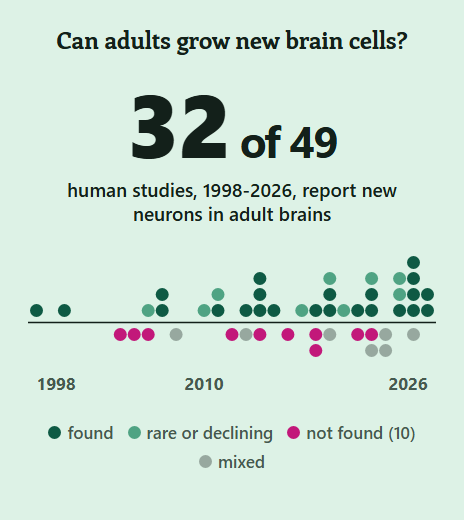
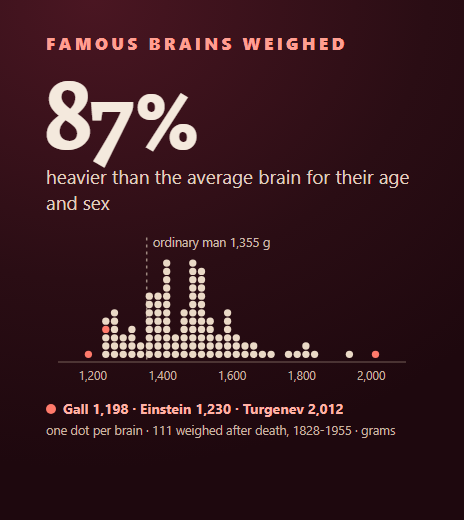
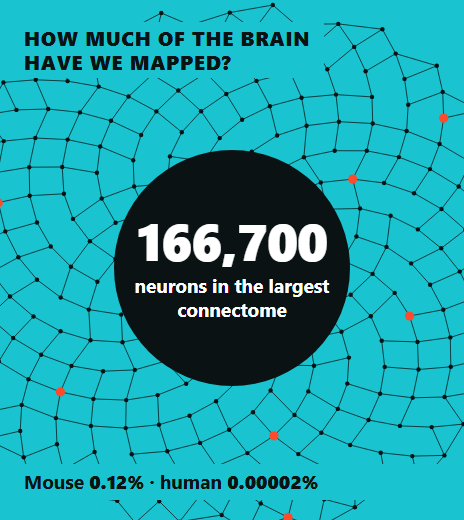
Surgery in adulthood is rarer. Fourteen adults in São Paulo with an early stroke had a mean IQ of 84 before and 88 after functional hemispherectomy [6]. Our study of how much of the brain has been mapped shows how far brain wiring maps have come, famous brains weighed shows that brain size says little about ability, and whether adults grow new brain cells covers another kind of plasticity. The brain size and IQ correlation is only about 0.24, which half-brain adults with average scores illustrate well.
11 What does this mean, and what does it not show?
The data show that thinking ability usually survives the loss of a hemisphere at the level it had before, and that a few people reach the average range; they do not show what any one child will score. Every series is a group of patients chosen for surgery at one centre, tested with different scales, at different ages and for different follow-up times. Studies that report counts use different rules for a change. Children who could not be tested are often missing from the averages, and papers that report only words (“improved”, “stable”) are not in our numbers.
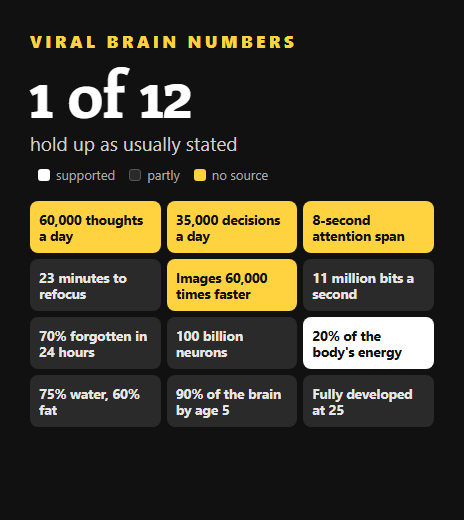
Nothing on this page is medical advice, and it says nothing about whether a particular child should have surgery. The brain statistics fact check traces other famous brain numbers to their sources, and human brain facts lists the basics: weight, neurons, energy.
Two hemispheres or one, reasoning can be measured.
Our IQ test measures pattern reasoning in adults and gives a percentile.
Take the IQ test12 Every series and every patient in our dataset
Every series in our dataset (23 rows)
Oldest first. Patients = the whole series; with result = patients with an IQ or DQ result after surgery, where the paper states it. "After surgery" = the range, mean or median printed. The finding is in our words; the CSV adds DOI, counts, rules and licences. As of 9 November 2026.
| Tinuper 1988 [1] | 1988 | Montreal Neurological Hospital and Institute, Canada | functional hemispherectomy | 20 | – | IQ | – | mean increase of 10 IQ points where seizures stopped |
| Vargha-Khadem 1997 [2] | 1997 | Institute of Child Health, London, UK | left hemispherectomy (comparison group) | 10 | 9 | IQ | 40 to 68 | nine left-hemispherectomy patients with IQ 40 to 68 (comparison group of a case study) |
| Maehara 2002 [3] | 2002 | Tokyo Metropolitan Neurological Hospital, Japan | hemispherotomy at 6 years or younger | 14 | 14 | DQ | mean 31.9 | mean total DQ 25.5 before and 31.9 after |
| Jonas 2004 [5] | 2004 | University of California, Los Angeles, USA | hemispherectomy | 115 | – | DQ (Vineland) | – | Vineland DQ rose by 5 points or more in 57%; mean change +12.7 (cortical dysplasia) to -0.6 (infarct) |
| Pulsifer 2004 [4] | 2004 | Johns Hopkins Hospital, USA | hemispherectomy, 1968 to 1997 | 71 | 53 | IQ | – | 34 of 53 changed by less than 15 points; 11 declined, 8 improved |
| Cukiert 2009 [6] | 2009 | Hospital Brigadeiro, Sao Paulo, Brazil | functional hemispherectomy in adults | 14 | 14 | IQ | mean 88 | adults with early stroke: mean IQ 84 before, 88 after |
| Boshuisen 2010 [7] | 2010 | University Medical Center Utrecht, Netherlands | functional hemispherectomy, 1994 to 2008 | 43 | 34 | IQ or MDI | – | under 55 after surgery: 90% with, 42% without contralateral MRI abnormalities; improved in 0% vs 38% |
| Ciliberto 2012 [8] | 2012 | Washington University, St Louis, USA | peri-insular hemispherotomy (bilateral seizure onset) | 7 | – | FSIQ | – | no patient had a decrement in full-scale IQ |
| Honda 2013 [9] | 2013 | National Center of Neurology and Psychiatry, Tokyo, Japan | vertical parasagittal hemispherotomy in infants | 12 | 12 | DQ | 3 to 61 | after surgery mean DQ 31.3 (7 to 61) in the 8 without seizures, 5.5 (3 to 8) in the 4 with seizures |
| Bulteau 2015 [10] | 2015 | Rothschild Foundation / INSERM, Paris, France | left hemispherotomy for Rasmussen encephalitis | 6 | 6 | VCI (verbal index) | – | all 6 reached a verbal comprehension index above 70; performance index fell in 5 of 6 |
| Taussig 2015 [11] | 2015 | Rothschild Foundation, Paris, France | hemispherotomy after perinatal stroke | 3 | 3 | verbal intelligence (category) | – | 2 of 3 reached normal verbal intelligence; the one operated at 38 months did not |
| van Schooneveld 2016 [12] | 2016 | UMC Utrecht, Netherlands (nationwide cohort) | hemispherectomy, 1994 to 2009 | 31 | 22 | IQ | 45 to 82; median 61 | 22 tested: IQ 45 to 82 (median 61); 9 more could not be tested with age-level tests |
| Kliemann 2019 [13] | 2019 | California Institute of Technology, USA | hemispherectomy in childhood (adults scanned) | 6 | 6 | FSIQ | mean 90.8 | six adults: mean full-scale IQ 90.83 (SD 7.41) |
| Bajer 2020 [16] | 2020 | Schoen Klinik Vogtareuth, Germany | hemispherotomy, 6 months after | 75 | 31 | FSIQ | – | testable group: FSIQ rose in 5 of 31, none fell significantly (2 lost performance IQ only); severely impaired group: 30 of 40 kept developing |
| Qu 2020 [15] | 2020 | Tangdu Hospital, Xi’an, China | functional hemispherectomy, surgery after age 6 | 23 | 23 | FSIQ | – | 17 of 23 had a significant rise in full-scale IQ |
| Silva 2020 [14] | 2020 | Ribeirao Preto Medical School, University of Sao Paulo, Brazil | left hemispherectomy at 6 to 18 years | 15 | 9 | IQ level (Wechsler) | – | 8 of 9 kept the same intellectual level; verbal IQ unchanged in 13 and improved in 1; performance IQ fell in 4 |
| Kliemann 2021 [23] | 2021 | California Institute of Technology and University of Iowa, USA | hemispherectomy in childhood (adults scanned) | 4 | 4 | FSIQ | – | four adults: full-scale IQ 80, 105, 96 and 95 (two of them also in the 2019 study) |
| Shurtleff 2021 [17] | 2021 | Seattle Children’s Hospital, USA | functional hemispherectomy, 1996 to 2020 | 71 | 36 | IQ (summary score) | – | no group decline; intelligence and adaptive skills stable or better in 85% of 66 tested twice |
| De Knegt 2024 [18] | 2024 | Rigshospitalet, Copenhagen, Denmark (all Danish cases 1996 to 2019) | hemispherectomy | 16 | – | IQ or DQ | – | median IQ/DQ 44 before; median change 0 points (IQR -10 to +4) |
| Bisten 2025 [20] | 2025 | University Hospital Bonn, Germany | hemispherotomy, 1992 to 2012 | 22 | 22 | VIQ and PIQ | 45 to 110 | verbal IQ 51 to 110 and performance IQ 45 to 100 across 22 people; overlaps the Bonn 2026 cohort, so not pooled (overlaps Bauer 2026; not pooled) |
| Ramantani 2025 [19] | 2025 | University Children’s Hospital Zurich and partner centres (multicenter) | hemispherotomy, 2000 to 2016 | 296 | 296 | IQ or DQ | – | after surgery: 11% above 85, 16% 70 to 84, 22% 55 to 69, 51% below 55 |
| Bauer 2026 [22] | 2026 | University Hospital Bonn, Germany | hemispherotomy | 26 | 22 | FSIQ | – | per-patient table: full-scale IQ for 22 of 26 (our summary in the patient rows) |
| Cantarin-Extremera 2026 [21] | 2026 | Hospital Infantil Universitario Nino Jesus, Madrid, Spain | hemispherectomy for Rasmussen syndrome | 13 | 13 | FSIQ | – | 7 of 13 had significant cognitive deterioration after surgery; 1 rose from 78 to 87 |
Source: Papers of our dataset; PubMed [45]; compiled by IQ Metrics
Every patient with printed values (41 rows)
Study and patient number as printed in the paper; no names. Ages in years. FSIQ, VIQ, PIQ = full-scale, verbal and performance IQ after surgery; other = index scores or another test. "-" = not printed. Four Bauer 2026 patients have no IQ in the table. As of 9 November 2026.
| Bauer 2026 #1 [22] | R | Ganglioglioma | 26 | 26 | – | – | – | – | – |
| Bauer 2026 #2 [22] | L | Rasmussen’s encephalitis | 19 | 21 | – | 68 | 60 | 80 | – |
| Bauer 2026 #3 [22] | R | Porencephaly | 16 | 19 | – | 47 | 51 | 45 | – |
| Bauer 2026 #4 [22] | L | Rasmussen’s encephalitis | 18 | 20 | – | 82 | 68 | 100 | – |
| Bauer 2026 #5 [22] | L | Porencephaly | 10 | 16 | – | 72 | 80 | 68 | – |
| Bauer 2026 #6 [22] | R | Porencephaly | 15 | 17 | – | 83 | 89 | 79 | – |
| Bauer 2026 #7 [22] | R | Encephalitis | 30 | 45 | – | – | – | – | – |
| Bauer 2026 #8 [22] | L | Hemimegalencephaly | 6 | 25 | – | 55 | 69 | 54 | – |
| Bauer 2026 #9 [22] | L | Porencephaly | 13 | 21 | – | 77 | 81 | 72 | – |
| Bauer 2026 #10 [22] | L | Porencephaly | 18 | 20 | – | 77 | 90 | 61 | – |
| Bauer 2026 #11 [22] | L | Hemimegalencephaly | 0 | 18 | – | – | – | – | – |
| Bauer 2026 #12 [22] | R | Polymicrogyria | 10 | 23 | – | 94 | 107 | 75 | – |
| Bauer 2026 #13 [22] | L | Rasmussen’s encephalitis | 7 | 11 | – | 78 | – | – | – |
| Bauer 2026 #14 [22] | L | Porencephaly | 33 | 43 | – | 79 | 90 | 68 | – |
| Bauer 2026 #15 [22] | L | Porencephaly | 9 | 20 | – | 77 | 81 | 75 | – |
| Bauer 2026 #16 [22] | L | Porencephaly | 11 | 22 | – | 80 | 84 | 75 | – |
| Bauer 2026 #17 [22] | R | Porencephaly | 10 | 21 | – | 102 | 110 | 91 | – |
| Bauer 2026 #18 [22] | L | Rasmussen’s encephalitis | 12 | 18 | – | 61 | 64 | 67 | – |
| Bauer 2026 #19 [22] | L | Porencephaly | 10 | 18 | – | 66 | 78 | 58 | – |
| Bauer 2026 #20 [22] | R | Porencephaly | 25 | 36 | – | 70 | 81 | 61 | – |
| Bauer 2026 #21 [22] | R | Hemimegalencephaly | 0 | 16 | – | 68 | 75 | 66 | – |
| Bauer 2026 #22 [22] | R | Porencephaly | 16 | 27 | – | 56 | 67 | 58 | – |
| Bauer 2026 #23 [22] | R | Sturge–Weber syndrome | 1 | 20 | – | 79 | 80 | 78 | – |
| Bauer 2026 #24 [22] | R | Porencephaly | 29 | 32 | – | 59 | 74 | 56 | – |
| Bauer 2026 #25 [22] | L | Porencephaly | 9 | 19 | – | 83 | 90 | 78 | – |
| Bauer 2026 #26 [22] | L | Porencephaly | 49 | 49 | – | – | – | – | – |
| Cantarin 2026 (case) [21] | R | Rasmussen encephalitis | – | – | FSIQ 78 | 87 | – | – | – |
| Georgy 2016 #DR [24] | R | Rasmussen encephalitis | 17 | 19 | FSIQ 77 | 83 | 87 | 83 | before: VIQ 92, PIQ 65 |
| Grosmaitre 2015 (case) [27] | L | Rasmussen encephalitis | 7 | 11 | – | – | – | – | VCI 155 |
| Kliemann 2019 #HS1 [13] | R | Rasmussen encephalitis | 7 | 29 | – | – | – | – | VCI 105, POI 74 |
| Kliemann 2019 #HS3 [13] | L | Perinatal stroke | 8 | 22 | – | – | – | – | VCI 109, POI 89 |
| Kliemann 2019 #HS4 [13] | R | Rasmussen encephalitis | 11 | 31 | – | – | – | – | VCI 118, POI 86 |
| Kliemann 2019 #HS5 [13] | R | Rasmussen encephalitis | 4 | 20 | – | – | – | – | VCI 109, POI 95 |
| Kliemann 2021 #LHS4 [23] | L | Perinatal stroke | 6 | 26 | – | 95 | – | – | VCI 101, POI 95 (HS2 in the 2019 study) |
| Kliemann 2021 #RHS1 [23] | R | Cortical dysplasia | 0.2 | 22 | – | 80 | – | – | VCI 91, POI 72 |
| Kliemann 2021 #RHS2 [23] | R | Rasmussen encephalitis | 20 | 23 | – | 105 | – | – | VCI 109, POI 93 |
| Kliemann 2021 #RHS3 [23] | R | Perinatal stroke | 15 | 21 | – | 96 | – | – | VCI 101, POI 86 |
| Moletto 2018 (case) [25] | R | Polymicrogyria | 5 | 17 | – | 88 | 120 | 71 | – |
| Pepi 2022 #1 [26] | R | Hemimegalencephaly | 1.3 | 10.5 | DQ (Griffiths) 62 | 73 | 92 | 74 | – |
| Pepi 2022 #2 [26] | R | Hemimegalencephaly | 2.8 | 6 | DQ (Griffiths) 53 | – | – | – | Leiter-R brief IQ 62 |
| Pepi 2022 #3 [26] | L | Hemimegalencephaly | 0.2 | 7 | – | 49 | 56 | 85 | – |
Source: [22] [21] [24] [23] [25] [26] [13] [26] [27]; typed or parsed by IQ Metrics
13 How we built the dataset
- 01
Search
One Europe PMC title search (hemispherectomy, hemispherotomy, hemidecortication, hemispheric surgery or disconnection, one hemisphere, half a brain): 1,052 records, plus named leads and an open full-text search for per-patient tables [44].
- 02
Screen
A scripted rule kept 158 records whose title or abstract names a thinking measure; we read 79 by hand (full PubMed abstracts, and open full texts where they exist) [45].
- 03
Type
For each series we typed the counts, averages, ranges and bands exactly as printed; per-patient values come only from tables or case text (study and patient number as printed). The Bonn 2026 table was parsed by script.
- 04
Check
A script found every typed value (151 checks) in the saved abstract or full text. IQ and developmental quotients are kept apart; full-scale IQ is kept apart from verbal or performance IQ.
- 05
Compute
Direction counts, bands, medians, the verbal-performance gap and the age correlation: all IQ Metrics calculations, scripted from the cached files.
Read every number with these in mind
- The dataset is a lower bound: 23 series found by our search and leads. Papers that print IQ only in paywalled tables are missing.
- Rules for “the same IQ” differ between papers; the pooled count adds verdicts, not points.
- The 31 per-patient IQs come mostly from brain-imaging studies of able adults and are higher than typical outcomes.
- Two Bonn papers share patients; we pool only the 2026 table. Two Caltech people appear in both Kliemann papers; we keep one row each.
- IQ and DQ are different scales and are never combined; changes in different scales are shown side by side, not added.
- Nothing here is medical advice or a prediction for any person.
Sources
- Annals of Neurology. Tinuper et al. (1988). Functional hemispherectomy for treatment of epilepsy associated with hemiplegia: rationale, indications, results, and comparison with callosotomy. 1988. doi.org/10.1002/ana.410240107Publisher copyright: abstract read (PubMed); facts cited only
- Brain. Vargha-Khadem et al. (1997). Onset of speech after left hemispherectomy in a nine-year-old boy. 1997. doi.org/10.1093/brain/120.1.159Publisher copyright: abstract read (PubMed); facts cited only
- Brain & Development. Maehara et al. (2002). Postoperative development of children after hemispherotomy. 2002. doi.org/10.1016/s0387-7604(02)00010-4Publisher copyright: abstract read (PubMed); facts cited only
- Epilepsia. Pulsifer et al. (2004). The cognitive outcome of hemispherectomy in 71 children. 2004. doi.org/10.1111/j.0013-9580.2004.15303.xPublisher copyright: abstract read (PubMed); facts cited only
- Neurology. Jonas et al. (2004). Cerebral hemispherectomy: hospital course, seizure, developmental, language, and motor outcomes. 2004. doi.org/10.1212/01.wnl.0000127109.14569.c3Publisher copyright: abstract read (PubMed); facts cited only
- Epilepsia. Cukiert et al. (2009). Outcome after hemispherectomy in hemiplegic adult patients with refractory epilepsy associated with early middle cerebral artery infarcts. 2009. doi.org/10.1111/j.1528-1167.2008.01795.xPublisher copyright: abstract read (PubMed); facts cited only
- Neurology. Boshuisen et al. (2010). Contralateral MRI abnormalities affect seizure and cognitive outcome after hemispherectomy. 2010. doi.org/10.1212/WNL.0b013e3181fb4400Publisher copyright: abstract read (PubMed); facts cited only
- Journal of Neurosurgery: Pediatrics. Ciliberto et al. (2012). Palliative hemispherotomy in children with bilateral seizure onset. 2012. doi.org/10.3171/2011.12.PEDS11334Publisher copyright: abstract read (PubMed); facts cited only
- Epilepsy & Behavior. Honda et al. (2013). Long-term developmental outcome after early hemispherotomy for hemimegalencephaly in infants with epileptic encephalopathy. 2013. doi.org/10.1016/j.yebeh.2013.06.006Publisher copyright: abstract read (PubMed); facts cited only
- Epilepsy & Behavior. Bulteau et al. (2015). Language recovery after left hemispherotomy for Rasmussen encephalitis. 2015. doi.org/10.1016/j.yebeh.2015.07.044Publisher copyright: abstract read (PubMed); facts cited only
- European Journal of Paediatric Neurology. Taussig et al. (2015). Hemispherotomy for isolated infantile spasms following perinatal ischemic stroke. 2015. doi.org/10.1016/j.ejpn.2015.04.003Publisher copyright: abstract read (PubMed); facts cited only
- European Journal of Paediatric Neurology. van Schooneveld et al. (2016). The spectrum of long-term cognitive and functional outcome after hemispherectomy in childhood. 2016. doi.org/10.1016/j.ejpn.2016.01.004Publisher copyright: abstract read (PubMed); facts cited only
- Cell Reports. Kliemann et al. (2019). Intrinsic functional connectivity of the brain in adults with a single cerebral hemisphere. 2019. doi.org/10.1016/j.celrep.2019.10.067CC BY-NC-ND 4.0 (author manuscript, PMC): facts cited only
- Child's Nervous System. Silva et al. (2020). Left hemispherectomy in older children and adolescents: outcome of cognitive abilities. 2020. doi.org/10.1007/s00381-019-04377-9Publisher copyright: abstract read (PubMed); facts cited only
- World Neurosurgery. Qu et al. (2020). Long-term cognitive improvement after functional hemispherectomy. 2020. doi.org/10.1016/j.wneu.2019.12.058Publisher copyright: abstract read (PubMed); facts cited only
- Epileptic Disorders. Bajer et al. (2020). Correlates of intellectual development before and after hemispherotomy: an analysis of 75 children and adolescents. 2020. doi.org/10.1684/epd.2020.1193Publisher copyright: abstract read (PubMed); facts cited only
- Epilepsy & Behavior. Shurtleff et al. (2021). Pediatric hemispherectomy outcome: adaptive functioning, intelligence, and memory. 2021. doi.org/10.1016/j.yebeh.2021.108298Publisher copyright: abstract read (PubMed); facts cited only
- Brain & Development. De Knegt et al. (2024). Current state of hemispherectomy and callosotomy for pediatric refractory epilepsy in Denmark. 2024. doi.org/10.1016/j.braindev.2023.11.009Publisher copyright: abstract read (PubMed); facts cited only
- Epilepsia. Ramantani et al. (2025). Determinants of intellectual and developmental outcomes in a multicenter pediatric hemispherotomy cohort. 2025. doi.org/10.1111/epi.18391Publisher copyright: abstract read (PubMed); facts cited only
- Human Brain Mapping. Bisten et al. (2025). Structural white matter correlates of the crowding effect: insights from a tractography study of the arcuate fasciculus post-hemispherotomy. 2025. doi.org/10.1002/hbm.70258CC BY 4.0 (PMC full text)
- Orphanet Journal of Rare Diseases. Cantarin-Extremera et al. (2026). Clinical spectrum, diagnosis, cognitive outcomes and therapeutic strategies in pediatric Rasmussen syndrome. 2026. doi.org/10.1186/s13023-026-04357-8CC BY 4.0 (PMC full text)
- Brain Communications. Bauer et al. (2026). Default-mode network activity is retained in the isolated hemisphere of people after hemispherotomy. 2026. doi.org/10.1093/braincomms/fcag211CC BY 4.0 (PMC full text); per-patient table read by script
- Brain Sciences. Kliemann et al. (2021). Reorganization of the social brain in individuals with only one intact cerebral hemisphere. 2021. doi.org/10.3390/brainsci11080965CC BY 4.0 (PMC full text)
- Cortex. Georgy L. et al. (2016). The superior colliculus is sensitive to gestalt-like stimulus configuration in hemispherectomy patients. 2016. doi.org/10.1016/j.cortex.2016.04.018CC BY-NC-ND 4.0 (PMC): facts cited only
- Child's Nervous System. Moletto A. et al. (2018). Long term neurocognitive improvement after "late" right hemispherectomy: case report and review of the literature. 2018. doi.org/10.1007/s00381-018-3775-0Publisher copyright: abstract read (PubMed); facts cited only
- Brain Sciences. Pepi C. et al. (2022). Hemispherotomy in infants with hemimegalencephaly: long-term seizure and developmental outcome in early treated patients. 2022. doi.org/10.3390/brainsci13010073CC BY 4.0 (PMC full text)
- Neurocase. Grosmaitre C. et al. (2015). Exceptional verbal intelligence after hemispherotomy in a child with Rasmussen encephalitis. 2015. doi.org/10.1080/13554794.2013.878724Publisher copyright: abstract read (PubMed); facts cited only
- Neurology. Smith A., Sugar O. (1975). Development of above normal language and intelligence 21 years after left hemispherectomy. 1975. doi.org/10.1212/wnl.25.9.813Publisher copyright: abstract read (PubMed); facts cited only
- Science. Lewin R. (1980). Is your brain really necessary? (news article; no abstract). 1980. pubmed.ncbi.nlm.nih.gov/7434023Publisher copyright: record only (paywalled; not read)
- The Lancet. Feuillet L., Dufour H., Pelletier J. (2007). Brain of a white-collar worker (case report; no abstract). 2007. doi.org/10.1016/S0140-6736(07)61127-1Publisher copyright: record only (paywalled; not read)
- JAMA. Dandy W.E. (1928). Removal of right cerebral hemisphere for certain tumors with hemiplegia. 1928. doi.org/10.1001/jama.1928.02690380007003Crossref record (title, journal, date)
- Journal of Neurology, Neurosurgery and Psychiatry. Krynauw R.A. (1950). Infantile hemiplegia treated by removing one cerebral hemisphere. 1950. doi.org/10.1136/jnnp.13.4.243PubMed record (scan in PMC; not read by script)
- Journal of Neurology, Neurosurgery and Psychiatry. McFie J. (1961). The effects of hemispherectomy on intellectual functioning in cases of infantile hemiplegia. 1961. doi.org/10.1136/jnnp.24.3.240PubMed record (scan in PMC; not read by script)
- Journal of Neurology, Neurosurgery and Psychiatry. Oppenheimer D.R., Griffith H.B. (1966). Persistent intracranial bleeding as a complication of hemispherectomy. 1966. doi.org/10.1136/jnnp.29.3.229OpenAlex record (CC0 metadata)
- Canadian Journal of Neurological Sciences. Rasmussen T. (1983). Hemispherectomy for seizures revisited. 1983. doi.org/10.1017/s0317167100044668OpenAlex record (CC0 metadata)
- Neurosurgery. Schramm J. et al. (2001). Transsylvian keyhole functional hemispherectomy. 2001. doi.org/10.1227/00006123-200110000-00021OpenAlex record (CC0 metadata)
- Operative Neurosurgery. Delalande O. et al. (2007). Vertical parasagittal hemispherotomy: surgical procedures and clinical long-term outcomes. 2007. doi.org/10.1227/01.neu.0000249246.48299.12Crossref record (title, journal, date)
- Journal of Neurosurgery: Pediatrics. Chandra P.S. et al. (2019). Endoscope-assisted (with robotic guidance and using a hybrid technique) interhemispheric transcallosal hemispherotomy (abridged title). 2019. doi.org/10.3171/2018.8.PEDS18131Publisher copyright: abstract read (PubMed); facts cited only
- Journal of Neurology, Neurosurgery and Psychiatry. Althausen A. et al. (2013). Long-term outcome of hemispheric surgery at different ages in 61 epilepsy patients. 2013. doi.org/10.1136/jnnp-2012-303811Publisher copyright: abstract read (PubMed); facts cited only
- Journal of Clinical Neurology. Lee Y.J. et al. (2014). Long-term outcomes of hemispheric disconnection in pediatric patients with intractable epilepsy. 2014. doi.org/10.3988/jcn.2014.10.2.101CC BY-NC 3.0 (PMC full text): history facts cited only
- Journal of Neurology. Schmidlechner T. et al. (2023). IQ changes after pediatric epilepsy surgery: a systematic review and meta-analysis. 2023. doi.org/10.1007/s00415-023-12002-8CC BY 4.0 (PMC full text)
- Epilepsia. Stefanos-Yakoub I. et al. (2024). Long-term intellectual and developmental outcomes after pediatric epilepsy surgery: a systematic review and meta-analysis. 2024. doi.org/10.1111/epi.17834Publisher copyright: abstract read (PubMed); facts cited only
- CDC, National Center on Birth Defects and Developmental Disabilities. Centers for Disease Control and Prevention (2026). About anencephaly (page updated 6 November 2026). 2026. www.cdc.gov/birth-defects/about/anencephaly.htmlUS government work (public domain)
- EMBL-EBI. Europe PMC REST API: one title search (hemispherectomy, hemispherotomy, hemidecortication and related words), 1,052 records with abstracts. 2026. europepmc.org/RestfulWebServiceMetadata open; abstracts cited as facts
- US National Library of Medicine. NCBI E-utilities: PubMed abstracts (85 records) and PubMed Central full texts (27 open articles). 2026. www.ncbi.nlm.nih.gov/books/NBK25501US government service; each article keeps its own licence
Version history
- 2026.119 November 2026First release. Next update due November 2027 (search re-run yearly; new multicentre series appear about once a year); sooner if a paper in the dataset is corrected or a large per-patient table is published.
Leon Falkner, Data & Research Analyst. Leon owns the arithmetic on IQ Metrics: the percentile tables, the score converter and the figures in everyone else's drafts. On the research desk Leon pulls the data, builds each index and writes the method. More about Leon.
Questions
Can a human live without a brain?
No. A person cannot live without a brain: almost all babies born with anencephaly, missing parts of the brain and skull, die shortly after birth (CDC). People can live with one cerebral hemisphere, and 23 published series have measured their IQ.
Can you live with half a brain?
Yes. Hundreds of children have had one hemisphere removed or disconnected to stop severe epilepsy, and many go to school and work as adults. Six Caltech adults with one hemisphere averaged a full-scale IQ of 90.83.
Does IQ drop after a hemispherectomy?
Usually not. In 129 children tested before and after the surgery, 68 kept about the same IQ, 31 rose and 18 fell. Losses were most common in Rasmussen encephalitis, which strikes a hemisphere that worked normally before.
What is the average IQ after a hemispherectomy?
Below 100 for most patients. In the largest series of 296 children, 11% scored above 85 and 51% below 55. The 31 people with a full-scale IQ printed one by one have a median of 78, but they are a selected, more able group.
How many hemispheres does the human brain have?
Two. The human cerebrum has a left and a right cerebral hemisphere, joined by the corpus callosum. A hemispherectomy removes or disconnects one of them; the brainstem and cerebellum stay in place.
How long can a human live without a brain?
Not long. Babies born with anencephaly, the condition closest to having no brain, almost all die shortly after birth, according to the CDC. Living with one hemisphere is different: people operated on in childhood have been followed for more than 20 years.
Is it worse to lose the left or the right hemisphere?
Not clearly. In 31 people with a printed full-scale IQ, the median is 77 after left and 81.5 after right surgery. Verbal IQ beats performance IQ in 21 of 25 people, more often after right-side surgery (12 of 12) than left (9 of 13).
Why do doctors remove half a brain?
Mostly to stop severe epilepsy that starts in one hemisphere and does not respond to drugs, caused by Rasmussen encephalitis, a stroke around birth or a malformation such as hemimegalencephaly. Walter Dandy first removed a hemisphere for tumours in 1928.
What is the difference between hemispherectomy and hemispherotomy?
A hemispherectomy removes most of one hemisphere; a hemispherotomy leaves it in place but cuts all of its connections. Both leave a person thinking with one hemisphere; the newer disconnection operations remove far less tissue.
Is the story of the student with almost no brain and a high IQ true?
It is a single reported case from a 1980 news article in Science about hydrocephalus, not surgery. The article has no abstract and is paywalled, so we could not check the number and print none; single cases are never pooled here.
Share it, cite it, download it
You may reuse everything on this page under CC BY 4.0: in articles, reports, lessons and posts. The one condition is credit to IQ Metrics with a link to this page.
Cite this study
Version 2026.11. Citing the version lets readers find the exact numbers.
Archived copy with a DOI: 10.5281/zenodo.24074464 (report PDF and data on Zenodo).
Falkner, L. (2026). Can you live with half a brain? Every hemispherectomy IQ study (Version 2026.11) [Data set]. IQ Metrics Research. https://iqmetrics.org/research/can-you-live-with-half-a-brain/ (DOI: 10.5281/zenodo.24074464)
Falkner, Leon. "Can you live with half a brain? Every hemispherectomy IQ study." IQ Metrics Research, 9 Nov. 2026, iqmetrics.org/research/can-you-live-with-half-a-brain/. DOI: 10.5281/zenodo.24074464.
Falkner, Leon. "Can you live with half a brain? Every hemispherectomy IQ study." IQ Metrics Research. November 9, 2026. https://iqmetrics.org/research/can-you-live-with-half-a-brain/. DOI: 10.5281/zenodo.24074464.
@misc{iqmetrics2026canyoulivewithhalfabrain, author = {Falkner, Leon}, title = {Can you live with half a brain? Every hemispherectomy IQ study}, institution = {IQ Metrics}, year = {2026}, version = {2026.11}, doi = {10.5281/zenodo.24074464}, url = {https://iqmetrics.org/research/can-you-live-with-half-a-brain/} }
Source: Leon Falkner, "Can you live with half a brain? Every hemispherectomy IQ study." IQ Metrics Research, version 2026.11, https://iqmetrics.org/research/can-you-live-with-half-a-brain/ (DOI 10.5281/zenodo.24074464)
Embed the key numbers
Paste this into an article or post. It lists the main numbers and credits the source.
Get the data
One row per published series (23 rows, row_type cohort) and one row per patient with printed values (41 rows, row_type patient), from papers that report an IQ or developmental quotient after hemispherectomy or hemispherotomy. Values as printed; empty = not printed. Patients are identified only by study and the number the paper uses.
| Column | What it holds |
|---|---|
row_type, study_id, first_author, year, journal, doi, pmid, pmcid | Cohort or patient row; our study id; bibliographic data |
place, operation, patients_in_series, patients_with_iq_or_dq | Centre or country, the operation as described, patients in the series and patients with an IQ or DQ result |
measure | IQ, FSIQ, DQ, VCI, IQ or DQ, as the paper uses it (never converted) |
patient_as_printed, side_removed_or_disconnected, cause_as_printed, cause_group | Patient number as printed; L or R; the cause as printed; our group (acquired, developmental, other) |
age_at_seizure_onset_y, age_at_surgery_y, age_at_test_y | Ages in years, as printed (months converted to years) |
before_measure, before_value | Score before surgery and its scale, where printed |
after_fsiq, after_viq, after_piq, after_other | Full-scale, verbal and performance IQ after surgery; other scores (index or other test) |
after_low, after_middle, after_high, after_middle_kind | Range and mean or median after surgery for a series, as printed |
change_points, change_kind | Change from before to after (mean, median, or our subtraction where both averages are printed) |
n_same, n_up, n_down, n_not_stated, counting_rule | Patients whose IQ stayed the same, rose or fell by the paper's own rule, and the rule |
band_after | Our full-scale IQ band after surgery: 85 or more, 70 to 84, 55 to 69, under 55 |
follow_up, finding_in_our_words, source_text_read, licence_of_source, note | Follow-up as printed; the finding in our words; abstract or full text; the paper's licence; overlaps and notes |
For journalists, researchers and teachers
Everything on this page may be quoted, charted and republished with credit. No embargo, no permission needed, no sign-up. If you need a number that is not here, ask.
Summary you can paste
Plain news style. Edit freely; keep the credit.
IQ Metrics Research assembled every published IQ or developmental-quotient result after hemispherectomy or hemispherotomy we could find: 23 series (1988-2026, 891 patients) and 41 people whose values are printed one by one. In 129 children tested before and after, 68 kept about the same IQ, 31 rose and 18 fell. In the largest series (296 children), 11% scored above 85 after surgery and 51% below 55. Source: IQ Metrics Research, https://iqmetrics.org/research/can-you-live-with-half-a-brain/
Angles for a story
- Half a brain, same IQ: 68 of 129 children kept their level (Figure 4)
- Why one series lost ground: Rasmussen encephalitis and the children with most to lose (Figure 5)
- Words outlast shapes: verbal IQ beat performance IQ in 21 of 25 (Figure 11)
- Left or right half? The answer is less clear than people think (Figure 10)
- From Dandy’s 1928 tumour operations to endoscopic hemispherotomy (Figure 2)
- “Can a human live without a brain?” What the CDC and the myths say (the section)
Quotes you can use
Attributable as written, with the name and title. For a different angle or a quote on a specific figure, ask through the contact page.
Half a brain does not mean half an IQ. Just over half of the children keep the level they had before surgery; the hard part is that the level was often low to begin with.
Leon Falkner, Data & Research Analyst, IQ Metrics ResearchThe adults you read about with one hemisphere and an average IQ are real, but they are the able end of a wide range. Our tables show both ends.
Leon Falkner, Data & Research Analyst, IQ Metrics ResearchEvery paper uses its own rule for a change in IQ. We counted the verdicts, kept IQ and developmental scores apart, and printed the rule next to each one.
Leon Falkner, Data & Research Analyst, IQ Metrics Research
Files
- CSV of every series and every patient: authors, year, DOI, place, operation, measure, counts, ranges, rules, per-patient side, cause, ages, FSIQ, VIQ, PIQ, licence (CC BY 4.0)
- Every figure as a print-ready PNG: use the Image button under each figure
- Embed code and data table under every figure
- Share images for social media in three sizes, with the credit line built in
- Citations in APA, MLA, Chicago, BibTeX and plain text
Terms, contact and corrections
Credit: “IQ Metrics Research, Can you live with half a brain? (2026)” with a link to this page. On air or in print, “IQ Metrics” and the page address are enough.
What it covers: published series and case tables with an IQ or developmental quotient after hemispherectomy or hemispherotomy, 1988-2026; reviews are context only. No patient names.
Contact: the research team, through the contact page. Corrections are made on this page with a dated note in the version history.