Famous brains weighed: did history’s great minds have bigger brains?
Turgenev’s brain weighed 2,012 g, Einstein’s 1,230 g. We gathered every brain weight of an eminent person we could find in the old records, 309 figures for 136 people, and asked three questions: were they heavier than average for their age, where do the records disagree, and did size track IQ?

By Leon Falkner, Data & Research Analyst · Reviewed by Aarav Vardhan, Editor-in-Chief · Published 27 October 2026 · 10 min read
About this study
- Report type
- Data study combining historical records
- Data
- 309 printed brain weights for 136 eminent people, from 10 public-domain books and papers (1860-1927) and the 1955 Einstein record
- Compared with
- Average brain for the same age and sex: Boyd (1861), 2,086 hospital post-mortems
- Joined to
- Wikidata (dates, CC0) and Cox (1926) IQ estimates
- Licence
- CC BY 4.0 (our dataset and charts)
- Version
- 2026.10
- Sources
- 18
Yes, on average, but not by much: 91 of 105 eminent people with known ages (87%) had brains heavier than the average for their age and sex. The 111 famous brains weighed after death between 1828 and 1955 averaged 1,467 g, about 144 g (11%) above that norm. Albert Einstein’s 1,230 g was below average for a man of 76, and among the 7 people with Cox (1926) IQ estimates, brain weight showed no link to IQ. IQ Metrics Research combined 309 printed figures from 10 public-domain sources into one open dataset, October 2026.
01 Key findings
- 87% of famous brains were heavier than average for their age and sex (91 of 105), by +144 g on average (+11%), against ordinary London hospital patients of the 1840s.Spitzka 1907; Boyd 1861; analysis by IQ Metrics
- 53% weighed over 1,450 g, against about one ordinary man in five (20.4% in a Leipzig hospital series of 1906); 14% weighed 1,600 g or more, against 4.4% of ordinary men.Spitzka 1907; Handmann 1906, pp. 38-39
- The spread is wider than the gap. Turgenev’s brain (2,012 g) weighed 814 g more than Gall’s (1,198 g); Einstein’s 1,230 g was 4.6% below the average for his age.Spitzka 1907; Men et al. 2014; Boyd 1861
- The records disagree for 15 people, and every later “correction” went up. Byron’s brain is 1,807 g to 2,238 g depending on which pound was meant; all 18 later estimates for 12 weighed brains are higher than the weighing, by up to 302 g.Spitzka 1907; Donaldson 1895; Matiegka 1902 and the reports they quote
- No link to IQ estimates: for the 7 people with a Cox (1926) IQ estimate, r = −0.06 (95% CI −0.78 to 0.73). A sample this small can rule out only a strong link.Cox 1926; analysis by IQ Metrics
02 Statistics to quote
Eminent people with a brain weight in print, from 309 printed figures in 10 public-domain books and papers (1860-1927) plus Einstein’s.
IQ Metrics, 2026Of 105 famous brains with known age at death were heavier than the average for their age and sex.
Spitzka 1907; Boyd 1861Average gap above that expected weight (+11%).
IQ Metrics, from Spitzka 1907 and Boyd 1861The heaviest reliable famous brain: the novelist Ivan Turgenev, who died near Paris in 1883.
Spitzka 1907, p. 210Albert Einstein’s brain, weighed in 1955: 4.6% below the average for a man of his age.
Men et al. 2014; Boyd 1861Brain weight against Cox’s 1926 IQ estimates, 7 people: no link.
Cox 1926; IQ Metrics03 Did famous people have bigger brains?
On average, yes. The 111 brains on our reliable list, all weighed fresh after death, averaged 1,467 g (median 1,468 g). That is heavier than the average adult man of the time: 1,345 to 1,366 g in the London hospital tables of Robert Boyd (1861, ages 20 to 60) and 1,355 g in Ernst Handmann’s Leipzig series of 1906 [2] [3]. Handmann himself checked an earlier version of this list and found that 82 of 99 famous brains beat his average [3].
Brain weight falls with age, and most of these men died old (median age 63), so we compared each person with the average for his or her own sex and age band in Boyd’s tables. 91 of 105 were heavier (87%); the average gap was +144 g, or +11%. 53% weighed more than 1,450 g, against 20.4% of ordinary adult men in Leipzig [3].
How much 111 famous brains weighed
Brains of eminent people weighed fresh after death, 1828-1955, in 50 g steps (the middle famous brain: 1,468 g). The dotted line marks the average brain of ordinary adult men in a Leipzig hospital series of 1906.
Brain weight (grams)
Source: Spitzka 1907, Table I [1] and later reports (see the method); ordinary men: Handmann 1906 [3]; analysis by IQ Metrics
Data table
| from | to | people |
|---|---|---|
| 1150 | 1200 | 1 |
| 1200 | 1250 | 5 |
| 1250 | 1300 | 9 |
| 1300 | 1350 | 6 |
| 1350 | 1400 | 16 |
| 1400 | 1450 | 15 |
| 1450 | 1500 | 18 |
| 1500 | 1550 | 16 |
| 1550 | 1600 | 9 |
| 1600 | 1650 | 5 |
| 1650 | 1700 | 3 |
| 1700 | 1750 | 1 |
| 1750 | 1800 | 2 |
| 1800 | 1850 | 3 |
| 1850 | 1900 | 0 |
| 1900 | 1950 | 1 |
| 1950 | 2000 | 0 |
| 2000 | 2050 | 1 |
Embed this chart
Paste this HTML into your page: it carries the numbers and the credit link to this figure.
The gap is real but small next to the spread: the famous brains themselves range over 814 g, from 1,198 g to 2,012 g, more than five times the average gap. Studies of living people’s brain scans find the same pattern, a modest link between brain volume and IQ of about 0.24 [18]. Our news desk explains what a correlation of 0.24 means; this page does not repeat it. Our blog checks six popular brain myths, and our study of 222 species compares brains across animals.
The 20 best-known brains against the average for their age
Name and age at death. Grey: the average brain of ordinary hospital patients of the same sex and age band (Boyd, London, 1861). Blue: what the famous brain weighed. "Best-known" = the most Wikipedia language editions.
Brain weight in grams
Source: Weights: Spitzka 1907 [1]; Einstein: Men et al. 2014 [10]; averages: Boyd 1861 [2]; ages: Wikidata [7]; analysis by IQ Metrics
Data table
| person | Average for age and sex (Boyd 1861) | Weighed after death |
|---|---|---|
| Turgenev, 64 | 1315 | 2012 |
| Cuvier, 62 | 1315 | 1830 |
| Thackeray, 52 | 1345 | 1658 |
| Webster, 70 | 1290 | 1518 |
| Gauss, 77 | 1290 | 1492 |
| Cope, 56 | 1345 | 1545 |
| Napoleon III, 64 | 1315 | 1500 |
| Agassiz, 66 | 1315 | 1495 |
| De Morgan, 64 | 1315 | 1494 |
| Powell, 68 | 1315 | 1488 |
| Dirichlet, 54 | 1345 | 1520 |
| Broca, 56 | 1345 | 1484 |
| Babbage, 79 | 1290 | 1403 |
| Whewell, 71 | 1290 | 1389 |
| Skobelev, 38 | 1366 | 1457 |
| Henry Wilson, 63 | 1315 | 1389 |
| Liebig, 69 | 1315 | 1352 |
| Whitman, 72 | 1290 | 1282 |
| Einstein, 76 | 1290 | 1230 |
| Gall, 70 | 1290 | 1198 |
Embed this chart
Paste this HTML into your page: it carries the numbers and the credit link to this figure.
04 Who had the heaviest and the lightest famous brain?
The heaviest reliable figure is Ivan Turgenev’s 2,012 g, weighed at his autopsy in 1883; it is 53% above the average for a man of his age. Spitzka accepted it on the signed autopsy report [1]; Henry Donaldson had left it out of his 1895 table as one of the “mythical records” [12]. Next come the notary Joseph Bouny (1,935 g), the naturalist Georges Cuvier (1,830 g) and Edward H. Knight (1,814 g), author of the American Mechanical Dictionary [1].
The lightest is Franz Joseph Gall’s 1,198 g. Gall founded phrenology, the belief that a bigger brain region means a stronger talent. He died at 70 with a shrunken brain and fluid in the skull, and Spitzka argued from his skull that it had once weighed about 1,500 g [1]. Walt Whitman’s brain (1,228 g or 1,282 g) was about average for his age; Carl Friedrich Gauss’s (1,492 g) was 16% above it. The lightest figure in print for any famous person, Anatole France’s 1,017 g, was weighed after his body had been embalmed with formol and alcohol, at 80, so it is not on the reliable list [17].
Einstein's brain
The pathologist Thomas Harvey removed and weighed Albert Einstein’s brain after the autopsy in 1955: 1,230 g, a figure later studies cite from Anderson and Harvey (1996) [10] [8]. That is 60 g below the average for men of 70 to 80 in Boyd’s tables (1,290 g), and close to the 1,219 g average of the elderly comparison brains in a later study of the same brain [10]. Studies of Einstein’s brain have looked for unusual shapes, not size [9]; see our profile of Albert Einstein and of Carl Friedrich Gauss, whose brain Rudolf Wagner described in 1860 [5].
05 Did mathematicians have bigger brains than poets?
We sorted everyone into six fields from Spitzka’s occupations and Wikidata. In every field the median is above the expected weight. The median gap was largest in public life (+13.5%, 20 people) and smallest in music, art and stage (+6.9%, 4). The boxes overlap almost completely, and the groups are small, so this is not evidence that one kind of talent needs a bigger brain. Spitzka read similar averages in 1907 as proof that the “higher” occupations, mathematics first, go with heavier brains [1].
Heavier than expected in every field, by different amounts
% above (or below) the average brain for the person's age and sex. Box = the middle half, line = the median, whiskers = lightest to heaviest; every dot is one person. Groups are small: read the overlap, not the order.
Dotted line: Average for age and sex.
Source: Spitzka 1907 [1]; Boyd 1861 [2]; fields by IQ Metrics from Spitzka’s occupations and Wikidata [7]
Data table
| field | n | low | q1 | median | q3 | high |
|---|---|---|---|---|---|---|
| Public life | 20 | -4.7 | 6.9 | 13.5 | 18.1 | 36.3 |
| Maths & physics | 13 | -4.6 | 8 | 13 | 21.6 | 34.9 |
| Life & earth science | 26 | -7.1 | 5.2 | 10.8 | 14.6 | 39.1 |
| Medicine | 20 | -6.6 | 3.2 | 8.4 | 13.3 | 35.8 |
| Writers & thinkers | 21 | -7.1 | 3.6 | 7.6 | 12 | 53 |
| Music, art & stage | 4 | -2.4 | -2 | 6.9 | 18.9 | 28.5 |
Embed this chart
Paste this HTML into your page: it carries the numbers and the credit link to this figure.
06 How much do the old records disagree?
For 15 people we found more than one weight in print for the same brain. Most gaps are small copying or rounding differences: Louis Agassiz is 1,514 g in the autopsy report and 1,495 g in Spitzka’s table; Walt Whitman’s brain is given as 1,282 g and as 1,228 g. A few are large. Lord Byron’s brain was reported in 1825 as “6 medicinal pounds”; depending on whose pound was meant, that is 1,807 g, 1,924 g or 2,238 g, and Spitzka put it among the doubtful reports [1].
Where the records disagree: 15 famous brains with more than one weight
Each dot is one figure in print for the same brain; the diamond is the figure in Spitzka's 1907 table, used on this page. Later estimates (Figure 5) are left out here. Hover or tap a dot for its source.
Grams. Byron's figures are one report ("6 medicinal pounds") read in three systems of weights.
Source: Spitzka 1907 [1] and the reports he quotes; other compilations as listed in the method; analysis by IQ Metrics
Data table
| person | source | value | kind | value used |
|---|---|---|---|---|
| Lord Byron | Gazette de Santé 1825 (Miquel), converted by Spitzka 1907, p. 207; Wagner 1860, Vorstudien I, p. 32; Guillaume-Louis and Dubreuil-Chambardel, Le cerveau d'Anatole France (1924-27), p. 6 | 1807 | report | |
| Lord Byron | Gazette de Santé 1825 (Miquel), converted by Spitzka 1907, p. 207 | 1924 | report | |
| Lord Byron | Bischoff 1880 (quoting others), p. 135 | 2233 | report | |
| Lord Byron | Gazette de Santé 1825 (Miquel), converted by Spitzka 1907, p. 206; Donaldson 1895, The Growth of the Brain (text, quoting others), p. 127; Wagner 1860 (quoting others), p. 30; Topinard 1885, Éléments d'anthropologie générale, p. 545; Matiegka 1902, Über das Hirngewicht, p. 35 | 2238 | report | |
| Robert Schumann | Spitzka 1907, reading Richarz's "7 ounces … less than is usual", p. 181 | 1105 | report | 1352 |
| Robert Schumann | Spitzka 1907, Table I (died insane), p. 212 | 1352 | report | 1352 |
| Robert Schumann | Richarz, as quoted by Schaafhausen (Archiv f. Anthrop. XVI) and Spitzka 1907, p. 181 | 1475 | report | 1352 |
| Hermann von Helmholtz | Matiegka 1902, Über das Hirngewicht, p. 36 | 1420 | report | |
| Hermann von Helmholtz | Spitzka 1907, Table I (doubtful), p. 212; Spitzka 1907 Table I (doubtful), p. 212 | 1440 | report | |
| Hermann von Helmholtz | Spitzka 1907, Table I (doubtful), p. 212; Spitzka 1907 Table I (doubtful), p. 212 | 1508 | report | |
| Hermann von Helmholtz | Spitzka 1907, Table I (doubtful), p. 212 | 1700 | report | |
| Otto von Bismarck | Spitzka 1907, citing Mies 1895, p. 215 | 1710 | report | |
| Otto von Bismarck | Matiegka 1902, Über das Hirngewicht, p. 36 | 1807 | report | |
| Otto von Bismarck | Spitzka 1907, citing Mies 1895, p. 215 | 1867 | report | |
| Léon Gambetta | Spitzka 1907, Table I (doubtful), p. 212; Topinard 1885, Éléments d'anthropologie générale, p. 545 | 1160 | report | 1160 |
| Léon Gambetta | Donaldson 1895, The Growth of the Brain, Table 26, p. 128; Retzius 1898, Biologische Untersuchungen N.F. VIII, p. 2 | 1294 | report | 1160 |
| Joseph Leidy | Spitzka 1907, Table I (doubtful), p. 212 | 1415 | report | |
| Joseph Leidy | Spitzka 1907, Table I (doubtful), p. 212; Spitzka 1907, p. 208 | 1545 | report | |
| Oliver Cromwell | Donaldson 1895, The Growth of the Brain (text, quoting others), p. 127; Topinard 1885, Éléments d'anthropologie générale, p. 545; Matiegka 1902, Über das Hirngewicht, p. 35 | 2231 | report | |
| Oliver Cromwell | Spitzka 1907, from a 1702 account (Schuchardt), p. 206; Wagner 1860 (quoting others), p. 30 | 2233 | report | |
| Oliver Cromwell | Bischoff 1880 (quoting others), p. 135 | 2238 | report | |
| Oliver Cromwell | Spitzka 1907, from a 1702 account (Schuchardt), p. 206; Wagner 1860 (quoting others), p. 94-95 | 2330 | report | |
| Louis Asseline | Retzius 1898, Biologische Untersuchungen N.F. VIII, p. 2 | 1403 | report | 1468 |
| Louis Asseline | Spitzka 1907, Table I, p. 211; Donaldson 1895, The Growth of the Brain, Table 26, p. 128 | 1468 | report | 1468 |
| Walt Whitman | In re Walt Whitman (1893) and C. K. Mills (in Spitzka 1907), p. 195 | 1228 | report | 1282 |
| Walt Whitman | Spitzka 1907, Table I, p. 211 | 1282 | report | 1282 |
| Friedrich Tiedemann | Spitzka 1907, Table I, p. 211; Donaldson 1895, The Growth of the Brain, Table 26, p. 129; Bischoff 1880, Das Hirngewicht des Menschen, p. 136; Wagner 1862, Vorstudien II, p. 93; Thurnam 1866, Journal of Mental Science, p. 34 | 1254 | report | 1254 |
| Friedrich Tiedemann | Guillaume-Louis and Dubreuil-Chambardel, Le cerveau d'Anatole France (1924-27), p. 5 | 1294 | report | 1254 |
| J. F. L. Hausmann | Spitzka 1907, Table I, p. 211; Donaldson 1895, The Growth of the Brain, Table 26, p. 129; Wagner 1860, Vorstudien I, p. 33; Wagner 1862, Vorstudien II, p. 93; Thurnam 1866, Journal of Mental Science, p. 34 | 1226 | report | 1226 |
| J. F. L. Hausmann | Bischoff 1880, Das Hirngewicht des Menschen, p. 136 | 1266 | report | 1226 |
| Georges Cuvier | Bischoff 1880 (quoting others), p. 135; Wagner 1860 (quoting others), p. 30; Matiegka 1902, Über das Hirngewicht, p. 35; Guillaume-Louis and Dubreuil-Chambardel, Le cerveau d'Anatole France (1924-27), p. 6 | 1829 | report | 1830 |
| Georges Cuvier | Spitzka 1907, Table I, p. 210; Donaldson 1895, The Growth of the Brain, Table 26, p. 128; Thurnam 1866, Journal of Mental Science, p. 34; Topinard 1885, Éléments d'anthropologie générale, p. 545 | 1830 | report | 1830 |
| Georges Cuvier | Rousseau, Lancette française, 26 May 1832 (in Spitzka 1907), p. 178; Wagner 1860, Vorstudien I, p. 32 | 1861 | report | 1830 |
| Louis Agassiz | Spitzka 1907, Table I, p. 210 | 1495 | report | 1495 |
| Louis Agassiz | Donaldson 1895, The Growth of the Brain, Table 26, p. 128 | 1512 | report | 1495 |
| Louis Agassiz | M. Wyman 1874, Medical and Surgical Reporter (in Spitzka 1907), p. 185 | 1514 | report | 1495 |
| William Makepeace Thackeray | Donaldson 1895, The Growth of the Brain, Table 26, p. 128 | 1644 | report | 1658 |
| William Makepeace Thackeray | Spitzka 1907, Table I, p. 210; Retzius 1898, Biologische Untersuchungen N.F. VIII, p. 2 | 1658 | report | 1658 |
| Auguste Coudereau | Donaldson 1895, The Growth of the Brain, Table 26, p. 128; Retzius 1898, Biologische Untersuchungen N.F. VIII, p. 2 | 1378 | report | 1390 |
| Auguste Coudereau | Spitzka 1907, Table I, p. 211 | 1390 | report | 1390 |
Embed this chart
Paste this HTML into your page: it carries the numbers and the credit link to this figure.
Some famous figures have no weighing behind them at all. Oliver Cromwell’s 2,231 to 2,330 g goes back to a book printed 44 years after his death, and Spitzka wrote that no value could be attached to any account [1]. Otto von Bismarck’s 1,807 g in Matiegka (1902) has no source [16]; Spitzka found no autopsy, only estimates of 1,710 or 1,867 g from head measurements taken in 1895 [1]. And Donaldson’s 1895 table prints Léon Gambetta’s brain as 1,294 g, which was an estimate: it weighed 1,160 g after embalming [12] [1]. We keep all of these in the dataset, marked, but out of every average.
07 Why were small famous brains "corrected" upward?
When a famous brain came out light, the scientists of the day often proposed a heavier “true” weight: before old age shrank it, before alcohol shrank it, or from the size of the skull. We found 18 such estimates for 12 weighed brains, and all 18 of them are higher than the weighing. Daniel Webster’s 1,518 g became 1,807 g “at maturity”; Gall’s 1,198 g became about 1,500 g [1]. For five brains in John Marshall’s London series, Matiegka (1902) prints higher figures; the older the man died, the bigger the increase, which looks like a correction for age [16].
Every later estimate moved a famous brain up
What the brain weighed (Kovalevskaya: after four years in alcohol; Gambetta: after embalming) and the highest weight later proposed for it, "at maturity", before shrinkage or for a younger age. All 12 people go up.
Source: Spitzka 1907 [1], quoting Jeffries, Bischoff, Marshall, Duval, Krause and Retzius; Matiegka 1902 [16]
Data table
| person | Weighed | Later estimate |
|---|---|---|
| Kovalevskaya | 1108 | 1385 |
| Gambetta | 1160 | 1314 |
| Gall | 1198 | 1500 |
| Tiedemann | 1254 | 1422 |
| R. E. Grant | 1290 | 1382 |
| Liebig | 1352 | 1450 |
| Babbage | 1403 | 1488 |
| Grote | 1410 | 1505 |
| De Morgan | 1494 | 1545 |
| Webster | 1518 | 1807 |
| Train | 1525 | 1600 |
| Thackeray | 1658 | 1673 |
Embed this chart
Paste this HTML into your page: it carries the numbers and the credit link to this figure.
Some of these adjustments have a real basis, since brains do lose weight with age and in preservatives. But no one proposed a lower “true” weight for a heavy brain. The historian of science Stephen Jay Gould argued that 19th-century brain measurers let what they expected to find steer how they handled awkward numbers [11]. This page uses the weights as recorded, not the corrections.
08 Did a heavier brain mean a higher IQ?
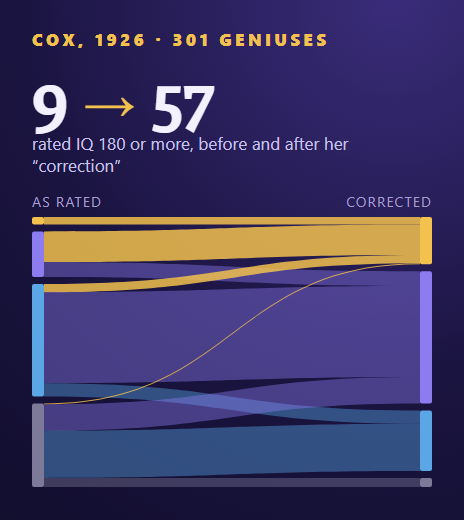
Only 7 people are in both our dataset and Catharine Cox’s 1926 estimates of the IQs of 301 historical geniuses (our full Cox table). Among them, brain weight and estimated IQ do not move together: r = −0.06 for the weight and −0.06 for the gap above the expected weight. Justus von Liebig had the highest estimate of the seven (165) and the lightest brain (1,352 g); Georges Cuvier had both a high estimate and a very heavy brain.
Brain weight against Cox's IQ estimates: no link in 7 people
Across: Catharine Cox's 1926 IQ estimate for ages 17 to 26. Up: % above the average brain for the person's age and sex. Pearson r = −0.06 (95% CI −0.78 to 0.73), n = 7.
% above the average brain for age and sex
Cox (1926) IQ estimate, ages 17-26
Seven points cannot show a weak link; they can only show there is no strong one.
Source: Cox 1926, Tables 12A-12B, via IQ Metrics [6]; brains: Spitzka 1907 [1]; averages: Boyd 1861 [2]
Data table
| person | cox_iq_aii | diff_pct |
|---|---|---|
| Georges Cuvier | 160 | 39.1 |
| William Makepeace Thackeray | 140 | 23.3 |
| Daniel Webster | 150 | 17.7 |
| Thomas Chalmers | 160 | 14.3 |
| Louis Agassiz | 160 | 13.7 |
| George Grote | 140 | 9.3 |
| Justus von Liebig | 165 | 2.8 |
Embed this chart
Paste this HTML into your page: it carries the numbers and the credit link to this figure.
With 7 people the 95% confidence interval runs from −0.78 to 0.73, so this cannot rule out a weak link of the size found in modern studies. It does show that the famous-brains lists, often quoted as proof that genius means a big brain, do not support that claim on their own.
09 When were famous brains weighed, and why?
Weighing the brains of the eminent became a project in the second half of the 19th century. Rudolf Wagner in Göttingen described the brains of Gauss and Dirichlet [5]; Theodor Bischoff listed the brains of Munich professors [4]; in Paris, members of a mutual autopsy society bequeathed their brains for study; at Cornell, Burt Green Wilder kept the brains of local professors and physicians [1]. Our dataset peaks with deaths in the 1890s.
The great age of brain weighing: famous brains by decade of death
People in the dataset by the decade they died, 1820s-1900s (the main sources were compiled in 1907; Einstein, who died in 1955, is left out of this chart).
Source: Spitzka 1907 [1]; dates of death: Wikidata [7]
Data table
| label | value |
|---|---|
| 1820s | 1 |
| 1830s | 2 |
| 1840s | 3 |
| 1850s | 9 |
| 1860s | 11 |
| 1870s | 16 |
| 1880s | 18 |
| 1890s | 26 |
| 1900s | 16 |
Embed this chart
Paste this HTML into your page: it carries the numbers and the credit link to this figure.
10 Every famous brain in the dataset
All 111 famous brains on the reliable list
Sorted by weight; click a column to re-sort. Expected = the average for the person's age and sex in Boyd (1861). Every source figure is in the CSV.
| Ivan Turgenev (1818-1883) | Writers & thinkers | 64 | 2,012 | 1,315 | +53% |
| Joseph Bouny (dates unknown) | Public life | – | 1,935 | – | – |
| Georges Cuvier (1769-1832) | Life & earth science | 62 | 1,830 | 1,315 | +39% |
| Edward H. Knight (1824-1883) | Maths & physics | 58 | 1,814 | 1,345 | +35% |
| Unnamed Freiburg theologian (dates unknown) | Writers & thinkers | 42 | 1,800 | 1,354 | +33% |
| John Abercrombie (1780-1844) | Medicine | 64 | 1,786 | 1,315 | +36% |
| Benjamin F. Butler (1818-1893) | Public life | 74 | 1,758 | 1,290 | +36% |
| Edward Olney (1827-1887) | Maths & physics | 60 | 1,701 | 1,315 | +29% |
| Hermann Levi (1839-1900) | Music, art & stage | 60 | 1,690 | 1,315 | +28% |
| Alexander Winchell (1824-1891) | Life & earth science | 66 | 1,666 | 1,315 | +27% |
| William Makepeace Thackeray (1811-1863) | Writers & thinkers | 52 | 1,658 | 1,345 | +23% |
| Rudolf Lenz (dates unknown) | Music, art & stage | – | 1,636 | – | – |
| John Goodsir (1814-1867) | Life & earth science | 52 | 1,629 | 1,345 | +21% |
| Hosea Curtice (1825-1893) | Maths & physics | 68 | 1,612 | 1,315 | +23% |
| Charles G. Atherton (1804-1853) | Public life | 49 | 1,602 | 1,354 | +18% |
| Siemens (first name not given) (dates unknown) | Maths & physics | 68 | 1,600 | 1,315 | +22% |
| George Brown (1818-1880) | Public life | 61 | 1,596 | 1,315 | +21% |
| Aleko Konstantinov (1863-1897) | Writers & thinkers | 34 | 1,595 | 1,366 | +17% |
| William Pepper (1843-1898) | Medicine | 54 | 1,593 | 1,345 | +18% |
| Robert A. Harrison (1833-1878) | Public life | 45 | 1,590 | 1,354 | +17% |
| Friedrich B. W. von Hermann (1795-1868) | Public life | 72 | 1,590 | 1,290 | +23% |
| Riebeck (unidentified) (dates unknown) | Unknown | 61 | 1,580 | 1,315 | +20% |
| Hans Buchner (1850-1902) | Medicine | 51 | 1,560 | 1,345 | +16% |
| Georg Bittner (dates unknown) | Music, art & stage | 57 | 1,556 | 1,345 | +16% |
| Lavollay (dates unknown) | Public life | – | 1,550 | – | – |
| Edward Drinker Cope (1840-1897) | Life & earth science | 56 | 1,545 | 1,345 | +15% |
| George McKnight (1840-1897) | Medicine | 57 | 1,545 | 1,345 | +15% |
| Harrison Allen (1841-1897) | Life & earth science | 56 | 1,531 | 1,345 | +14% |
| James Young Simpson (1811-1870) | Medicine | 58 | 1,531 | 1,345 | +14% |
| George Francis Train (1829-1904) | Public life | 74 | 1,525 | 1,290 | +18% |
| Taguchi Kazuyoshi (1838-1904) | Life & earth science | 66 | 1,520 | 1,315 | +16% |
| Peter Gustav Lejeune Dirichlet (1805-1859) | Maths & physics | 54 | 1,520 | 1,345 | +13% |
| Charles de Morny (1811-1865) | Public life | 53 | 1,520 | 1,345 | +13% |
| Daniel Webster (1782-1852) | Public life | 70 | 1,518 | 1,290 | +18% |
| John Campbell, 1st Baron Campbell (1779-1861) | Public life | 81 | 1,517 | 1,285 | +18% |
| Chauncey Wright (1830-1875) | Writers & thinkers | 45 | 1,516 | 1,354 | +12% |
| Edward Constant Seguin (1843-1898) | Medicine | 55 | 1,505 | 1,345 | +12% |
| Martin Schleich (1827-1881) | Writers & thinkers | 54 | 1,503 | 1,345 | +12% |
| Thomas Chalmers (1780-1847) | Writers & thinkers | 67 | 1,503 | 1,315 | +14% |
| Garrick Mallery (1831-1894) | Life & earth science | 63 | 1,503 | 1,315 | +14% |
| Napoleon III (1808-1873) | Public life | 64 | 1,500 | 1,315 | +14% |
| Conrad Heinrich Fuchs (1803-1855) | Medicine | 51 | 1,499 | 1,345 | +11% |
| Louis Agassiz (1807-1873) | Life & earth science | 66 | 1,495 | 1,315 | +14% |
| Carlo Giacomini (1840-1898) | Life & earth science | 57 | 1,495 | 1,345 | +11% |
| Augustus De Morgan (1806-1871) | Maths & physics | 64 | 1,494 | 1,315 | +14% |
| Carl Friedrich Gauss (1777-1855) | Maths & physics | 77 | 1,492 | 1,290 | +16% |
| Charles Letourneau (1831-1902) | Life & earth science | 70 | 1,492 | 1,290 | +16% |
| Unnamed Swedish statesman (dates unknown) | Public life | 53 | 1,489 | 1,345 | +11% |
| John Wesley Powell (1834-1902) | Life & earth science | 68 | 1,488 | 1,315 | +13% |
| Karl von Pfeufer (1806-1869) | Medicine | 62 | 1,488 | 1,315 | +13% |
| Wuelfert (first name not given) (dates unknown) | Public life | 63 | 1,485 | 1,315 | +13% |
| Paul Broca (1824-1880) | Life & earth science | 56 | 1,484 | 1,345 | +10% |
| Gabriel de Mortillet (1821-1898) | Life & earth science | 77 | 1,480 | 1,290 | +15% |
| Philip A. Aylett (dates unknown) | Medicine | 58 | 1,474 | 1,345 | +10% |
| Francis Jeffrey, Lord Jeffrey (1773-1850) | Public life | 76 | 1,471 | 1,290 | +14% |
| Louis Asseline (1829-1878) | Writers & thinkers | 49 | 1,468 | 1,354 | +8% |
| Mikhail Skobelev (1843-1882) | Public life | 38 | 1,457 | 1,366 | +7% |
| Christoph Heinrich Ernst Bischoff (1781-1861) | Medicine | 80 | 1,452 | 1,285 | +13% |
| Hugo Gyldén (1841-1896) | Maths & physics | 55 | 1,452 | 1,345 | +8% |
| Franz von Kobell (1803-1882) | Life & earth science | 79 | 1,445 | 1,290 | +12% |
| Géza Mihalkovics (1844-1899) | Life & earth science | 55 | 1,440 | 1,345 | +7% |
| Guillaume Dupuytren (1777-1835) | Medicine | 57 | 1,437 | 1,345 | +7% |
| Per Adam Siljeström (1815-1892) | Maths & physics | 76 | 1,422 | 1,290 | +10% |
| Allen Thorndike Rice (1851-1889) | Writers & thinkers | 37 | 1,418 | 1,366 | +4% |
| James Edward Oliver (1829-1895) | Maths & physics | 65 | 1,418 | 1,315 | +8% |
| Melchior Meyr (1810-1871) | Writers & thinkers | 60 | 1,415 | 1,315 | +8% |
| Philip Leidy (1838-1891) | Medicine | 52 | 1,415 | 1,345 | +5% |
| Johann Nepomuk von Nussbaum (1829-1890) | Medicine | 61 | 1,410 | 1,315 | +7% |
| George Grote (1794-1871) | Writers & thinkers | 76 | 1,410 | 1,290 | +9% |
| Johannes Huber (1830-1879) | Writers & thinkers | 49 | 1,409 | 1,354 | +4% |
| James B. Pond (1838-1903) | Public life | 65 | 1,407 | 1,315 | +7% |
| Charles Babbage (1791-1871) | Maths & physics | 79 | 1,403 | 1,290 | +9% |
| Jules Assézat (1832-1876) | Writers & thinkers | 44 | 1,403 | 1,354 | +4% |
| Carl von Kupffer (1829-1902) | Life & earth science | 73 | 1,400 | 1,290 | +9% |
| Louis-Adolphe Bertillon (1821-1883) | Life & earth science | 61 | 1,398 | 1,315 | +6% |
| Friedrich Goltz (1834-1902) | Life & earth science | 67 | 1,395 | 1,315 | +6% |
| Auguste Coudereau (1832-1882) | Medicine | 50 | 1,390 | 1,345 | +3% |
| William Whewell (1794-1866) | Writers & thinkers | 71 | 1,389 | 1,290 | +8% |
| Isaac Jones Wistar (1827-1905) | Public life | 77 | 1,389 | 1,290 | +8% |
| Henry Wilson (1812-1875) | Public life | 63 | 1,389 | 1,315 | +6% |
| Dezső Szilágyi (1840-1901) | Public life | 61 | 1,380 | 1,315 | +5% |
| Nicolaus Rüdinger (1832-1896) | Life & earth science | 64 | 1,380 | 1,315 | +5% |
| Hermann von Schmid (1815-1880) | Writers & thinkers | 65 | 1,374 | 1,315 | +4% |
| Abel Hovelacque (1843-1896) | Public life | 52 | 1,373 | 1,345 | +2% |
| Theodor Ludwig Wilhelm Bischoff (1807-1882) | Life & earth science | 75 | 1,370 | 1,290 | +6% |
| Chevé (first name not given) (dates unknown) | Unknown | – | 1,365 | – | – |
| Samuel D. Gross (1805-1884) | Medicine | 78 | 1,361 | 1,290 | +6% |
| Karl Friedrich Hermann (1804-1855) | Writers & thinkers | 51 | 1,358 | 1,345 | +1% |
| Justus von Liebig (1803-1873) | Maths & physics | 69 | 1,352 | 1,315 | +3% |
| Schlagintweit (Hermann or Robert) (dates unknown) | Life & earth science | 51 | 1,352 | 1,345 | +1% |
| Jakob Philipp Fallmerayer (1790-1861) | Writers & thinkers | 70 | 1,349 | 1,290 | +5% |
| John Hughes Bennett (1812-1875) | Medicine | 63 | 1,332 | 1,315 | +1% |
| Max von Pettenkofer (1818-1901) | Medicine | 82 | 1,320 | 1,285 | +3% |
| Johann Zeyer (dates unknown) | Music, art & stage | 56 | 1,320 | 1,345 | −2% |
| Senzel (first name not given) (dates unknown) | Music, art & stage | 50 | 1,312 | 1,345 | −2% |
| Josef Jiří Kolár (1812-1896) | Writers & thinkers | 83 | 1,300 | 1,285 | +1% |
| Robert Edmond Grant (1793-1874) | Life & earth science | 80 | 1,290 | 1,285 | 0% |
| Walt Whitman (1819-1892) | Writers & thinkers | 72 | 1,282 | 1,290 | −1% |
| Robert Cory (1844-1900) | Medicine | 56 | 1,276 | 1,345 | −5% |
| José María Guardia (1830-1897) | Writers & thinkers | 67 | 1,272 | 1,315 | −3% |
| Madame Leblais (dates unknown) | Writers & thinkers | – | 1,260 | – | – |
| Édouard Séguin (1812-1880) | Medicine | 68 | 1,257 | 1,315 | −4% |
| Friedrich Tiedemann (1781-1861) | Life & earth science | 79 | 1,254 | 1,290 | −3% |
| Ernst von Lasaulx (1805-1861) | Writers & thinkers | 56 | 1,250 | 1,345 | −7% |
| Marie Bittner (dates unknown) | Music, art & stage | – | 1,250 | – | – |
| Jean-Baptiste Vincent Laborde (1830-1903) | Life & earth science | 72 | 1,234 | 1,290 | −4% |
| Albert Einstein (1879-1955) | Maths & physics | 76 | 1,230 | 1,290 | −5% |
| Ludwig von Buhl (1816-1880) | Medicine | 64 | 1,229 | 1,315 | −7% |
| Johann Friedrich Ludwig Hausmann (1782-1859) | Life & earth science | 77 | 1,226 | 1,290 | −5% |
| Benjamin G. Ferris (1802-1891) | Public life | 89 | 1,225 | 1,285 | −5% |
| Franz Joseph Gall (1758-1828) | Life & earth science | 70 | 1,198 | 1,290 | −7% |
Source: Spitzka 1907 [1] and later reports; expected weights: Boyd 1861 [2]; ages: Wikidata [7]
Kept apart: doubtful reports, brains not weighed fresh, and Spitzka's "died insane" list
| Person | Figures in print (g) | Why kept apart |
|---|---|---|
| Andrew Combe (1797-1847) | 1,616 | Spitzka: could not be verified or not weighed fresh |
| Eduard Lasker (1829-1884) | 1,300 | Figure cited by Lombroso, cannot be verified |
| Emil Harless (1820-1862) | 1,238 | Estimated from the preserved brain |
| Franz Schubert (1797-1828) | 1,420 | No authority for the figure (Spitzka) |
| Friedrich Schiller (1759-1805) | 1,785 | Matiegka (1902) lists 1,785 g with no source; no weighing is on record |
| Hermann von Helmholtz (1821-1894) | 1,420 / 1,440 / 1,508 / 1,700 | Died of a brain haemorrhage; weight includes blood clots |
| Ignaz Döllinger (1770-1841) | 1,207 | Estimated from the preserved brain |
| Jean Maximilien Lamarque (1770-1832) | 1,449 | Probably estimated from the skull, not weighed |
| Johann Spurzheim (1776-1832) | 1,559 / 1,695 | Probably estimated from the skull, not weighed |
| Joseph Leidy (1823-1891) | 1,415 / 1,545 | 45.5 oz or 54.5 oz: a copying error |
| János Vajda (1827-1897) | 1,500 | Spitzka: could not be verified or not weighed fresh |
| Lord Byron (1788-1824) | 1,807 / 1,924 / 2,233 / 2,238 | 6 medicinal pounds, unit unknown; Spitzka put it with doubtful reports |
| Léon Gambetta (1838-1882) | 1,160 / 1,204 / 1,241 / 1,246 / 1,294 / 1,314 | Weighed 25 days after death, after embalming |
| Oliver Cromwell (1599-1658) | 2,231 / 2,233 / 2,238 / 2,330 | 6½ pounds first printed 44 years after his death; Spitzka called it mythical |
| Otto von Bismarck (1815-1898) | 1,710 / 1,807 / 1,867 | No autopsy found (Spitzka 1907): every figure is an estimate from head measurements taken in life |
| Bedřich Smetana (1824-1884) | 1,250 | Died insane (Spitzka’s separate list) |
| Frank Collier (dates unknown) | 1,720 | Died insane (Spitzka’s separate list) |
| Gaetano Donizetti (1797-1848) | 1,391 | Died insane (Spitzka’s separate list) |
| Ludwig II of Bavaria (1845-1886) | 1,349 | Died insane (Spitzka’s separate list) |
| Richard Altmann (1852-1900) | 1,460 | Died insane (Spitzka’s separate list) |
| Robert Schumann (1810-1856) | 1,105 / 1,352 / 1,475 | Died insane (Spitzka’s separate list) |
| Wilhelm Steinitz (1836-1900) | 1,462 | Died insane (Spitzka’s separate list) |
| Anatole France (1844-1924) | 1,017 | Weighed after embalming with a formol-alcohol injection; aged 80½ (the report) |
| Caroline B. Winslow (1822-1896) | 1,266 | Weighed after formalin |
| Sofya Kovalevskaya (1850-1891) | 1,108 / 1,385 | Weighed after four years in alcohol; Retzius estimated the fresh weight |
Source: Spitzka 1907 [1]; Donaldson 1895 [12]; Matiegka 1902 [16]; other sources as listed in the method
Your own reasoning, measured
Brain weight cannot tell you how well you reason. A timed test can: our IQ test places your result against adults, with a percentile.
Take the IQ test11 How we built the dataset
- 01
Start from the most complete list
Edward Anthony Spitzka’s 1907 study in the Transactions of the American Philosophical Society lists 137 notable people with notes on each brain and a table of 127 weights (pages 210-212), split into 108 reliable, 7 who died insane and 12 doubtful [1]. We typed the table from the archive.org scan and rebuilt its rows from the word positions on each page.
- 02
Keep every figure, not one
Where Spitzka’s notes or another source print a different weight for the same brain, we kept each figure with its source and page (309 figures in all). The weight used on this page is the one in Spitzka’s table; later estimates are kept but never used for averages.
- 03
Read the other compilations
We read every brain-weight list we could find from before 1931 in its scanned pages: Wagner 1860 and 1862 [5], Thurnam 1866 [13], Bischoff 1880 [4], Topinard 1885 [14], Donaldson 1895 [12], Retzius 1898 [15], Matiegka 1902 [16] and the 1924 report on Anatole France [17]. A figure the same author prints twice is counted once. Wikipedia’s lists were used only as leads to these sources, never as a source.
- 04
Add later and missing cases
We added Einstein (weighed in 1955) [10] and the women in Spitzka’s notes, and kept legends such as Byron’s and Cromwell’s in a separate list.
- 05
Identify every person
Each person was matched to Wikidata (CC0) for dates of birth and death, by name and checked against the dates in the source [7]. 115 of 136 people matched; the others are unnamed, known only by surname, or have no Wikidata entry, and for them we used the source’s dates. Several of Spitzka’s dates were wrong; the CSV notes each correction.
- 06
Compare with ordinary brains of the same age and sex
Robert Boyd’s 1861 tables give the average brain weight of 2,086 patients of a London infirmary by sex and age band [2]. We converted his ounces to grams and gave each person the average for his or her own band. As a second check we used Handmann’s 1906 Leipzig series [3].
- 07
Match to IQ estimates
We matched people to Cox’s 1926 table by name and dates and computed Pearson’s r with a Fisher 95% confidence interval [6].
Read every number with these in mind
- These are the brains someone chose to weigh and publish. Large brains made news; we cannot know how many light ones went unrecorded.
- The famous men were better fed and probably taller than the poor hospital patients in Boyd’s tables, and body size alone raises brain weight.
- Weighing methods differed: with or without membranes and fluid, minutes or days after death. Spitzka believed all his figures included the membranes.
- Many died old or ill. Age shrinks the brain; illness can swell or shrink it.
- Brain weight is not intelligence. Modern studies of living people find only a modest link between brain size and IQ scores.
- History of bias: 19th-century brain science was used to rank groups of people. This study makes no comparison between races, sexes or nationalities, and sex is used only to pick each person’s own expected weight.
Sources
- American Philosophical Society. Spitzka, E. A. A study of the brains of six eminent scientists and scholars belonging to the American Anthropometric Society. Transactions of the American Philosophical Society, 21(4), 175-308. 1907. archive.org/details/jstor-1005434Public domain (US)
- Royal Society. Boyd, R. Tables of the weights of the human body and internal organs in the sane and insane of both sexes at various ages. Philosophical Transactions of the Royal Society, 151, 241-262 (Table I). 1861. archive.org/details/jstor-108735Public domain (US)
- Archiv für Anatomie und Physiologie. Handmann, E. Über das Hirngewicht des Menschen auf Grund von 1414 im Pathologischen Institut zu Leipzig vorgenommenen Hirnwägungen. Archiv für Anatomie und Physiologie. 1906. archive.org/details/IA41535720_0014Public domain (US)
- Neusser, Bonn. Bischoff, T. L. W. von. Das Hirngewicht des Menschen: eine Studie. 1880. archive.org/details/dashirngewichtd00biscgoogPublic domain (US)
- Dieterich, Göttingen. Wagner, R. Vorstudien zu einer wissenschaftlichen Morphologie und Physiologie des menschlichen Gehirns als Seelenorgan, I (1860) and II (1862). 1860-1862. archive.org/details/vorstudienzueine00wagnPublic domain (US)
- Stanford University Press. Cox, C. M. Genetic Studies of Genius, Vol. II: The Early Mental Traits of Three Hundred Geniuses (Tables 12A-12B, as published by IQ Metrics). 1926. iqmetrics.org/research/iq-of-historical-geniusesPublic domain (US); our transcription CC BY 4.0
- Wikimedia Foundation. Wikidata: items for each person (dates of birth and death, sex, occupation), read 27 October 2026. 2026. www.wikidata.orgCC0 1.0
- Elsevier. Anderson, B. & Harvey, T. Alterations in cortical thickness and neuronal density in the frontal cortex of Albert Einstein. Neuroscience Letters, 210, 161-164. 1996. doi.org/10.1016/0304-3940(96)12693-8Cited for a fact (the brain weight); text not reproduced
- Elsevier. Witelson, S. F., Kigar, D. L. & Harvey, T. The exceptional brain of Albert Einstein. The Lancet, 353, 2149-2153. 1999. doi.org/10.1016/S0140-6736(98)10327-6Cited; text not reproduced
- Oxford University Press. Men, W., Falk, D., Sun, T. et al. The corpus callosum of Albert Einstein's brain: another clue to his high intelligence? Brain, 137(4), e268 (Table 1). 2014. doi.org/10.1093/brain/awt252Cited for facts; text not reproduced
- W. W. Norton. Gould, S. J. The Mismeasure of Man. 1981. archive.org/details/mismeasureofman00goulCited; text not reproduced (in copyright)
- Walter Scott, London. Donaldson, H. H. The Growth of the Brain: A Study of the Nervous System in Relation to Education (Table 26, pp. 127-129). 1895. archive.org/details/growthofbrainstu00donaPublic domain (US)
- Journal of Mental Science. Thurnam, J. On the weight of the brain, and on the circumstances affecting it. Journal of Mental Science, 12 (table of distinguished men, p. 34 of the offprint). 1866. archive.org/details/b22282415Public domain (US)
- Delahaye et Lecrosnier, Paris. Topinard, P. Éléments d'anthropologie générale (pp. 544-546). 1885. archive.org/details/b29289324Public domain (US)
- Stockholm. Retzius, G. Das Gehirn des Astronomen Hugo Gyldén. Biologische Untersuchungen, Neue Folge VIII. 1898. archive.org/details/biologischeunte8retzPublic domain (US)
- Königlich böhmische Gesellschaft der Wissenschaften, Prague. Matiegka, H. Über das Hirngewicht, die Schädelkapacität und die Kopfform, sowie deren Beziehungen zur psychischen Thätigkeit des Menschen (pp. 35-39). 1902. archive.org/details/bub_gb_la0_AQAAMAAJPublic domain (US)
- Imprimerie Arrault, Tours. Guillaume-Louis & Dubreuil-Chambardel, L. Le cerveau d'Anatole France (pamphlet, Tours: Arrault; printed after the 1924 autopsy). 1924-1927. archive.org/details/lecerveaudanatol00guiluoftPublic domain (US): published before 1931
- Elsevier. Pietschnig, J., Penke, L., Wicherts, J. M., Zeiler, M. & Voracek, M. Meta-analysis of associations between human brain volume and intelligence differences: how strong are they and what do they mean? Neuroscience & Biobehavioral Reviews, 57, 411-432. 2015. doi.org/10.1016/j.neubiorev.2015.09.017Cited for one figure; text not reproduced
Version history
- 2026.1027 October 2026First release.
Leon Falkner, Data & Research Analyst. Leon owns the arithmetic on IQ Metrics: the percentile tables, the score converter and the figures in everyone else's drafts. On the research desk Leon pulls the data, builds each index and writes the method. More about Leon.
Questions
How much did Einstein's brain weigh?
1,230 grams. The pathologist Thomas Harvey weighed it after the autopsy in April 1955, when Einstein was 76. That is about 60 g below the average brain of men aged 70 to 80 in Boyd's 1861 tables, and close to the elderly comparison brains of a 2014 study. Scientists have studied its shape, not its size.
Who had the heaviest brain of any famous person?
The Russian novelist Ivan Turgenev, whose brain weighed 2,012 grams at his autopsy in 1883, about 53% above the average for his age. Bigger figures quoted for Lord Byron and Oliver Cromwell are not reliable: Byron's comes from an unclear unit, Cromwell's from a book printed 44 years after his death.
Did geniuses have bigger brains?
Slightly, on average. Of 105 eminent people weighed after death between 1828 and 1955, 87% had brains heavier than the average for their age and sex, by 144 g on average. But many famous minds had average or small brains, Einstein's and Walt Whitman's among them, and size did not track IQ estimates.
Is brain size linked to IQ?
Weakly. Studies of living people's brain scans put the correlation between brain volume and IQ at about 0.24, so size explains only a small share of the differences between people. Among the 7 famous people in our data with both a brain weight and a Cox IQ estimate, there was no link at all (r = −0.06).
How much does an average human brain weigh?
About 1,350 to 1,400 grams for an adult man and 1,200 to 1,250 grams for an adult woman in the hospital series of the 1800s and early 1900s used here (Boyd 1861, Handmann 1906). Brains get lighter with age: in Boyd's tables, people over 80 had brains about 6% (men) and 9% (women) lighter than the heaviest age band.
Share it, cite it, download it
You may reuse everything on this page under CC BY 4.0: in articles, reports, lessons and posts. The one condition is credit to IQ Metrics with a link to this page.
Cite this study
Version 2026.10. Citing the version lets readers find the exact numbers.
Archived copy with a DOI: 10.5281/zenodo.23688443 (report PDF and data on Zenodo).
Falkner, L. (2026). Famous brains weighed: did history's great minds have bigger brains? (Version 2026.10) [Data set]. IQ Metrics Research. https://iqmetrics.org/research/famous-brains-weighed/ (DOI: 10.5281/zenodo.23688443)
Falkner, Leon. "Famous brains weighed: did history's great minds have bigger brains?" IQ Metrics Research, 27 Oct. 2026, iqmetrics.org/research/famous-brains-weighed/. DOI: 10.5281/zenodo.23688443.
Falkner, Leon. "Famous brains weighed: did history's great minds have bigger brains?" IQ Metrics Research. October 27, 2026. https://iqmetrics.org/research/famous-brains-weighed/. DOI: 10.5281/zenodo.23688443.
@misc{iqmetrics2026famousbrainsweighed, author = {Falkner, Leon}, title = {Famous brains weighed: did history's great minds have bigger brains?}, institution = {IQ Metrics}, year = {2026}, version = {2026.10}, doi = {10.5281/zenodo.23688443}, url = {https://iqmetrics.org/research/famous-brains-weighed/} }
Source: Leon Falkner, "Famous brains weighed: did history's great minds have bigger brains?" IQ Metrics Research, version 2026.10, https://iqmetrics.org/research/famous-brains-weighed/ (DOI 10.5281/zenodo.23688443)
Embed the key numbers
Paste this into an article or post. It lists the main numbers and credits the source.
Get the data
One row per person: the brain weight used (Spitzka 1907 where he lists it), every other figure in print with its source, page and kind (weighed, estimated, weighed after preservation, estimated from the skull), age at death, the average brain for that age and sex in Boyd (1861), the gap in grams and per cent, Wikidata QID, and the Cox (1926) IQ estimate where there is one.
| Column | What it holds |
|---|---|
person, wikidata_qid, sex, born, died | Who it is (Wikidata, CC0, where an item exists; otherwise the dates in the source) |
age_at_death, age_source | Age in whole years, from Wikidata dates, else the source |
field | Our six fields, from the source's occupation and Wikidata |
spitzka_list | Reliable (Spitzka's Table I), died insane, doubtful, or not weighed fresh |
brain_g, brain_g_source, brain_g_page | The weight used on the page and where it is printed |
expected_g_boyd1861, boyd_band | Average brain weight for the same sex and age band, Boyd (1861) Table I, ounces converted to grams |
diff_g, diff_pct | brain_g minus the expected weight, in grams and per cent |
reported_min_g, reported_max_g, reported_range_g | Lowest and highest weight in print for the same brain (estimates left out) |
n_figures, all_figures | Every figure in print: grams [source, page, kind] |
cox_iq_aii, cox_iq_corrected_aii | Cox (1926) IQ estimate for ages 17-26 and her corrected figure, where the person is in her table |
note | Identity problems, corrected dates and how the brain was weighed |
For journalists, researchers and teachers
Everything on this page may be quoted, charted and republished with credit. No embargo, no permission needed, no sign-up. If you need a number that is not here, ask.
Summary you can paste
Plain news style. Edit freely; keep the credit.
IQ Metrics Research combined every post-mortem brain weight of an eminent person it could find in public-domain records, 309 figures for 136 people, and compared each brain with the average for the person's age and sex in Robert Boyd's 1861 hospital tables. Of 105 eminent people weighed fresh after death between 1828 and 1955, 91 (87%) had heavier brains than average, by +144 g (+11%) on average. The heaviest was Ivan Turgenev's (2,012 g), the lightest Franz Joseph Gall's (1,198 g); Albert Einstein's (1,230 g) was below average for his age. Among 7 people with Cox (1926) IQ estimates, brain weight showed no link to IQ (r = −0.06). Source: IQ Metrics Research, https://iqmetrics.org/research/famous-brains-weighed/
Angles for a story
- Einstein’s brain was below average weight for his age (heaviest and lightest).
- The heaviest famous brain: Turgenev’s 2,012 g, and why one 1895 author called it a myth (the extremes).
- How scientists “corrected” small famous brains upward, every time (Figure 5).
- Byron, Cromwell and Bismarck: famous brain weights with nothing behind them (records disagree).
- Mathematicians, poets and statesmen: brain weight by field (Figure 4).
Quotes you can use
Attributable as written, with the name and title. For a different angle or a quote on a specific figure, ask through the contact page.
Famous brains were heavier than average, but only by about a tenth, and the spread among them is far wider than that gap. Einstein’s was below average for his age.
Leon Falkner, Data & Research Analyst, IQ Metrics ResearchEvery “correction” of a famous brain we found made it heavier. We publish the weights as recorded and keep the corrections separate.
Leon Falkner, Data & Research Analyst, IQ Metrics ResearchThe old lists are full of conflicts: Byron’s brain is anywhere from 1,807 to 2,238 grams depending on which pound you think the doctor used.
Leon Falkner, Data & Research Analyst, IQ Metrics Research
Files
- CSV of every person, with every printed figure, its source and page (CC BY 4.0)
- Every figure as a print-ready PNG: use the Image button under each figure
- Embed code and data table under every figure
- Share images for social media in three sizes, with the credit line built in
- Citations in APA, MLA, Chicago, BibTeX and plain text
Terms, contact and corrections
Credit: “IQ Metrics Research, Famous Brains Weighed (2026)” with a link to this page. On air or in print, “IQ Metrics” and the page address are enough.
What it measures: brain weights recorded after death, mostly 1830-1905, against ordinary hospital patients of the same era. Please do not describe them as intelligence measurements.
Contact: the research team, through the contact page. Corrections are made on this page with a dated note in the version history.