



Brain Teasers for Adults: Answers and How Often Adults Solve Them
Eight original brain teasers for adults, each with its answer. Then the numbers nobody prints beside them: 17% of 3,428 people got all three Cognitive Reflection puzzles right, and few solve the famous four-card puzzle.


What you need to know
- These eight original brain teasers for adults come with answers and the skill each trains: a number rule, deduction, counting, a cube, worst-case thinking, a clock, a work rate and a probability trap.
- Few people solve the famous ones. In Frederick's 2005 data 17% of 3,428 people got all three Cognitive Reflection puzzles right and 33% got none. Among 2,643 Luxembourg students aged 16 to 18, 14% solved the Wason four-card puzzle and 16% the Linda problem (Bruckmaier and colleagues, 2021).
- The famous teasers are not one ability. Five of them were only weakly related (Cronbach's alpha 0.21), and maths competence predicted solving them best, then intelligence. One brain teaser is not an IQ test.
- We found no study showing that brain teasers raise IQ. Reviews of brain training find gains on the practised task and little carry-over to other tasks.
Good brain teasers for adults have one checkable answer and a tempting wrong one. This page gives eight original puzzles with answers, then the solve rates nobody prints beside them. In Frederick's 2005 data, 17% of 3,428 people answered all three Cognitive Reflection puzzles correctly. A brain teaser trains one skill. It is not an IQ test.
Below: the puzzles in two sets, how often adults solve the famous ones, what research says about brain teasers and IQ, and which skill each puzzle trains. Try every puzzle before you read its answer.
What are good brain teasers for adults, with answers?
Good adult brain teaser puzzles need no special knowledge. They have a single answer, and the first idea that comes to mind is often wrong. We wrote the eight below ourselves and checked each answer twice, once by hand and once with a computer that listed every case. Each answer sits under its puzzle with the skill it trains, so this works as a brain teaser with answers you can check line by line. If you searched for brain teasers for adults with answers, start with puzzle 1 and work down.
Puzzle 1. The numbers go 4, 9, 20, 43, 90. What comes next?
Answer: 185. Each number is double the one before plus a counter: plus 1, plus 2, plus 3, plus 4. The next step adds 5 to 180. Trains: spotting a rule that has two moving parts.
Puzzle 2. One of four people took the office key: Kim, Lee, Max or Nia. Kim says, "Lee took it." Lee says, "Nia took it." Max says, "I did not take it." Nia says, "Lee is lying." Exactly one of the four statements is true. Who took the key?
Answer: Max. Test each suspect in turn. If Kim, Lee or Nia took the key, at least two statements come out true, which breaks the rule. If Max took it, only Nia's statement is true, because Lee is lying. Trains: deduction by trying every case.
Puzzle 3. Five couples meet at a dinner. Everyone shakes hands once with every other guest except their own partner. How many handshakes happen?
Answer: 40. Ten people could form 10 times 9 divided by 2, which is 45 pairs. Remove the 5 couples and 40 handshakes remain. Trains: counting pairs without counting each one twice.
Puzzle 4. A 4 by 4 by 4 cube is painted red on all six faces, then cut into 64 small cubes. How many small cubes have exactly one red face?
Answer: 24. Each face has a 2 by 2 block of centre cubes with one painted side, and 6 faces times 4 cubes gives 24. The rest are 8 corners with three red faces, 24 edge cubes with two and 8 hidden cubes with none. Check: 24 plus 24 plus 8 plus 8 is 64. Trains: picturing a solid and sorting its parts by position.
What is a hard brain teaser for adults?
A hard brain teaser is usually a simple rule hidden inside a hard-looking story. Puzzles 5 to 8 are our harder set. Each has an obvious answer that fails, and each rewards you for stopping to test it.
Puzzle 5. A drawer holds 10 black socks and 10 white socks. The light is off. How many socks must you take out to be sure of a matching pair? And how many to be sure of a matching black pair?
Answer: 3, then 12. With two colours, the third sock must match one of the first two. For a black pair, the worst case is 10 white socks first and then 2 black ones, which makes 12. Trains: planning for the worst case instead of the likely one.
Puzzle 6. Between 3:00 and 4:00 the hour hand and the minute hand of an analogue clock point the same way once. At what time?
Answer: about 3:16 and 22 seconds, which is 16 and 4/11 minutes past 3. The minute hand moves 6 degrees a minute and the hour hand 0.5 degrees. At 3:00 the hour hand is 90 degrees ahead, and the minute hand gains 5.5 degrees a minute, so it catches up after 90 divided by 5.5 minutes. Trains: thinking in relative speed.
Puzzle 7. A tank fills in 6 hours through pipe A and in 3 hours through pipe B. A leak would empty a full tank in 12 hours. With both pipes and the leak working together, how long does an empty tank take to fill?
Answer: 2 hours 24 minutes. Count in tanks per hour. Pipe A adds 1/6, pipe B adds 1/3 and the leak removes 1/12, so the net rate is 5/12 of a tank an hour. One tank takes 12/5 hours, which is 2.4 hours. Trains: adding and subtracting rates.
Puzzle 8. A condition affects 1 person in 100. A screening test flags 90% of people who have it, and it also flags 10% of people who do not. You test positive. About how likely is it that you have the condition?
Answer: about 8%, not 90%. Picture 1,000 people. Ten have the condition and 9 of them test positive. Of the 990 without it, 99 also test positive. So 9 of the 108 positive results are real, which is 8.3%. Trains: using the base rate, the share of people who have the condition before any test.
How often do adults solve the classic brain teasers?
Rarely, and the exact share depends on the puzzle and the group. These are the solve rates we could trace to a paper, each with its group. They are not one ranking, because the groups, tasks and years differ.
- Cognitive Reflection Test, all three correct: 17% of 3,428 people. None correct: 33% (Frederick, 2005)
- Wason four-card puzzle, Wason's first study: 5 of 128 students, about 4% (as described by Bruckmaier and colleagues, 2021)
- Wason four-card puzzle, 2,643 Luxembourg students aged 16 to 18: 14% on the letters-and-numbers version, 29% on a stamps-and-letters version (Bruckmaier and colleagues, 2021)
- Linda problem, same 2,643 students: 16% answered correctly, meaning they did not rank the two-part description as more likely
- Hospital problem on small and large samples, same students: 10%
- Medical-test problem given in percentages, about 880 of those students: 2%
Three notes help you read the list. Frederick's 17% comes from convenience samples, not a population norm, and our guide to the Cognitive Reflection Test has the breakdown by university. The Wason figure for Wason's own study is a second-hand description: his 1968 abstract gives no percentage, so we cite the 2021 paper that reports it. And the Luxembourg students were 16 to 18, not adults, so treat their rows as a guide to how hard these puzzles are for young people who know some maths.
The Monty Hall puzzle is the odd one out. In Herbranson and Schroeder's 2010 experiment, pigeons learned to approach the best strategy of switching, while people, even with extensive training, did not adopt it. Our Monty Hall guide gives the numbers. Another puzzle with a famous claim is Einstein's riddle, where we found no source for the line that only 2% of people can solve it. Our guide to Einstein's riddle traces it.
Do brain teasers make you smarter or raise IQ?
No study we found shows that they do. The nearest evidence comes from reviews of brain training, which find gains on the trained task and little carry-over to other tasks.
Simons and colleagues reviewed the studies cited by brain-training companies in Psychological Science in the Public Interest (2016). They found extensive evidence that training improves the trained task, less for closely related tasks and little for distant ones. Sala and Gobet reached a similar view in Trends in Cognitive Sciences (2019): minimal effects on general cognitive skills. Our guide to whether brain training apps work covers the apps. Our piece on brain teasers for middle schoolers asks the same question about children.
Fewer than 1 in 5 people get all three Cognitive Reflection puzzles right. Missing them says almost nothing about your IQ.
Is a brain teaser an IQ test, and which skill does each one train?
No. An IQ test compares your score with a norm group and reports a rank, and a single brain teaser has no norm group. Solving one tells you nothing about rank. You can see how ranks work with the IQ percentile calculator.
The research on the famous teasers points the same way. Bruckmaier and colleagues gave five such tasks to 2,643 students and found them only weakly related to each other (Cronbach's alpha 0.21), so there was no single ability to see through them. The best predictor of solving them was maths competence, followed by intelligence. The Cognitive Reflection Test sits closest to an ability measure: a 2022 meta-analysis found r = .38 with intelligence across 49 samples, as our CRT guide explains.
Across the eight puzzles above, the skills are rule-finding (1), deduction (2), counting (3), spatial visualisation (4), worst-case thinking (5), relative speed (6), rates (7) and base rates (8). In our judgement, puzzles 1 and 2 lean on fluid reasoning, the ability to solve new problems, and puzzles 3 to 8 lean more on school maths. That matches the finding that maths competence predicted the famous teasers best.
Where would your own score land?
Want a score instead of a puzzle? The IQ Metrics test reports a result on the standard scale, with its percentile.
Find your IQ score now! →For more practice, try the logic puzzles in our brain games, or read why high IQ riddles are not IQ test items. To see a result on the standard IQ scale, take the IQ Metrics test.
Common questions
What are good brain teasers for adults, with answers?
Puzzles with one checkable answer and a tempting wrong one. This page has eight original ones, including a number rule, a key-thief deduction, a cube count and a screening-test probability trap, each with its answer and the skill it trains.
How often do adults solve the classic brain teasers?
Rarely. In Frederick's pooled data 17% of 3,428 people answered all three Cognitive Reflection puzzles correctly and 33% got none. Among 2,643 students aged 16 to 18, 14% solved the Wason four-card puzzle and 16% the Linda problem. The groups differ, so the rates are not one ranking.
Do brain teasers raise IQ?
No study we found shows that they do. Reviews of brain training find that practice improves the practised task, with little transfer to distant tasks. Spatial and other puzzles can make you better at similar puzzles.
Is a brain teaser an IQ test?
No. An IQ test is compared with a norm group and reports a rank. A brain teaser has no norm group. Five famous teasers were only weakly related to each other in a study of 2,643 students, so one puzzle says little about general ability.
Sources for this story
- Frederick S. Cognitive Reflection and Decision Making. Journal of Economic Perspectives 19(4):25-42 (2005), doi 10.1257/089533005775196732 — American Economic Association
- Bruckmaier G, Krauss S, Binder K, Hilbert S, Brunner M. Tversky and Kahneman's cognitive illusions: who can solve them, and why? Frontiers in Psychology 12:584689 (2021), doi 10.3389/fpsyg.2021.584689 — Frontiers
- Wason PC. Reasoning about a rule. Quarterly Journal of Experimental Psychology 20(3):273-281 (1968), doi 10.1080/14640746808400161 — Taylor & Francis
- Herbranson WT, Schroeder J. Are birds smarter than mathematicians? Pigeons perform optimally on a version of the Monty Hall dilemma. Journal of Comparative Psychology 124(1):1-13 (2010), doi 10.1037/a0017703 — American Psychological Association
- Simons DJ and colleagues. Do brain-training programs work? Psychological Science in the Public Interest 17 (2016), doi 10.1177/1529100616661983 — Association for Psychological Science
- Sala G, Gobet F. Cognitive training does not enhance general cognition. Trends in Cognitive Sciences 23 (2019), doi 10.1016/j.tics.2018.10.004 — Cell Press
Corrections: spotted an error? Email corrections@iqmetrics.org and we will update this story and note the change here.
Related stories
All news →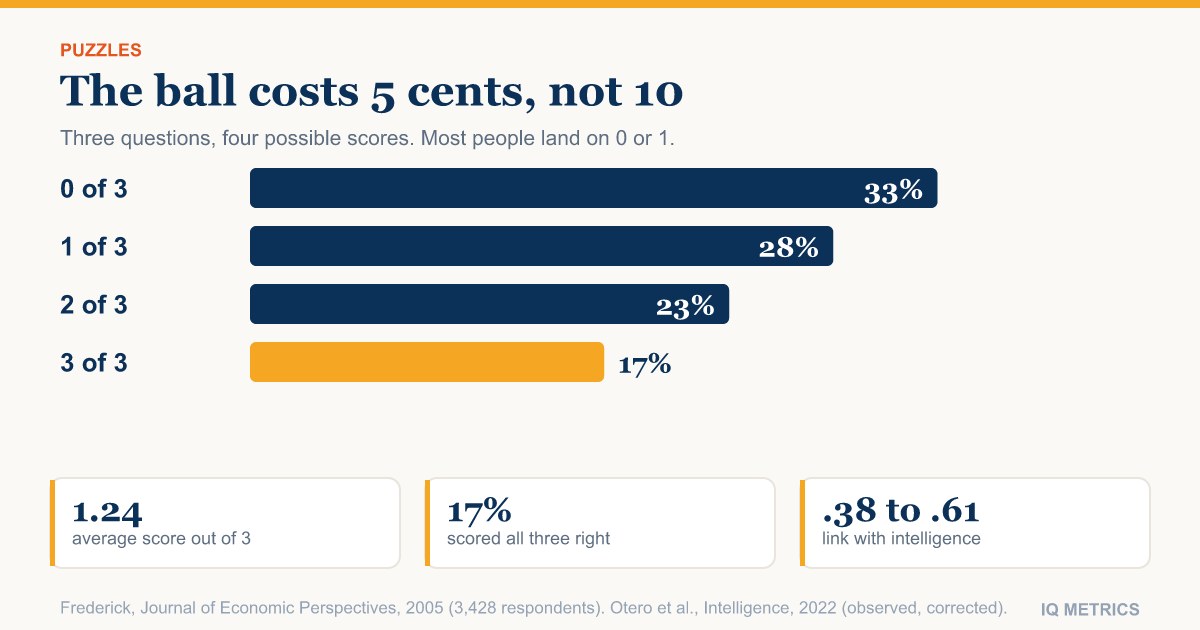
Cognitive Reflection Test: What the Bat-and-Ball Score Says About IQ
Across 3,428 people the three-question Cognitive Reflection Test averaged 1.24 correct, and only 17% got all three. Its link to IQ is moderate, not one-to-one, and the questions are now so well known that familiarity shifts scores.

Monty Hall Problem: Why Switching Wins and What Pigeons Did
Switching doors wins 2 times in 3, and Marilyn vos Savant was right to say so. In a 2010 experiment six pigeons learned to switch 96% of the time within 30 days, while 13 students did not reach the best strategy.

Math Brain Teasers for Adults: Puzzles With Answers and the Skill Each Trains
Nine original math puzzles for adults, each answer checked by script: a 5-cent pen, a 4% price drop, a 40 km/h trip and a 50.73% chance that two of 23 people share a birthday.
Read the research.
Then find your own number.
Our IIF-certified assessment reports your score with its scale, percentile and confidence range — and a breakdown of the cognitive domains behind it.
Start IQ Test →