



Math Brain Teasers for Adults: Puzzles With Answers and the Skill Each Trains
Nine original math puzzles for adults, each answer checked by script: a 5-cent pen, a 4% price drop, a 40 km/h trip and a 50.73% chance that two of 23 people share a birthday.


What you need to know
- Math brain teasers for adults are puzzles solved by arithmetic, algebra, counting or probability. Our nine original puzzles each have an answer checked by script: the pen costs 5 cents, a 20% rise then a 20% fall is a 4% drop, and the trip averages 40 km/h.
- The birthday puzzle, exactly: 23 people give a 50.73% chance of a shared birthday, 57 give 99.01% and 70 give 99.92% (365 equally likely days, our computation).
- Four rolls of a die give at least one six 51.77% of the time. Six rolls give only 66.51%.
- There is no math IQ on the standard scale. In 2,643 students, mathematical competence was the best predictor of solving famous puzzles, ahead of intelligence, and the puzzles were weakly related to each other (Bruckmaier and colleagues, 2021).
Math brain teasers for adults are short puzzles you solve with arithmetic, algebra, counting or probability, not with trivia. Here are nine original ones with answers, each checked by script. The pen in the first puzzle costs 5 cents, not 10. A 20% rise followed by a 20% fall is a 4% drop. And in a room of 23 people, the chance that two share a birthday is 50.73%.
Below: the nine puzzles, why the bat-and-ball puzzle fools so many people, which skill each one trains, and whether a math puzzle says anything about IQ. The nine are new. We did not reuse the puzzles of our guides to brain teasers for adults or brain teasers for middle schoolers.
What are good math brain teasers for adults, with answers?
Good ones have a tempting wrong answer and a short way to check the right one. People search for them as brain teaser maths, math brain teaser questions, mathematics brain teaser questions or brain teaser math puzzles, and all four mean the same thing: a puzzle you can finish on paper. Here are three on arithmetic reasoning. Try each before you read on.
Puzzle 1. A notebook and a pen cost $1.10 together. The notebook costs $1.00 more than the pen. How much does the pen cost?
Answer: 5 cents. Call the pen p. The notebook is p + $1.00, so 2p + $1.00 = $1.10 and p = $0.05. The tempting answer, 10 cents, fails the check: a 10-cent pen means a $1.10 notebook and a $1.20 pair. Check line: 5 + 105 = 110 cents.
Puzzle 2. A jacket costs $100. Its price rises by 20%, then falls by 20%. What does it cost now, and what is the net change?
Answer: $96, a net fall of 4%. A 20% rise takes $100 to $120. A 20% fall then removes $24, not $20, because the second percentage is taken from a bigger base. Check line: 100 x 1.2 x 0.8 = 96.
Puzzle 3. You drive 60 km at 30 km/h, then drive back the same 60 km at 60 km/h. What is your average speed for the whole trip?
Answer: 40 km/h, not 45. The outward leg takes 2 hours and the return takes 1 hour, so 120 km takes 3 hours. The slow leg lasts longer, so it counts for more. Check line: 120 / 3 = 40.
Why do so many people give the wrong answer to the bat-and-ball puzzle?
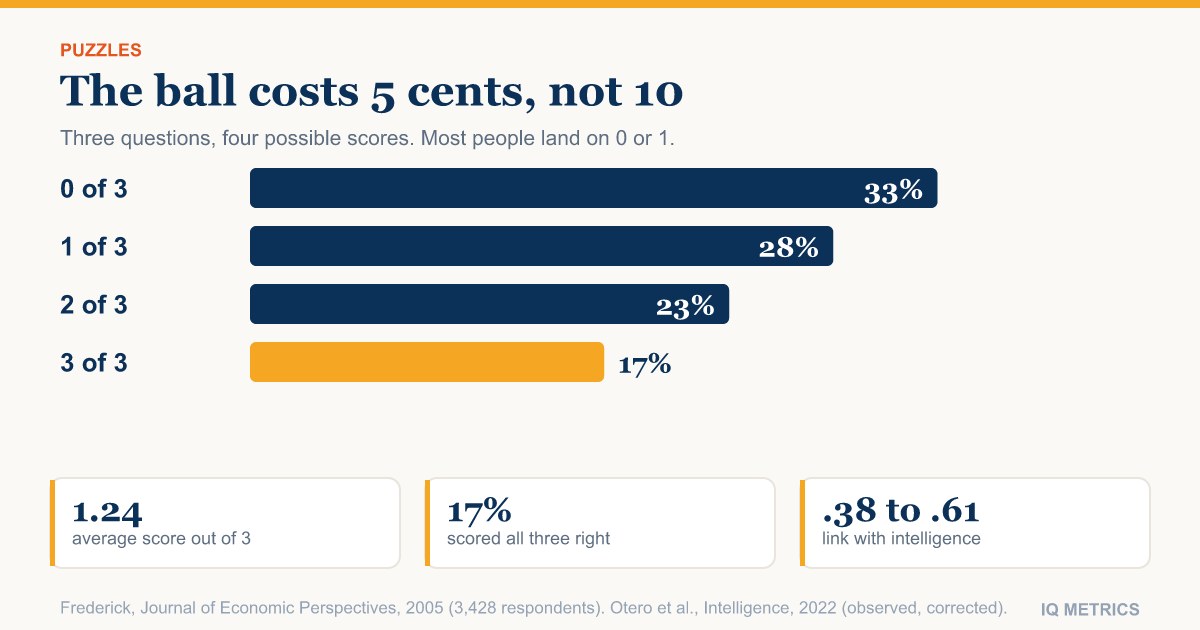
Puzzle 1 is a re-skin of the bat-and-ball item from Shane Frederick's 2005 Cognitive Reflection Test, and the same trap catches many people: 10 cents looks right at a glance. Frederick (Journal of Economic Perspectives, 2005) pooled 3,428 respondents from 35 studies. As our cognitive reflection test guide reports, the mean was 1.24 out of 3, 33% got none right and 17% got all three.
The popular story says fast intuition gives 10 cents and slow thinking corrects it. Bago and De Neys (Thinking and Reasoning, 2019) tested that story, and our guide reports the result. In their first study, final accuracy on the bat-and-ball problem was 24.5%, and 67.2% of the people who finally answered correctly had already given the correct answer at a four-second first response. So for many solvers the right answer is an intuition too. The wrong answer is common, but it is not the only quick one.
Which skill does each math puzzle train?
Each puzzle leans on one skill, and the skills differ. Here are the next two, on number sense, and one on number series.
Puzzle 4. How many zeros does 25! end with? (25! means 25 x 24 x 23 x … x 1.)
Answer: 6. Each zero needs a factor of 10, which is a 2 times a 5. There are plenty of 2s, so count the 5s: the multiples 5, 10, 15, 20 and 25 give five, and 25 holds a second 5. That is six. Check line: 25! = 15,511,210,043,330,985,984,000,000.
Puzzle 5. What is the last digit of 7 to the power 2026?
Answer: 9. The last digits of the powers of 7 repeat every four steps: 7, 9, 3, 1. Dividing 2026 by 4 leaves a remainder of 2, so the last digit matches the second step, 9. Check line: a computer's modular power, 7^2026 mod 10, gives 9.
Puzzle 6. The numbers go 3, 8, 15, 24, 35. What comes next?
Answer: 48. Each term is a square minus one: 4 – 1, 9 – 1, 16 – 1, 25 – 1, 36 – 1. The next is 49 – 1. The gaps 5, 7, 9, 11, 13 grow by 2 each time, a second sign of squares. Our guide to number sequence puzzles shows how to find the rule.
- Puzzles 1 to 3: arithmetic reasoning (algebra, percentages, rates)
- Puzzles 4 and 5: number sense (factors and cycles)
- Puzzle 6: number series
- Puzzles 7 to 9: counting and probability
Why does the birthday puzzle surprise people?
Because people count people, not pairs. Three more puzzles show how counting and probability beat intuition.
Puzzle 7. A PIN has four digits. How many PINs use four different digits, and what share of all 10,000 PINs is that?
Answer: 5,040, which is 50.4%. There are 10 choices for the first digit, 9 for the second, 8 for the third and 7 for the fourth. Check line: 10 x 9 x 8 x 7 = 5,040, and a script that tests every PIN from 0000 to 9999 also finds 5,040.
Puzzle 8. You roll a fair die four times. What is the chance of at least one six? Is it more or less than 50%?
Answer: about 51.77%, a little more than half. The easy route is the chance of no six: 625 of the 1,296 outcomes. That leaves 671 of 1,296 outcomes with at least one six. Six rolls do not make a six certain: they give 66.51%.
Puzzle 9. In a room of 23 people, how likely is it that two share a birthday? Assume 365 equally likely birthdays.
Answer: 50.73%. Work out the chance that all 23 birthdays differ, 365/365 x 364/365 x … x 343/365, which is 49.27%, and subtract it from 100%. With 57 people the chance is 99.01%, and with 70 it is 99.92% (our computation, same assumption). The jump is less strange once you count pairs: 23 people form 253 pairs.
Nine original puzzles, every answer checked by script: 23 people give a 50.73% chance of a shared birthday, and 57 give 99.01%.
Do math puzzles raise IQ, and is there a math IQ?
There is no separate math IQ on the standard scale, and a puzzle score is not an IQ. A search for an IQ math test or a mathematical IQ test usually wants a number-based set of questions. Those exist, and our page on the numerical IQ test describes them. An IQ score places you against other people on a scale where the average is 100, and our IQ percentile calculator converts it to a percentile.
Research on famous puzzles points the same way. Bruckmaier and colleagues (Frontiers in Psychology, 2021) gave the best-known brain teasers to 2,643 Luxembourg students aged 16 to 18. The best predictor of solving them, across all models, was mathematical competence, followed by intelligence. The puzzles were also only weakly related to each other (Cronbach's alpha 0.21), so there is no single "puzzle ability". Whether practice with puzzles raises IQ is covered in our brain teasers for adults guide.
How do I get better at math brain teasers?
Check your first answer, and test it against a simple case. In puzzle 1 the check is one line of addition. In puzzle 3 it is total distance over total time. Writing the unknown as a letter, as in puzzle 1, turns a trap into an equation. For logic and number puzzles you can try yourself, see our logic puzzles, and for the classic probability trap read the Monty Hall problem.
Where would your own score land?
Want to see how you score on the standard scale? The IQ Metrics test reports a result with its percentile.
Find your IQ score now! →For a result on the standard scale rather than a puzzle answer, take the IQ Metrics test.
Common questions
What are good math brain teasers for adults?
Puzzles with a tempting wrong answer and a short check, such as: a notebook and a pen cost $1.10 and the notebook costs $1.00 more (the pen is 5 cents), or a 20% rise followed by a 20% fall (a 4% net drop). Our nine have answers checked by script.
Why do people get the bat-and-ball puzzle wrong?
10 cents looks right at a glance. In Frederick's 2005 data, 33% of 3,428 respondents got none of the three Cognitive Reflection puzzles right. In one 2019 study, 67.2% of the people who ended up correct had already answered correctly at a four-second first response, so intuition is not always the culprit.
Do math puzzles raise IQ?
No study we read shows that practice with puzzles raises IQ. In 2,643 students, mathematical competence was the best predictor of solving famous puzzles, followed by intelligence (Bruckmaier and colleagues, 2021).
Is there a math IQ?
Not on the standard IQ scale, which gives an overall score with an average of 100. Number-based questions measure numeric reasoning, and a puzzle score is not an IQ score.
Sources for this story
- Frederick S. Cognitive reflection and decision making. Journal of Economic Perspectives 19(4):25-42 (2005), doi 10.1257/089533005775196732; 3,428 respondents as reported in our cognitive reflection test guide — American Economic Association
- Bruckmaier G, Krauss S, Binder K, Hilbert S, Brunner M. Tversky and Kahneman's cognitive illusions: who can solve them, and why? Frontiers in Psychology 12:584689 (2021), doi 10.3389/fpsyg.2021.584689; full text read on Europe PMC (PMC8075297) — Frontiers
- Bago B, De Neys W. The smart System 1: evidence for the intuitive nature of correct responding on the bat-and-ball problem. Thinking and Reasoning 25(3):257-299 (2019), doi 10.1080/13546783.2018.1507949; figures as reported in our cognitive reflection test guide — Taylor and Francis
- IQ Metrics computation, 11 November 2026: every puzzle answer checked by brute force and by formula (PIN count, die outcomes, factorial, modular power, birthday probabilities) — IQ Metrics
Corrections: spotted an error? Email corrections@iqmetrics.org and we will update this story and note the change here.
Related stories
All news →
Brain Teasers for Adults: Answers and How Often Adults Solve Them
Eight original brain teasers for adults, each with its answer. Then the numbers nobody prints beside them: 17% of 3,428 people got all three Cognitive Reflection puzzles right, and few solve the famous four-card puzzle.
Cognitive Reflection Test: What the Bat-and-Ball Score Says About IQ
Across 3,428 people the three-question Cognitive Reflection Test averaged 1.24 correct, and only 17% got all three. Its link to IQ is moderate, not one-to-one, and the questions are now so well known that familiarity shifts scores.

Brain Teasers for Middle Schoolers: Answers and What They Train
Ten original brain teasers for grades 5 to 8, with answers and the one skill each trains. Practice makes a child better at puzzles like these. The research we read does not show that it raises IQ.
Read the research.
Then find your own number.
Our IIF-certified assessment reports your score with its scale, percentile and confidence range — and a breakdown of the cognitive domains behind it.
Start IQ Test →