Do school phone bans work? What 10 studies and 13 national rules show
Our dataset joins 13 national school phone rules in 9 countries, each read on the government’s own page, with 10 evaluations of what such rules did to test scores, attention and wellbeing, each graded by a rule written first, plus how many pupils the rules cover.

By Leon Falkner, Data & Research Analyst · Reviewed by Aarav Vardhan, Editor-in-Chief · Published 13 November 2026 · 13 min read
About this study
- Report type
- Data study: our two linked tables of national school phone rules and their evaluations
- Data
- 13 national rules in 9 countries (plus one bill), 10 evaluations, pupils covered from World Bank enrolment
- Sources
- Government pages and gazettes, papers and working papers, NCES, World Bank, OpenAlex; every quote checked by script
- Years
- Rules 2018-2026, evaluations 2016-2026; as of 13 November 2026
- Licence
- CC BY 4.0 (our dataset and charts)
- Version
- 2026.11
- Sources
- 27
On test scores, mostly no: of 10 evaluations of school phone rules in our dataset, 5 measured test scores and only one found a gain whose interval excludes zero (Florida, about 0.016 SD); the largest study, nearly 5,000 US schools with lockable pouches, found -0.003 SD. Phone use in school falls; bullying and absences improve where measured. 9 countries, 13 rules, 2018-2026. IQ Metrics Research.
01 Key findings
- Test-score effects are small. England +0.064 SD (interval includes zero), Florida +0.016 SD (excludes zero), US pouch schools -0.003 SD.Beland 2016, Figlio 2025, Allcott 2026
- Weaker designs show bigger gains. The same Florida ban: 3.5 percentiles before-after, 1.1 against comparison schools.Figlio and Özek 2025, 2026
- Rules are new. 8 of 9 countries started a national rule in 2024 or 2025; France was first in 2018.Government pages
- Phone use and bullying fall where measured; wellbeing mostly does not change. Teachers see better focus far more often than pupils (79% vs 22% in New Zealand).Goodyear 2025, Beneito 2022, ERO 2025
- 54.5 million pupils are enrolled at levels these rules cover in the 9 countries we could source; Brazil is 67% of them. Not a world total.World Bank WDI; IQ Metrics calculation
02 Statistics to quote
countries with a national school phone rule we could source from the government’s own page, 2018-2026 (13 rules).
IQ Metrics ResearchFrance, the first national law in our table (Loi n° 2018-698 of 3 August 2018).
IQ Metrics Researchcountries whose first rule took effect in 2024 or 2025.
IQ Metrics Researchpupils enrolled at the school levels these rules cover in the 9 countries we could source (not a world total; England not counted).
IQ Metrics Researchcountries whose rule covers the whole school day, breaks included (“bell to bell”).
IQ Metrics Researchevaluations that measured test scores.
IQ Metrics Researchtest-score estimates with comparison schools and an interval that excludes zero (Florida).
IQ Metrics Researchaverage test-score effect in the largest, pre-registered US study (gains above 0.007 SD ruled out).
IQ Metrics Researchthe Florida before-after gain (3.5 percentiles) vs the comparison-school estimate (1.1) for the same ban.
IQ Metrics Researchof US public schools prohibited non-academic phone use in 2021-22 (90.9% in 2009-10).
IQ Metrics ResearchNew Zealand secondary teachers vs rule-following pupils who say focus improved (2025).
IQ Metrics Research03 Do school phone bans work?
School phone bans reliably cut phone use in class, but on test scores they show small or no effects: of 10 published evaluations in our dataset, 5 measured test scores and only one, in Florida, found a gain whose 95% interval excludes zero, about 0.016 standard deviations (SD) [3]. The largest study, a pre-registered analysis of US schools that adopted lockable pouches, found an average effect of -0.003 SD and ruled out gains larger than 0.007 SD [5].
What does work, where it was measured, is less phone use and some calmer school days. A cross-sectional study of 30 English secondary schools found 0.67 fewer hours of phone use during school time where recreational use was not allowed, but no difference in wellbeing [6]. Florida schools saw fewer unexcused absences, and a short-term rise in suspensions that began to fade after the first year [3]. Bullying fell in the two Spanish regions that banned phones in 2015 [2].
A rule on paper is not a phone left in a bag. Every coverage number on this page counts pupils enrolled where a rule applies, an upper bound on who is actually without a phone. New Zealand’s Education Review Office found that only about half of secondary pupils follow the national rule consistently [11].
5 of 10 evaluations measured test scores
One square per evaluation in our evidence table, coloured by what it found for test scores: 1 clear gain, 3 gain without a clear interval, 1 no clear effect, 5 did not measure scores (wellbeing, phone use or perceptions only). As of 13 November 2026.
10 evaluationsone square = one evaluation
Source: IQ Metrics evidence table (sources in the reference list)
Data table
| evaluation | group | label | detail |
|---|---|---|---|
| figlio2025 | Test-score gain, interval excludes zero | Figlio and Özek 2025 | Figlio and Özek (United States (Florida), grade B): +0.622 percentiles in year 2 (SE 0.276); spring tests +1.083 (SE 0.451) |
| beland2016 | Gain reported, no interval or interval includes zero | Beland and Murphy 2016 | Beland and Murphy (England, grade B): +6.41% of an SD (SE 0.0373); lowest fifth of prior attainment +0.1423 SD |
| beneito2022 | Gain reported, no interval or interval includes zero | Beneito and Vicente-Chirivella 2022 | Beneito and Vicente-Chirivella (Spain, grade B): Galicia: 0.6-0.8 years of learning in maths |
| figlio-ba | Gain reported, no interval or interval includes zero | Figlio and Özek, before-after view 2026 | Figlio and Özek, before-after view (United States (Florida), grade C): about +3.5 percentiles two years later |
| allcott2026 | No clear effect on test scores | Allcott, Baron, Dee, Duckworth, Gentzkow and Jacob 2026 | Allcott, Baron, Dee, Duckworth, Gentzkow and Jacob (United States (national), grade A): -0.006 school-level SD (SE 0.010), about -0.003 student-level SD |
| goodyear2025 | Test scores not measured | Goodyear et al. (SMART Schools) 2025 | Goodyear et al. (SMART Schools) (England, grade C): wellbeing -0.48 points (95% CI -2.05 to 1.06); phone time in school -0.67 h |
| saffer2026 | Test scores not measured | Saffer 2026 | Saffer (United States (3 states), grade B): no clear evidence of change (preliminary) |
| nl-ocw2024 | Test scores not measured | Ministry of Education (OCW) survey 2024 | Ministry of Education (OCW) survey (Netherlands, grade D): pupils more social and more concentrated (as perceived) |
| nz-ero2025 | Test scores not measured | Education Review Office, Do not disturb 2025 | Education Review Office, Do not disturb (New Zealand, grade D): 79% of secondary teachers say focus improved; 22% of rule-following students say so |
| pt-cpaap2025 | Test scores not measured | Planning and Evaluation Centre study, as reported by the Government 2025 | Planning and Evaluation Centre study, as reported by the Government (Portugal, grade D): a relation between the ban and less bullying (no numbers in the cached release) |
Embed this chart
Paste this HTML into your page: it carries the numbers and the credit link to this figure.
04 Which countries ban phones in schools?
9 countries in our table have a national rule limiting pupils’ phones at school that we could read on the government’s own page: France, England (UK), the Netherlands, Norway, New Zealand, Hungary, Austria, Portugal and Brazil, with 13 rules between them; Sweden has a government bill that would start on 1 August 2026 [24]. France was first, with a law of 3 August 2018 for écoles and collèges [14].
The wider count is larger. The authors of the national US pouch study note that more than half of countries worldwide have enacted legislation limiting student phone access [5]. Our table is smaller on purpose: a country enters only when its ministry, gazette or legislature page is cached and the rule text is checked word for word by script. We checked 16 more countries (China, South Korea, Italy, Greece, Finland, Spain and others) and found news leads but no government page we could read in this version, so they are listed but not counted.
The instruments differ. 7 of the 9 countries use a binding instrument (a law, decree, regulation, statutory guidance or a ministry rule); the Netherlands and Norway rely on a national agreement or recommendation that schools are expected to follow [17] [18]. England moved from non-statutory guidance in February 2024 to statutory guidance from 29 June 2026 [16]; France widened its rule to upper secondary schools from September 2026 [15].
France went first in 2018; 8 of 9 countries followed in 2024-2025
Each lane is one country's national rule, from the date it took effect (or was adopted where no start date is printed) to today, coloured by instrument; a new colour marks a stronger rule. Sweden's bill (in force 1 August 2026 if adopted) is hatched. Only rules whose government page we could cache are shown. As of 13 November 2026.
Source: Government pages and gazettes [14] [15] [16] [17] [18] [19] [20] [21] [22] [23] [24]
Data table
| country | type | from | to | label | detail |
|---|---|---|---|---|---|
| France | span | 2018-08 | 2025-09 | law | |
| France | span | 2025-09 | 2026-09 | ministry rule | |
| France | span | 2026-09 | now | ministry rule | |
| France | event | 2018-08 | Law 2018-698 | France: Loi n° 2018-698 du 3 août 2018 (law), 2018-08; levels P L; whole school day | |
| France | event | 2025-09 | Collèges: phones put away | France: Portable en pause (collèges) (national rule (ministry)), 2025-09; levels L; whole school day | |
| France | event | 2026-09 | Lycées added | France: Interdiction de l’école au lycée (national rule (ministry)), 2026-09; levels P L U; whole school day | |
| Netherlands | span | 2024-01 | 2024-08 | guidance | |
| Netherlands | span | 2024-08 | now | guidance | |
| Netherlands | event | 2024-01 | Secondary | Netherlands: Landelijke afspraak mobiele telefoons (voortgezet onderwijs) (non-statutory national agreement), 2024-01; levels L U; lessons only | |
| Netherlands | event | 2024-08 | Primary | Netherlands: Landelijke afspraak (basisonderwijs, speciaal onderwijs) (non-statutory national agreement), 2024-08; levels P; lessons only | |
| Norway | span | 2024-02 | now | guidance | |
| Norway | event | 2024-02 | Recommendation | Norway: Nasjonal anbefaling (Utdanningsdirektoratet) (non-statutory national guidance), 2024-02; levels P L U; lessons only | |
| England (UK) | span | 2024-02 | 2026-06 | guidance | |
| England (UK) | span | 2026-06 | now | statutory guidance | |
| England (UK) | event | 2024-02 | DfE guidance | United Kingdom (England): Mobile phones in schools (DfE) (non-statutory national guidance), 2024-02; levels P L U; whole school day | |
| England (UK) | event | 2026-06 | Statutory | United Kingdom (England): Mobile phones in schools, revised (DfE) (statutory guidance), 2026-06; levels P L U; whole school day | |
| New Zealand | span | 2024-04 | now | law | |
| New Zealand | event | 2024-04 | Regulation | New Zealand: Education (School Boards) Regulations 2020, reg. 22 (regulation), 2024-04; levels P L U; whole school day | |
| Hungary | span | 2024-09 | now | law | |
| Hungary | event | 2024-09 | Decree 245/2024 | Hungary: Government Decree 245/2024 (VIII. 8.) (decree), 2024-09; levels P L U; whole school day | |
| Brazil | span | 2025-01 | now | law | |
| Brazil | event | 2025-01 | Law 15.100 | Brazil: Lei nº 15.100, de 13 de janeiro de 2025 (law), 2025-01; levels P L U; whole school day | |
| Austria | span | 2025-05 | now | law | |
| Austria | event | 2025-05 | Regulation | Austria: Schulordnung 2024 amendment, BGBl. II Nr. 80/2025 (regulation), 2025-05; levels P L; whole school day | |
| Portugal | span | 2025-07 | now | law | |
| Portugal | event | 2025-07 | Decree-law | Portugal: Decree-law approved by the Council of Ministers, 3 July 2025 (decree-law), 2025-07; levels P; whole school day | |
| Sweden | span | 2026-08 | 2026-11 | proposed | |
| Sweden | event | 2026-08 | Bill | Sweden: Prop. 2025/26:193 (government bill (proposed law)), 2026-08; levels P L; whole school day |
Embed this chart
Paste this HTML into your page: it carries the numbers and the credit link to this figure.
12 of 13 national rules took effect in 2024 or later
National rules taking effect each year, 2016-2026, by instrument (a country can add a second, stronger rule: England in 2024 and 2026, France in 2018, 2025 and 2026). No rule we could source took effect from 2016 to 2017 or 2019 to 2023. As of 13 November 2026.
Source: IQ Metrics policy table (government pages, see Figure 1)
Data table
| year | Law, decree or regulation | Statutory guidance | Ministry rule | Non-statutory guidance or agreement | total |
|---|---|---|---|---|---|
| 2016 | 0 | ||||
| 2017 | 0 | ||||
| 2018 | 1 | 1 | |||
| 2019 | 0 | ||||
| 2020 | 0 | ||||
| 2021 | 0 | ||||
| 2022 | 0 | ||||
| 2023 | 0 | ||||
| 2024 | 2 | 4 | 6 | ||
| 2025 | 3 | 1 | 4 | ||
| 2026 | 1 | 1 | 2 |
Embed this chart
Paste this HTML into your page: it carries the numbers and the credit link to this figure.
05 What is a bell-to-bell phone ban?
A bell-to-bell rule covers the whole school day, breaks and lunch included, not only lessons; 7 of the 9 countries in our table use one. New Zealand’s rule says pupils cannot use or access their phone at school, including during lunch time and breaks [19]; Brazil’s law covers class, recess and the intervals between lessons [23]; Hungary’s decree has phones handed in before lessons [21].
The two lessons-only rules are the Dutch agreement, under which phones are not allowed in the classroom unless a lesson needs them [17], and the Norwegian recommendation, which asks for phones out of classrooms at every level and adds breaks only for primary and lower secondary pupils [18]. Levels covered also differ: Portugal’s decree-law covers pupils up to the 6th year [22], Austria’s regulation runs to the 8th school year [20], and 7 countries now cover primary, lower and upper secondary.
7 of 9 countries now cover primary, lower and upper secondary
Year a national rule first covered each school level (empty = not covered by a national rule we could source). Portugal covers up to the 6th year, Austria up to the 8th; France reached upper secondary (lycée) in 2026. As of 13 November 2026.
Source: IQ Metrics policy table (government pages)
Data table
| country | Primary | Lower secondary | Upper secondary |
|---|---|---|---|
| France | 2018 | 2018 | 2026 |
| Hungary | 2024 | 2024 | 2024 |
| Netherlands | 2024 | 2024 | 2024 |
| New Zealand | 2024 | 2024 | 2024 |
| Norway | 2024 | 2024 | 2024 |
| England (UK) | 2024 | 2024 | 2024 |
| Austria | 2025 | 2025 | |
| Brazil | 2025 | 2025 | 2025 |
| Portugal | 2025 |
Embed this chart
Paste this HTML into your page: it carries the numbers and the credit link to this figure.
06 How many pupils are covered by a national phone rule?
About 54.5 million pupils were enrolled at the school levels covered by the national rules in our table, by our calculation from World Bank enrolment counts (latest year 2023 or 2024) [25]. Brazil alone is 36.6 million, 67% of the total. This is not a world total: it counts only the 9 countries whose rule we could read on a government page, and leaves out England (guidance, no count), China, Italy, South Korea and others still to be sourced.
Three choices keep the number honest. We count only the levels a rule covers (Portugal: primary pupils only). Where a rule covers lower but not upper secondary we count all secondary pupils, because the World Bank series does not split them, and flag the row as an upper bound. England is not counted, because the World Bank publishes UK totals and the rule applies to England only. The total grew from 10.4 million in 2018 (France) to 54.5 million by 2025.
Brazil holds 67% of the 54.5 million pupils under these national rules
Pupils enrolled in the school levels each rule covers (World Bank, latest year 2023 or 2024; Austria and Sweden-style lower-secondary rules count all secondary pupils, an upper bound). England is not counted: the World Bank publishes UK totals only. Enrolment under a rule is not the number of pupils who leave their phone alone. IQ Metrics calculation. As of 13 November 2026.
Source: World Bank WDI SE.PRM.ENRL, SE.SEC.ENRL [25]; IQ Metrics calculation
Data table
| label | value |
|---|---|
| Brazil | 36.6 |
| France | 10.4 |
| Netherlands | 2.8 |
| Hungary | 1.2 |
| Austria | 1.1 |
| New Zealand | 0.9 |
| Norway | 0.9 |
| Portugal | 0.6 |
Embed this chart
Paste this HTML into your page: it carries the numbers and the credit link to this figure.
Pupils under a national rule: 10.4 million in 2018, 54.5 million by 2025
Cumulative pupils (millions) in countries whose first national rule had taken effect by each year, 2016-2026, at the latest enrolment count. Only the 9 countries whose national rule we could source are counted, so this is not a world total; a rule is not enforcement. IQ Metrics calculation. As of 13 November 2026.
Source: World Bank WDI [25]; IQ Metrics policy table and calculation
Data table
| label | value |
|---|---|
| 2016 | 0 |
| 2017 | 0 |
| 2018 | 10.4 |
| 2019 | 10.4 |
| 2020 | 10.4 |
| 2021 | 10.4 |
| 2022 | 10.4 |
| 2023 | 10.4 |
| 2024 | 16.2 |
| 2025 | 54.5 |
| 2026 | 54.5 |
Embed this chart
Paste this HTML into your page: it carries the numbers and the credit link to this figure.
07 How many US schools ban cell phones?
76.1% of US public schools prohibited non-academic use of cell phones or smartphones during school hours in 2021-22, the latest year in the federal Digest of Education Statistics table, down from 90.9% in 2009-10 and up from a low of 65.8% in 2015-16 [26]. These are school rules reported by principals, not state laws.
State laws came later and are not compiled in this version. The authors of the national pouch study note that roughly two-thirds of US states had enacted legislation limiting student phone access as of 2026 [5]; we did not read each legislature’s bill page in time, so the United States has no row in our policy table and no state map. The US evidence, however, is the deepest: two of the three test-score studies with intervals are American [3] [5].
76.1% of US public schools prohibited non-academic phone use in 2021-22
Share of US public schools that prohibited non-academic use of cell phones or smartphones during school hours, by school year: 90.9% in 2009-10, a low of 65.8% in 2015-16, 76.1% in 2021-22 (the latest year in the federal table; the 2013-14 value comes from a different survey mode). A school rule, not a state law. As of 13 November 2026.
Source: NCES Digest of Education Statistics, Table 233.50 [26]
Data table
| label | value |
|---|---|
| 2009-10 | 90.9 |
| 2013-14 | 75.9 |
| 2015-16 | 65.8 |
| 2017-18 | 70.3 |
| 2019-20 | 76.9 |
| 2021-22 | 76.1 |
Embed this chart
Paste this HTML into your page: it carries the numbers and the credit link to this figure.
08 Do phone bans raise test scores?
Phone bans raise test scores by little or nothing in the strongest studies: the three comparison-school estimates with intervals are +0.064 SD in England (interval -0.009 to +0.137), +0.016 SD in Florida (+0.002 to +0.029) and -0.003 SD across US pouch schools (-0.013 to +0.007). Only the Florida interval excludes zero.
The English study, Beland and Murphy, compared schools in four cities that introduced a ban with schools that did not, and reported a gain of 6.41% of an SD in age-16 exam scores, concentrated in the lowest-attaining pupils (0.1423 SD in the lowest group) [1]. Its printed standard error (0.0373) gives an interval that includes zero; the paper marks the estimate as significant at the 10% level. The Spanish study found gains in PISA maths and science in Galicia equal to 0.6 to 0.8 years of learning in maths; its abstract reports the gain for that region and prints no interval [2].
Florida and the national pouch study are the newest. Figlio and Özek found no change in the first year of a district ban and a gain in the second, 0.6 percentiles on all tests and 1.1 on spring tests [3]; we convert percentiles near the middle of the distribution at 0.025 SD each. Allcott and colleagues followed schools for up to three years and found effects close to zero, small positive ones in high-school maths (about 0.024 SD) and small negative ones in middle schools [5]. Two studies (England, Florida) report larger gains for lower attainers or older pupils; one (US national) finds none on average.
How big is 0.016 SD? For a pupil at the middle of the score distribution it is a move of about 0.6 of a percentile point, from the 50th to about the 50.6th; the Allcott study puts its high-school maths effect of 0.024 SD at roughly 0.9 percentile points [5]. For comparison, the same authors cite a one-SD better teacher as worth about 0.14 SD in maths. The upper end of the English interval (0.137 SD) would be a real gain; its lower end is a small loss, so the study cannot separate the two.
Only one of three test-score intervals excludes zero
Effect of a school phone rule on test scores in standard deviations (SD), with 95% intervals computed as estimate +/- 1.96 x the printed standard error. England +0.064 SD, Florida +0.016 SD, US national -0.003 SD. Florida percentiles x 0.025 and the US school-level SD x 0.5 are IQ Metrics conversions. Square size is illustrative (n not comparable across designs). No pooled estimate: three designs in two countries. As of 13 November 2026.
Difference in test scores (SD), schools with a rule minus comparison
Source: Beland & Murphy 2016 [1]; Figlio & Özek 2025 [3]; Allcott et al. 2026 [5]; IQ Metrics conversion
Data table
| study | study | detail | n | estimate | ci_low | ci_high |
|---|---|---|---|---|---|---|
| Test scores (3 studies with an interval) | Beland & Murphy 2016 | Grade B, difference-in-differences, England | 300 | 0.1 | -0 | 0.1 |
| Test scores (3 studies with an interval) | Figlio & Özek 2025 | Grade B, difference-in-differences, United States (Florida) | 230065 | 0 | 0 | 0 |
| Test scores (3 studies with an interval) | Allcott 2026 | Grade A, pre-registered staggered difference-in-differences, United States (national) | 400000 | -0 | -0 | 0 |
Embed this chart
Paste this HTML into your page: it carries the numbers and the credit link to this figure.
Test scores are not IQ
Every number in this study is a school test score, a survey answer or a count of rules. None of the evaluations measured IQ. If you want to see how your own reasoning compares with adults, our IQ test gives a percentile.
Take the IQ test09 Why do some studies find bigger effects than others?
Studies without comparison schools find larger effects: for the same Florida ban, the before-after change of about 3.5 percentiles is 3.2 times the 1.1 percentiles the same authors estimate against comparison schools [4] [3]. A before-after number also picks up whatever changed for every school at once, such as the recovery of scores after the pandemic.
The pattern repeats across the table. The one pre-registered study, graded A, has the smallest estimate (-0.003 SD); the two grade B estimates with an SD have a median of 0.040 SD; the grade C before-after view is 0.088 SD. Perception surveys, graded D, are the most positive of all: they report better concentration but measure no scores. Grades come from a rule written before any row was read (A pre-registered with comparison schools, B comparison schools, C before-after or cross-sectional, D perceptions).
Perception surveys run the other way for a simple reason: they ask the people who introduced or enforce a rule whether it helped. In New Zealand the gap between teachers (79%) and pupils who follow the rule (22%) is 57 percentage points [11]. Neither group is wrong about what it sees, but neither answer is a measured change in learning, which is why surveys get grade D here.
Same Florida ban, two designs: 3.5 percentiles vs 1.1
Test-score change in national percentile points after the same district ban. Before-after, all schools: about 3.5 two years later. Comparison-school design (high vs low pre-ban phone use), spring tests: 1.1; all tests: 0.6. The comparison design strips out what changed for every school at once. As of 13 November 2026.
Source: Figlio & Özek, Education Next 2026 [4] and EdWorkingPaper 2025, Table 3 and Appendix Table 1 [3]
Data table
| label | value |
|---|---|
| Before-after, all schools (grade C) | 3.5 |
| Comparison schools, spring tests (grade B) | 1.1 |
| Comparison schools, all tests (grade B) | 0.6 |
Embed this chart
Paste this HTML into your page: it carries the numbers and the credit link to this figure.
From 12 evaluations found to 1 clear test-score gain
Evaluations of school phone rules we found; those whose text we could read and cache; those that measured test scores; those graded A or B (comparison schools) with an interval; those whose interval excludes zero. As of 13 November 2026.
Source: IQ Metrics evidence table; OpenAlex look-ups [27]
Data table
| stage | count | pct_of_first | pct_of_previous |
|---|---|---|---|
| Evaluations found | 12 | 100 | 100 |
| Text cached and read | 10 | 83.3 | 83.3 |
| Measured test scores | 5 | 41.7 | 50 |
| Grade A or B with an interval | 3 | 25 | 60 |
| Interval excludes zero | 1 | 8.3 | 33.3 |
Embed this chart
Paste this HTML into your page: it carries the numbers and the credit link to this figure.
10 Do phone bans improve attention, bullying or wellbeing?
Teachers say attention improves, pupils mostly do not: in New Zealand 79% of secondary teachers and 83% of secondary leaders said focus on schoolwork improved after the national rule, against 22% of pupils who follow the rule and 9% of those who break it and call it unfair [11]. In the Netherlands, teachers and leaders of nearly 600 secondary schools said pupils were more social and more concentrated in lessons [10]. The national US study found no clear improvement in pupils’ own reports of classroom attention [5].
Wellbeing shows no clear change in two studies and a dip then a recovery in a third. The English SMART Schools comparison found an adjusted wellbeing difference of -0.48 points (95% interval -2.05 to 1.06) [6]; an early study of three US states found no clear change in screen time or wellbeing [7]; the pouch study found wellbeing fell in the first year and turned positive by the third, a pattern its authors read cautiously [5]. Bullying improved in both studies that counted it in person [2] [22]; online bullying did not change [5].
New Zealand: 79% of secondary teachers but 22% of pupils say focus improved
Share who say focus on schoolwork improved after the national rule (Education Review Office survey, 2025): secondary leaders 83%, secondary teachers 79%, pupils who follow the rule 22%, pupils who break it and call it unfair 9%. Perceptions, not test scores. As of 13 November 2026.
Source: Education Review Office, Do not disturb (2025) [11]
Data table
| label | value |
|---|---|
| Secondary school leaders | 83 |
| Secondary teachers | 79 |
| Pupils who follow the rule | 22 |
| Pupils who break it, call it unfair | 9 |
Embed this chart
Paste this HTML into your page: it carries the numbers and the credit link to this figure.
Bullying and absences improve where measured; wellbeing mostly does not change
Other outcomes, one count per evaluation and outcome: better, no difference, worse in the first year then faded or better, worse. Discipline and suspensions rose in year 1 and faded (Florida, US national). Attention "better" comes only from teacher and school-leader surveys (grade D); the one comparison-school study that asked pupils found no clear change. As of 13 November 2026.
Source: IQ Metrics evidence table
Data table
| outcome | Better | No difference | Worse in year 1, then faded or better | Worse |
|---|---|---|---|---|
| Wellbeing | 0 | 2 | 1 | 0 |
| Bullying | 2 | 0 | 0 | 0 |
| Online bullying | 0 | 1 | 0 | 0 |
| Attention | 2 | 2 | 0 | 0 |
| Phone use in school | 1 | 0 | 0 | 0 |
| Absences | 1 | 0 | 0 | 0 |
| Attendance | 0 | 1 | 0 | 0 |
| Discipline | 0 | 0 | 1 | 0 |
| Suspensions | 0 | 0 | 1 | 0 |
| Screen time | 0 | 1 | 0 | 0 |
| Social contact | 1 | 0 | 0 | 0 |
Embed this chart
Paste this HTML into your page: it carries the numbers and the credit link to this figure.
11 Do phones in school lower IQ?
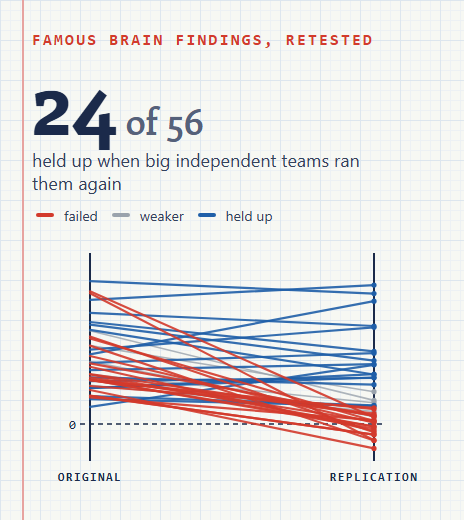
No study in our dataset measured IQ, so none can say that phones lower IQ or that bans raise it; the outcomes are school test scores, attendance, behaviour and survey answers. The best-known lab claim, that a smartphone on the desk drains thinking capacity (Ward and colleagues, 2017, r = 0.16 in 275 people) [12], did not hold in a larger replication (r = 0.02, 383 people) [13]; it is one of the failed rows in our replication scorecard.
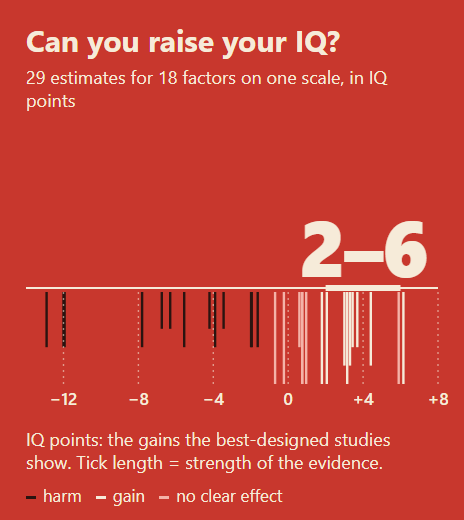
Distraction is still real in the narrower sense the studies measure. The Beland and Murphy result was largest for the lowest-attaining pupils [1], which fits the idea that a phone competes for limited attention. Our attention span check explains why the famous “8 seconds” figure has no source, and our screen-time news report covers eight years of data on screen time and cognitive test scores in children. For what does move IQ scores, see our ledger of factors, where one more year of school is the most consistent gain (see also does school raise IQ?).
Working memory is part of the same story: it holds what a pupil is attending to, and it is linked to maths results (working memory and maths). Offloading memory to devices is a separate question, reviewed in AI and memory. A quick way to feel interference between two streams of information is the Stroop test in our brain games.
12 Should phones be banned in schools? What the evidence can and cannot say
The evidence cannot settle whether phones should be banned, because only 5 evaluations measured test scores and they disagree in size; it does show that rules cut in-school phone use and that the best-designed score effects are small. That is a statement about averages in the schools studied, not advice for any school or family.
Three gaps stand out. First, every comparison-school evaluation of test scores comes from England, the United States or Spain; none of the 8 countries in our policy table that adopted a rule in 2024 or 2025 has a published comparison-school study of test scores yet. Second, rules differ (lessons only or the whole day, a bag or a locked pouch), and no study compares those designs head to head. Third, enforcement is rarely measured: the New Zealand review is the only official source here that reports how many pupils actually follow the rule [11]. A 2024 rapid review reached a similar view of the earlier studies [9]; a Swedish study of 2020 is found but not read here [8].
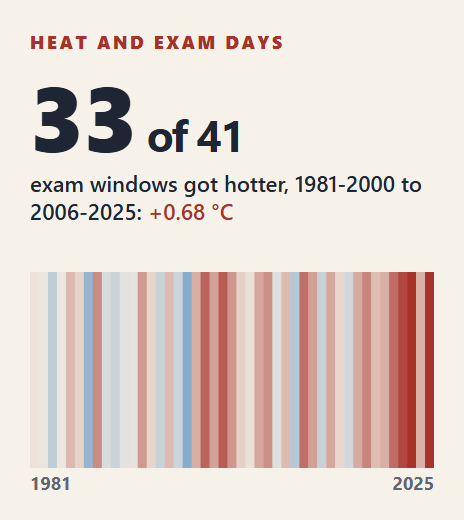
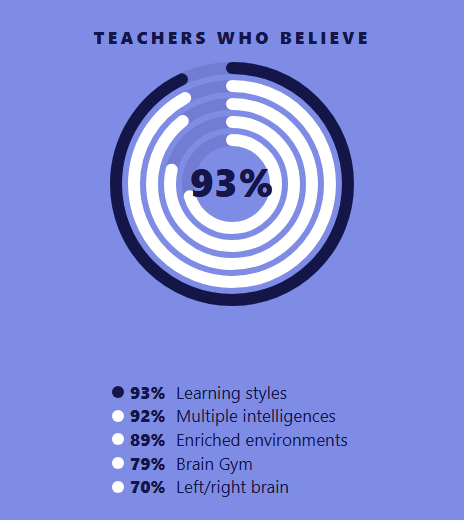
Other conditions in the exam room matter as well: our study of heat and test scores found that most studies with a readable finding report worse thinking or test scores in heat, and neuromyths by country shows how often teachers believe brain claims without evidence. How fast attention moves in the first place is measured in how fast do humans think.
13 How we built the dataset
- 01
Rules first
On 13 November 2026, before reading any row, we wrote the inclusion rule (national rules from a cached government page; evaluations of school rules with a cached text) and the evidence grade rule (A to D by design).
- 02
Cache every source
Every page and paper was downloaded once into the study folder with its sha256 and date; where a government site refused scripted requests we used an Internet Archive byte copy and logged both URLs.
- 03
Check every quote
A script stops the build if any rule quote, effect or standard error printed in our tables is not found word for word in the cached text.
- 04
Convert and count
Effects go to SD only by a stated formula (percentiles x 0.025; school-level x 0.5 as the paper itself does); intervals are estimate +/- 1.96 x the printed SE. 138 automated checks recount every number on this page from the CSV files.
- 05
Coverage
Pupils covered = World Bank primary and secondary enrolment (latest year) for the levels each rule covers; the world total uses the World Bank aggregate of the same series.
- School phone ban
- A rule that pupils may not use (or may not have) a phone during lessons or the school day. We say “ban” only where the text bans; guidance is a “rule”.
- Bell to bell
- A rule covering the whole school day from the first bell to the last, including breaks and lunch, not only lessons.
- Statutory guidance
- Guidance schools must follow by law (England from 29 June 2026). Non-statutory guidance is advice they are expected to follow.
- Standard deviation (SD)
- The usual spread of test scores. An effect of 0.1 SD moves an average pupil from the 50th to about the 54th percentile.
- Difference-in-differences
- A design that compares the change in schools with a rule to the change in similar schools without one over the same years.
- Pre-registered
- The analysis plan was published before the results were known, which limits choosing the most flattering result.
- Pupils covered
- Pupils enrolled at the school levels a rule covers. An upper bound: a rule is not enforcement.
- Evidence grade
- Our A to D label for how strong an evaluation’s design is, set by a rule written before the rows were read.
Read every number with these in mind
- The policy table is a lower bound. It counts 9 countries whose government page we could cache; the US authors note that more than half of countries have legislation [5]. “Not sourced here” never means “no rule”.
- Rules are not enforcement. Pupils covered = pupils enrolled, an upper bound on who is actually without a phone.
- US state laws, Australian states, Canadian provinces and Scotland are out of this version; China, South Korea, Italy, Greece and Finland have news leads but no cached government page.
- Five evaluations measured test scores; three print an interval. Effects in SD use stated conversions (IQ Metrics conversion).
- Two working papers (Florida, US national) are not yet peer reviewed; the Spanish and SMART Schools rows rest on their abstracts.
- Perception surveys (grade D) report what teachers, leaders or pupils believe, not measured change.
- Enrolment counts are the latest World Bank year (2023 or 2024); the world total is the World Bank aggregate.
14 Every rule and every study in the dataset
Every national rule in the dataset (14 rows)
Click a heading to sort. Start = date the rule took effect where the government page prints it, else the date adopted. Pupils = enrolment at the levels covered (World Bank; England not counted). As of 13 November 2026.
| France | law | Loi n° 2018-698 du 3 août 2018 | 2018-08 | primary, lower sec. | whole school day | [14] | |
| Netherlands | non-statutory national agreement | Landelijke afspraak mobiele telefoons (voortgezet onderwijs) | 2024-01 | lower sec., upper sec. | lessons only | [17] | |
| England (UK) | non-statutory national guidance | Mobile phones in schools (DfE) | 2024-02 | primary, lower sec., upper sec. | whole school day | [16] | |
| Norway | non-statutory national guidance | Nasjonal anbefaling (Utdanningsdirektoratet) | 2024-02 | primary, lower sec., upper sec. | lessons only | 903,930 | [18] |
| New Zealand | regulation | Education (School Boards) Regulations 2020, reg. 22 | 2024-04 | primary, lower sec., upper sec. | whole school day | 945,434 | [19] |
| Netherlands | non-statutory national agreement | Landelijke afspraak (basisonderwijs, speciaal onderwijs) | 2024-08 | primary | lessons only | 2,754,015 | [17] |
| Hungary | decree | Government Decree 245/2024 (VIII. 8.) | 2024-09 | primary, lower sec., upper sec. | whole school day | 1,199,959 | [21] |
| Brazil | law | Lei nº 15.100, de 13 de janeiro de 2025 | 2025-01 | primary, lower sec., upper sec. | whole school day | 36,603,585 | [23] |
| Austria | regulation | Schulordnung 2024 amendment, BGBl. II Nr. 80/2025 | 2025-05 | primary, lower sec. | whole school day | 1,075,303 | [20] |
| Portugal | decree-law | Decree-law approved by the Council of Ministers, 3 July 2025 | 2025-07 | primary | whole school day | 598,661 | [22] |
| France | national rule (ministry) | Portable en pause (collèges) | 2025-09 | lower sec. | whole school day | [15] | |
| England (UK) | statutory guidance | Mobile phones in schools, revised (DfE) | 2026-06 | primary, lower sec., upper sec. | whole school day | [16] | |
| Sweden | government bill (proposed law) (proposed) | Prop. 2025/26:193 | 2026-08 | primary, lower sec. | whole school day | [24] | |
| France | national rule (ministry) | Interdiction de l’école au lycée | 2026-09 | primary, lower sec., upper sec. | whole school day | 10,397,760 | [15] |
Source:
Every evaluation in the dataset (10 rows)
Click a heading to sort. Grade by our rule (A pre-registered with comparison schools, B comparison schools, C before-after or cross-sectional, D perceptions). SD = standard deviations of test scores (IQ Metrics conversion where noted). As of 13 November 2026.
| Allcott, Baron, Dee, Duckworth, Gentzkow and Jacob | 2,026 | United States (national) | pre-registered staggered difference-in-differences | A | state test score index (maths and ELA), 3 years | -0.003 | -0.006 school-level SD (SE 0.010), about -0.003 student-level SD | [5] |
| Saffer | 2,026 | United States (3 states) | synthetic difference-in-differences | B | screen time, psychological wellbeing | no clear evidence of change (preliminary) | [7] | |
| Figlio and Özek | 2,025 | United States (Florida) | difference-in-differences | B | state test scores (national percentiles) | +0.016 | +0.622 percentiles in year 2 (SE 0.276); spring tests +1.083 (SE 0.451) | [3] |
| Beneito and Vicente-Chirivella | 2,022 | Spain | synthetic control + difference-in-differences | B | PISA maths and science; bullying | Galicia: 0.6-0.8 years of learning in maths | [2] | |
| Beland and Murphy | 2,016 | England | difference-in-differences | B | age-16 national exam scores | +0.064 | +6.41% of an SD (SE 0.0373); lowest fifth of prior attainment +0.1423 SD | [1] |
| Figlio and Özek, before-after view | 2,026 | United States (Florida) | before-after without comparison | C | state test scores (national percentiles) | +0.088 | about +3.5 percentiles two years later | [4] |
| Goodyear et al. (SMART Schools) | 2,025 | England | cross-sectional comparison | C | mental wellbeing (WEMWBS); phone time | wellbeing -0.48 points (95% CI -2.05 to 1.06); phone time in school -0.67 h | [6] | |
| Education Review Office, Do not disturb | 2,025 | New Zealand | survey of perceptions | D | perceived focus and achievement | 79% of secondary teachers say focus improved; 22% of rule-following students say so | [11] | |
| Planning and Evaluation Centre study, as reported by the Government | 2,025 | Portugal | cross-sectional comparison (as reported) | D | bullying, indiscipline, socialising | a relation between the ban and less bullying (no numbers in the cached release) | [22] | |
| Ministry of Education (OCW) survey | 2,024 | Netherlands | survey of perceptions | D | perceived concentration and social contact | pupils more social and more concentrated (as perceived) | [10] |
Source:
Countries checked but not counted in this version (16)
A news report or official summary points to a rule, or a national rule is absent, but no government page could be cached and read here, so the country is not counted. Not sourced here is not the same as no rule. As of 13 November 2026.
| China | Ministry of Education notice (2021) per news leads; moe.gov.cn page returned 404 and no archive copy |
| South Korea | Elementary and Secondary Education Act amendment passed 27 Aug 2025 per news leads; no government page cached |
| Italy | Ministry circulars 2024 and 16 June 2025 per news leads; mim.gov.it page not cached |
| Greece | Ministry rule from September 2024 per news leads; no ministry page cached |
| Finland | Basic Education Act amendment in force 1 Aug 2025 per news leads; Finlex page renders by script, text not read |
| United Kingdom (Scotland) | Scottish Government guidance 2024 per leads; gov.scot URL returned 404 |
| Spain | January 2024 national agreement per leads; not cached |
| Denmark | national law on phones in schools announced per leads; not cached |
| Ireland | not cached |
| Australia | state rules only per leads (no national rule found) |
| Canada | provincial rules only per leads (no national rule found) |
| United States | no federal rule found; state laws not compiled in this version |
| Japan | not cached |
| Mexico | not cached |
| Turkey | not cached |
| Belgium | community rules per leads; not cached |
Source:
Sources
- Elsevier / LSE Centre for Economic Performance. Beland, L.-P., & Murphy, R. (2016). Ill Communication: Technology, distraction and student performance. Labour Economics, 41, 61-76 (open copy: CEP Discussion Paper 1350). 2016. doi.org/10.1016/j.labeco.2016.04.004Paper paywalled; open discussion-paper copy read by script; facts cited
- Emerald. Beneito, P., & Vicente-Chirivella, Ó. (2022). Banning mobile phones in schools: evidence from regional-level policies in Spain. Applied Economic Analysis, 30(90), 153-175. 2022. doi.org/10.1108/AEA-05-2021-0112CC BY 4.0 (OpenAlex licence field "cc-by"); abstract read
- Annenberg Institute at Brown University. Figlio, D., & Özek, U. (2025). The Impact of Cellphone Bans in Schools on Student Outcomes: Evidence from Florida. EdWorkingPaper 25-1315 (also NBER Working Paper 34388). 2025. doi.org/10.26300/9y5r-yx11Working paper; full text read by script; facts cited
- Education Next. Figlio, D., & Özek, U. (2026). Cellphone bans in Florida schools. Education Next, 26(2). 2026. www.educationnext.org/wp-content/uploads/2026/05/ednext_26_2_research_figlio_ozek.pdfArticle PDF read by script; facts cited
- National Bureau of Economic Research. Allcott, H., Baron, J., Dee, T., Duckworth, A. L., Gentzkow, M., & Jacob, B. (2026). The Effects of School Phone Bans: National Evidence from Lockable Pouches. NBER Working Paper 35132. 2026. www.nber.org/papers/w35132Working paper (author copy, August 2026) read by script; facts cited
- Elsevier. Goodyear, V. A., Randhawa, A., Adab, P., et al. (2025). School phone policies and their association with mental wellbeing, phone use, and social media use (SMART Schools): a cross-sectional observational study. The Lancet Regional Health – Europe, 51, 101211. 2025. doi.org/10.1016/j.lanepe.2025.101211CC BY 4.0 (OpenAlex licence field "cc-by"); abstract read
- National Bureau of Economic Research. Saffer, H. (2026). Youth Mental Health and School Smartphone Bans: Early Evidence. NBER Working Paper 35181. 2026. doi.org/10.3386/w35181Abstract (OpenAlex, CC0) read; facts cited
- Elsevier. Kessel, D., Hardardottir, H. L., & Tyrefors, B. (2020). The impact of banning mobile phones in Swedish secondary schools. Economics of Education Review, 77, 102009. 2020. doi.org/10.1016/j.econedurev.2020.102009Found; no abstract or open text could be read in this version, so no row
- MDPI. Böttger, T., & Zierer, K. (2024). To Ban or Not to Ban? A Rapid Review on the Impact of Smartphone Bans in Schools on Social Well-Being and Academic Performance. Education Sciences, 14(8), 906. 2024. doi.org/10.3390/educsci14080906CC BY 4.0; review used as context only
- Rijksoverheid (Netherlands). Ministerie van Onderwijs, Cultuur en Wetenschap (2024). OCW-onderzoek: leerlingen socialer en geconcentreerder door mobieltjesafspraak (12 July 2024). 2024. www.rijksoverheid.nl/ministeries/ministerie-van-onderwijs-cultuur-en-wetenschap/nieuws/2024/07/12/ocw-onderzoek-leerlingen-socialer-en-geconcentreerder-door-mobieltjesafspraakGovernment page; facts (dates, names, rule text) cited with credit, no table copied
- Education Review Office, New Zealand. Education Review Office (2025). Do not disturb: A review of removing cell phones from New Zealand's classrooms. 2025. evidence.ero.govt.nz/media/y5wbe4r4/do-not-disturb-a-review-of-removing-cell-phones-from-new-zealand-s-classrooms.pdfGovernment page; facts (dates, names, rule text) cited with credit, no table copied
- University of Chicago Press. Ward, A. F., Duke, K., Gneezy, A., & Bos, M. W. (2017). Brain Drain: The Mere Presence of One's Own Smartphone Reduces Available Cognitive Capacity. Journal of the Association for Consumer Research, 2(2), 140-154. 2017. doi.org/10.1086/691462Cited for its published result (facts), as in our replication scorecard
- Elsevier. Ruiz Pardo, A. C., & Minda, J. P. (2022). Reexamining the "brain drain" effect: A replication of Ward et al. (2017). Acta Psychologica, 230, 103717. 2022. doi.org/10.1016/j.actpsy.2022.103717Cited for its published result (facts), as in our replication scorecard
- Légifrance (France). Loi n° 2018-698 du 3 août 2018 relative à l'encadrement de l'utilisation du téléphone portable dans les établissements d'enseignement scolaire (Journal officiel). 2018. www.legifrance.gouv.fr/jorf/id/JORFTEXT000037284333Official gazette; Internet Archive byte copy read (the site refused scripted requests); facts cited
- Ministère de l'Éducation nationale (France). Ministère de l'Éducation nationale: Interdiction du téléphone portable de l'école au lycée et numérique raisonné. 2026. www.education.gouv.fr/interdiction-du-telephone-portable-de-l-ecole-au-lycee-et-numerique-raisonne-455181Government page; facts (dates, names, rule text) cited with credit, no table copied; Internet Archive byte copy read
- GOV.UK (England). Department for Education: Mobile phones in schools (guidance, 19 February 2024; revised January 2026, statutory from 29 June 2026). 2026. www.gov.uk/government/publications/mobile-phones-in-schoolsOpen Government Licence v3.0
- Rijksoverheid (Netherlands). Rijksoverheid: Mobiele apparaten in de klas. 2024. www.rijksoverheid.nl/onderwerpen/voortgezet-onderwijs/mobiele-apparaten-in-de-klasGovernment page; facts (dates, names, rule text) cited with credit, no table copied
- Regjeringen (Norway). Regjeringen: Ny nasjonal anbefaling: Mobilfrie klasserom på alle nivå (7 February 2024). 2024. www.regjeringen.no/no/aktuelt/ny-nasjonal-anbefaling-mobilfrie-klasserom-pa-alle-niva/id3024645Government page; facts (dates, names, rule text) cited with credit, no table copied; Internet Archive byte copy read
- Ministry of Education (New Zealand). Ministry of Education: Using phones at school (Phones away for the day; Education (School Boards) Regulations 2020, reg. 22). 2025. www.education.govt.nz/parents-and-caregivers/schools-year-0-13/digital-technology/using-phones-schoolGovernment page; facts (dates, names, rule text) cited with credit, no table copied
- Bundesministerium für Bildung (Austria). Rundschreiben Nr. 17/2025: Nutzungsverbot für Mobiltelefone und ähnliche Geräte (BGBl. II Nr. 80/2025). 2025. rundschreiben.bmbwf.gv.at/media/rundschreiben_nr._17_2025_aenderung_der_schulordnung_2024_bds.pdfGovernment page; facts (dates, names, rule text) cited with credit, no table copied
- European Commission, Eurydice. Eurydice: Hungary: restrictions on the use of mobile phones in schools (Government Decree 245/2024). 2025. eurydice.eacea.ec.europa.eu/news/hungary-restrictions-use-mobile-phones-schoolsEuropean Commission reuse policy (CC BY 4.0); facts cited
- Governo de Portugal. Governo de Portugal: Proibição de smartphones nas escolas diminui bullying e aumenta socialização dos alunos (8 July 2025). 2025. portugal.gov.pt/gc25/comunicacao/noticias/proibicao-de-smartphones-nas-escolas-diminui-bullying-e-aumenta-socializacao-dos-alunosGovernment page; facts (dates, names, rule text) cited with credit, no table copied
- Planalto (Brazil). Lei nº 15.100, de 13 de janeiro de 2025 (Presidência da República). 2025. www.planalto.gov.br/ccivil_03/_ato2023-2026/2025/lei/L15100.htmBrazilian law text (not subject to copyright); Internet Archive byte copy read (the site showed a robot check)
- Sveriges riksdag (Sweden). Regeringens proposition 2025/26:193 Bättre förutsättningar för trygghet och studiero i skolan (17 March 2026). 2026. data.riksdagen.se/dokument/HD03193.htmlGovernment page; facts (dates, names, rule text) cited with credit, no table copied
- World Bank. World Bank World Development Indicators: SE.PRM.ENRL (primary enrolment) and SE.SEC.ENRL (secondary enrolment), most recent value. 2026. data.worldbank.org/indicator/SE.PRM.ENRLCC BY 4.0 (World Bank open data terms)
- NCES, US Department of Education. National Center for Education Statistics: Digest of Education Statistics 2023, Table 233.50 (public schools with safety and security measures, 1999-2000 to 2021-22). 2024. nces.ed.gov/programs/digest/d23/tables/dt23_233.50.aspUS government work (public domain)
- OurResearch. OpenAlex works API: DOI look-ups for metadata, abstracts and citation counts. 2026. openalex.orgCC0 1.0 (public domain dedication)
Version history
- 2026.1113 November 2026First release. Next update due May 2027: US state laws, China, South Korea, Italy, Greece and Finland from their government pages, and the first comparison-school studies of the 2024-2025 national rules.
Leon Falkner, Data & Research Analyst. Leon owns the arithmetic on IQ Metrics: the percentile tables, the score converter and the figures in everyone else's drafts. On the research desk Leon pulls the data, builds each index and writes the method. More about Leon.
Questions
Do phone bans in schools work?
They cut phone use in class, but test-score effects are small or zero. Of 10 evaluations in the IQ Metrics Research dataset, 5 measured test scores and one, in Florida, found a gain whose interval excludes zero (about 0.016 SD). The largest US study found -0.003 SD.
Which countries ban phones in schools?
In our table, 9 countries have a national rule we could read on a government page: France (first, 2018), England, the Netherlands, Norway, New Zealand, Hungary, Austria, Portugal and Brazil. Sweden has a bill. More than half of countries have some legislation, according to a 2026 study.
How many states ban cell phones in school?
Roughly two-thirds of US states had legislation limiting student phone access as of 2026, according to the authors of the national pouch study. IQ Metrics Research has not yet compiled each state law; 76.1% of US public schools already prohibited non-academic phone use in 2021-22.
Do cell phone bans in schools improve test scores?
Barely. Comparison-school estimates are +0.064 SD in England (interval includes zero), +0.016 SD in Florida (excludes zero) and -0.003 SD across US pouch schools. A before-after view of the Florida ban shows 3.5 percentiles, 3.2 times the comparison-school estimate.
What is a bell to bell phone ban?
A bell-to-bell ban covers the whole school day, breaks and lunch included, not only lessons. In the IQ Metrics Research table, 7 of 9 countries use one, including New Zealand, Brazil and Hungary; the Netherlands and Norway limit phones in lessons.
Should phones be banned in schools?
The evidence cannot decide it alone. Rules reduce phone use in school, and bullying and absences improved where measured, but test-score gains in the best-designed studies are small. Only 5 of 10 evaluations measured scores, so most new national rules are still untested.
Do phone bans improve attention?
Teachers say yes, pupils mostly no. In New Zealand 79% of secondary teachers said focus improved, against 22% of rule-following pupils (ERO 2025). The national US pouch study found no clear change in pupils' own reports of classroom attention.
Do phones lower IQ?
No evaluation of school phone rules measured IQ, so none shows that phones lower IQ or bans raise it. The lab claim that a nearby smartphone drains thinking capacity (r = 0.16) failed a larger replication (r = 0.02), as our replication scorecard records.
How many pupils are covered by school phone bans?
About 54.5 million pupils were enrolled at school levels covered by the national rules in our table (World Bank enrolment, IQ Metrics calculation); Brazil is 67% of them. It is not a world total, because only the 9 countries whose rule we could source are counted, and a rule is not enforcement.
Which country banned phones in schools first?
France, with Loi n° 2018-698 of 3 August 2018, which bans pupils' phones in écoles and collèges; it extended the rule to lycées from September 2026. It is the earliest national rule among the 13 in the IQ Metrics Research table.
Share it, cite it, download it
You may reuse everything on this page under CC BY 4.0: in articles, reports, lessons and posts. The one condition is credit to IQ Metrics with a link to this page.
Cite this study
Version 2026.11. Citing the version lets readers find the exact numbers.
Archived copy with a DOI: 10.5281/zenodo.24213413 (report PDF and data on Zenodo).
Falkner, L. (2026). Do school phone bans work? What 10 studies and 13 national rules show (Version 2026.11) [Data set]. IQ Metrics Research. https://iqmetrics.org/research/do-school-phone-bans-work/ (DOI: 10.5281/zenodo.24213413)
Falkner, Leon. "Do school phone bans work? What 10 studies and 13 national rules show." IQ Metrics Research, 13 Nov. 2026, iqmetrics.org/research/do-school-phone-bans-work/. DOI: 10.5281/zenodo.24213413.
Falkner, Leon. "Do school phone bans work? What 10 studies and 13 national rules show." IQ Metrics Research. November 13, 2026. https://iqmetrics.org/research/do-school-phone-bans-work/. DOI: 10.5281/zenodo.24213413.
@misc{iqmetrics2026doschoolphonebanswork, author = {Falkner, Leon}, title = {Do school phone bans work? What 10 studies and 13 national rules show}, institution = {IQ Metrics}, year = {2026}, version = {2026.11}, doi = {10.5281/zenodo.24213413}, url = {https://iqmetrics.org/research/do-school-phone-bans-work/} }
Source: Leon Falkner, "Do school phone bans work? What 10 studies and 13 national rules show." IQ Metrics Research, version 2026.11, https://iqmetrics.org/research/do-school-phone-bans-work/ (DOI 10.5281/zenodo.24213413)
Embed the key numbers
Paste this into an article or post. It lists the main numbers and credits the source.
Get the data
One row per national rule (14, including one proposed law), per evaluation (10) and per country checked without a cached government page (16). Empty = not printed in the text we could read.
| Column | What it holds |
|---|---|
table, id | rule, study or checked; our row id |
jurisdiction, year | Country (or US state in a later version); year the rule started or the study appeared |
instrument_or_design | Law, decree, regulation, statutory or non-statutory guidance; or the study design |
title_or_study | Rule title as printed, or study authors |
date_adopted, date_in_force | Dates as printed on the government page |
levels, scope | P primary, L lower secondary, U upper secondary; whole school day or lessons only |
status | adopted, proposed, or not sourced in this version |
grade, outcome | Evidence grade A-D; outcome measured |
effect_as_printed, effect_sd, ci_low_sd, ci_high_sd | Effect as printed; in SD with 95% interval (IQ Metrics conversion where noted) |
pupils_covered_wdi | World Bank enrolment at the levels covered (latest year; upper bound) |
source, quote | Source id or DOI/URL, and the sentence from the cached source that holds the fact |
For journalists, researchers and teachers
Everything on this page may be quoted, charted and republished with credit. No embargo, no permission needed, no sign-up. If you need a number that is not here, ask.
Summary you can paste
Plain news style. Edit freely; keep the credit.
IQ Metrics Research built one dataset of 13 national school phone rules in 9 countries (2018-2026, each from a cached government page) and 10 evaluations of what such rules did (2016-2026, each graded A-D by a rule written first), plus pupils covered from World Bank enrolment (54.5 million in those countries; not a world total). 5 evaluations measured test scores; 1 of 3 comparison-school estimates with an interval excludes zero.
Angles for a story
- Five of nine countries started a national rule in 2024 or later; France was first in 2018 (Figure 2)
- Only 5 of 10 evaluations measured test scores, and 1 of 3 comparison-school estimates excludes zero (Figure 10)
- Same Florida ban, two designs: 3.5 percentiles before-after vs 1.1 with comparison schools (Figure 9)
- Teachers vs pupils: 79% of New Zealand secondary teachers say focus improved, 22% of pupils who follow the rule (Figure 11)
- Brazil holds two-thirds of the pupils under the national rules in our table (Figure 5)
- US schools: 76.1% already prohibited non-academic phone use in 2021-22, before most state laws (Figure 7)
Quotes you can use
Attributable as written, with the name and title. For a different angle or a quote on a specific figure, ask through the contact page.
Phone rules do what they say on the tin: phones come out of lessons. What they do to test scores is much smaller than the debate suggests, and in the biggest study it is close to zero.
Leon Falkner, Data & Research Analyst, IQ Metrics ResearchThe same Florida ban looks three times better in a before-after chart than against comparison schools. When a number about phone bans sounds large, ask what it was compared with.
Leon Falkner, Data & Research Analyst, IQ Metrics ResearchMost of the national rules in our table started in 2024 or 2025, and not one of them has a published comparison-school study of test scores yet. The evidence is years behind the rules.
Leon Falkner, Data & Research Analyst, IQ Metrics Research
Files
- CSV of every rule and study in our dataset: jurisdiction, instrument, dates, levels, scope, status, design, grade, outcome, effect as printed and in SD, interval, pupils covered, source and quote (CC BY 4.0)
- Every figure as a print-ready PNG: use the Image button under each figure
- Embed code and data table under every figure
- Share images for social media in three sizes, with the credit line built in
- Citations in APA, MLA, Chicago, BibTeX and plain text
Terms, contact and corrections
Credit: “IQ Metrics Research, Do school phone bans work? (2026)” with a link to this page. On air or in print, “IQ Metrics” and the page address are enough.
What it covers: national rules with a cached government page, and evaluations of school rules with a cached text; no ranking of countries, no advice for schools or families, no IQ claims.
Contact: the research team, through the contact page. Corrections are made on this page with a dated note in the version history.