



What Is the Differential Aptitude Test (DAT)? Subtests, Scores and IQ
The Differential Aptitude Test began in 1947 with eight subtests for grades 7 to 12. Its current version, DAT Next Generation, has five subtests and 15 adaptive items each. Here is what each measures, how scores and stanines work, and why a DAT percentile is not an IQ.


What you need to know
- The differential aptitude test (DAT) was first published in 1947. The classic edition has eight subtests (verbal reasoning, numerical ability, abstract reasoning, perceptual speed and accuracy, mechanical reasoning, space relations, spelling, language usage); the fifth edition was out of print from December 2014 (Buros).
- Pearson TalentLens sells DAT Next Generation: five subtests of 15 adaptive items each, about 12 minutes, untimed and unsupervised, used for recruitment, apprenticeships, career guidance and higher education.
- Scores are percentiles against a chosen norm group, with T-scores, stanines and stens in the technical section. The classic DAT also reported percentile ranks by age and gender. No DAT report we read gives an IQ.
- Our stanine arithmetic: the nine bands hold 4, 7, 12, 17, 20, 17, 12, 7 and 4% of a group, and stanine 3 or 7 is one SD below or above the mean, about 85 or 115 on the IQ scale only if the norm group were the general population.
The Differential Aptitude Test (DAT) is a set of aptitude tests first published in 1947. The classic edition for grades 7 to 12 has eight subtests. Pearson TalentLens now sells DAT Next Generation, a 15-item adaptive version with five. Its reports give percentiles, stanines, T-scores and stens, not an IQ, although the publisher calls the new version a measure of general cognitive ability.
Below: the DAT subtests of both versions, how scores are reported, a stanine table converted to the IQ scale, and the other DAT, the Dental Admission Test.
What is the Differential Aptitude Test and who takes it?
The DAT is a multiple aptitude battery. The classic edition was written to measure how well students in grades 7 to 12, and some adults, can learn or succeed in selected areas, according to the Shirley Ryan AbilityLab database (page last updated in 2015). The authors were Bennett, Seashore and Wesman, and Pearson published it. The Buros test database records that the publisher advised the fifth edition was out of print as of December 2014.
The current product is DAT Next Generation. The publisher says it is used for recruitment, talent identification, apprenticeships, career guidance and higher education. Each subtest has 15 items and takes about 12 minutes. It is untimed and unsupervised, and it uses computerised adaptive testing, where each answer sets the difficulty of the next question. It is offered in English, French, Dutch and Spanish.
What are the DAT subtests?
The classic DAT has eight subtests, and DAT Next Generation has five. These are the DAT subtests of the classic battery, as listed by the AbilityLab database:
- Verbal Reasoning
- Numerical Ability
- Abstract Reasoning
- Perceptual (Clerical) Speed and Accuracy
- Mechanical Reasoning
- Space Relations
- Spelling
- Language Usage
It gives nine scores: one per subtest, plus a Scholastic Aptitude composite built from verbal reasoning and numerical ability. All the subtests are multiple choice except speed and accuracy, and the database says the full battery takes up to three hours.
DAT Next Generation, according to the publisher's own page, measures these five:
- Verbal Analogies: verbal reasoning through the relationships between pairs of words
- Numerical Calculations: addition, subtraction, division, percentages, algebra and multiplication
- Numerical Sequences: problem solving with numbers
- Abstract Reasoning: seeing sequences in shapes and patterns
- Space Relations: visualising two-dimensional shapes in three dimensions
The page is not fully consistent. One sentence names mechanical reasoning among the choices of subtest, but the list of what the test measures has no mechanical subtest. We list the five in that list. For the mechanical kind of question, see our guide to the mechanical aptitude test. Our guides to verbal reasoning tests, numerical reasoning tests and spatial reasoning cover the same kinds of ability, and our aptitude test hub lists the rest.
How are differential aptitude test scores reported?
Differential aptitude test scores come as percentiles against a norm group, with T-scores, stanines and stens as extras. The publisher says the DAT Next Generation profile report shows an overall percentile against the chosen norm group. The T-score, stanine and sten sit in the report's additional technical information. Each person also gets a raw score on an adaptive scale, called theta, which is converted to a standardised score.
The number of questions you answer correctly is of little value, the publisher says, because everyone answers 15 items and the items differ in difficulty. The classic DAT reported percentile ranks by age and gender and stanines with a mean of 5 and a standard deviation (SD) of 2, according to the AbilityLab database.
These are standard scales. A T-score has a mean of 50 and an SD of 10. A sten has ten bands with a mean of 5.5 and an SD of 2. A stanine has nine bands with a mean of 5 and an SD of 2, and our guide to CAT4 scores, stanines and IQ shows the same scale in a school test.
What do DAT stanines mean?
DAT stanines work like this: a stanine cuts the normal curve into nine bands, each half an SD wide. The bands hold 4%, 7%, 12%, 17%, 20%, 17%, 12%, 7% and 4% of the norm group. The table below, our own arithmetic, also gives each band on the IQ scale, where the mean is 100 and the SD is 15:
- Stanine 9: the top 4% of the group (above about the 96th percentile), IQ-scale about 126 and above
- Stanine 8: the next 7% (about the 89th to 96th percentile), IQ-scale about 119 to 126
- Stanine 7: the next 12% (about the 77th to 89th), IQ-scale about 111 to 119
- Stanine 6: the next 17% (about the 60th to 77th), IQ-scale about 104 to 111
- Stanine 5: the middle 20% (about the 40th to 60th), IQ-scale about 96 to 104
- Stanine 4: 17% (about the 23rd to 40th), IQ-scale about 89 to 96
- Stanine 3: 12% (about the 11th to 23rd), IQ-scale about 81 to 89
- Stanine 2: 7% (about the 4th to 11th), IQ-scale about 74 to 81
- Stanine 1: the lowest 4% (below about the 4th percentile), IQ-scale about 74 and below
A stanine of 7 means well above a chosen group, not an IQ of 115.
Read the IQ-scale column with care. It assumes the norm group is the general population. DAT reports compare you with a chosen norm group, such as an age and gender group or an applicant pool, so stanine 7 means well above that group. It does not mean an IQ of about 115. Our IQ percentile calculator shows how a percentile maps to the IQ scale for the general population.
Is the DAT an IQ test?
Is the DAT an IQ test? Not as it is published: no DAT report we read gives an IQ score. The publisher calls DAT Next Generation an intellectual ability test of verbal, numerical, abstract and spatial skills. The word IQ does not appear on its page. Those are the same kinds of reasoning that full IQ batteries sample, but a DAT percentile is a rank within a norm group, not an IQ.
The database page adds a limit of its own: the classic DAT "loses its ability to differentiate" between people in higher education and advanced students. If you want a score on the IQ scale, take a test built for that. At work, general ability tests predict job and training performance in many roles, but how strongly is contested; see our guide to what a cognitive ability test at work predicts.
Is the DAT the Dental Admission Test?
No. The Dental Admission Test, also called the DAT, is an unrelated exam run by the American Dental Association. US dental schools require applicants to take it, its total administration time is five hours and 15 minutes, and the ADA started a new scoring system on 1 March 2025. This page covers only the Differential Aptitude Test.
Where would your own score land?
A DAT report ranks you inside a norm group. For a score on the standard IQ scale with its percentile, take the IQ Metrics test.
Find your IQ score now! →To see how your reasoning compares with other adults, take the IQ Metrics test.
Common questions
What is the Differential Aptitude Test?
A battery of aptitude tests first published in 1947. The classic edition measured students in grades 7 to 12 on eight subtests. Pearson TalentLens now sells DAT Next Generation, an adaptive version with five subtests of 15 items each, used for hiring, apprenticeships and career guidance.
What are the DAT subtests?
The classic DAT has eight: verbal reasoning, numerical ability, abstract reasoning, perceptual speed and accuracy, mechanical reasoning, space relations, spelling and language usage. DAT Next Generation lists five: verbal analogies, numerical calculations, numerical sequences, abstract reasoning and space relations.
How are differential aptitude test scores reported?
As an overall percentile against the chosen norm group, with T-score, stanine and sten in the technical section. The classic DAT reported percentile ranks by age and gender and stanines with a mean of 5 and an SD of 2. The number of correct answers is of little value on the adaptive version.
Is the DAT an IQ test?
Not as published. No DAT report we read gives an IQ score, and the publisher's page does not use the word IQ. It tests verbal, numerical, abstract and spatial reasoning, but a DAT percentile is a rank within a norm group. A stanine of 7 means well above that group, not an IQ of 115.
Sources for this story
- Pearson TalentLens, DAT Next Generation product page (subtests, format, reports and FAQ), read in a browser on 14 November 2026 — Pearson TalentLens
- Buros Online Shop: Differential Aptitude Tests, Fifth Edition (Bennett, Seashore, Wesman; 1947-1992; out of print as of December 2014 per the publisher), read 14 November 2026 — Buros Center for Testing, University of Nebraska-Lincoln
- RehabMeasures database: Differential Aptitude Test (eight scales, grades 7-12, percentiles by age and gender and stanines; page last updated 3 September 2015), read 14 November 2026 — Shirley Ryan AbilityLab
- Dental Admission Test (DAT), program page (five hours 15 minutes; new scoring from 1 March 2025), read 14 November 2026 — American Dental Association
- IQ Metrics computation, 14 November 2026: stanine band shares and IQ-scale bands from the normal curve (mean 100, SD 15) — IQ Metrics
Corrections: spotted an error? Email corrections@iqmetrics.org and we will update this story and note the change here.
Related stories
All news →
Mechanical Aptitude Test: What It Measures, How Long It Takes, What Scores Mean
The Bennett BMCT-II has 55 items in 25 minutes and the ASVAB's mechanical subtest 15 scored items in 22. None of the publisher pages we read gives a pass mark, and none reports an IQ.
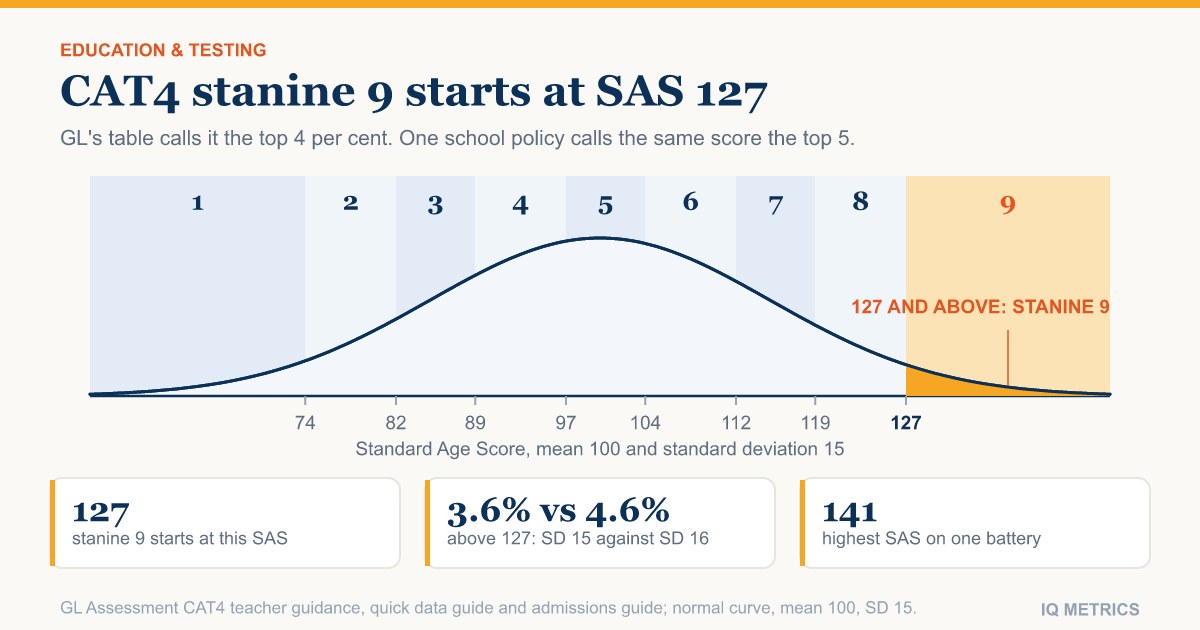
CAT4 Scores Explained: SAS, Stanines, Good Scores and the 141 Cap
GL Assessment prints CAT4 results as a Standard Age Score with an average of 100 and a standard deviation of 15, from 59 to 141, then folds them into stanines. Its own table starts the top 4 per cent at 127, and schools use their own gifted and talented lines, from stanine 8 to a SAS of 130.

UCAT Situational Judgement Test: Bands 1-4, Scoring and Whether It Measures IQ
The UCAT situational judgement test is 69 questions in 26 minutes, scored outside the 900-2700 total as a band from 1 to 4. UCAT's own reports show how bands are set and how closely the test tracks the cognitive subtests.
Read the research.
Then find your own number.
Our IIF-certified assessment reports your score with its scale, percentile and confidence range — and a breakdown of the cognitive domains behind it.
Start IQ Test →