





Spatial Reasoning: What Spatial Intelligence Is, Examples and How to Improve It
Spatial reasoning is the skill of picturing and turning shapes in your mind. What it means, everyday examples, how the Wechsler IQ tests measure it with Block Design and Visual Puzzles, why it predicts careers in science and engineering, and why 217 training studies say you can improve it.

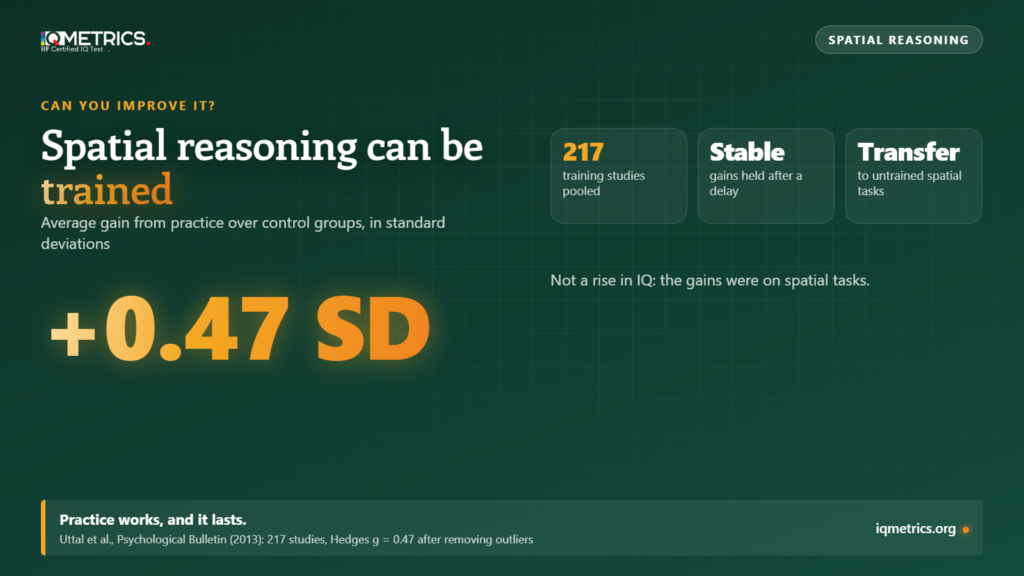
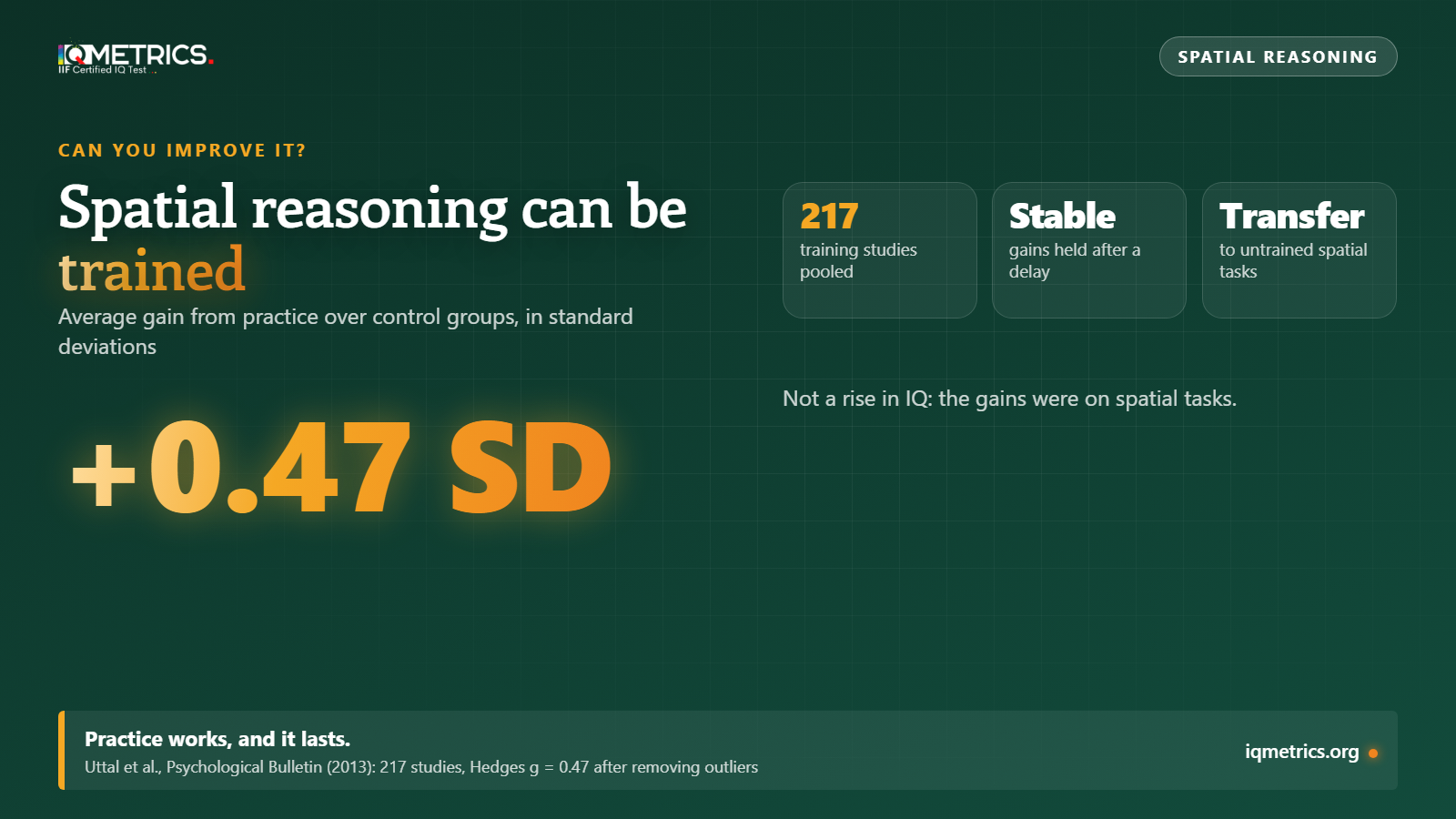
Spatial reasoning is the ability to picture shapes and spaces in your mind and work with them: turn an object around, fold a flat pattern into a box, read a map or pack a suitcase. Psychologists also call it spatial ability or spatial intelligence. It is not fixed. A review of 217 training studies found that practice raised spatial skills by about half a standard deviation, and the gains lasted.
Below: what spatial reasoning means, everyday examples, how IQ tests measure it, why it matters for science and engineering, and what improves it.
What is spatial reasoning?
Spatial reasoning is thinking with shapes and positions instead of words or numbers. One open-access review defines spatial ability as “the ability to understand the relationships among different positions in space or imagined movements of two- and three-dimensional objects.”
Researchers often split it into three kinds, a grouping that goes back to a 1985 review by Marcia Linn and Anne Petersen:
- Spatial perception: judging where things are and which way is upright, even when the surroundings mislead you.
- Mental rotation: turning a shape in your head to see whether it matches another one.
- Spatial visualization: several steps in a row, such as imagining a sheet of paper folded, punched and opened again.
So when people ask what spatial reasoning means, the short answer is this: it is the part of intelligence you use when the problem is a picture.
What is spatial intelligence?
In everyday use, the same skill. Howard Gardner listed spatial intelligence among his multiple intelligences, which Harvard’s Project Zero sums up as “an ability to recognize and manipulate large-scale and fine-grained spatial images.” Gardner adds that it does not depend on sight: “one can be spatially skilled even when one is blind.”
Search for spatial intelligence today and you will also find pages about AI. There the phrase means AI models that perceive and build 3D worlds, the work of companies such as World Labs, which Fei-Fei Li co-founded. That is a different subject from the human skill in this article.
What are examples of spatial reasoning?
You use it many times a day without noticing. A few spatial intelligence examples:
- Packing a suitcase or a car so everything fits.
- Building flat-pack furniture from a diagram with no words.
- Turning a map in your head so it matches the street you are on.
- Parking, or judging whether a sofa will fit through a door.
- Fitting a falling block into a gap in a puzzle game.
- Reading a technical drawing, an X-ray or a floor plan.
The first two come from a 2019 Emory University press release, in which the researcher Jillian Lauer used them to explain mental rotation.
How do IQ tests measure spatial reasoning?
With puzzles you solve by looking and arranging, not by talking. The Wechsler scales, the most widely used IQ tests, report a separate visual spatial score. In the WISC-V for children and the WAIS-5 for adults (2024), it comes from two subtests:
| Subtest | What you do |
|---|---|
| Block Design | Look at a model or picture and rebuild the design with two-colored blocks, against the clock |
| Visual Puzzles | Look at a completed puzzle and choose the three pieces that together would rebuild it |
Our guide to WAIS-5 index scores explains how this score sits beside the others. A short, non-clinical way to check your own level is our spatial reasoning test.
What is a mental rotation test?
It is the classic laboratory measure. In 1971 Roger Shepard and Jacqueline Metzler showed people pairs of drawings of 3D shapes and timed how long they took to say whether the two were the same shape. The time was “a linearly increasing function” of the angle between them: the further a shape had to turn, the longer people took, as if they were turning it in their heads.
In 1978 Steven Vandenberg and Allan Kuse turned those figures into a paper-and-pencil test, the Mental Rotations Test. It proved reliable, and it correlated strongly with other spatial tests and hardly at all with verbal ones. Our article on paper folding and mental rotation questions shows how such items are built.
Where would your own score land?
Take the IIF-certified assessment and get your score with the scale it was measured on, the percentile it corresponds to and the confidence range around it — the three figures most online tests leave out.
Find your IQ score now! →Why does spatial reasoning matter?
It helps predict who goes into science and engineering. Jonathan Wai, David Lubinski and Camilla Benbow studied a stratified random sample of about 400,000 US high-school students. Their conclusion was that “spatial ability plays a critical role in developing expertise in STEM”.
They also argued that talent searches that test only maths and verbal skills miss many teenagers with real potential for science, technology, engineering and maths. Spatial skill is easy to overlook because school reports rarely measure it.
Can you improve spatial reasoning?
Yes, and this is the best-supported finding in the field. David Uttal and colleagues pooled 217 training studies in 2013. After removing outliers, training beat control conditions by an average of g = 0.47, roughly half a standard deviation. “Training effects were stable,” they wrote, and they “transferred to other spatial tasks that were not directly trained.”
Read that carefully. The review found transfer to other spatial tasks. It did not show that spatial training raises IQ scores or school grades.
Action video games help a little. In a 2007 study by Feng, Spence and Pratt, 10 hours of an action game produced “substantial gains” in mental rotation, with women gaining more than men, while a non-action game produced none. A 2018 meta-analysis by Bediou and colleagues put the average effect in training studies at about a third of a standard deviation (g = 0.34), and warned that published studies overstate it.
How to improve spatial reasoning as an adult
- Do rotation and assembly puzzles: 3D puzzles, tangrams and block-fitting games.
- Build things from diagrams, such as model kits or flat-pack furniture, before reading any text.
- Sketch an object from two or three angles, then check it against the real thing.
- Find your way with a paper map, or turn off turn-by-turn directions on familiar trips.
- Practise timed spatial items, then review the ones you missed.
These follow the kinds of practice the training studies used. Expect gains on spatial tasks like the ones you practise, not a jump in overall IQ.
Which jobs use spatial reasoning?
Any job where you work from drawings, maps or 3D objects. Architects and engineers turn plans into buildings and machines. Surgeons and dentists picture structures they cannot fully see. Pilots, drivers and air traffic controllers track objects moving in space. Designers, carpenters, electricians and mechanics read technical drawings and fit parts together.
That is one reason employers and schools sometimes add a spatial section to an aptitude test, next to verbal and numerical ones. If a job description mentions diagrams, layouts or assembly, expect spatial items.
Are there sex differences in spatial reasoning?
On average, on one kind of task. Linn and Petersen found that “large sex differences are found only on measures of mental rotation”, with smaller ones on spatial perception. A 2019 review by Lauer, Yhang and Lourenco of 303 effect sizes from 30,613 children found a small male advantage in mental rotation in childhood that grew to a moderate size in adolescence, and found that the size depends on the task.
These are group averages with wide overlap. They say nothing about any one person, and the training studies above show the skill moves with practice.
How does spatial reasoning fit with other abilities?
It is one of several abilities an IQ test samples, next to verbal, numerical and logical reasoning. Our guides to verbal and non-verbal IQ scores and to the logical reasoning test explain the non-verbal side, and our sibling article on the numerical reasoning test covers the job-test version of number skills. Tests built to reduce language and culture, such as our culture-fair IQ test, lean heavily on spatial and pattern items.
If you want to see where your overall reasoning sits on the standard IQ scale, take the IQ test.
Keep reading
All articles →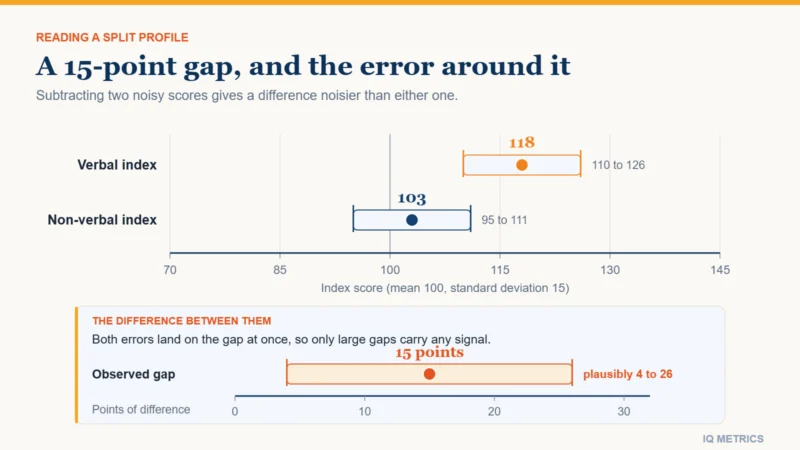 Scores & Scales
Verbal vs Non-Verbal IQ Scores
Two people can hold the same IQ number and have completely different profiles, and a split between the verbal and non-verbal indexes is far commoner than most test-takers expect. Here is what base-rate tables and compounding measurement error say about how large a gap has to be before it means anything.
 Taking a Test
What Are The Type of Questions Asked On IQ Test?
IQ tests ask a small set of question types: pattern and matrix reasoning, verbal reasoning, number series, spatial puzzles, working memory and speed tasks. See what each looks like, how many questions a test has and which tests are multiple choice.
 Taking a Test
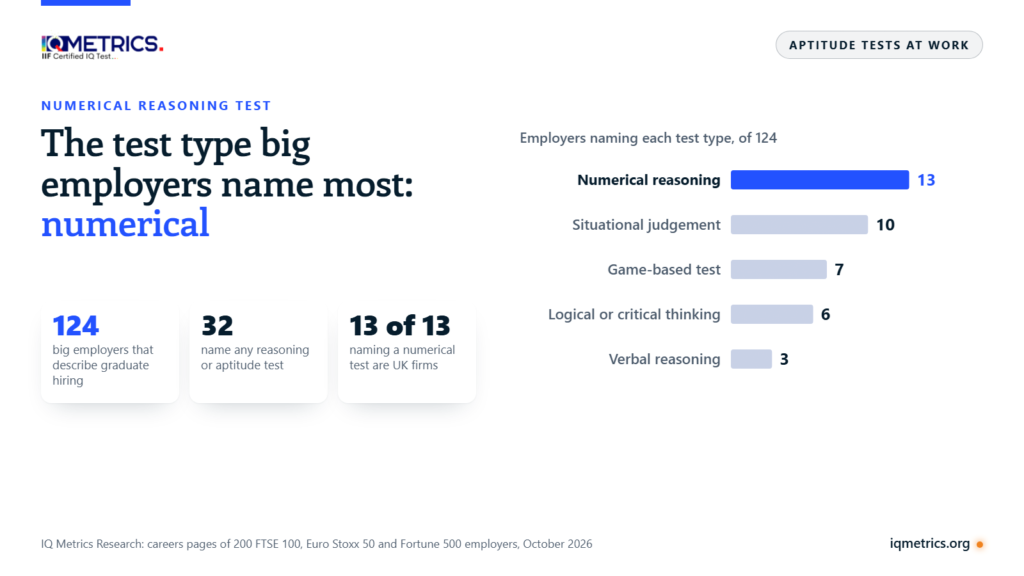
Numerical Reasoning Test
A numerical reasoning test asks you to read tables and charts against the clock. Five worked example questions with answers, the mistakes that cost the most points, what a good score means, and the 13 big employers in our study of 124 that name a numerical test.