





Bipolar Disorder and IQ: Are Bipolar People Smarter?
Are bipolar people smarter? Not on average, but the evidence is more interesting than yes or no. Swedish data on a million men show a reversed-J pattern, excellent school grades carried nearly four times the risk in males, and after diagnosis cognitive scores run about 0.6 standard deviations lower.

Bipolar disorder and IQ are linked in a more complicated way than the popular claim that bipolar people are smarter, and the evidence does not show higher intelligence on average. What the studies show instead is a mix. A cohort of more than a million Swedish men found that risk fell as IQ rose, with risk rising again at the very top among men with no other psychiatric diagnosis. A school-grades study found nearly four times the risk in males with excellent grades. A UK cohort linked higher childhood IQ to more manic features. And reviews of people who already have the diagnosis find moderate cognitive deficits, even between episodes. This guide lays out each result and what it can and cannot support.
- A million men: across 1,049,607 Swedish men, hospital admission for bipolar disorder became less likely as IQ rose. Among men with no other psychiatric diagnosis the pattern was reversed-J: highest risk at the lowest IQ, with risk elevated again at the highest IQ, mainly for verbal or technical ability.
- School grades: excellent grades at age 15 to 16 carried a hazard ratio of 3.79 for later bipolar disorder in Sweden, in males only; the poorest grades carried 1.86.
- Mixed evidence: a smaller conscript cohort (50,087 men) found no link between IQ and bipolar disorder, and a UK cohort found a small positive correlation (r = .16) between childhood IQ and manic features.
- After diagnosis: a 2025 meta-analysis of 75 studies found general cognitive functioning about 0.58 standard deviations lower between episodes.
- The bottom line: bipolar disorder is not a marker of genius. High verbal ability shows up as a risk marker in some cohorts, but the average person with the diagnosis scores lower, not higher, on cognitive tests.
This page is a companion to depression and IQ, where the pattern runs the opposite way, and to our overview of high IQ and mental health. Creativity is the other thread people usually bring up, and we cover it in creativity and IQ.
Does a higher IQ raise the risk of bipolar disorder?
The largest study is by Gale and colleagues (2013). They linked IQ measured at military conscription (mean age 18.3) in 1,049,607 Swedish men to national hospital records over an average of 22.6 years. Across all men, the risk of admission with any form of bipolar disorder fell in a stepwise way as IQ rose. But when they restricted the analysis to men with no psychiatric comorbidity, they found a reversed-J shape: men with the lowest IQ had the greatest risk of being admitted with “pure” bipolar disorder, but risk was elevated again among men with the highest IQ, mainly those with the highest verbal or technical ability. Their conclusion was careful: at least in men, high intelligence may be a risk factor, but only for the minority of cases in whom the disorder occurs in a pure form.
Two other studies point to a high-ability link. MacCabe and colleagues (2010) used school grades for everyone who finished compulsory schooling in Sweden between 1988 and 1997 and followed them for hospital admissions up to age 31. Students with excellent grades had a nearly fourfold risk of later bipolar disorder compared with students with average grades (hazard ratio 3.79, 95% confidence interval 2.11 to 6.82), and the association appeared confined to males. Students with the poorest grades were also at moderately increased risk (hazard ratio 1.86). Smith and colleagues (2015) used a UK birth cohort, the Avon Longitudinal Study of Parents and Children. Among 1,881 people, IQ at age 8 correlated at r = .16 with lifetime manic features reported at age 22 to 23 on a screening checklist, which is not a diagnosis. Those in the highest decile of manic features had a mean full-scale IQ of 110 against 101 in the lowest decile, and the link was strongest for verbal IQ.
Not every cohort agrees. Zammit and colleagues (2004) followed 50,087 Swedish conscripts for 27 years and found no association between IQ and bipolar disorder at all, even though lower IQ predicted schizophrenia and severe depression in the same men. The Dunedin cohort in New Zealand (Koenen and colleagues, 2009) found the opposite of its depression result for mania: higher childhood IQ predicted a higher risk of adult mania.
| Study | Who and what | Result |
|---|---|---|
| Gale et al. (2013) | 1,049,607 Swedish men, IQ at about 18, hospital admissions over 22.6 years on average | Risk fell as IQ rose overall; reversed-J in men with no other psychiatric diagnosis, with higher risk again at the top, mainly for verbal or technical ability |
| MacCabe et al. (2010) | All Swedish students finishing compulsory school 1988 to 1997, grades at 15 to 16, admissions to age 31 | Excellent grades: hazard ratio 3.79, males only; poorest grades: 1.86 |
| Smith et al. (2015) | 1,881 people in a UK birth cohort, IQ at 8, manic features at 22 to 23 | r = .16; strongest for verbal IQ |
| Koenen et al. (2009) | 1,037 people in a New Zealand birth cohort, IQ at 7 to 11, diagnoses to age 32 | Higher childhood IQ predicted adult mania |
| Zammit et al. (2004) | 50,087 Swedish men, IQ at about 18, 27 years of hospital records | No association between IQ and bipolar disorder |
The studies measured different things: an IQ test, school grades, a self-report symptom checklist, hospital admissions, a diagnosis made in an interview. They looked at different ages and outcomes, and several are limited to men or are strongest in men. Two of them point specifically at verbal ability. Even where the association is real, it is modest. An r of .16 means childhood IQ accounts for about 2.5% of the variation in manic features, and bipolar disorder is uncommon, so a fourfold relative risk applies to a small absolute number. Most people with excellent grades or a high IQ never develop it.
Do people with bipolar disorder have lower IQs before the illness starts?
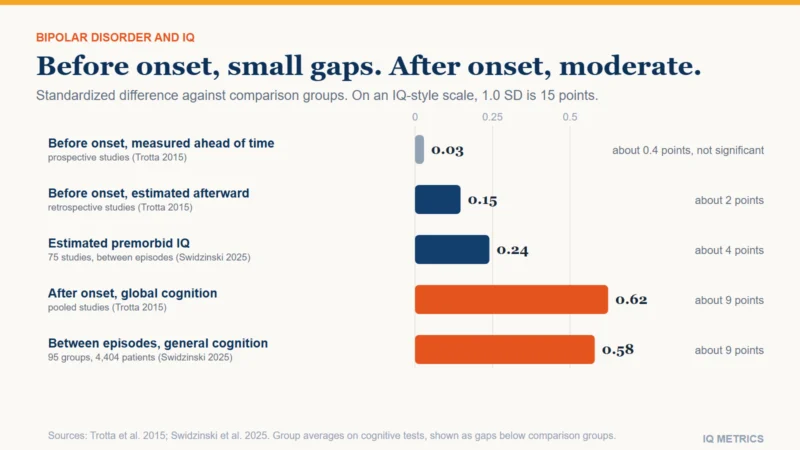
This is the premorbid question, and it is where bipolar disorder and schizophrenia differ most. A 2015 meta-analysis by Trotta and colleagues pooled studies that compared cognitive function in both disorders. People who later developed schizophrenia had a clear premorbid deficit (a standardized mean difference of 0.60 below healthy comparison groups). For bipolar disorder the picture was weaker and depended on how premorbid function was assessed: a small deficit of 0.15 when it was estimated retrospectively, after the illness had begun, and essentially none (0.03, not statistically significant) when it was measured prospectively, before onset. The authors called the evidence on premorbid function in bipolar disorder equivocal.
That is in line with the 2004 Swedish conscript cohort, which found no IQ association with bipolar disorder, although the much larger 2013 cohort did find a gradient, so the evidence is not uniform. Zammit and colleagues took the contrast with schizophrenia to mean that at least some aspects of the neurodevelopmental origins of bipolar disorder may differ from those of the other conditions. The same cohort is described in depression and IQ, where lower IQ predicted severe depression.
What happens to thinking after bipolar disorder starts?
After onset the direction is clear. In the Trotta meta-analysis people with bipolar disorder showed moderate cognitive impairment compared with healthy controls (0.62 standard deviations), and people with schizophrenia a much larger one (1.37). A 2025 meta-analysis by Swidzinski and colleagues looked only at people who were euthymic, meaning mood-stable between episodes. Pooling 95 groups from 75 studies (4,404 people with bipolar disorder and 4,037 healthy controls), they found impairment in general cognitive functioning (0.58 standard deviations lower) and in every domain tested: verbal memory (0.70), executive function (0.69), visuospatial memory (0.68), attention and processing speed (0.64) and working memory (0.61). Estimated premorbid IQ was about 0.24 standard deviations lower in those studies.
On an IQ-style scale with a standard deviation of 15, 0.58 to 0.62 standard deviations would be about 9 points. As with depression, that is an illustration of size, not an IQ loss: these are group averages on cognitive tests that mix many different tasks, and individuals vary widely. More years of education went with slightly less verbal-memory impairment; the other demographic and clinical variables the authors tested were not associated with performance. Our guide to processing speed and IQ and the piece on the digit span test explain two of the abilities involved.
Where would your own score land?
Take the IIF-certified assessment and get your score with the scale it was measured on, the percentile it corresponds to and the confidence range around it — the three figures most online tests leave out.
Find your IQ score now! →Is bipolar disorder linked to creativity?
This is the other half of the “bipolar genius” story, and the evidence is about occupations, not IQ. Kyaga and colleagues (2011) used Swedish registers to compare people treated in hospital for schizophrenia, bipolar disorder or unipolar depression, and their relatives, with controls. People with bipolar disorder, and the healthy siblings of people with bipolar disorder or schizophrenia, were overrepresented in creative professions. People with unipolar depression, and their siblings, were not. The authors suggested the traits may run together in families. Full siblings share about half of their genetic variants on average, which is part of why they resemble each other on many traits; our guide to whether siblings have similar IQs puts numbers on that for test scores.
Creative occupations are a coarse stand-in for creative ability, and holding one is not the same as being exceptionally intelligent. See creativity and IQ for how the two relate, and humor and IQ for another creative skill that has been measured in the lab: being funny on demand.
What does this mean for you or someone you know?
Three practical points. First, an IQ test cannot detect or rule out bipolar disorder; diagnosis is clinical and rests on a history of manic or hypomanic and depressive episodes. Second, thinking difficulties such as slowed processing or trouble with memory and concentration are well documented even between episodes, and are worth raising with a clinician rather than dismissing. Third, a high score does not signal risk, and a diagnosis does not signal either genius or decline: the group differences described here are averages, and individuals vary widely.
If you are curious about your own reasoning scores, you can take the IQ test; for how a profile of strengths and weaknesses is read in practice, see how to read an IQ test report. If you are worried about mood symptoms, speak to a doctor or mental health professional. In the United States, anyone in crisis can call or text 988 to reach the Suicide & Crisis Lifeline.
Quick answers
- Are bipolar people smarter? Not on average. After onset, people with bipolar disorder score lower on cognitive tests (about 0.6 standard deviations in two meta-analyses), and the evidence on IQ before onset is equivocal.
- Is bipolar disorder linked to high IQ? Weakly and inconsistently. Risk was elevated at the highest verbal or technical IQ among Swedish men with no other diagnosis, excellent school grades carried nearly four times the risk in males, and childhood IQ correlated .16 with manic features in a UK cohort; one smaller cohort found no link.
- Do people with bipolar disorder have lower IQs? After onset, on average, moderately lower cognitive scores, including between episodes. Before onset, small or no differences depending on how it was measured.
- Is bipolar disorder linked to creativity? Registry data show people with bipolar disorder, and healthy siblings of people with it, are overrepresented in creative professions. That is about occupations, not IQ.
- Can an IQ test diagnose bipolar disorder? No.
- How does it differ from schizophrenia? Premorbid deficits are clear in schizophrenia (0.60 standard deviations) and lower IQ predicted it in the Swedish cohort; for bipolar disorder the premorbid evidence is equivocal.
Sources
- Gale, C.R. et al. (2013): Is bipolar disorder more common in highly intelligent people? A cohort study of a million men, Molecular Psychiatry, 18(2), 190-194.
- MacCabe, J.H. et al. (2010): Excellent school performance at age 16 and risk of adult bipolar disorder: national cohort study, British Journal of Psychiatry, 196(2), 109-115.
- Smith, D.J. et al. (2015): Childhood IQ and risk of bipolar disorder in adulthood: prospective birth cohort study, BJPsych Open, 1(1), 74-80.
- Zammit, S. et al. (2004): A longitudinal study of premorbid IQ score and risk of developing schizophrenia, bipolar disorder, severe depression, and other nonaffective psychoses, Archives of General Psychiatry, 61(4), 354-360.
- Koenen, K.C. et al. (2009): Childhood IQ and adult mental disorders: a test of the cognitive reserve hypothesis, American Journal of Psychiatry, 166(1), 50-57.
- Trotta, A., Murray, R.M. and MacCabe, J.H. (2015): Do premorbid and post-onset cognitive functioning differ between schizophrenia and bipolar disorder? A systematic review and meta-analysis, Psychological Medicine, 45(2), 381-394.
- Swidzinski, S. et al. (2025): Domain-specific cognitive function in euthymic bipolar disorder: a systematic review and meta-analysis, Psychological Medicine, 55, e336.
- Kyaga, S. et al. (2011): Creativity and mental disorder: family study of 300,000 people with severe mental disorder, British Journal of Psychiatry, 199(5), 373-379.
Keep reading
All articles →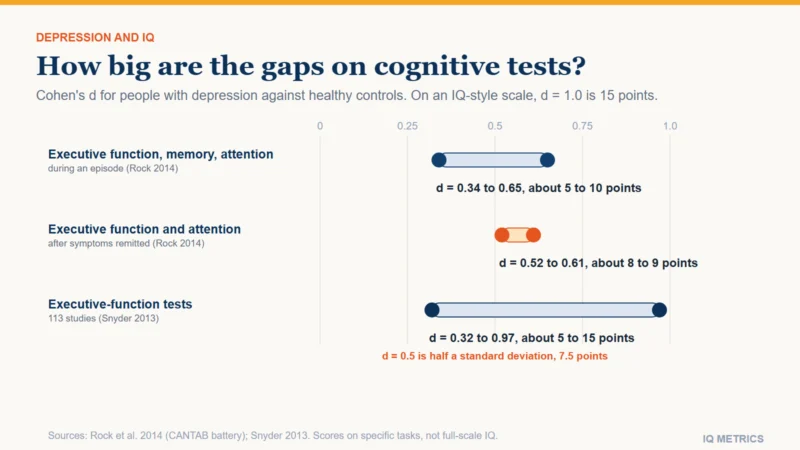 Mind & Everyday Life
Depression and IQ
Does depression lower IQ? It lowers performance on attention, memory, speed and planning tasks while an episode lasts, and some executive and attention differences remain after recovery. A permanent loss of intelligence is not shown, and two large cohorts suggest the arrow also runs the other way.
 Understanding IQ
High IQ and Mental Health
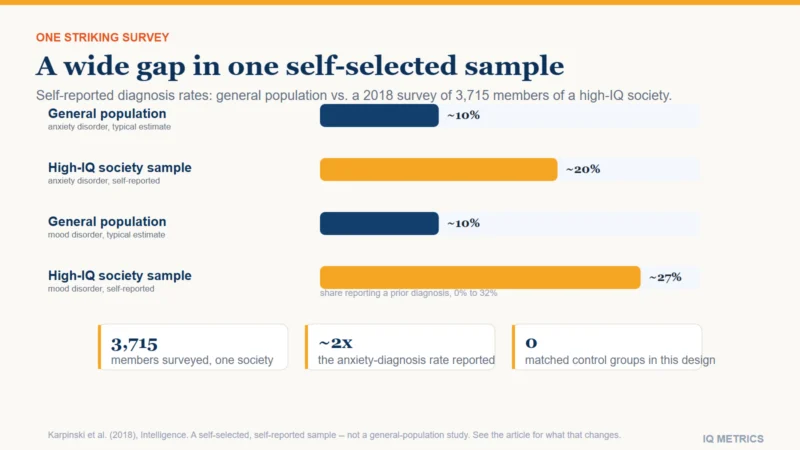
A widely cited 2018 study found sharply higher rates of anxiety and depression among members of a high-IQ society. Why that finding is far from the whole story, what a century of gifted research actually shows, and what seems to matter more than IQ itself.
 Understanding IQ
Creativity and IQ
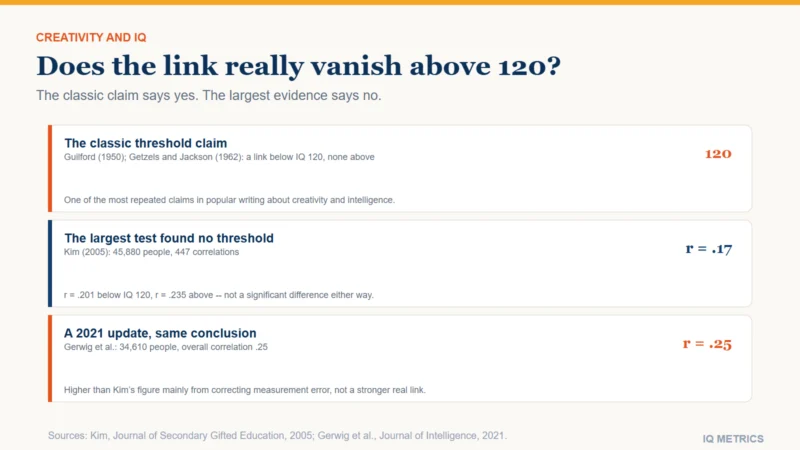
Creativity and IQ correlate only weakly. The largest meta-analysis ever run on the question, covering 45,880 people, found no significant threshold at IQ 120, just a modest overall link of about .17 to .25. See what the strongest evidence shows, and why the classic claim does not hold up.