





Digit Span Test: How It Works, Average Scores and What They Mean for IQ
A digit span test asks you to repeat lists of digits; on the WAIS it has three tasks of eight items. Verified adult averages run from 5.3 to 6.9 digits, not seven, and language matters: 8.84 in Mandarin versus 5.77 in English for the same people.

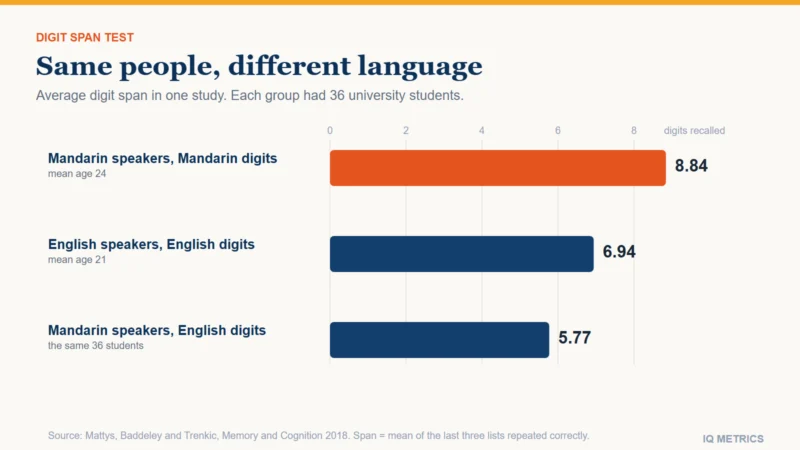
A digit span test asks you to repeat lists of digits that get longer, and your span is the longest list you get right. On the Wechsler adult scales it has been three tasks, forward, backward and sequencing, each with eight items of two trials, stopping when both trials of an item are missed. There is no single average score. The adult means we could verify run from about 5.3 to 6.9 digits forward, depending on language and procedure, so the popular “seven” is only a rough rule of thumb, and the same Mandarin-speaking students recalled 8.84 digits in Mandarin but 5.77 in English. Digit span rises roughly in a straight line with intelligence in the WAIS-IV norm sample of 1,800, yet training it has not been shown to raise intelligence. This guide covers how the test works, how it is scored, what changed in the WAIS-5, average spans, the language effect, the link to IQ, online versions and training.
- Forward: repeat the digits in the order you heard them. Backward and sequencing tasks also require you to manipulate the digits before answering.
- WAIS-IV structure: three tasks of eight items, two trials per item, stopping after both trials of an item are missed; the longest span that can be scored is 9 digits forward and 8 backward.
- WAIS-5: no subtest is called Digit Span any more. Digit Sequencing is a primary subtest in the Full Scale IQ, Digits Forward and Digits Backward are secondary, and Running Digits is new.
- Average: verified adult means of 5.3 to 6.9 digits forward; the figure depends on the language and the procedure.
- IQ: a mostly linear link with Full Scale IQ (Gignac and Weiss 2015); working-memory training shows no convincing far transfer (Melby-Lervåg et al. 2016).
What is the digit span test?
An examiner reads a list of digits and you repeat it. On forward span you repeat the digits in the order heard. On backward span you say them in reverse, and the WAIS-IV includes a third, sequencing task. Researchers describe forward span as mainly short-term storage, while backward and sequencing demand active mental manipulation (Lintas et al. 2025). The task is old: Baddeley’s group notes that digit span was first developed by Jacobs in 1887. On the WAIS-IV it is presented by voice only, and a 2015 study of 226 patients referred for neuropsychological examination found the modality mattered, advising clinicians to “consider testing visual span as well before drawing conclusions about impaired WM from the WAIS-IV” (Egeland 2015). Because it is spoken, hearing matters; see our guide to hearing loss and test scores.
In the WAIS-IV, Digit Span is one of ten core subtests behind the Full Scale IQ and sits in the Working Memory Index with Arithmetic; our guide to WAIS-IV and WAIS-5 index scores explains how subtests roll up into index scores, and our WISC-V guide covers the children’s version. We do not reproduce test items here, because they are copyrighted.
How is the WAIS digit span scored?
- Structure: forward, backward and sequencing each have eight items, and each item has two trials scored 0 or 1, so an item is worth 0, 1 or 2 points (Abdelhamid et al. 2021, describing an Arabic adaptation; a US record form shows the same two-trial structure).
- Stopping rule: a task ends after scores of 0 on both trials of an item.
- Two numbers per task: the total raw score, with a maximum of 16 for forward and 16 for backward, and the longest span, the number of digits on the last trial passed, which is at most 9 forward and 8 backward (from a WAIS-IV record form).
- Conversion: raw scores become scaled scores with a mean of 10 and a standard deviation of 3, and index scores with a mean of 100 and a standard deviation of 15, through the publisher’s age-based norm tables. We could not verify the exact rule that combines the three tasks into one scaled score; the tables sit in the publisher’s manuals.
What changed in the WAIS-5?
The WAIS-5, published in 2024, no longer has a subtest called Digit Span. Pearson lists Digit Sequencing as a primary subtest that counts toward the Full Scale IQ, Digits Forward and Digits Backward as secondary subtests that do not, and a new Running Digits subtest, described as an auditory working-memory task “designed to measure registration and maintenance, including refreshing and updating information held in short term storage.” The primary Working Memory Index is now Digit Sequencing plus Running Digits, and Arithmetic is no longer part of it. A 2024 review sums up the changes: “one subtest was eliminated (Arithmetic), one was added (Running Digits), and one was substantially modified (Digit Span, now called Digit Sequencing)” (Winter, Trudel and Kaufman 2024). The Full Scale IQ is now a composite of seven subtests.
Pearson’s FAQ gives one worked example of how the norms read. At ages 16 to 17, a longest Digit Sequencing of four digits is at a cumulative percentage of 18.9, and eight digits at 96.1, where a cumulative percentage is “the percentage of examinees in the normative sample scoring below that score.” That is one age band on one task, not a table for every age.
What is the average digit span?
Not seven. George Miller’s 1956 paper “The Magical Number Seven, Plus or Minus Two” is the source of that idea, but Nelson Cowan’s 2001 reconsideration says Miller’s figure “was meant more as a rough estimate and a rhetorical device than as a real capacity limit,” and puts the limit at “about four chunks” when people cannot group items. Digits are easy to group, and the spans measured in real samples depend on the language, the pace and the scoring rule. These are the data points we could verify:
| Group | Procedure | Forward | Backward |
|---|---|---|---|
| 36 native English speakers, University of York, mean age 21 | Digits spoken 650 ms apart; span is the mean of the last three lists repeated correctly | 6.94 (SD 1.03) | not tested |
| 36 native Mandarin speakers, same university, mean age 24 | Same procedure, digits in Mandarin | 8.84 (SD 1.30) | not tested |
| The same Mandarin speakers, digits in English | Same procedure | 5.77 (SD 0.93) | not tested |
| 225 healthy Italian adults | Computer, headphones, Italian digits | 5.30 (SD 1.16; range 2 to 9) | 4.54 (SD 1.23; range 1 to 9) |
The first three rows are from Mattys, Baddeley and Trenkic (2018) and the last from Italian norms (Priftis et al. 2025). Neither is a Wechsler score, so they cannot be read straight against a scaled score. Two more findings put the numbers in context. In 784 healthy adults aged 60 to 90 in Seoul, tested on the WAIS-R digit span, education accounted for 29.8% of the variance in forward span and 28.3% in backward span, while age accounted for 1.1% and 0.6% (Choi et al. 2014). And backward spans are shorter than forward spans, by about 0.8 digit in the Italian sample.
We could not find an open table of average forward and backward spans by age band, for children or adults, and Wechsler’s norm tables are copyrighted. If a chart claims to give the normal digit span for a ten-year-old or a fifty-year-old without naming its sample, treat it as unverified.
Does language change your digit span?
Yes, and by a lot. In the York study, Mandarin speakers recalled 8.84 digits in Mandarin against 6.94 for English speakers in English (a difference of 1.62 standard deviations), and the same Mandarin speakers fell to 5.77 in English digits. Chinese digits were also spoken faster, at 6.44 syllables per second against 4.47 for English. The old explanation is that memory span depends on how many items you can rehearse aloud before the trace fades, so shorter names mean longer spans. The authors found it was not the whole story: single spoken digits lasted 417 ms in Chinese and 449 ms in English, a difference that was not significant, and they concluded that “speed of rehearsal did not provide an adequate account of differences between Mandarin and English spans.”
- Welsh and English: in bilingual speakers, Welsh digits take longer to say and digit span is significantly smaller in Welsh; the authors argued that this word-length difference, “rather than intellectual differences,” explains why Welsh children’s digit-span norms were lower than American ones (Ellis and Hennelly 1980). A later study, as summarized by Mattys and colleagues, put the Welsh gap on coarticulation between words instead.
- Four languages: across English, Spanish, Hebrew and Arabic, faster reading rates went with larger memory spans, tied to the number of syllables or phonemes per item (Naveh-Benjamin and Ayres 1986).
- Children: in kindergarten to second grade, Chinese children remembered at least two more digits on average than American or Japanese children, with no Chinese advantage on backward span (Stigler et al. 1986, as summarized by Mattys and colleagues).
- Older adults: a 2025 conference abstract covering 3,681 people aged 40 to 90 in 14 language cohorts found that, among cognitively normal people, forward and backward spans differed significantly between languages even after adjusting for age and education, and the best cut-offs for spotting Alzheimer’s differed by language (Tee et al. 2025).
The practical point is that a digit span is not a measure of memory that ignores language. A test given in a second language can understate the span, as the York Mandarin speakers show, and a single cut-off cannot serve every language. Our guides to second-language test scores and bilingualism and IQ cover the wider issue.
Where would your own score land?
Take the IIF-certified assessment and get your score with the scale it was measured on, the percentile it corresponds to and the confidence range around it — the three figures most online tests leave out.
Find your IQ score now! →Digit span and IQ: what the research says
Wechsler himself contended in 1958 that beyond an average span there was little benefit to a longer one. The WAIS-IV norm sample says otherwise. Gignac and Weiss analyzed 1,800 people aged 16 to 69 and found that all three longest-span scores “were found to exhibit primarily linear associations with FSIQ/g,” so “the commonly held position that Digit Span performance beyond an average level is not indicative of greater intellectual functioning was not supported” (Gignac and Weiss 2015). Every extra digit counts, on average, but one subtest is only one of ten (WAIS-IV) or seven (WAIS-5) inputs to the Full Scale IQ, so no chart converts a span into an IQ. No source we could open gives a reliable span-to-IQ conversion, whatever a search for “digit span iq” or “reverse digit span iq” turns up.
Forward and backward span are related but different. In a national sample of 1,342 children aged 5 to 19, Reynolds found the two processes distinct enough that they “should not be combined for clinical interpretation” (Reynolds 1997). The common belief that backward span is the more sensitive test is not supported either: in WAIS-III and WMS-III data, the backward conditions “did not appear more affected by risk factors such as aging or pathology than the forward scores” (Wilde et al. 2004). Our guides to working memory and reasoning and memory and IQ explain why remembering things and reasoning about them are different abilities.
What does a low digit span mean?
On its own, not much. Baddeley’s group notes that low digit span has been found in children with delayed reading and with slow vocabulary learning, and that it predicts difficulty learning a second language, so it is a useful clue in a full evaluation, for example alongside the working-memory profile described in our dyslexia and IQ guide. It is not a diagnosis. The score also depends on language, education, hearing, attention and the mode of presentation, as this guide has shown.
Digit span online and at home
Online digit span tests vary: some show the digits on screen, some play them, and each chooses its own pace and scoring. That matters because a Wechsler score is a total of trial points with a longest-span record, while the York study averaged the last three correct lists; a visual test also taps a different route than the spoken WAIS test (Egeland 2015). None of them is normed the way a Wechsler subtest is, and we could not verify any published average for the popular online number-memory tests, so treat a “level” on a website as an entertaining benchmark, not a norm. For an informal try with a friend, keep the pace steady at about one digit a second (the rate used in a large WAIS-R-based study of older adults) and stop when two tries at one length fail. Our guide to taking an official IQ test explains what a supervised evaluation involves.
Can you improve your digit span?
You can improve the skill, dramatically, with a method. In a 1980 Science paper, one subject raised his memory span “from 7 to 79 digits” after “more than 230 hours of practice in the laboratory,” and the authors concluded that with an appropriate mnemonic system there is “seemingly no limit to memory performance with practice” (Ericsson, Chase and Faloon 1980). What does not follow is that intelligence rises. A meta-analysis of 87 publications and 145 comparisons found “no convincing evidence of any reliable improvements” in nonverbal ability, verbal ability, word decoding, reading comprehension or arithmetic when working-memory training was compared with a treated control (Melby-Lervåg, Redick and Hulme 2016). See our guides to brain training apps and the memory athletes study. Some trials of supplements have also used backward digit span as an outcome; see our news guide to creatine and IQ.
Quick answers
- What is a good digit span? Most healthy adults fall between about 5 and 7 digits forward in the studies we could verify, and less backward; the range depends on language and procedure.
- What is the average digit span? Not a single number: 6.94 for English speakers in a York study, 5.30 for Italian adults in a computer test, 8.84 for Mandarin speakers in Mandarin.
- How is the WAIS digit span scored? Eight items per task, two trials each, 0 or 1 point per trial, stopping after both trials of an item fail; raw scores convert to scaled scores with a mean of 10.
- Does the WAIS-5 still have digit span? Its digit tasks continue as Digit Sequencing, Digits Forward, Digits Backward and Running Digits; the name Digit Span was retired.
- Does digit span measure IQ? It is one input to IQ and relates to it roughly linearly, but a span cannot be converted into an IQ.
- Is backward digit span harder or better? It is a different task, but not more sensitive to aging or pathology than forward span in WAIS-III and WMS-III data.
- Can you train digit span? Yes, with mnemonics, but training has not been shown to raise intelligence.
The bottom line
A digit span score is a short, spoken window on short-term storage and manipulation. It carries real information about working memory, it rises with intelligence across the whole range in the WAIS-IV norm sample, and it moves with language, education and the way it is presented. For a score you can interpret, you need the whole battery and the publisher’s norms; for curiosity, an online test is a fun benchmark against yourself. Reaction time is another simple speed measure that gets over-read; see our guide to reaction time test.
Sources
- Pearson: Wechsler Adult Intelligence Scale, Fifth Edition (WAIS-5) product page and FAQ, checked 30 September 2026; and the WAIS-5 overview brochure.
- Winter, E., Trudel, S. and Kaufman, A.S. (2024): Wait, where’s the Flynn effect on the WAIS-5? Journal of Intelligence, 12(11), 118.
- Abdelhamid, G.S.M., Bassiouni, M. and Gómez-Benito, J. (2021): Assessing cognitive abilities using the WAIS-IV: an item response theory approach, International Journal of Environmental Research and Public Health, 18(13), 6835.
- Lintas, A., Bader, M. and Villa, A.E.P. (2025): Boosting working memory in ADHD: adaptive dual n-back training enhances WAIS-IV performance, but yields mixed Corsi outcomes, Brain Sciences, 15(9), 998.
- Egeland, J. (2015): Measuring working memory with digit span and the letter-number sequencing subtests from the WAIS-IV: too low manipulation load and risk for underestimating modality effects, Applied Neuropsychology: Adult, 22(6), 445-451.
- Miller, G.A. (1956): The magical number seven, plus or minus two: some limits on our capacity for processing information, Psychological Review, 63(2), 81-97.
- Cowan, N. (2001): The magical number 4 in short-term memory: a reconsideration of mental storage capacity, Behavioral and Brain Sciences, 24(1), 87-114.
- Mattys, S.L., Baddeley, A. and Trenkic, D. (2018): Is the superior verbal memory span of Mandarin speakers due to faster rehearsal? Memory & Cognition, 46(3), 361-369.
- Priftis, K. et al. (2025): Digit span and bisyllabic non-word span: Italian norms, Journal of Neuropsychology, 19(3), 520-540.
- Choi, H.J., Lee, D.Y. and Seo, E.H. (2014): A normative study of the digit span in an educationally diverse elderly population, Psychiatry Investigation, 11(1), 39-43.
- Ellis, N.C. and Hennelly, R.A. (1980): A bilingual word-length effect: implications for intelligence testing and the relative ease of mental calculation in Welsh and English, British Journal of Psychology, 71(1), 43-51.
- Naveh-Benjamin, M. and Ayres, T.J. (1986): Digit span, reading rate, and linguistic relativity, Quarterly Journal of Experimental Psychology A, 38(4), 739-751.
- Stigler, J.W., Lee, S.Y. and Stevenson, H.W. (1986): Digit memory in Chinese and English: evidence for a temporally limited store, Cognition, 23(1), 1-20.
- Tee, B.L. et al. (2025): Digits across languages: the role of lexical and numerical characteristics in digit span performance across fourteen languages, Alzheimer’s & Dementia, 21(S3), e106101 (conference abstract).
- Gignac, G.E. and Weiss, L.G. (2015): Digit Span is (mostly) related linearly to general intelligence: every extra bit of span counts, Psychological Assessment, 27(4), 1312-1323.
- Reynolds, C.R. (1997): Forward and backward memory span should not be combined for clinical analysis, Archives of Clinical Neuropsychology, 12(1), 29-40.
- Wilde, N.J., Strauss, E. and Tulsky, D.S. (2004): Memory span on the Wechsler scales, Journal of Clinical and Experimental Neuropsychology, 26(4), 539-549.
- Ericsson, K.A., Chase, W.G. and Faloon, S. (1980): Acquisition of a memory skill, Science, 208(4448), 1181-1182.
- Melby-Lervåg, M., Redick, T.S. and Hulme, C. (2016): Working memory training does not improve performance on measures of intelligence or other measures of “far transfer”: evidence from a meta-analytic review, Perspectives on Psychological Science, 11(4), 512-534.
Keep reading
All articles →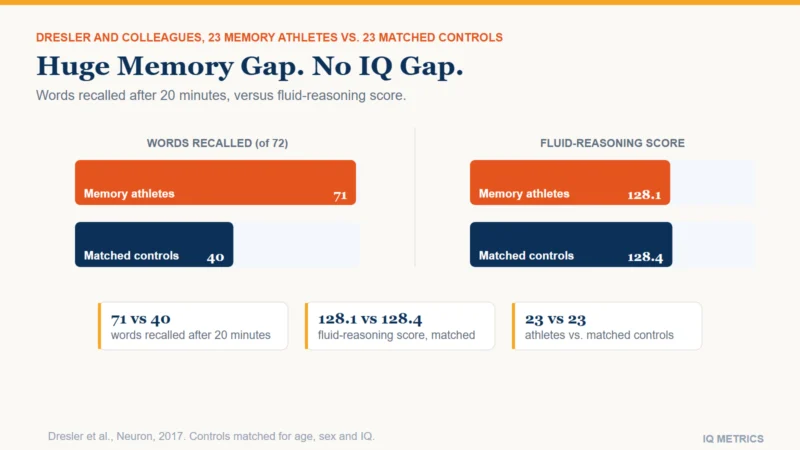 Understanding IQ
Memory and IQ
The world's best memory athletes can memorize 71 shuffled words in twenty minutes. Their IQ scores are not measurably different from a matched control group who could only manage 40. If a spectacular memory is not the same thing as a high IQ, what actually is the difference?
 Scores & Scales
How to Read an IQ Test Report
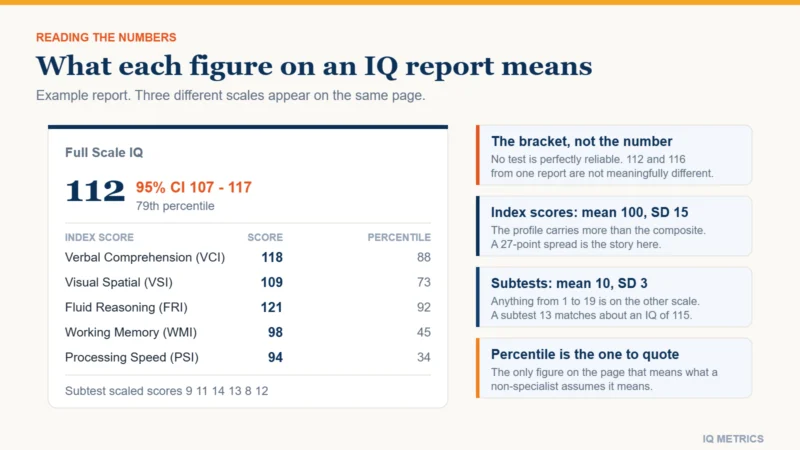
An IQ report puts numbers on at least three different scales and almost never explains which of them matters. Here is what FSIQ, the index scores, the subtest scaled scores, the percentile rank and that bracketed range each mean, and when the headline number should not be read at all.
 Understanding IQ
Reaction Time Test
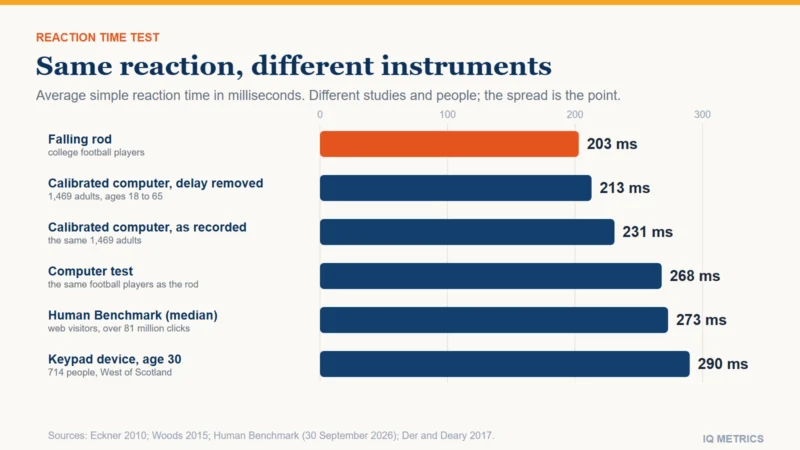
A reaction time test depends on the equipment: 203 ms with a falling rod, 231 ms on a calibrated computer, 273 ms online. See the ruler drop conversion table, why online scores run slow, driving and sprint reaction times, and what really changes your speed.