





High IQ and Mental Health: What the Research Actually Shows
A widely cited 2018 study found sharply higher rates of anxiety and depression among members of a high-IQ society. Why that finding is far from the whole story, what a century of gifted research actually shows, and what seems to matter more than IQ itself.

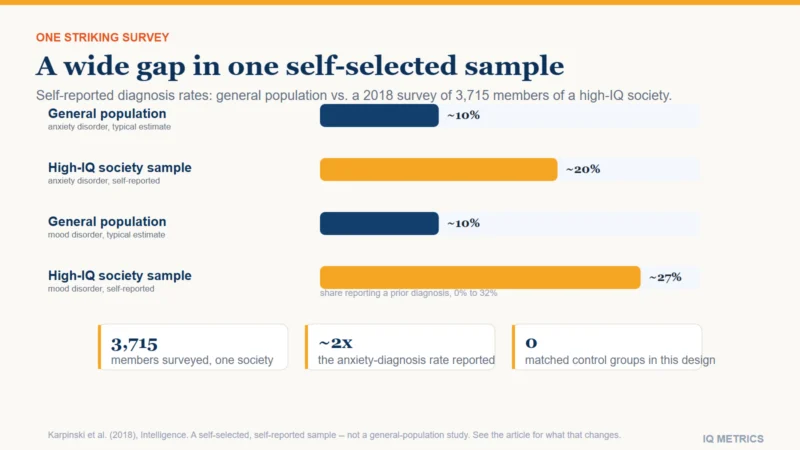
The evidence is genuinely mixed, and both sides of the debate can point to a real study. The finding that gets shared the most — sharply higher rates of anxiety and depression among members of a high-IQ society — comes from one widely cited 2018 survey with real limitations. A much larger and older body of research on gifted people, running for decades, found close to the opposite: that gifted children and adults were, on average, at least as well-adjusted as everyone else. This article covers both bodies of evidence, why they disagree, what a much older stereotype gets wrong, and what seems to matter more than the IQ number itself.
The idea that intelligence and mental fragility travel together is far older than any of this research, and the popular link between IQ and creativity carries a version of the same stereotype. Aristotle is often paraphrased as observing that eminent philosophers, poets and artists tend toward melancholy, and the Romantic era built an entire aesthetic around the tortured genius. The stereotype hardened into something resembling a scientific claim with the Italian criminologist Cesare Lombroso, whose 1889 book “The Man of Genius” argued that genius was itself a form of hereditary degeneration related to insanity — a theory taken seriously in its own time and thoroughly discredited since. Modern research did not invent the “sad genius” idea; it inherited a stereotype that predates any actual data on the question by more than a century, which is worth knowing before treating either side of the current debate as the first word on the subject.
The study behind the headlines
Psychologist Ruth Karpinski and colleagues at Pitzer College surveyed 3,715 members of American Mensa, whose entry requirement sits around the 98th percentile on a standard IQ test, roughly 132 or higher. Published in the journal Intelligence in 2018, the survey found that about 20% of respondents reported having been diagnosed with an anxiety disorder, and nearly 27% reported a mood disorder such as major depression or bipolar disorder — against typical general-population estimates of roughly 10% for each. The researchers proposed a "hyper brain, hyper body" explanation: heightened psychological and physiological reactivity to stimuli, sometimes called overexcitability, that produces more intense rumination and worry alongside a higher measured rate of physical conditions like allergies, asthma and autoimmune disease in the same sample. The "hyper body" half of that name is doing real work — the survey’s central claim is not just about mood, it is that the same heightened nervous-system reactivity shows up in both the mind and the immune system at once.
Why one study should not settle the question
The sample was self-selected twice over: people who sought out membership in a high-IQ society in the first place, then volunteered to answer an online survey about their health. Every diagnosis was self-reported rather than clinically verified, which opens the door to recall and disclosure differences. And the general-population comparison numbers came from separate sources using different methodologies, not a matched control group given the identical instrument — a design that can widen or narrow an apparent gap for reasons that have nothing to do with intelligence itself, including how comfortable a highly educated, self-selected group is with reporting a mental-health diagnosis in the first place.
The older, larger, more optimistic picture
Long before this survey, Lewis Terman’s "Genetic Studies of Genius" — a longitudinal study that began following gifted California children in 1921 and continued tracking many of them for the rest of their lives — found gifted children to be, on average, physically healthier and at least as socially and emotionally well-adjusted as their peers, directly contradicting the popular "sad genius" stereotype. That study has its own limits: a sample drawn overwhelmingly from white, middle-class children in one state, assessed with the diagnostic categories and social norms of the 1920s through 1950s. Neither study is the final word; each was built to answer the question in a different, imperfect way.
What later research on gifted adults adds
The Study of Mathematically Precocious Youth, running continuously since 1971, has tracked profoundly gifted people into midlife and generally found life satisfaction and psychological well-being comparable to or better than the general population on average. The same body of research also documents real, specific challenges for profoundly gifted children in particular — asynchronous development, where a child’s intellectual, emotional and physical development advance at different rates, and social mismatch with same-age peers who do not share their interests. A ten-year-old reading at a college level but still navigating a ten-year-old’s friendships and emotional regulation is the practical shape this takes, and it is a real source of strain even though it is not the same claim as elevated adult rates of diagnosed anxiety or depression.
Where would your own score land?
Take the IIF-certified assessment and get your score with the scale it was measured on, the percentile it corresponds to and the confidence range around it — the three figures most online tests leave out.
Find your IQ score now! →Overexcitability: an interesting theory, not a settled fact
The framework behind the "hyper brain, hyper body" idea traces back to Kazimierz Dabrowski’s Theory of Positive Disintegration, popular in gifted-education circles for decades. Dabrowski described five domains of overexcitability — psychomotor, sensual, intellectual, imaginational and emotional — and proposed that gifted individuals experience several of them more intensely than average, with the resulting inner turmoil framed as a necessary stage on the way to a more advanced personality, not simply a deficit. It is a genuinely interesting lens, and it is also a theory with limited independent empirical validation outside the research groups that developed it, which is a different status than an established, broadly replicated finding.
A separate honesty check worth naming: the Mensa sample sits at the extreme tail of the distribution, roughly the 98th percentile and above. Nothing about that survey speaks to whether someone with an above-average but non-extreme score — say, 115 or 120 — carries any elevated risk at all. If the "hyper brain, hyper body" pattern is real, the current evidence does not show whether it appears gradually across the range or only shows up near the far tail that this specific sample was drawn from.
What seems to matter more than the number itself
Across both bodies of research, the environmental details show up more consistently than intelligence itself as a driver of outcomes: social isolation from same-age peers, boredom in a school setting that is not matched to a child’s pace, and simply being treated as strange for thinking differently. Signs of a gifted child covers identification in more depth, and the twice-exceptional overlap covered in high IQ and ADHD shares the same underlying thread: giftedness does not automatically come with better self-regulation or emotional coping, and IQ and emotional intelligence are measuring genuinely separate skills that develop on separate tracks.
As with other striking single-study claims about high-IQ populations — see IQ and testosterone for a similar case — a dramatic finding from one sample is not the same thing as a settled scientific consensus, and the honest version of this story is messier and less quotable than either headline.
If you are actually concerned about this
It is worth separating this from test anxiety, a narrower and more solidly established phenomenon: nervousness during the test itself, which can lower a score, rather than a general claim about mood or anxiety disorders in daily life. A high or low score on a cognitive test is not a mental-health diagnosis in either direction. Genuine, persistent anxiety or low mood is worth raising with a real clinician regardless of where anyone falls on any test, and a self-administered online quiz result is not a substitute for that conversation in either direction.
The bottom line
One striking survey found a wide gap; a much larger, older research tradition found close to none. Both have real limitations, the theory offered to explain the gap is more provisional than it sounds in a headline, and the factors that show up most consistently across the research — isolation, mismatch, being misunderstood — point more toward environment and social fit than toward intelligence itself as the thing driving mental health.
Keep reading
All articles →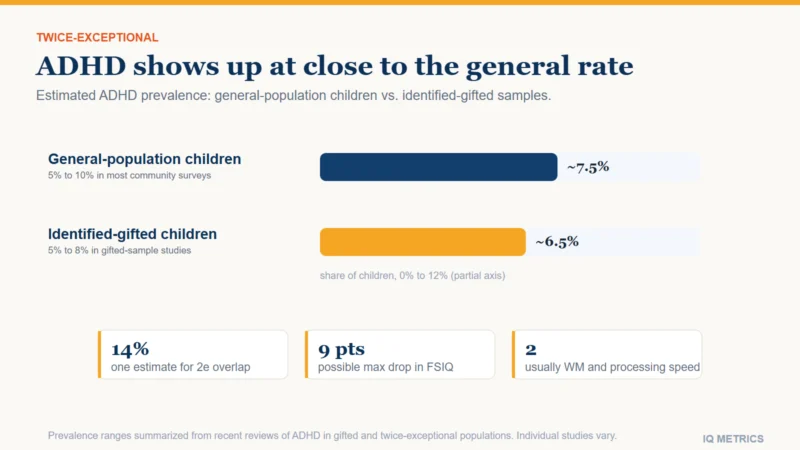 Understanding IQ
High IQ and ADHD
High IQ and ADHD can and do coexist, at close to the general-population rate. What twice-exceptional actually means, why the combination gets missed in both directions, and how ADHD can pull down a full-scale IQ score without touching real reasoning ability.
 Mind & Everyday Life
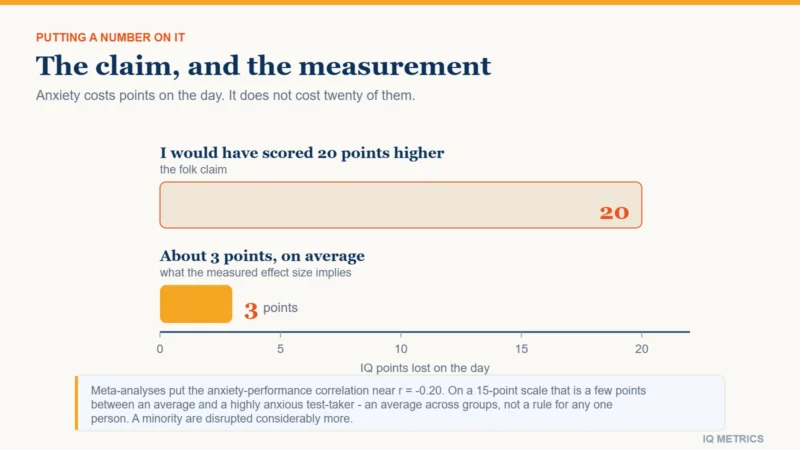
Test Anxiety and IQ Scores
Almost everyone who has had a disappointing result has wondered whether nerves cost them fifteen or twenty points. The evidence says no. Test anxiety and cognitive performance correlate at roughly r = -0.20, which works out to a few points on a 15-point scale. Here is the number, and what it changes.
 Understanding IQ
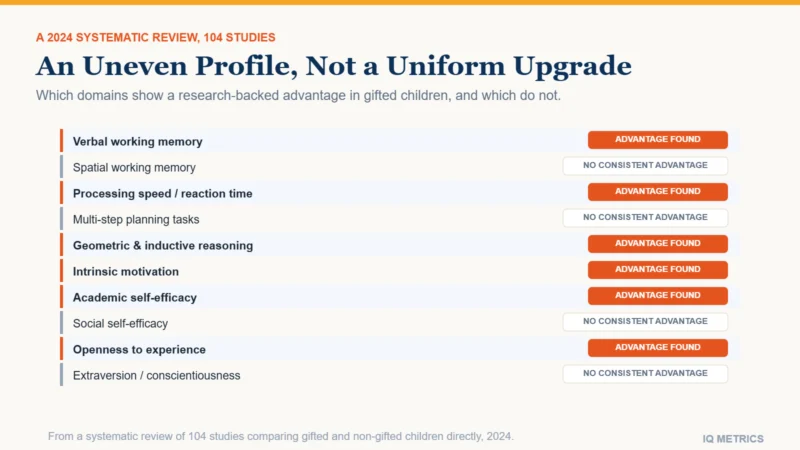
Signs of a Gifted Child
The "reads early, has a big vocabulary" checklist misses what a 2024 systematic review actually found: an uneven cognitive profile, a documented speed-accuracy tradeoff, asynchronous development, and real gaps in who gets identified. What the research says, and what to do with a hunch.