



What was Muhammad Ali’s IQ?
The rarest thing in this section: a real, documented test result.

Almost every number here is invented. Ali’s is not — he sat a US Army qualification test in 1964 and failed it. That makes this the best case study the section has of what such a test actually measures.
Muhammad Ali’s estimated IQ
- Sat the US Armed Forces qualification test in 1964 and scored between the 16th and 18th percentile, below the 30th percentile the Army then required.
- Press accounts have long converted that percentile to 78; FBI files cited by the historian Anthony Edmonds record 83.
- Graduated 376th out of 391 in his high school class at Central High, Louisville.
- Reclassified and inducted in 1966 when the Army lowered its qualifying threshold.
This is one of the few genuinely documented results in the section, and it should be read for exactly what it was: a written test of school-taught material, sat by a man who had been a full-time athlete since twelve and who is reported to have had significant reading difficulty.
- Born
- 17 January 1942, Louisville, Kentucky
- Died
- 3 June 2016, Scottsdale, Arizona
- Field
- Boxing
- Education
- Central High School, Louisville; graduated 376th of 391
- Documented test result
- US Armed Forces qualification test, 1964 — 16th to 18th percentile
- On record about IQ
- Said he had only ever claimed to be the greatest, not the smartest.
What an IQ of 80–100 actually means
Set the claim aside for a moment. If someone genuinely scored in this range, here is what that would represent.
Average is 100 by construction, and about two-thirds of people fall between 85 and 115. Take the test to place your own score on this scale.
| Score range | Classification | Share of people | What it indicates |
|---|---|---|---|
| 85 – 114 | Average | ~68% | The range most people fall into. |
| 115 – 129 | Above average | ~13.6% | Roughly one person in seven. |
| 130 – 144 | Gifted | ~2% | The threshold most high-IQ societies use. |
| Above 144 | Highly gifted | ~0.1% | Figures above this range are extrapolated from the curve rather than measured. |
Percentages are approximate and describe a normal distribution. The same number means different things on tests with different standard deviations.
Thirty questions gives you a measured position on this exact scale — your score, your percentile and the ability breakdown behind it.
Find out in 30 minutes →Who Muhammad Ali was
Cassius Marcellus Clay Jr. was born in Louisville, Kentucky, in 1942 and began boxing at twelve. He won a light-heavyweight gold medal at the 1960 Rome Olympics and took the world heavyweight title from Sonny Liston in 1964, at twenty-two.
He joined the Nation of Islam and took the name Muhammad Ali the following day. In 1967 he refused induction into the US Army on religious grounds, was stripped of his title and convicted of draft evasion; the conviction was overturned unanimously by the Supreme Court in 1971. He did not fight for three and a half years at the peak of his career.
He regained the title from George Foreman in Kinshasa in 1974 and again from Leon Spinks in 1978, the first heavyweight to win it three times. He was diagnosed with Parkinson’s syndrome in 1984 and died in Arizona in June 2016.
 By Elora Mercer, Celebrity Research WriterFigures checked by Leon Falkner, Data & Research Analyst
Reviewed by Aarav Vardhan, Editor-in-Chief · Last reviewed August 2026

Muhammad Ali: the documented record
The estimate above rests on this record. Every entry here is a matter of public fact, which is more than can be said for the number itself.
- 1942Born in Louisville, Kentucky.
- 1954Begins boxing at twelve after his bicycle is stolen.
- 1960Wins Olympic light-heavyweight gold in Rome.
- 1964Beats Sonny Liston for the world heavyweight title; sits and fails the Army qualification test.
- 1966Reclassified 1-A after the Army lowers its qualifying threshold.
- 1967Refuses induction; is stripped of his title and convicted.
- 1971The Supreme Court overturns the conviction unanimously.
- 1974Regains the title from George Foreman in Kinshasa.
- 1978Wins the heavyweight title for a third time.
- 1984Diagnosed with Parkinson’s syndrome.
- 2016Dies in Scottsdale, Arizona.
Where the 78 figure came from
Following a claim back to its first appearance is the part almost nobody does — and it is what most people are actually asking.
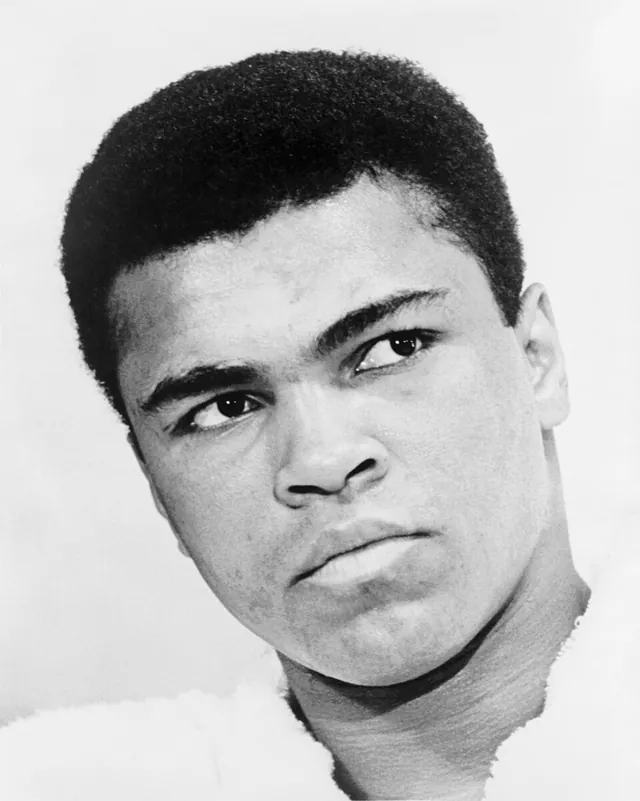
This page is the mirror image of the rest of the section. Everywhere else the problem is a number with no test behind it. Here there is a test, a date, an administering body and a result — and the number is still badly misused.
The Armed Forces Qualification Test was a screening instrument. It asked about arithmetic, vocabulary and mechanical reasoning, on paper, under time pressure, and it existed to decide who could be trained for which military role. Ali left Central High School ranked 376th of 391 and is reported to have struggled with reading throughout his life. A written test of school-taught material will report that, and it will report nothing else.
Ali himself gave the best answer anyone has given on this page. Asked about the result, he said he had never claimed to be the smartest, only the greatest. He did not dispute the score; he disputed its authority.
Then set the score against the record. He improvised rhyming verse in front of hostile press rooms for two decades, argued a conscientious-objection case that reached the Supreme Court and won it unanimously in 1971, and read a fight in real time well enough to invent a tactic — absorbing punishment on the ropes until an opponent punched himself out — and execute it against George Foreman. None of that is measured by an arithmetic and vocabulary paper, which is the point of this page.
Compare Eminem, whose modest circulating figure was reasoned backwards from leaving school, and whose verbal ability is by any standard exceptional. The failure mode is the same in both directions.
How we read a number →The documented result at the centre of this page: between the 16th and 18th percentile, below the 30th percentile then required.
Cites FBI file material recording the score as 83 rather than the 78 of press tradition.
The unanimous Supreme Court decision overturning his conviction. Cited as record, not as a measure.
The school record. Consistent with the test result, and subject to the same limitation.
The AFQT was a military screening instrument, not a clinical IQ test. No Wechsler, Stanford-Binet or comparable result has ever been published.
The sources behind our estimate
The figures that circulate for Muhammad Ali, what we were able to confirm, and where the two diverge.
That Muhammad Ali had an IQ of 78 — cited constantly, and almost always to make a point about the gap between the score and the man.
The underlying fact is solid: he sat the Armed Forces qualification test in 1964 and placed between the 16th and 18th percentile. But the AFQT was a written screening test of arithmetic, vocabulary and mechanical reasoning designed to sort recruits, not a clinical IQ instrument. The exact conversion is disputed — 78 in press tradition, 83 in FBI files, and the 16th percentile maps to roughly 85 on a modern scale.
For once the spread reflects a genuine dispute about converting a percentile, not competing inventions. That is a much healthier kind of disagreement.
Want a number that does hold up? Every figure on this page is somebody’s claim. Take the 30-question test and get a percentile you can check rather than a figure you have to trust.
Muhammad Ali — frequently asked
What was Muhammad Ali’s IQ?
He scored between the 16th and 18th percentile on the US Armed Forces qualification test in 1964. Press tradition converts that to 78; FBI files cited by the historian Anthony Edmonds record 83, and the percentile maps to roughly 85 on a modern scale.
Did Muhammad Ali really have an IQ of 78?
The result behind that number is real, but it came from a military screening test of arithmetic and vocabulary, not a clinical IQ test. The 78 is one of several conversions of the same percentile.
Why was the score so low?
It was a written test of school-taught material. Ali had boxed full-time since he was twelve, graduated 376th of 391 from his high school, and is reported to have had significant reading difficulty throughout his life.
What did Ali say about it?
That he had never claimed to be the smartest, only the greatest. He did not dispute the score so much as its authority.
Does the score mean he was not intelligent?
It means he did poorly on a paper test of schooling. He improvised verse under pressure for two decades, won a unanimous Supreme Court case, and invented and executed a tactical plan against George Foreman in 1974. None of that appears on an AFQT.
Which other athletes are profiled here?
Magnus Carlsen and Bobby Fischer, both estimated from rated performance, and Cristiano Ronaldo and LeBron James, whose figures are unsourced.
How does my IQ compare with Muhammad Ali?
You can find out in about fifteen minutes. The IQ Metrics assessment is 30 questions, scored on the same 100-mean scale used throughout this page, so your result and the estimate above are at least expressed in the same units — one measured, one inferred. Once you have a number, the leaderboard shows where it would sit, and how we score and norm it explains the benchmarking.
Where does this estimate come from?
From the documented record rather than a test — the method is named above and set out in full under how we read a number. Compare it against the other athletes profiles, starting with Magnus Carlsen.
- Take the 30-question IQ test — get a measured score and percentile of your own
- Average IQ by country — how the scale behaves across populations
- How IQ Metrics scores its assessment — the method behind our own number
- More on how IQ testing works — reliability, error and what a score can and cannot say
- More athletes profiles — same field, same method
More athletes


Photograph by Harry Pot for Anefo, Dutch National Archives, via Wikimedia Commons (26 April 1962), CC BY-SA 3.0 NL. Cropped to exclude another member of the delegation visible in the original frame. Background removed for the portrait above. · Photograph by Anand Anil (November 2017), CC BY-SA 4.0. Background removed for the portrait above. · Photograph by All-Pro Reels (Lambeau Field, Green Bay, Wisconsin, October 24, 2021), CC BY-SA 2.0. Background removed for the portrait above.


.jpg)
An estimate is an inference.
Yours can be measured.
Thirty questions, scored against general-population benchmarks. Your score, your percentile, your ability breakdown and a printable IIF certificate.
Find your IQ score now! →