



Einstein's Brain: Taken, Weighed, Sliced and What It Did Not Show
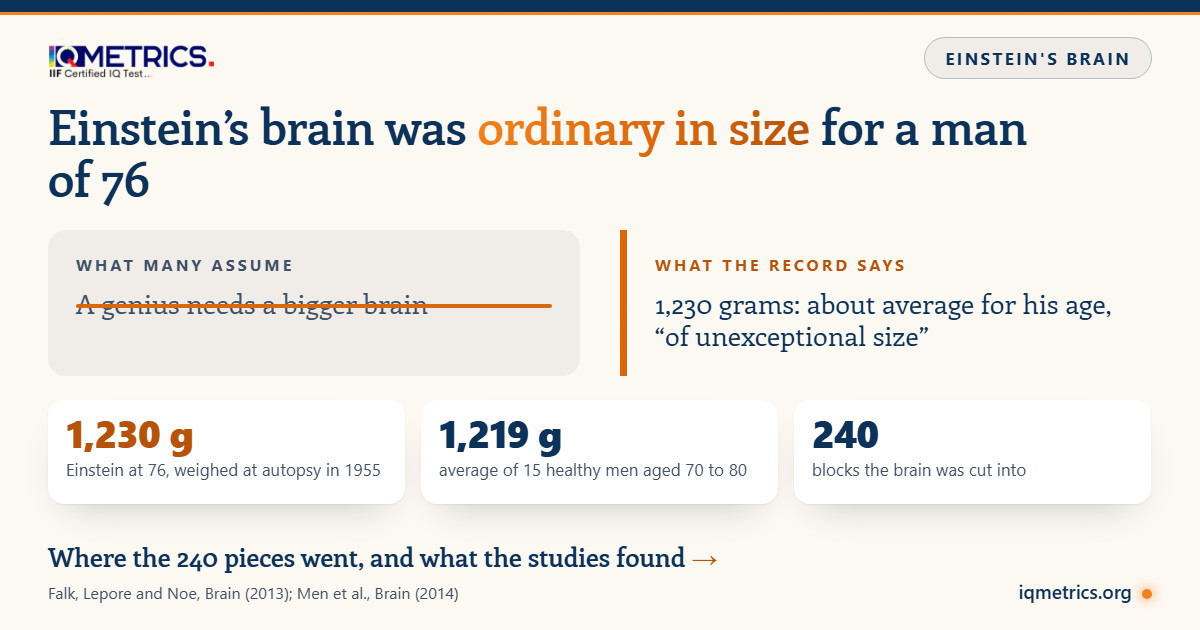
Einstein's brain weighed 1,230 grams, about average for a man of 76. It was cut into 240 blocks that are now spread across three institutions, and the studies of it are more modest, and more disputed, than the headlines.

What you need to know
- Einstein's brain weighed 1,230 g at autopsy in April 1955. A 2014 comparison found healthy men aged 70 to 80 averaging 1,219 g, and the 2013 study in Brain calls it 'of unexceptional size'.
- Pathologist Thomas Harvey cut it into 240 blocks. By 2012, 180 blocks were at the University Medical Center at Princeton and 567 slides at the National Museum of Health and Medicine; the Mütter Museum in Philadelphia shows 46 slides.
- Whether Harvey had permission is disputed: a 2013 paper says Einstein's son and executor gave it, while historian Brian Burrell writes that the blessing was retroactive and reluctant.
- The famous findings are narrow: one of four areas differed in 1985, the 1996 neuron count was the same as controls, and a 2013 photo study contradicted the 1999 "missing groove". A 2014 review found the evidence "wanting".
Einstein's brain was removed within hours of his death in April 1955 and weighed 1,230 grams. That is ordinary for a man of 76: in a 2014 comparison, healthy men aged 70 to 80 averaged 1,219 grams. The pathologist, Thomas Harvey, cut it into 240 blocks. Studies since then report a few unusual features, but none shows why Einstein was a genius.
Below: whether the brain was stolen, how its size compares with a normal brain, where the pieces are now, what four studies found and why critics doubt them.
Was Einstein's brain stolen?
Was Einstein's brain stolen? Accounts differ. Einstein died shortly after 1 a.m. on 18 April 1955 at Princeton Hospital in New Jersey, aged 76. Within hours, the hospital pathologist Thomas Harvey removed his brain, weighed it and took 40 measurements. The rest of the body was cremated the same day.
A 2013 paper in the journal Brain, led by anthropologist Dean Falk, says permission to keep and study the brain was obtained from Einstein's son, Hans Albert, and his executor, Otto Nathan. The historian Brian Burrell tells it differently. In his 2005 book he writes that Harvey did not have permission at the time and later won a "reluctant and retroactive blessing" from Hans Albert, on condition that the brain be used only for science.
Burrell adds that the hospital dismissed Harvey within months when he refused to hand the specimen over. So "stolen" is the popular word, and the record is murkier than that.
How big was Einstein's brain compared with a normal brain?
Einstein's brain size was ordinary. The 2013 Brain study calls it "of unexceptional size". Brains lose weight with age, so the fair comparison is with older men, and there Einstein sits right on the average.
- Einstein at 76: 1,230 grams
- Healthy men aged 70 to 80 (a 2014 comparison of 15 men): 1,219 grams on average
- Adult men of all ages (a German study of more than 8,000 autopsies): 1,336 grams on average
- Adult women of all ages (the same study): 1,198 grams on average
The German study found men's brains losing about 2.7 grams a year with age. Falk's team corrected Einstein's weight for age and put it at about 1,352 grams, close to a young adult man.
Our own study of famous brains weighed after death points the same way. Of 105 eminent people whose age was known, 91 (87%) had brains heavier than the average for their age in old London hospital tables. Einstein was one of the exceptions: his 1,230 grams was 4.6% below that average.
Where is Einstein's brain now?
Where is Einstein's brain now? In pieces, in several places. Harvey cut the brain into 240 blocks and had thin slides made from them for other researchers. By Falk's count in 2012, the main collections were these:
- University Medical Center at Princeton: 180 of the 240 blocks
- National Museum of Health and Medicine: 567 slides plus Harvey's photographs and papers, donated by his estate in 2010, with no tissue blocks
- The Mütter Museum in Philadelphia: 46 slides, donated in 2011 and put on display
- A few scattered blocks in Ontario, California, Alabama, Argentina, Japan, Hawaii and Philadelphia
Einstein's eyes were removed too and remain in private hands, Falk writes, and the 1955 autopsy report has been missing for years. In 1997 Harvey even drove across the United States with Einstein's brain in the trunk of his Buick Skylark, a trip the writer Michael Paterniti told in the book Driving Mr. Albert.
How was Einstein's brain studied?
Mostly through slides and photographs, over five decades. Harvey photographed the whole brain, then cut the two hemispheres into 240 blocks and embedded them in celloidin, a material that keeps tissue firm for slicing. Between 5 and 12 sets of 100 or 200 slides were made and stained, Falk writes; accounts of the exact number vary.
Harvey sent pieces and pictures to researchers who asked. No fewer than 18 investigators received brain tissue or photographs from him, but only six peer-reviewed papers had come out of them by Falk's 2013 count. Some material was simply too old for modern methods: DNA taken from one block in 1988 "had completely fragmented."
Even the famous weight comes with a caveat. Falk notes that "details of how, exactly, this weight was measured are not available", so nobody knows whether membranes or fluid were included.
What did scientists find in Einstein's brain?
Four findings are quoted most often. Each one is narrower than the headlines it produced.
1985, glial cells. Marian Diamond and colleagues compared four small areas of cortex with the brains of 11 men. Only one area, on the left side (area 39), differed: it had fewer neurons for each glial support cell. The other three areas did not differ.
1996, neuron density. Britt Anderson and Harvey compared part of the right prefrontal cortex with five elderly men. Einstein had the same number of neurons under each square millimetre and the same neuron size. The neurons were packed more tightly only because his cortex was thinner.
1999, the parietal lobes. Sandra Witelson's team at McMaster University in Canada reported in The Lancet that the parietal lobes, linked to mathematical and spatial thinking, were unusually developed and that part of a groove was missing. Press reports at the time described the brain as 15% wider than the comparison brains. We could not read the paper itself, so treat the details as reported.
2013, the photographs. Falk, Frederick Lepore and Adrianne Noe studied 14 newly found photographs. They describe "an extraordinary prefrontal cortex" and unusual folding. They also write that the brain "does not lack parietal opercula", which contradicts the 1999 claim about a missing groove.
Einstein's brain weighed 1,230 grams. Healthy men his age in one comparison averaged 1,219.
Did Einstein's brain explain his genius?
No study shows that. The psychologist Terence Hines reviewed the work in 2014 and found it "wanting". The results, he wrote, "do not, in fact, provide support for the claim that the structure of Einstein's brain reflects his intellectual abilities."
The basic problem is that there is only one Einstein. Every brain differs from others in many small ways, so with one case and many measurements some differences will turn up by chance. Age is another catch: Falk notes that nobody knows how much of the thinner cortex Anderson found was simply due to age.
Brain size and IQ do correlate across large groups, but only weakly, as our report on brain size and IQ explains. Brain scans of gifted children show a similar pattern of small group differences, covered in our piece on what gifted brain scans show.
What was Einstein's IQ?
He never took an IQ test. Figures such as 160 are estimates, not scores. Our profile of Albert Einstein's IQ traces where those numbers come from, and our check of Nobel Prize winners' IQs shows how few famous scientists were ever tested. Even the famous logic puzzle sold as "Einstein's riddle" has no link to him, as our riddle article shows.
Where would your own score land?
Want a real score instead of an estimate? Take the IQ Metrics test.
Find your IQ score now! →A real test gives you a score and a percentile. Take the IQ Metrics test, or use our IQ percentile calculator to see how rare any score is, including the 160 often claimed for Einstein.
Common questions
How much did Einstein's brain weigh?
1,230 grams at autopsy in April 1955, when he was 76. Healthy men aged 70 to 80 averaged 1,219 grams in a 2014 comparison, so his brain was about average for his age.
Was Einstein's brain stolen?
Accounts differ. A 2013 paper says his son and executor gave permission; the historian Brian Burrell writes that the pathologist Thomas Harvey had none at the time and later received a retroactive blessing for scientific use only.
Where is Einstein's brain now?
In pieces. By 2012, 180 of the 240 blocks were at the University Medical Center at Princeton and 567 slides at the National Museum of Health and Medicine; the Mütter Museum in Philadelphia holds 46 slides.
Was Einstein's brain different from a normal brain?
In a few small ways, according to studies of one area of glial cells and of its folding, but its size was ordinary and a 2014 review concluded the findings do not show that its structure explains his abilities.
Sources for this story
- The cerebral cortex of Albert Einstein: a description and preliminary analysis of unpublished photographs (2013) — Brain
- The corpus callosum of Albert Einstein's brain: another clue to his high intelligence? (letter, 2014) — Brain
- On the brain of a scientist: Albert Einstein (1985); Alterations in cortical thickness and neuronal density in the frontal cortex of Albert Einstein (1996) — Experimental Neurology; Neuroscience Letters
- Neuromythology of Einstein's brain (2014) — Brain and Cognition
- Normal weight of the brain in adults in relation to age, sex, body height and weight (1994); Why size mattered for Einstein (1999) — Der Pathologe; BBC News
- Postcards from the Brain Museum (2005), excerpt — Brian Burrell, via NPR
Corrections: spotted an error? Email corrections@iqmetrics.org and we will update this story and note the change here.
Related stories
All news →Brain Size and IQ: What a Correlation of 0.24 Means
The largest synthesis of the question pooled 88 imaging studies and put the association between brain volume and IQ at roughly 0.24. That is about six per cent of the variation in scores, which is enough to rule out the strong claim and the flat denial at the same time.

IQ of Nobel Prize Winners: What Was Measured and What Was Guessed
Nobel week prompts lists of laureate IQs near 150 to 160. The measured record is a few childhood scores in the 120s, one 1953 test of 64 leading scientists, and a simulation showing why Terman's study could easily miss two future laureates.

Does Aphantasia Affect IQ? What the Studies Measured
No study has measured IQ in a representative sample of people with aphantasia, the lifelong absence of mental pictures. The two small studies that report IQ-style scores disagree on direction, +5.5 and -4.0 points, and neither gap was significant.
Read the research.
Then find your own number.
Our IIF-certified assessment reports your score with its scale, percentile and confidence range — and a breakdown of the cognitive domains behind it.
Start IQ Test →