



MCAT Score to IQ: What the AAMC Percentile Can and Cannot Tell You
Online calculators turn a 500 into an IQ of 100. The AAMC says its percentiles only compare you with other test takers, a group already filtered by college and ambition. No study has calibrated the modern MCAT against an intelligence test, so here is the 2026-27 percentile table and the arithmetic that shows why.


What you need to know
- No valid MCAT-to-IQ conversion exists. The AAMC table in force from 1 May 2026 (305,494 exams, 2023-2025; mean 500.6, standard deviation 11.2) puts a 500 at the 48th percentile, a 510 at the 79th and a 515 at the 91st, but those are ranks among MCAT takers, not among the population, and no study has calibrated the modern exam against an IQ test.
- The pool is selected and then narrows. Applicants averaged 506.3 (SD 10.0) in 2025-26 against 500.6 for all test takers, and the 23,440 matriculants averaged 512.1 with an SD of only 6.5. A matriculant mean is about one standard deviation (1.03) above the all-taker mean.
- The same score shifts across tables. A 510 was the 82nd percentile in the 2017-18 table, the 77th in 2022-23 and the 79th now. Retesters (42% of 2023-2025 takers) gained 2.8 points on average from a first score of 510 to 513, a gain of about a quarter of a standard deviation.
- Doctors' average IQ has no reliable figure either. A UK study of medical students found a 0.28 correlation between an intelligence test and A-level results (n = 501), and the often-quoted 123.7 for physicians traces to a sample of 30 in a US survey, per a secondary summary.
There is no valid way to turn an MCAT score into an IQ, and the common calculator that treats a 500 as an IQ of 100 is wrong by construction. The AAMC's percentile table, in force from 1 May 2026 to 30 April 2027 and built from 305,494 exams taken in 2023, 2024 and 2025, puts a 500 at the 48th percentile, a 510 at the 79th and a 515 at the 91st. Each of those is a rank among other MCAT takers, a group already filtered by college, prerequisite science courses and ambition, and in the AAMC's own words percentile ranks "simply compare applicants' scores to the pool of examinees they tested with." No peer-reviewed study we found has calibrated the modern 472 to 528 MCAT against an intelligence test. What can be done is read the percentile properly, see exactly where an IQ conversion breaks, and put the exam in the context of the people who sit it.
What percentile is each MCAT score?
The AAMC defines a percentile as "the percentage of scores equal to or less than each score point." The mean total score in the current table is 500.6 with a standard deviation (the typical spread of scores) of 11.2. Scores run from 472 to 528 and each section from 118 to 132. The list below gives every total from 480 to 524; it is the official 2026-27 table, not a third-party chart, because many online charts still carry an older version (one prep site's chart shows a 513 as the 87th percentile where the current table says the 86th).
- MCAT 480: 4th percentile
- MCAT 481: 5th percentile
- MCAT 482: 6th percentile
- MCAT 483: 8th percentile
- MCAT 484: 9th percentile
- MCAT 485: 11th percentile
- MCAT 486: 12th percentile
- MCAT 487: 14th percentile
- MCAT 488: 16th percentile
- MCAT 489: 18th percentile
- MCAT 490: 20th percentile
- MCAT 491: 23rd percentile
- MCAT 492: 25th percentile
- MCAT 493: 28th percentile
- MCAT 494: 31st percentile
- MCAT 495: 33rd percentile
- MCAT 496: 36th percentile
- MCAT 497: 39th percentile
- MCAT 498: 42nd percentile
- MCAT 499: 45th percentile
- MCAT 500: 48th percentile
- MCAT 501: 52nd percentile
- MCAT 502: 55th percentile
- MCAT 503: 58th percentile
- MCAT 504: 61st percentile
- MCAT 505: 64th percentile
- MCAT 506: 67th percentile
- MCAT 507: 71st percentile
- MCAT 508: 74th percentile
- MCAT 509: 76th percentile
- MCAT 510: 79th percentile
- MCAT 511: 82nd percentile
- MCAT 512: 84th percentile
- MCAT 513: 86th percentile
- MCAT 514: 89th percentile
- MCAT 515: 91st percentile
- MCAT 516: 92nd percentile
- MCAT 517: 94th percentile
- MCAT 518: 95th percentile
- MCAT 519: 96th percentile
- MCAT 520: 97th percentile
- MCAT 521: 98th percentile
- MCAT 522: 99th percentile
- MCAT 523: 99th percentile
- MCAT 524: 99th percentile
- MCAT 525 to 528: 100 (every score at or above 525 sits at the top of the table)
The table is updated on 1 May each year, and the same score moves. A 510 was the 82nd percentile in the 2017-18 table (based on 2015 and 2016 exams), the 77th in the 2022-23 table and the 79th in the table now in force. If you quote a percentile, quote the year of the table. The AAMC also reports total scores with a confidence band of plus or minus 2 points, a reminder that, as with any test, a score is a range.
Can you convert an MCAT score to an IQ?
Not honestly, and the arithmetic shows why. If you take the AAMC's mean and standard deviation and place the score on an IQ-style ruler (mean 100, standard deviation 15), a 500 becomes 99, a 505 becomes 106, a 510 becomes 113, a 515 becomes 119, a 520 becomes 126 and a 525 becomes 133. Those numbers are what many calculators print. But they describe where a person stands among MCAT takers, as if MCAT takers were the general population. They are not. They are college students who completed a premedical sequence and chose to take a four-section science exam, so the real population average sits at a different point on the MCAT scale than 500. Our guide to IQ z-scores shows the formula; the missing ingredient here is what the test takers' own average IQ and spread are.
To see how much that missing piece matters, try two pools that are made up on purpose, to show the mechanics and not as findings. If MCAT takers averaged an IQ of 110 with a spread of 12, a 500 would be about 109 and a 510 about 120. If they averaged 105 with a spread of 13, a 500 would be about 104 and a 510 about 116. The same MCAT score, a gap of four to five IQ points either way, and nobody has published the true pool average or spread. That is why no single conversion exists, and why the AAMC frames the exam as a measure of "academic readiness in relation to scientific and reasoning competencies", not of general intelligence.
An MCAT percentile is a rank inside a group that has already been filtered, so it cannot be read as an IQ percentile.
What do applicants and medical school entrants actually score?
The AAMC's FACTS tables show how the pool narrows. Applicants score above the all-test-taker mean, and the people who enter medical school score higher again with a much smaller spread:
- 2025-26: 54,699 applicants, mean MCAT 506.3 (standard deviation 10.0), mean GPA 3.67; 23,440 matriculants, mean 512.1 (SD 6.5), GPA 3.81
- 2022-23: 55,189 applicants, mean 506.5 (SD 9.9), GPA 3.62; 22,710 matriculants, mean 511.9 (SD 6.7), GPA 3.75
- 2020-21: 53,030 applicants, mean 506.4 (SD 9.2), GPA 3.60; 22,239 matriculants, mean 511.5 (SD 6.5), GPA 3.73
- All test takers, 2023-2025: mean 500.6 (SD 11.2)
Two things follow. A matriculant mean of 512.1 is 1.03 standard deviations above the all-taker mean of 500.6, so the typical entrant is already a high scorer among test takers. And the matriculant spread of 6.5 is only 58% of the all-taker spread of 11.2, which is the statistical signature of a selected group (range restriction). It is also why correlations between the MCAT and anything else, including an intelligence test, look smaller among medical students than among everyone who sits the exam. Admission is not a score cut-off either. Summing the AAMC's Table A-23 over the 2023-24 to 2025-26 cycles for MD-granting schools (our arithmetic), about 42% of applicants had a 510 or higher, 62.4% of those with a 510 to 513 were accepted, 79.9% of those above 517, and 45.1% of all applicants.
Does the MCAT measure intelligence?
It measures readiness for medical school, and it predicts it moderately well. A 2007 meta-analysis of 23 studies in Academic Medicine (Donnon, Paolucci and Violato) found a predictive validity coefficient of 0.39 for the preclinical years and 0.60 for the USMLE Step 1 exam, and concluded that the predictive validity of the MCAT "ranges from small to medium"; the AAMC's 2026 guide describes the correlations with preclerkship, clerkship and Step performance as "medium to large". The same guide says students with a wide range of MCAT scores passed Step 1 and Step 2 CK. For connections to general ability we found only old, small studies, such as a correlation of 0.64 between the ACT composite and the MCAT total at one university in 1987, which is not a basis for a conversion. The better-documented comparison is the SAT, which researchers have described as a reasonably good proxy for general mental ability; our guides to SAT score to IQ, ACT score to IQ and GRE and LSAT scores work through those. For the MCAT, even that foundation is missing.
Does retaking the MCAT show a change in ability?
About 42% of the people who took the MCAT in 2023, 2024 and 2025 were retesters. The AAMC reports that retesters across the score range tend to gain on the second try, with a median gain generally 1 to 3 points. The mean gain from the first to the second exam was 3.6 points for a first score of 498 to 501 (9,123 retesters), 2.8 points for 510 to 513 (3,100) and 1.2 points for 518 to 528 (110), so gains shrink toward the top. Against the AAMC's standard deviation of 11.2, a 2.8-point gain is about a quarter of a standard deviation, the same size as the 3.7-point retest gain (also about 0.25 of a standard deviation) reported for the WAIS-5 Full Scale IQ, as our WAIS-5 guide notes. Practice and preparation lift scores on both kinds of test, so a higher second score is not clean evidence that ability changed.
What is the average IQ of medical students or doctors?
There is no reliable published figure for the average IQ of doctors. A UK study of medical students (McManus and colleagues, BMC Medicine, 2013) gave them the AH5 intelligence test and reported a correlation of 0.28 with their best three A-level grades (501 students), and said applicants were of above-average ability compared with applicants in general, but it gives no mean IQ. A 2026 analysis of the US National Longitudinal Survey of Youth (Edwards and DeYoung) found that health-diagnosing occupations, which include doctors, were among the most intelligent on a math-verbal measure, without a number we could verify. The widely repeated 123.7 for physicians traces, according to a secondary summary, to a sample of 30 physicians in that survey, and pages that say 120 to 130 give no primary source. One paper often cited for doctors, Wai's 2013 study of elites, covers CEOs, judges, billionaires and legislators, not physicians. Our pages on average IQ by occupation, Harvard students and the UK UCAT explain the same limits for other groups.
What should a premed student take from this?
Use the MCAT percentile for what it was built for: comparing yourself with other applicants, with the year of the table beside it. Do not translate it into an IQ for a profile, a forum thread or a society application, because the pool, not the exam, sets the number. If you want a score on the general-population scale, a properly normed test reports it with a percentile and a range; our percentile calculator converts any score on the mean-100, standard-deviation-15 scale.
Where would your own score land?
Want a score on the general-population scale? Take the IQ Metrics test for a result with its percentile and range.
Find your IQ score now! →In short: a 510 is the 79th percentile among MCAT takers and about 1.0 standard deviations above their mean, which says a lot about preparation and little about a specific IQ. Our IQ Metrics test reports its score with a percentile among the general population for that reason.
Common questions
Can you convert an MCAT score to an IQ?
Not validly. The AAMC percentile ranks compare you with other MCAT takers, a selected group of college students, and no peer-reviewed study has calibrated the modern 472 to 528 exam against an IQ test. Calculators that map a 500 to an IQ of 100 treat the test takers as the general population.
What percentile is a 510 MCAT score?
The 79th percentile in the AAMC table in force from 1 May 2026 to 30 April 2027. A 515 is the 91st percentile, a 505 the 64th and a 500 the 48th. The same 510 was the 82nd percentile in the 2017-18 table.
What is the average MCAT score?
For all test takers in 2023-2025 the mean is 500.6 (standard deviation 11.2). Applicants averaged 506.3 in 2025-26 and students who matriculated at medical school averaged 512.1.
What is the average IQ of a doctor?
No reliable figure exists. Figures of 120 to 130 online usually have no primary source, and the often-repeated 123.7 traces to a sample of 30 physicians in a US survey, according to a secondary summary.
Sources for this story
- MCAT percentile ranks in effect May 1, 2026 to April 30, 2027 — AAMC
- Using MCAT Data in 2027 Medical Student Selection (2026), and FACTS Tables A-16 and A-23 — AAMC
- Donnon, Paolucci and Violato (2007), The predictive validity of the MCAT for medical school performance and medical board licensing examinations: a meta-analysis, Academic Medicine 82(1) — Association of American Medical Colleges
- McManus et al. (2013), The Academic Backbone: longitudinal continuities in educational achievement from secondary school and medical school to MRCP(UK) and the specialist register, BMC Medicine 11:242 — BioMed Central
- Edwards and DeYoung (2026), More Than General Intelligence: Cognitive Abilities and Class Structure — Intelligence & Cognitive Abilities
Corrections: spotted an error? Email corrections@iqmetrics.org and we will update this story and note the change here.
Related stories
All news →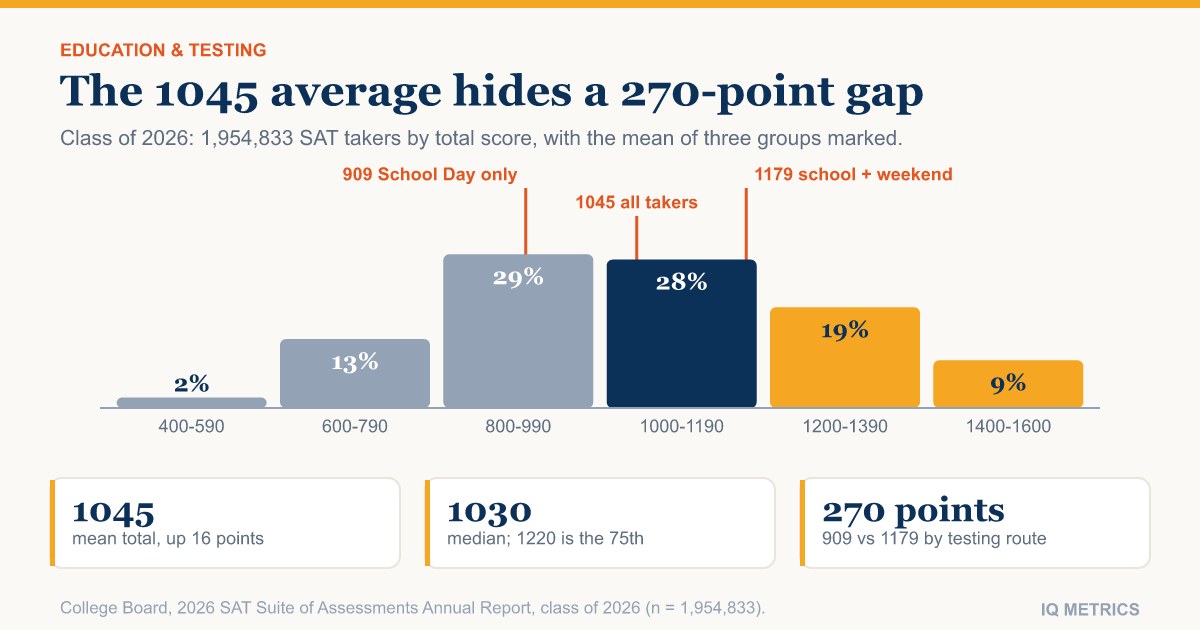
SAT Scores for the Class of 2026: What the 1045 Average Means
The College Board reports a mean of 1045 for 1,954,833 test takers, 16 points up on last year. The median is 1030, and two groups of takers sit 270 points apart, so the headline average reflects who sits the test as well as how well they do.

Average IQ of Harvard Students: About 130, Not 145
Harvard publishes SAT scores, not IQs, and one study gave 184 Harvard students a Wechsler IQ test. Both routes land close to 130, not the 145 or higher that circulates online. We also set Harvard beside Yale, Stanford, MIT and Cornell, and look at Harvard Law School.

ACT Score to IQ: What the 2026-27 National Ranks Do and Do Not Say
ACT's new national ranks put a composite of 27 at the 89th percentile of ACT-tested graduates. That is not the 89th percentile of everyone, and by ACT's own table the headline average fell mostly because of who sits the test.
Read the research.
Then find your own number.
Our IIF-certified assessment reports your score with its scale, percentile and confidence range — and a breakdown of the cognitive domains behind it.
Start IQ Test →