



IQ Test Games: Which Measure a Real Ability and Which Only Feel Like a Test
An IQ test game gives a raw score on one skill, not an IQ. We map four of our brain games to the lab tasks they come from, what each taps, and what the research says about game scores and IQ.


What you need to know
- IQ test games cannot give you an IQ. A game scores one skill in raw units such as milliseconds, moves or path length. An IQ test combines several skills and compares you with a norm group.
- Four of our brain games resemble named lab tasks: Stroop (1935), Corsi block-tapping (1972), the Tower of Hanoi planning puzzle and Mastermind. Knuth showed in 1976 that Mastermind can always be cracked in 5 guesses.
- Online versions have no fair norms. Our Stroop and sequence memory pages give no percentile. Lab norms, such as the Corsi norms from 70 healthy adults in 2000, do not carry over to a phone screen.
- Playing raises the game you play. A 2016 review found extensive evidence that training improves the trained task, less for related tasks, and little for everyday performance.
IQ test games cannot give you an IQ. A game scores one skill in raw units, such as milliseconds, moves or the longest path you can repeat. An IQ test combines several skills and compares you with a norm group. People who search for a test IQ game or an intelligence test game get games; this page explains what it can and cannot tell you.
The new part: we mapped four of our own brain games to the lab tasks they come from. The Stroop game comes from 1935. The sequence memory game comes from the 1972 Corsi block-tapping test. The Tower of Hanoi is a planning puzzle first published in 1883, and Code Breaker comes from Mastermind. Each one measures a real ability, and each one is raw, not normed.
Below: whether a game can measure your IQ, which games come from lab tasks, which ability each taps, and whether game scores track IQ or playing raises it.
Can IQ test games measure your IQ?
No. A game shows how one skill is doing today, while an IQ test puts several skills side by side and turns them into one score.
Our Brain Games hub lists eight games and says what each one measures. It also names the closest of the five areas a modern IQ test reports: verbal comprehension, visual spatial, fluid reasoning, working memory and processing speed. Then it adds the key line: a game is practice for one skill, not a measure of that index.
That is why most test IQ games end with a number in the game's own unit, such as a Stroop effect in milliseconds or a path length in tiles, and no IQ. The score is in the game's own unit. An IQ test, by contrast, has a norm sample, a mean of 100 and a standard deviation, so a score becomes a percentile.
On a scale with a mean of 100 and an SD of 15, 68.3% of people score between 85 and 115, 15.9% score below 85 and 15.9% score above 115. Our guide to CHC theory shows the abilities such tests are built on.
Here is what each of the four games reports, in its own unit:
- Stroop: your Stroop effect, the milliseconds the clashing words cost you
- Sequence memory: the longest path you repeat, and where a path slipped
- Tower of Hanoi: your moves, next to the minimum of 2 to the power n minus 1 for n disks
- Code Breaker: your guesses, next to how Knuth's strategy would have cracked the same code
None of these units converts to an IQ. A Tower of Hanoi with 3 disks needs at least 7 moves and one with 4 disks needs 15. But no published norm table turns moves or time into an IQ (as our Tower guide reports). So a claim such as "solve four disks and score a given IQ" has no source.
Which brain games come from real lab tasks?
Four of ours do: Stroop, sequence memory, Tower of Hanoi and Code Breaker, each a game version of a task psychologists have used for decades.
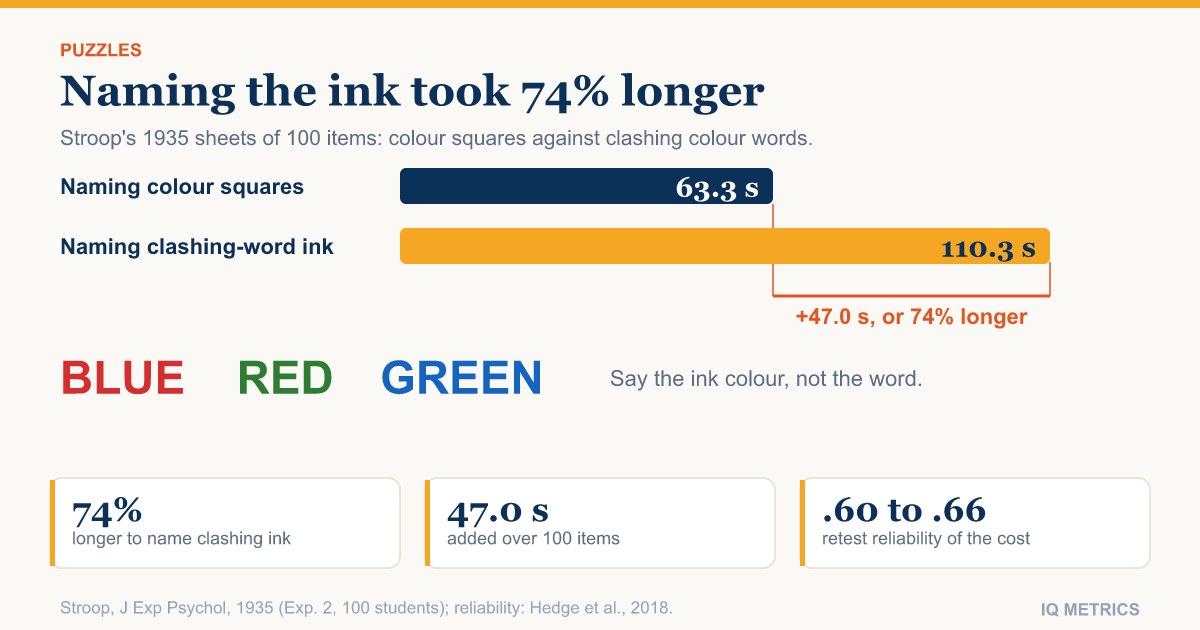
- Stroop Test: the Stroop task (1935). In Stroop's experiment, naming 100 ink colours took 110.3 seconds when the words clashed, against 63.3 seconds for colour squares, 74% longer
- Sequence Memory Test: the Corsi block-tapping task (1972), a test of visual memory span
- Tower of Hanoi: a planning puzzle published by Édouard Lucas in 1883, with tower puzzles used in research on planning
- Code Breaker: Mastermind. Donald Knuth showed in 1976 that every one of the 1,296 four-peg, six-colour codes can be cracked in 5 guesses or fewer
Our guides cover each one: the Stroop test, the Tower of Hanoi and the Mastermind strategy. You can play the Stroop test, the sequence memory test, the Tower of Hanoi and Code Breaker in your browser.
Our other four games, reaction time, digit span, the memory game and logic puzzles, have their own pages on the hub. We did not map them here.
Which ability does each game tap?
Each game works one skill hardest, but a skill label is a rough guide, not a measurement of an IQ index.
- Stroop Test: attention, inhibition and speed. Closest IQ area: processing speed
- Sequence Memory Test: spatial working memory. Closest IQ area: working memory
- Tower of Hanoi: planning and problem solving. Closest IQ area: fluid reasoning
- Code Breaker: deduction. Closest IQ area: fluid reasoning
The labels are our own reading, and the research shows why to hold them loosely. In one study of 137 students, Hanoi performance tied most strongly to inhibition. In another, of 85 students, working memory, inhibition and fluid intelligence each explained part of it (as our Tower of Hanoi guide reports). One game can tap several abilities at once.
Working memory and reasoning show the same pattern. The two correlate substantially, but how strongly depends on how each is measured, and they are not the same thing, as our working memory guide explains. A good result in a sequence memory game tells you about memory, not about reasoning.
Do game scores track IQ, and does playing raise it?
Only weakly for some tasks, and playing mostly raises the game you play.
A single Stroop score is also noisy. In a 2018 test-retest study, the reaction-time cost had a reliability of .60 and .66 in two samples, so one result says little about one person. Our Stroop guide also reports that the test tracks IQ weakly. For the other three games we found no study that links their online scores to IQ, so we state no correlation.
Does playing raise IQ? Simons and colleagues reviewed the studies that brain-training companies cite. They found extensive evidence that training improves the trained tasks. They found less that it improves closely related tasks, and little that it improves distantly related tasks or everyday performance (Psychological Science in the Public Interest, 2016).
You get better at the game you practise. Whether that spreads to IQ is the part the evidence does not show.
The longest trial is the ACTIVE study of 2,802 older adults, followed for twenty years. Speed training with boosters went with 25% fewer dementia diagnoses, while memory and reasoning training showed no significant difference, and no IQ score was an endpoint. Our brain training guide has the numbers.
Where would your own score land?
Want a score with a percentile instead of a raw number? Take the IQ Metrics test, which combines reasoning, memory and speed in one result.
Find your IQ score now! →Play a game to see how one skill is doing today. To see where you stand against other adults, take the IQ test. Then read the score on the IQ bell curve, or look up a percentile in the IQ percentile calculator.
Common questions
Can a game measure your IQ?
No. A game gives a raw score on one skill, such as milliseconds, moves or path length. An IQ test combines several skills and compares you with a norm group, so only a test like that can give an IQ.
Which brain games come from real lab tasks?
Our Stroop game comes from the 1935 Stroop task and the sequence memory game from the 1972 Corsi block-tapping test. The Tower of Hanoi is an 1883 puzzle used in planning research, and Code Breaker comes from Mastermind.
Do game scores track IQ?
Only weakly for some tasks, and we found no study linking our online scores to IQ. A single Stroop score is noisy: its test-retest reliability was .60 and .66 in a 2018 study.
Does playing brain games raise IQ?
Not shown. A 2016 review found extensive evidence that training improves the trained task, less for related tasks, and little for distantly related tasks or everyday performance.
Sources for this story
- Do "Brain-Training" Programs Work? Psychological Science in the Public Interest 17(3), 2016 — Simons et al.
- The Corsi Block-Tapping Task: standardization and normative data. Applied Neuropsychology 7(4), 2000 — Kessels et al.
- Studies of interference in serial verbal reactions. Journal of Experimental Psychology 18(6), 1935 — J. Ridley Stroop
- The computer as master mind. Journal of Recreational Mathematics 9(1), 1976 — Donald E. Knuth
- Brain games: eight short tests of speed, memory, attention and logic — IQ Metrics
Corrections: spotted an error? Email corrections@iqmetrics.org and we will update this story and note the change here.
Related stories
All news →Do Brain Training Apps Work? One Trial Survived 20 Years
A follow-up published in February 2026 tracked 2,802 adults for two decades after five weeks of cognitive training. One of the three training arms showed a lower rate of dementia diagnosis. The other two showed nothing.
Stroop Test Explained: What It Measures and the IQ Link
In Stroop's 1935 study, naming the ink colour of 100 conflicting colour words took 47 seconds longer than naming coloured squares. The effect is among the most reliable in psychology, yet one person's score is not, and it tracks IQ only weakly.

Mental Math and IQ: Does Doing Sums in Your Head Mean You Are Smart?
Fast mental arithmetic is related to working memory and to IQ, but it is not an IQ test. In 11,224 children, mental arithmetic tracked working memory at r = 0.299 and written arithmetic at 0.311: about the same.
Read the research.
Then find your own number.
Our IIF-certified assessment reports your score with its scale, percentile and confidence range — and a breakdown of the cognitive domains behind it.
Start IQ Test →