





Does Reading Raise Your IQ? The Matthew Effect, Explained
Reading volume and vocabulary growth are genuinely linked, and the relationship compounds over years rather than staying fixed. But it is mostly the verbal, crystallized side of ability that moves, not the abstract reasoning an IQ test also measures, and cause and effect run both ways.

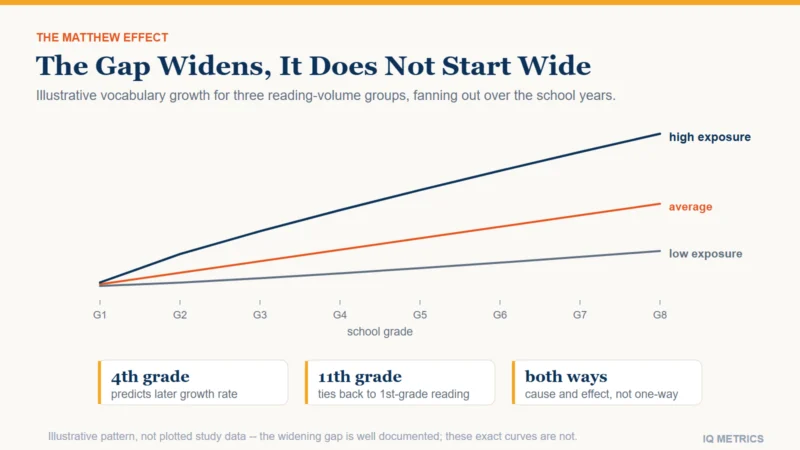
Reading volume and vocabulary growth are genuinely, strongly linked, and the relationship compounds over years rather than staying flat — psychologists call it a Matthew effect, after the biblical line about the rich getting richer. What it mostly moves, though, is verbal ability: vocabulary, background knowledge, comprehension. It is weaker evidence that reading raises the broader, more abstract reasoning an IQ test also tries to capture, and untangling cause from effect turns out to be harder than the popular version of this claim admits.
That distinction — which kind of ability actually moves — is the same question this batch keeps returning to with video games and exercise: a real, well-documented effect on something specific, next to a much weaker claim about intelligence in general.
The Matthew effect, named for a very old line
The psychologist Keith Stanovich described the pattern in the 1980s: children who decode text easily read more, and reading more builds vocabulary and background knowledge, which makes the next book easier to read, which leads to reading still more. Children who struggle with decoding do the opposite — they read less, encounter fewer new words, and fall further behind readers who started out only slightly ahead of them. The gap is not there from day one. It opens gradually, driven by a feedback loop rather than a single cause.
The name comes from a line in the Gospel of Matthew about the rich getting richer, and it is now used across psychology and economics for any process where a small early advantage compounds into a large later one, rather than staying the size it started at.
The same shape of feedback loop turns up outside reading too — in wealth, in athletic training, in scientific reputation — anywhere a small early edge changes how much opportunity or practice follows. Reading is simply one of the better-studied examples, because schools measure both sides of the loop, reading skill and vocabulary, on the same children year after year.
What the numbers show
This is not just a plausible story; it shows up in longitudinal data. One study tracking children from kindergarten through the later grades found that word-reading skill in fourth grade predicted the rate of vocabulary growth afterward, not just the vocabulary a child already had — and this held up even after statistically accounting for how large a child's vocabulary already was back in kindergarten. Above-average readers were not just ahead; they kept pulling further ahead.
The same body of research found first-grade reading ability predicting outcomes measured in eleventh grade, a full decade later, and that the prediction survived even after removing the part explained by earlier general cognitive-ability scores. In plain terms: how well a child was reading in first grade told researchers something real about where they would land by the end of school, beyond what an early IQ-type score alone would have predicted.
How researchers try to separate cause from effect
Simply asking children how much they read is a weak measure, because struggling and confident readers describe their own habits very differently. A workaround used across much of this literature is a print-exposure checklist: a long list of real book and author titles mixed in with invented ones that sound plausible, where the score is how many real titles a person recognizes. It is a rough proxy for how much a person has actually read over the years, and because it does not ask anyone to self-report or take a vocabulary test directly, it gives researchers a way to measure reading volume that is not simply the same thing as the vocabulary score it is being used to predict.
Twin studies add a second angle. Comparing identical and fraternal twins raised in the same household lets researchers estimate how much of the overlap between reading habits and vocabulary is really about shared genes and shared upbringing, rather than reading causing vocabulary directly. That work generally finds a real, independent contribution from reading itself — it is not purely a proxy for something else the twins already had in common — but it is a smaller contribution than the raw, unadjusted correlation between reading and vocabulary would suggest on its own.
Where would your own score land?
Take the IIF-certified assessment and get your score with the scale it was measured on, the percentile it corresponds to and the confidence range around it — the three figures most online tests leave out.
Find your IQ score now! →Which kind of smarter this is actually about
Psychologists split intelligence into a fluid part — reasoning through a genuinely new problem with no learned content to draw on — and a crystallized part, built from accumulated knowledge and vocabulary. The Matthew-effect research is almost entirely about the second kind. Verbal IQ scores draw heavily on vocabulary and general knowledge, which is exactly what wider reading builds most directly; the more abstract, pattern-based reasoning on the non-verbal side of most tests has a much thinner connection to how many books someone has read. This split between accumulated, knowledge-based ability and raw, in-the-moment reasoning is one of the oldest and best-replicated distinctions in the field; other frameworks for describing distinct mental abilities cover related ground from a different angle.
Cause and effect also run in both directions, which the phrase "reading raises your IQ" tends to flatten into one. Children with larger early vocabularies find reading easier and therefore do more of it; the reading then builds the vocabulary further. Some of what looks like reading's effect is really an early head start showing up again later, and the honest summary is a loop that reinforces an early difference rather than a one-way lever anyone can pull from a standing start.
Reading, EQ and other kinds of ability
It is worth being precise about what widening vocabulary actually buys a reader, socially as well as academically. A larger vocabulary and more background knowledge make it easier to follow, produce and be persuaded by complex arguments, which is a real advantage in school and at work even before it shows up as a higher test score. It is a different kind of advantage from the interpersonal skills covered in IQ versus EQ, which draw on a mostly separate set of abilities that reading volume on its own does not obviously move.
Does this still apply once you are an adult
Most of the strongest evidence here comes from childhood and the school years, when vocabulary and background knowledge are being built fastest and the gap has the most time to compound. The case for adult reading habits moving a fully developed vocabulary by a similar mechanism is much thinner — not because it has been disproven, but because it has simply been studied far less. What adult reading almost certainly still does is maintain and extend specific knowledge and vocabulary in whatever a person reads about, which matters for real-world communication and comprehension even without any change to a test score.
There is also a practical difference in what "reading" means at each age. A school-age Matthew effect is mostly about whether a child reads at all, and how much, since the comparison is against children who barely read outside class. An adult who already reads fluently is instead varying the topic, difficulty and volume of material that is, relatively speaking, a much smaller manipulation — more like choosing a harder workout than starting to exercise from nothing. That difference alone would predict a smaller effect in adulthood even if the underlying mechanism never changed.
So does reading raise your IQ
For the crystallized, vocabulary-and-knowledge side of ability, the evidence that reading volume matters is some of the strongest in this whole batch of questions — stronger than the case for chess or video games moving anything at all. For the fluid, reasoning side that IQ tests also measure, the case is much weaker, and at least part of the childhood effect is an early difference compounding rather than reading creating an advantage from nothing. The broader question of what actually moves an IQ score covers where reading fits next to environment and the other factors this site has looked at.
Keep reading
All articles →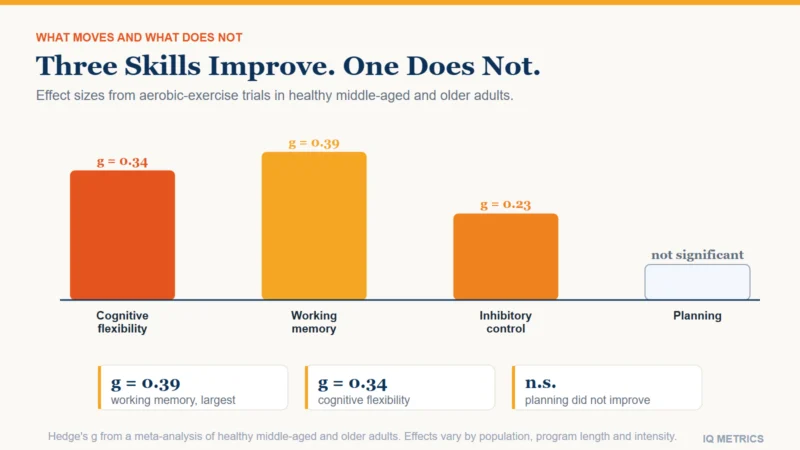 Mind & Everyday Life
Does Exercise Raise Your IQ?
Aerobic exercise has some of the best-replicated cognitive evidence of any lifestyle factor, but not for a full IQ score. What reliably improves is executive function: working memory, inhibitory control, cognitive flexibility. One related skill, planning, barely moves at all.
 Mind & Everyday Life
Do Video Games Raise Your IQ?
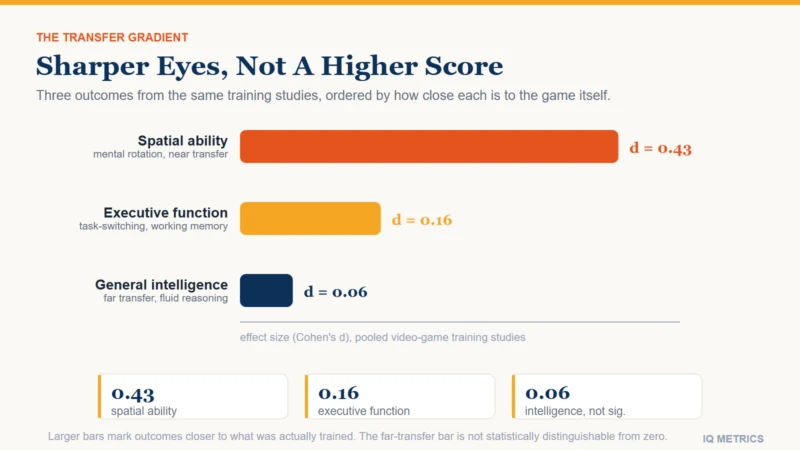
Action video games produce real, replicated gains in spatial ability and attention, some of the best near-transfer evidence in this batch. Push the test further away, toward the general reasoning an IQ test measures, and the effect all but disappears once the research is pooled properly.
 Scores & Scales
Verbal vs Non-Verbal IQ Scores
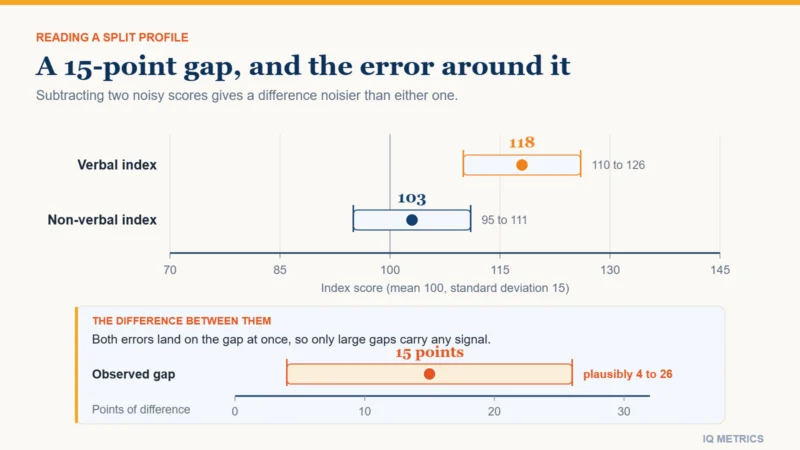
Two people can hold the same IQ number and have completely different profiles, and a split between the verbal and non-verbal indexes is far commoner than most test-takers expect. Here is what base-rate tables and compounding measurement error say about how large a gap has to be before it means anything.