
IIF Certified Assessment
Start IQ Test
IIF Certified Assessment
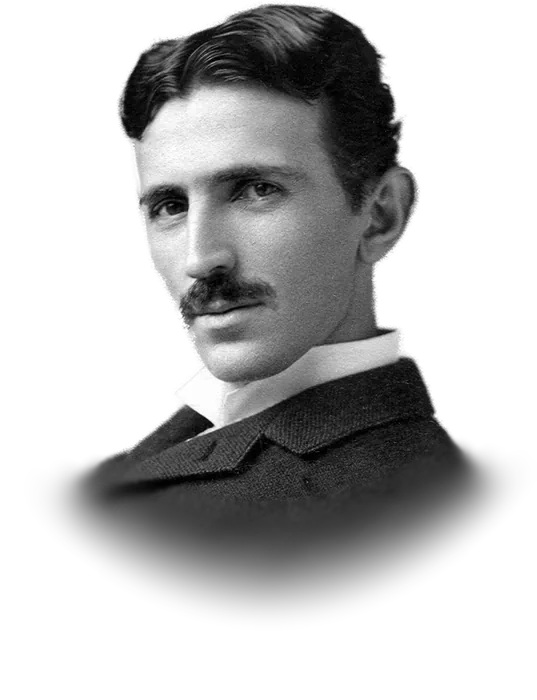
310 is the highest figure quoted for anyone on this site. It is also the least defensible: no scale in use during Tesla’s lifetime, or since, can produce it.
Tesla died in 1943 and was never tested, and almost none of the childhood record a historiometric estimate normally reads has survived. This range rests on the adult work alone, which makes it a good deal weaker than the ranges on this site built from school or university records.
Set the claim aside for a moment. If someone genuinely scored in this range, here is what that would represent.
Average is 100 by construction, and about two-thirds of people fall between 85 and 115. Take the test to place your own score on this scale.
| Score range | Classification | Share of people | What it indicates |
|---|---|---|---|
| 85 – 114 | Average | ~68% | The range most people fall into. |
| 115 – 129 | Above average | ~13.6% | Roughly one person in seven. |
| 130 – 144 | Gifted | ~2% | The threshold most high-IQ societies use. |
| Above 144 | Highly gifted | ~0.1% | Figures above this range are extrapolated from the curve rather than measured. |
Percentages are approximate and describe a normal distribution. The same number means different things on tests with different standard deviations.
Thirty questions gives you a measured position on this exact scale — your score, your percentile and the ability breakdown behind it.
Find out in 30 minutes →Nikola Tesla was born in 1856 in Smiljan, in what is now Croatia, and studied at the Polytechnic in Graz, which he left in his third year. He worked in Budapest and Paris before emigrating to the United States in 1884, arriving with a letter of introduction to Thomas Edison.
His polyphase alternating-current system, patented in 1888 and licensed to Westinghouse, settled the question of how electricity would be distributed. The lights at the 1893 Chicago World’s Fair ran on it. So does most of the grid today.
The later years — Wardenclyffe, wireless power, the increasingly unfundable projects — are the part of the story that attracts mythology, and the part where an inflated IQ figure does the most work. It substitutes a number for a reason, and the reasons are more interesting.
The estimate above rests on this record. Every entry here is a matter of public fact, which is more than can be said for the number itself.
Following a claim back to its first appearance is the part almost nobody does — and it is what most people are actually asking.

Tesla is the clearest example on this site of a number that grew. Earlier lists gave him 160 or 180 — already unsupported. The 310 appears later, on aggregator pages, and it spread because it is more shareable, not because anything new was found.
There is a specific technical reason 310 cannot be real, and it is worth stating plainly. An IQ score is a rank, not a quantity. It says where a person falls in a distribution of test-takers. A score of 310 would describe someone rarer than one in every particle in the observable universe, on tests whose norms run out around 160. The number does not overstate Tesla. It fails to mean anything.
None of which diminishes the record. Tesla’s polyphase AC work is one of the most consequential engineering contributions of the nineteenth century, and it is checkable in the patent archive. That record is what our 160–175 rests on — and it is why the range sits so far below the circulating figure. The invented score is not flattery; it replaces something documented with something fictional.
How we read a number →Granted patents, publicly archived. The strongest documented evidence of the work the number is supposedly standing in for.
Source of the mental-visualisation accounts. First-person and unverifiable, and it should be read as testimony rather than evidence.
The standard source for retrospective IQ estimates of historical figures. Tesla is not in it — the study covered people born between 1450 and 1850, and he was alive when it was published.
Tesla died in 1943. No school, army, university or press record of a test result has ever surfaced.
Source URLs and first-appearance date pending audit.
No original could be located. The figure appears to originate in list culture rather than any document.
The figures that circulate for Nikola Tesla, what we were able to confirm, and where the two diverge.
Figures between 160 and 310 circulate, with 310 by far the most repeated. It is often presented as fact, sometimes alongside a claim that it is the highest IQ ever recorded.
310 is not a score. It is not on any scale. Modern IQ tests are normed with a standard deviation of 15 or 16 around a mean of 100; 310 sits fourteen standard deviations above the mean, a region where the tests have no items, no norms and no meaning. Even the ratio-IQ formula used in the 1910s could not produce it for an adult.
A spread of 150 points is not disagreement about a measurement. It is the signature of a figure that was never measured at all.
Want a number that does hold up? Every figure on this page is somebody’s claim. Take the 30-question test and get a percentile you can check rather than a figure you have to trust.
No measured score exists — he was never tested. The 310 that circulates is invented. Our 160–175 range is inferred from his patent record and documented engineering work, not from a test.
No. It is not a recorded score at all. Modern tests have no norms above roughly 160, so 310 does not correspond to any measurable result.
IQ is a rank within a population, not a quantity of intelligence. On a scale with a mean of 100 and a standard deviation of 15, 310 is fourteen standard deviations out — beyond the range where any test has items or norms.
He described vivid mental imagery and said he could test machines in his head, in his 1919 autobiography. It is a first-person account and has never been independently verified.
No. He attended the Polytechnic at Graz on a scholarship and left in his third year without a degree, then studied briefly in Prague.
Einstein has a documented range built from his published record; Tesla has none, because the historiometric studies that produced numbers for earlier figures excluded anyone still alive in 1926.
You can find out in about fifteen minutes. The IQ Metrics assessment is 30 questions, scored on the same 100-mean scale used throughout this page, so your result and the estimate above are at least expressed in the same units — one measured, one inferred. Once you have a number, the leaderboard shows where it would sit, and how we score and norm it explains the benchmarking.
From the documented record rather than a test — the method is named above and set out in full under how we read a number. Compare it against the other scientists profiles, starting with Albert Einstein.


Portrait © Matthew Yohe, CC BY-SA 3.0. The background-removed portrait above is a derivative work and is likewise offered under the same licence. · Portrait © Debbie Rowe / The Royal Society, CC BY-SA 3.0. The background-removed portrait above is a derivative work and is likewise offered under the same licence. · Portrait by Christopher Smith, U.S. Department of Health and Human Services — a work of the U.S. federal government, public domain. Background removed for the portrait above.
Thirty questions, scored against general-population benchmarks. Your score, your percentile, your ability breakdown and a printable IIF certificate.
Find your IQ score now! →The assessment costs nothing and you always get a real result. Upgrades add precision, analysis and a certificate — never access to the test itself.
Whatever you paid comes off the next tier for 30 days. Start small without losing the money.
Not what you expected? Full refund, no questions, no form to hunt for.
Prices adjust to your country automatically, so the certificate is reachable outside high-income markets.
Coming later: an annual membership (~$89/year) for unlimited retests, practice sets and progress tracking. Monthly billing is deliberately not offered — a once-a-year assessment does not justify a monthly charge, and it would churn.





.jpg)
