





Is a 120 IQ Score High? Where the Number Actually Sits
A score of 120 sits comfortably above average, and roughly nine people in ten score below it. But "high" is a comparison, not a property, and the honest answer depends on which scale produced the number, how much error is wrapped around it, and what you were hoping the score would tell you.
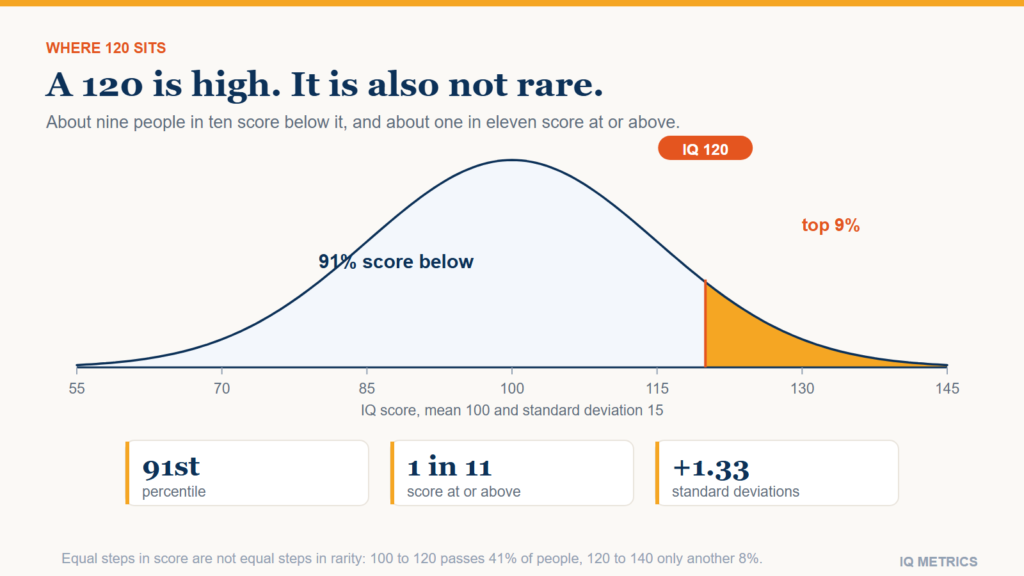
Yes. A score of 120 is high. On a test scaled to a mean of 100 and a standard deviation of 15, it sits one and one-third standard deviations above the average, which places it at roughly the 91st percentile — about nine people in every ten score below it.
That is the answer. The rest of this article is about the three things the number does not say, because those are what people usually want when they ask the question: how rare 120 actually is, how much of it is real, and what it is supposed to be good for. If you want the companion piece on what a 120 reports about the measurement itself, we wrote that separately as what an IQ of 120 means, and what it does not.
Where 120 sits on the curve
IQ scores are not counts of anything. They are positions in a distribution, built by giving a test to a large representative sample and then re-expressing every raw score as a rank within that sample. The scale is fixed by convention: the middle of the reference group is called 100, and one standard deviation is called 15 points.
That convention is what turns 120 into a percentile. Twenty points is 1.33 standard deviations, and on a normal curve 1.33 standard deviations above the mean cuts off the top 9.2 percent. So:
- About 91 percent of the reference population scores below 120.
- About 1 person in 11 scores at or above it.
- Inside a room of 100 people drawn at random, roughly nine others would match or beat the score.
That last framing is the one worth sitting with. A 120 is genuinely above average and it is genuinely not rare. Both are true, and which one feels more accurate depends entirely on the comparison group you have in your head. You can check any score against the curve directly with the IQ percentile calculator, or see the whole distribution laid out on the IQ bell curve page.
It is also worth noticing how quickly rarity changes as you move along the curve. Going from 100 to 120 takes you past 41 percent of the population. Going the same twenty points again, from 120 to 140, takes you past only another 8 percent, because the curve is thinning out underneath you. Equal steps in score are not equal steps in rarity, and that asymmetry is why a 20-point gap sounds like a fixed quantity and behaves like anything but. The scale is symmetric in the other direction too: 120 is exactly as far above the mean as 80 is below it, and the two are about equally common.
The label attached to 120 depends on which manual you read
There is no single official vocabulary for IQ bands. Every test publisher writes its own, and they disagree at exactly the point where 120 falls.
- On the Wechsler scales, the band containing 120 is usually printed as High Average or, in older editions, Superior — the boundary has moved between revisions.
- On Stanford-Binet, 120 sits in Superior.
- Many popular charts online invent a band, then attach adjectives to it that no test manual has ever used.
This matters more than it sounds. A reader who finds 120 called "Superior" on one chart and "High Average" on another has not found a contradiction in the data; they have found two publishers labelling the same slice of the same curve differently. If you want the labels compared properly, that is what IQ classifications and the ranges of IQ level are for. The number is the finding; the adjective is editorial.
Change the scale and 120 moves
The 15-point standard deviation is a convention, not a law. Some tests, Cattell's among them, use 16 points, and a handful of high-range tests use 24. The same performance therefore produces different numbers depending on which scale printed the report.
A score of 120 on a 15-point scale is about 121 on a 16-point scale, because both describe the same 91st percentile. That is a small gap in the middle of the range, but it widens fast towards the tails, which is why comparing two scores from two different tests is a real problem rather than a pedantic one. The IQ score converter does the translation, and the 15 versus 16 problem is written up in full.
The practical rule: a score without its scale is not a score. If a report does not say what standard deviation it used, the number in it cannot be compared to anything.
Where would your own score land?
Take the IIF-certified assessment and get your score with the scale it was measured on, the percentile it corresponds to and the confidence range around it — the three figures most online tests leave out.
Find your IQ score now! →The error bar around 120 is wider than people expect
No test measures without error. A well-built professional instrument reports a 95 percent confidence interval of roughly plus or minus 4 to 5 points on the full-scale score, and shorter or online tests are wider still.
So a measured 120 usually means something closer to "this person's true score is very probably somewhere between 115 and 125". Every number in that band is compatible with the evidence, and treating the printed 120 as exact is the single most common misreading of an IQ report. Two people scoring 118 and 122 have not been distinguished by the test at all. The margin of error explained covers why, and how to read an IQ test report shows where the interval is printed on an actual score sheet.
What a 120 does and does not predict
Cognitive ability scores are among the better-validated predictors in psychology, which is a lower bar than it sounds. In the ranges around 120 the relationships are real, consistently replicated, and modest.
- Academic work. Ability scores correlate with school attainment at roughly 0.5, which means they explain about a quarter of the variation in outcomes and leave three quarters to everything else. See does IQ predict school success.
- Job performance. The correlation in complex roles is real but smaller than the older literature claimed, and it has been revised downwards as the corrections applied to it were re-examined. What a score predicts at work has the current numbers.
- Income. Weakly, and mostly through education. Does IQ predict income goes through the evidence.
- Almost everything else people hope for. Judgment, discipline, creative output and good decisions are only loosely related to ability scores, which is the whole subject of why smart people make bad decisions.
None of that makes 120 unimportant. It makes it a starting condition rather than a verdict.
Is 120 high enough for a specific thing?
The question behind the question is usually about a threshold someone else has set, and those are easier to answer than the general case.
- Mensa. No. The entry requirement is the 98th percentile, which is 130 on a 15-point scale and 132 on a 16-point one — though what 130 actually marks is a separate question from what it admits you to. See Mensa IQ score requirements.
- School gifted programmes. Usually not, on a strict cutoff, though many districts use local rather than national norms and some screen more broadly. Gifted cutoff scores explains why the line is set where it is and who it misses.
- Postgraduate study or a demanding profession. There is no cognitive test threshold for either, and the admissions tests that do exist measure achievement and preparation as much as ability. Achievement tests versus IQ tests draws the line.
What to do with a 120
Very little, honestly, and that is not a dismissal. A single full-scale number is the least informative thing on a proper score report. The index scores underneath it — verbal comprehension, perceptual reasoning, working memory, processing speed — carry the information that is actually usable, and a flat 120 across four indices describes a different person from a 120 built out of a 135 and a 100.
If the number came from a short online test, treat it as an estimate with a wide interval rather than a measurement. If it came from a professional assessment, the interesting reading is in the profile, not the headline. Either way the useful next questions are about the shape of the score rather than its size: verbal versus non-verbal scores and processing speed are where that starts.
And if you are here because you scored 120 and wondered whether it was good, the more useful comparison is not against other people. It is against the same test taken again under better conditions, which is a genuinely different question and one the IQ comparison tool is built to answer.
Keep reading
All articles →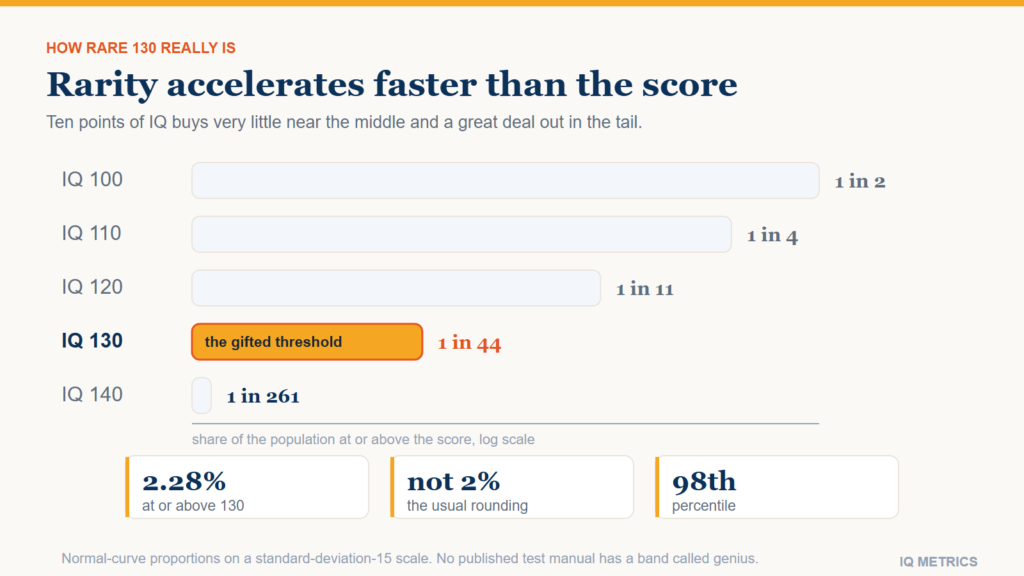 Scores & Scales
Is 130 IQ a Genius Score?
A score of 130 is the conventional threshold for gifted identification and for high-IQ society membership, and it is reached by about one person in 44. It is not, however, a "genius" score, because no published test defines such a band. The word is a popular import, and the difference is worth understanding.
 Scores & Scales
IQ Classifications
This article discusses the various factors that affect intelligence, the several IQ classifications, and their significance. IQ testing definitions and the origins of "gifted," "average," and "intellectually disabled" are revealed.
 Scores & Scales
Mensa IQ Score Requirements
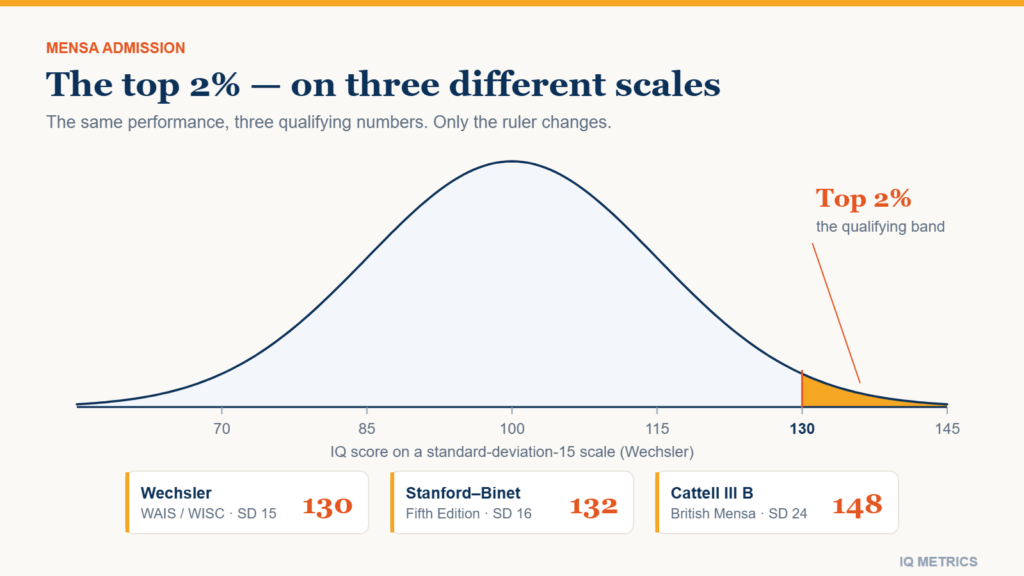
Mensa admits the top 2% of scorers, but "the top 2%" is a rank, not a number, and the number it maps to changes with the test you sat. Here is what qualifies on the Wechsler, Stanford-Binet and Cattell scales, the two routes to membership, and what the supervised admission test is actually like.