





Is 130 IQ a Genius Score? What the Number Really Marks
A score of 130 is the conventional threshold for gifted identification and for high-IQ society membership, and it is reached by about one person in 44. It is not, however, a "genius" score, because no published test defines such a band. The word is a popular import, and the difference is worth understanding.
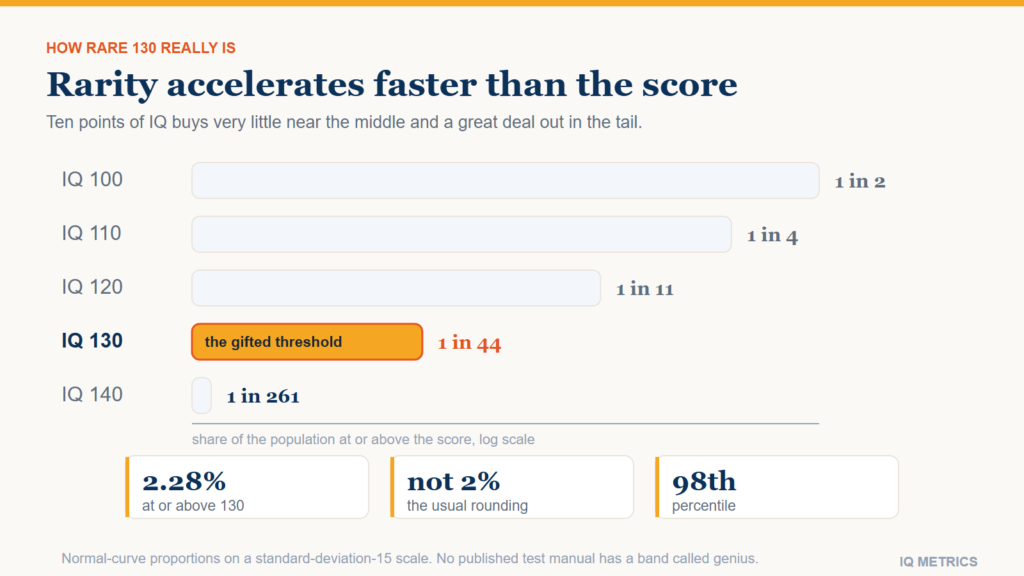
Not exactly. A score of 130 marks the conventional threshold for gifted identification and for admission to most high-IQ societies. It sits two standard deviations above the mean, at roughly the 98th percentile, reached by about one person in 44.
What it is not is a "genius" score, and the reason is simpler than it sounds: no published intelligence test has a band called genius. Not the Wechsler scales, not Stanford-Binet, not any current professional instrument. The word arrives from popular writing and attaches itself to whatever number a chart happens to have handy.
What 130 actually marks on a test manual
IQ scores are positions in a distribution. The mean of the reference sample is defined as 100, one standard deviation as 15 points, and every score is a rank against that sample. Two standard deviations above the mean is 130, and that is where the top band on most manuals begins.
The names used for that band are publisher-specific:
- Wechsler editions have printed it as Very Superior and, more recently, Extremely High.
- Stanford-Binet uses Gifted or Very Advanced.
- Education systems generally use gifted, and set the line at 130 or at a local equivalent.
- No manual anywhere uses genius.
That last point is not pedantry. "Genius" in ordinary use means exceptional creative achievement — work that changed a field. That is an outcome observed over a career, not a percentile observed in an afternoon. Conflating the two is how the internet ended up with confident IQ figures for historical figures who never sat a test, a problem taken apart in where celebrity IQ numbers come from.
How rare 130 really is
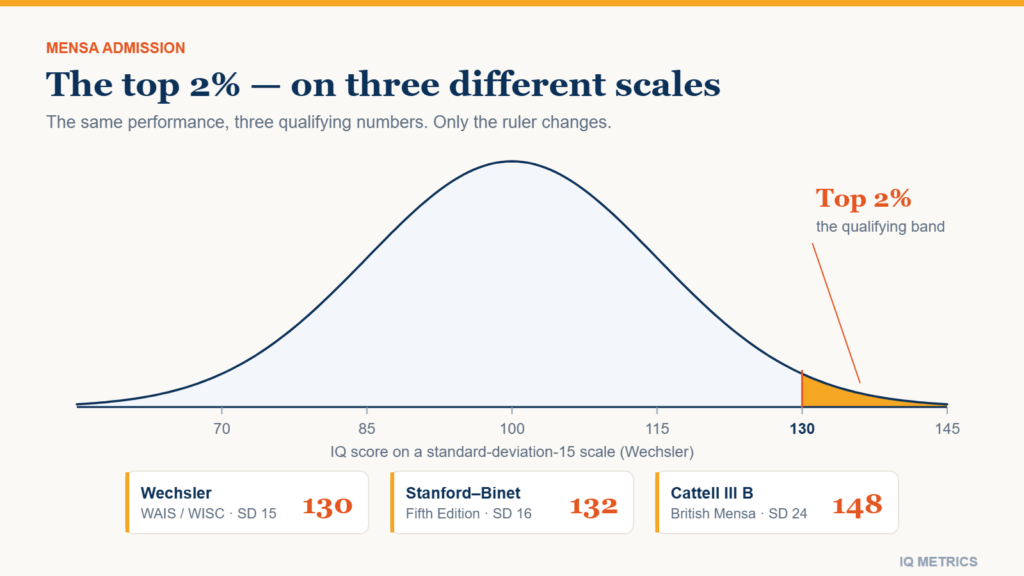
The usual claim is "the top 2 percent", which is close enough to be repeated everywhere and wrong enough to matter. On a normal curve, the proportion at or above two standard deviations is 2.28 percent — about 1 person in 44, not 1 in 50.
The gap widens as you go further out, because rarity accelerates much faster than the score does. Ten points of IQ near the middle of the curve moves a percentile by a few points; ten points near the tail changes rarity by an order of magnitude. How rare is an IQ of 130 works the numbers through, and the IQ bell curve page shows what each stretch of the curve actually contains.
130 on one scale is not 130 on another
The 15-point standard deviation is a convention. Cattell's scale uses 16, which is why Mensa publishes two qualifying numbers rather than one: 130 on a 15-point scale, 132 on a 16-point one. Both describe the same 98th percentile.
So a reported 130 means nothing until the scale is known, and a report that omits it cannot be compared with anything. Mensa IQ score requirements covers the accepted tests and the two thresholds, and the IQ score converter translates between scales directly.
The error bar straddles the line
A threshold implies a sharp edge. Measurement does not provide one.
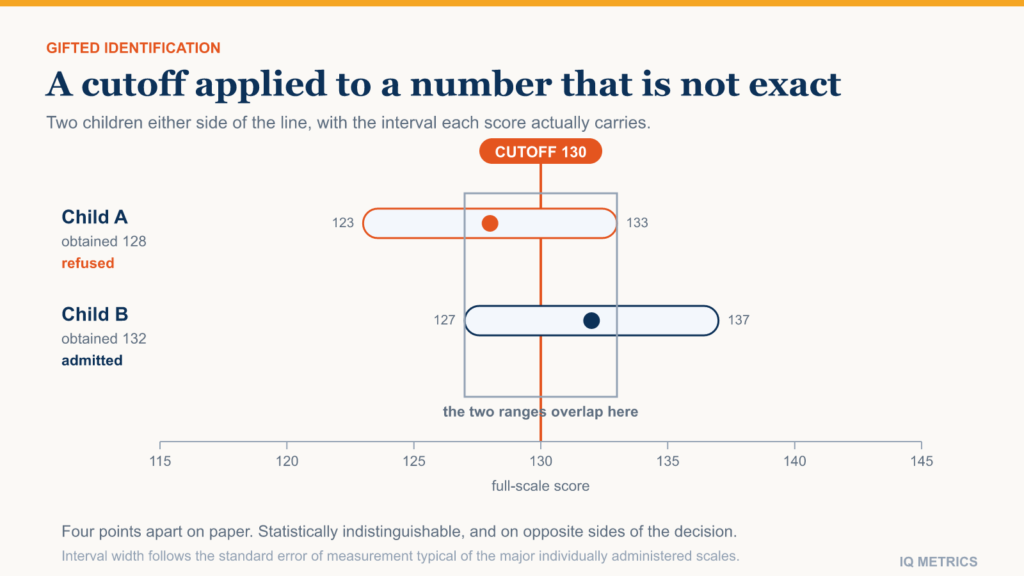
A professional full-scale score carries a 95 percent confidence interval of roughly plus or minus 4 to 5 points. A measured 130 therefore means "the true score is very probably between 125 and 135", and a measured 127 means "very probably between 122 and 132" — two intervals that overlap heavily. The test has not separated those two people, but a cutoff at 130 does.
This is a real administrative problem rather than a philosophical one, and it is the subject of gifted cutoff scores: who a single number misses, why local norms sometimes replace national ones, and why universal screening changes who gets identified at all. The margin of error explained covers the underlying arithmetic.
Where would your own score land?
Take the IIF-certified assessment and get your score with the scale it was measured on, the percentile it corresponds to and the confidence range around it — the three figures most online tests leave out.
Find your IQ score now! →What 130 predicts, and what it does not
The relationships that hold at 120 hold at 130, with the same honest limits. Ability scores correlate with academic attainment at around 0.5, with job performance in complex roles more weakly than the older literature claimed, and with income mostly through education.
Two findings are specific to the high end and worth knowing:
- The returns keep going, but they flatten. Above roughly 120 the incremental prediction of everyday outcomes weakens, though longitudinal work on very high scorers does still find differences in attainment, patents and doctorates at the top of the range. The effect is real and it is not a step change.
- Creative achievement is not the same variable. The threshold hypothesis — that above a certain level of ability, creativity depends on other things — is contested in its strong form, but the weak version is well supported: past a point, personality, opportunity and sheer output matter more than additional points. IQ and creativity goes through the evidence.
So 130 predicts that abstract problems get solved faster than average. It does not predict originality, judgment or persistence, and it is not what distinguishes people who actually change a field. Why smart people make bad decisions is about the gap between the two.
What a high-IQ society actually asks for
If the question is really "does 130 get me in", the answer depends on the society and, more importantly, on how the score was obtained.
- The threshold is a percentile, not a number. Mensa asks for the 98th percentile, which is why it lists different qualifying scores for different tests rather than a single figure.
- Supervised administration is required. No society accepts an unproctored online result, because the interval around one is far too wide and the conditions are unverifiable.
- Prior evidence is often accepted. A qualifying score from a professionally administered test, sometimes taken years earlier, is usually enough without re-testing.
- Other societies set higher lines. Some ask for the 99.9th percentile or beyond, where the norm tables are built on very small samples and the scores become correspondingly less reliable.
The full list of accepted tests and both qualifying numbers are in Mensa IQ score requirements, with the shorter version at the Mensa requirement explained.
A child scoring 130 and an adult scoring 130
The two are not the same claim, and conflating them causes real confusion for parents.
A child's score is a comparison against other children of the same age, and it is considerably less stable than an adult's. Scores measured in early childhood correlate only moderately with the same child's scores a decade later; stability improves substantially from around school age and is high by adolescence. A 130 at five years old is a much weaker prediction than a 130 at fifteen. What age is most accurate for an IQ test goes into the detail, and the IQ scale by age explains how the age norming works.
For an adult, the score is stable in the sense that the ranking tends to hold, but the underlying abilities do not all move together over a lifetime. Reasoning speed declines from early adulthood while accumulated knowledge keeps rising, and a full-scale number averages over both. IQ and age has the curves.
What the word "genius" is actually doing
Historically it was a scoring label. Lewis Terman's early Stanford-Binet used "genius or near genius" for scores above 140, and his longitudinal study of high scorers was informally called the Genetic Studies of Genius. The label did not survive contact with the results: the cohort did well, and produced no one whose work reshaped a discipline, while two future Nobel laureates had been screened out for scoring too low.
Test publishers dropped the word for good reasons, and it survives mainly in charts written by people who are not testing anyone. If the underlying question is about the top of the range rather than the vocabulary, what is genius IQ level and what is a genius IQ score cover the ground the term usually stands in for.
If you have a 130 in hand
The full-scale number is the least informative line on the report. A 130 built from four consistent index scores describes a different profile from a 130 built out of a 145 verbal score and a 108 processing speed, and the second is common enough that clinicians have a term for it. How to read an IQ test report shows where to find the index scores and the scatter between them.
And if the score came from a short online test, the interval around it is wide enough that the threshold question is genuinely open. High-IQ societies do not accept unproctored results for exactly that reason. Where a score sits relative to the curve is easy to check with the IQ percentile calculator; whether two scores actually differ is the harder question the IQ comparison tool is built for.
Keep reading
All articles →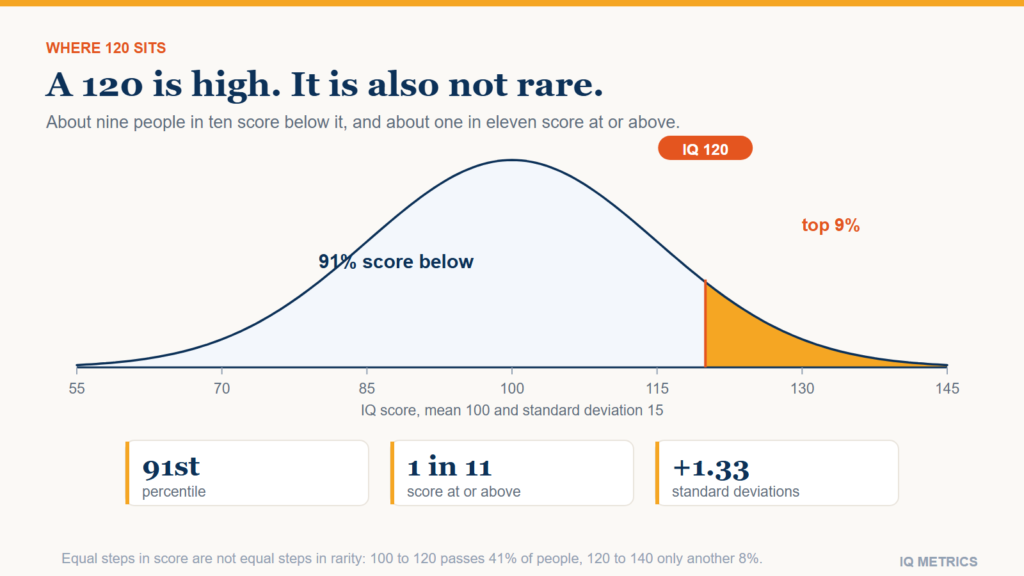 Scores & Scales
Is a 120 IQ High?
A score of 120 sits comfortably above average, and roughly nine people in ten score below it. But "high" is a comparison, not a property, and the honest answer depends on which scale produced the number, how much error is wrapped around it, and what you were hoping the score would tell you.
 Scores & Scales
Gifted Cutoff Scores
Most gifted programmes draw their line at an IQ of 130. The number is a statistical convention rather than a boundary in nature, and three well-documented features of how the score is produced and used mean a strict cutoff reliably excludes children who belong on the other side of it.
 Scores & Scales
Mensa IQ Score Requirements
Mensa admits the top 2% of scorers, but "the top 2%" is a rank, not a number, and the number it maps to changes with the test you sat. Here is what qualifies on the Wechsler, Stanford-Binet and Cattell scales, the two routes to membership, and what the supervised admission test is actually like.