


What an IQ of 110 Means: Average, High Average, or Both?
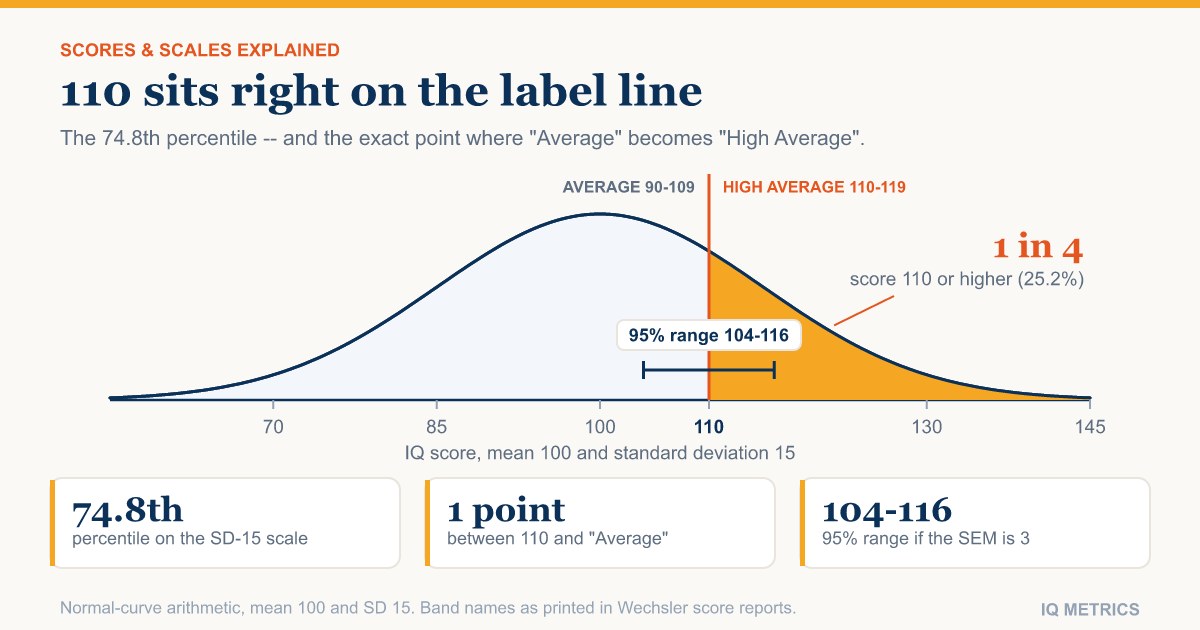
On the mean-100, standard-deviation-15 scale most modern tests use, 110 sits at the 74.8th percentile. The WISC-V calls it High Average, the Woodcock-Johnson IV still calls it Average, and the margin of error runs straight across the line between them.

What you need to know
- An IQ of 110 is two-thirds of a standard deviation above the mean on a mean-100, standard-deviation-15 scale. That is the 74.8th percentile, which score reports round to a percentile rank of 75: roughly one person in four scores 110 or higher.
- Tests disagree on the word. WISC-V and WAIS-IV reports label 110 High Average, the lowest score in that band, while the Woodcock-Johnson IV still counts it as Average and WAIS-5 reports use the wording Above average.
- The WISC-V Full Scale IQ has an average standard error of measurement of 2.90 points, so a symmetric 95% band around a reported 110 runs from about 104 to 116, a range that covers both labels.
- The printed number only means the 74.8th percentile on an SD-15 scale. On the SD-16 scale of the old Stanford-Binet Form L-M the same 110 is the 73.4th percentile, and on the SD-24 Cattell scale it is the 66.2nd.
A score of 110 is one of the most common results people bring back from an IQ test, and one of the hardest to read. It is clearly above 100, which feels as if it should mean something, yet it is nowhere near the rare territory that gets attention. The short answer is that 110 is above average. The longer answer is more useful: on the scale most tests use, 110 is a precise position, it sits exactly on the boundary between two descriptive labels, and the test's own margin of error is wide enough to put a person on either side of that boundary.
Where 110 sits on the bell curve
Modern IQ scores are deviation scores. A test is given to a large reference sample chosen to represent a population, the results are placed on a scale where the average is set to 100, and the spread is fixed so that one standard deviation — the typical distance of a score from that average — equals 15 points. On that scale, 110 is 10 points, or two-thirds of a standard deviation, above the mean.
Normal-curve arithmetic turns that distance into a percentile. Two-thirds of a standard deviation above the mean is the 74.8th percentile: about 74.8% of the reference sample scored below 110, and about 25.2% scored 110 or higher. Put plainly, roughly one person in four reaches 110 or more. Enter 110 with a standard deviation of 15 in our IQ percentile calculator and it returns the same figure. Here is how the neighbouring scores compare on the same scale:
- IQ 100: the 50th percentile, the exact middle of the reference sample
- IQ 105: the 63.1st percentile
- IQ 110: the 74.8th percentile, with about one person in four scoring this high or higher
- IQ 115: the 84.1st percentile, one full standard deviation above the mean
- IQ 120: the 90.9th percentile, the score covered in our note on what an IQ of 120 means
- IQ 130: the 97.7th percentile, two standard deviations above the mean
Is 110 a good IQ score?
"Good" is not a term any test manual uses. The descriptive labels printed on professional score reports are the closest thing to an official answer, and 110 lands right on the boundary between two of them. The children's Wechsler scale, the WISC-V, sorts its Full Scale IQ and index scores into these bands:
- Extremely High: 130 and above
- Very High: 120 to 129
- High Average: 110 to 119
- Average: 90 to 109
- Low Average: 80 to 89
- Very Low: 70 to 79
- Extremely Low: 69 and below
On that scale 110 is High Average, and it is the lowest score that earns the label: 109 is Average. The Average band is deliberately the widest on the chart, twenty points holding roughly half of the reference sample, so 110 is the first label change above the middle. Normal-curve arithmetic puts 16.1% of people between 110 and 120, the same share David Wechsler printed for that band in 1958.
The word printed beside a 110 depends on which test produced it, which is the first reason not to lean on the label:
- WISC-V: High Average, the band from 110 to 119
- WAIS-IV, the previous adult Wechsler scale: High Average in Pearson's own sample reports, which use the older names Superior and Very Superior for the bands above it
- WAIS-5, the adult edition released in 2024: Pearson's sample report describes a 111 as Above average rather than High Average
- Woodcock-Johnson IV: still Average, because its Average band runs from 90 to 110 and High Average begins at 111
- Wechsler's own 1958 classification: Bright-normal for 110 to 119, and in his 1944 edition the Average band ran from 91 to 110
So yes, 110 is a good score in the only sense a test can support: it is above average, higher than roughly three people in four in the reference sample. It is not rare, it is not a cut-off for anything in particular, and it is a long way from the 98th percentile that the Mensa admission rule asks for.
At 110 the number is steadier than the word printed beside it. A retest, or a different test, can change the label without anything about the person having changed.
The margin of error runs straight through the label line
No test measures without error. Test manuals publish a standard error of measurement, or SEM: an estimate of how far a reported score typically sits from the score the same person would average over many sittings. For the WISC-V Full Scale IQ the SEM averages 2.90 points across age groups, and the adult WAIS-IV, with a full-scale reliability of .98, implies about 2.1. A 95% confidence interval is roughly 1.96 standard errors either side of the score. Our explainer on why an IQ score is a range, not a number walks through that arithmetic in detail.
Apply it to 110. With the WISC-V's 2.90-point error, a symmetric 95% band runs from about 104 to 116. With the WAIS-IV's smaller error it runs from about 106 to 114. Either way the band straddles the line the label sits on. A person reported as High Average on one occasion could, with no change in ability at all, be reported as Average on a retest, and the reverse is just as plausible. The label flips; the estimate barely moves.
This is why comparisons at this level need care. A 107 and a 112 are not reliably different results, and neither are a 109 and a 110, even though a WISC-V report calls one of them Average and the other High Average. When a label matters for a decision, the range is the part of the report to read.
The same 110 on a different scale
Every figure above assumes a standard deviation of 15, which is what the modern Wechsler scales, the current Stanford-Binet and most contemporary tests use. A number printed without its scale cannot be interpreted, because the same 110 is a different position on a scale with a different spread:
- Standard deviation 15, the modern Wechsler and Stanford-Binet scales: 110 is the 74.8th percentile
- Standard deviation 16, used by the 1960 Stanford-Binet Form L-M: 110 is the 73.4th percentile
- Standard deviation 24, the Cattell scale some high-IQ societies still quote: 110 is only the 66.2nd percentile
Converting between scales means matching the percentile, not copying the number, which is exactly what our IQ score converter does. Our note on standard deviation 15 versus 16 shows the same effect at a higher score, where one percentile prints three different numbers.
What a 110 does not tell you
- It does not describe a profile. A Full Scale IQ of 110 can come from evenly matched index scores or from a strong verbal score balancing a weaker processing-speed score, and our piece on full-scale IQ versus index scores explains why the summary can hide the pattern
- It does not predict an individual outcome. Scores relate to averages across large groups, and the spread of outcomes around any average is wide
- It does not travel between tests. A 110 from a short, unnormed online quiz is not the same claim as a 110 from an individually administered battery; see what to check before trusting an online score
- It does not stay fixed as norms age. A 2014 meta-analysis of 285 studies in Psychological Bulletin put the Flynn effect at 2.31 points per decade, so a score measured against an old reference sample reads higher than the same performance against a new one
Where would your own score land?
To see where your own result falls, take a properly normed assessment and read the percentile and the range beside the score, not the single number alone.
Find your IQ score now! →So is 110 a good IQ? On the standard scale it is a solidly above-average result: the 74.8th percentile and, on the WISC-V, the first step into the High Average band. Read with its range attached, it is also a result that sits honestly on the line between two labels, which is the most accurate description a single test can give. If you want a score with its percentile beside it, our IQ test reports one.
Common questions
Is 110 a good IQ?
Yes, it is above average. On the mean-100, standard-deviation-15 scale most tests use, 110 is the 74.8th percentile, and WISC-V and WAIS-IV score reports classify it as High Average. It is the lowest score in that band, since 109 is labelled Average.
What percentile is an IQ of 110?
The 74.8th percentile on a standard-deviation-15 scale, which score reports round to a percentile rank of 75. About one person in four scores 110 or higher. On the SD-16 scale of the old Stanford-Binet Form L-M it is the 73.4th percentile, and on the SD-24 Cattell scale it is the 66.2nd.
Is 110 average or high average?
It depends on the test. The WISC-V and WAIS-IV label 110 High Average, the Woodcock-Johnson IV counts 90 to 110 as Average, and WAIS-5 reports use the wording Above average. Because every score carries a margin of error of a few points, a reported 110 is consistent with a true score on either side of that line.
Is 110 a good IQ for a teenager?
The number means the same thing at any age, because IQ scores are age-normed. A 13-year-old's 110 is compared with other people of the same age, so it places them at about the 74.8th percentile of their own age group.
Sources for this story
- WISC-V Interpretive Report sample: descriptive classifications, percentile ranks and 95% confidence intervals — Pearson (2020)
- WAIS-5 Sample Score Report — Pearson (2024)
- Woodcock-Johnson IV standard score and RPI interpretation charts — Riverside Insights
- The Measurement and Appraisal of Adult Intelligence, 4th edition, on the classification of intelligence — Wechsler, D. (1958), Williams & Wilkins
- Review of the WISC-V, on reliability and the standard error of measurement — Miller & McGill (2016), in Intelligent Testing with the WISC-V, Wiley
- The Flynn effect: A meta-analysis — Trahan, L. H., Stuebing, K. K., Fletcher, J. M., & Hiscock, M. (2014), Psychological Bulletin, 140(5)
Corrections: spotted an error? Email corrections@iqmetrics.org and we will update this story and note the change here.
Related stories
All news →What an IQ of 120 Means, and What It Does Not
On the scale most modern tests use, 120 sits around the 91st percentile. Change the scale and the same number moves. Add the measurement error every test carries and it stops being a point at all.
An IQ Score Is a Range, Not a Number: The Margin of Error
Every properly built test publishes a standard error of measurement alongside the score. On a mean-100, standard-deviation-15 scale it is large enough that a reported 104 and a reported 111 are not reliably different results.
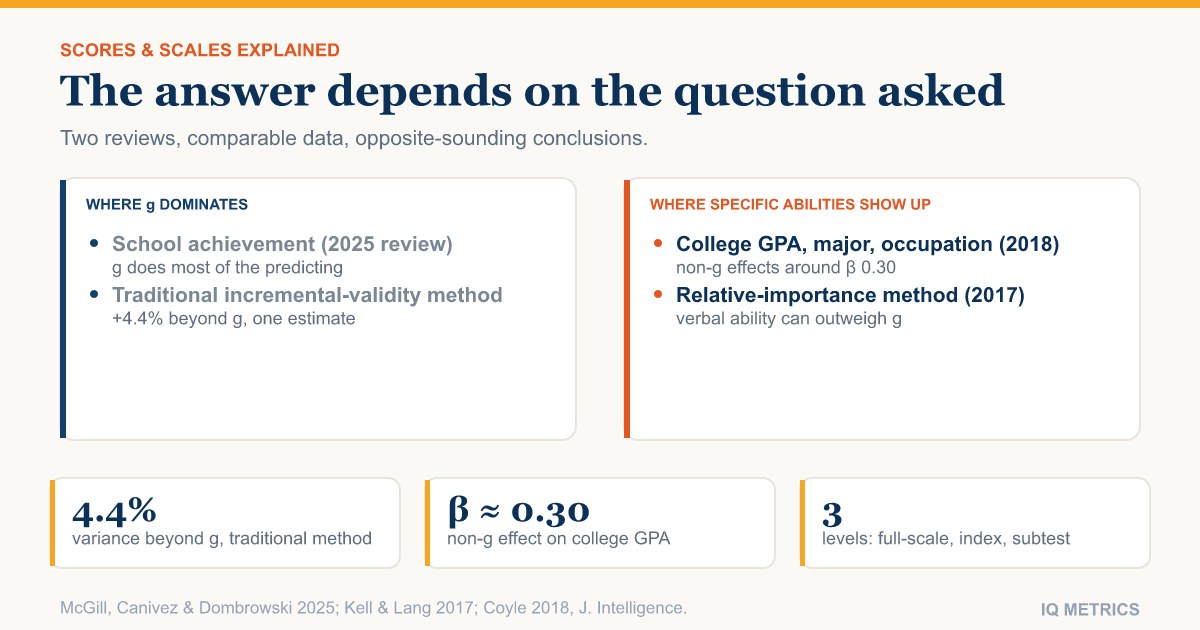
Specific Abilities vs g: What New Reviews Actually Weigh
Does a subtest or index score on an IQ test tell you anything beyond the single full-scale number? Recent reviews reach different answers, largely because they ask the question with different statistical methods.
Read the research.
Then find your own number.
Our IIF-certified assessment reports your score with its scale, percentile and confidence range — and a breakdown of the cognitive domains behind it.
Start IQ Test →