





High IQ and ADHD: What Twice-Exceptional Research Actually Shows
High IQ and ADHD can and do coexist, at close to the general-population rate. What twice-exceptional actually means, why the combination gets missed in both directions, and how ADHD can pull down a full-scale IQ score without touching real reasoning ability.

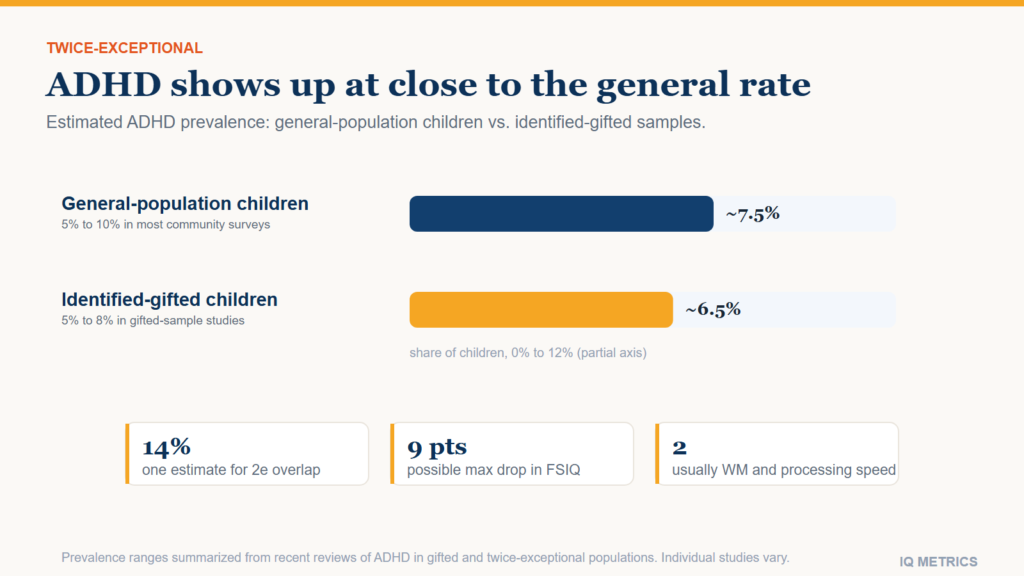
Yes. Having a high IQ does not prevent ADHD, and having ADHD does not cap how high an IQ score can go. Attention-deficit/hyperactivity disorder turns up in intellectually gifted people at close to the same rate it turns up everywhere else, and when the two coexist, clinicians call it twice-exceptional, or 2e for short.
That overlap is easy to miss in both directions. A child who reads early and talks like an adult does not look like the stereotype of ADHD, so the fidgeting and the unfinished worksheets get written off as boredom. An adult who was always “the smart one” rarely gets checked for ADHD at all. This article covers what twice-exceptional actually means, how common the overlap really is, why it is missed so often, and what ADHD can do to an IQ score itself.
What does twice-exceptional actually mean?
Twice-exceptional describes someone who qualifies as intellectually gifted and has one or more diagnosed neurodevelopmental conditions, most often ADHD, autism, or a specific learning disability such as dyslexia. How ADHD, autism and dyslexia affect IQ test scores covers the measurement side of that combination in detail; this piece focuses on the ADHD-and-giftedness pairing specifically, and on what it is like to live with, rather than how it is scored.
The term is not a diagnosis on its own, and it is not a trade-off. A student can be gifted and have ADHD without either label softening the other: the giftedness does not cancel out the attention difficulties, and the ADHD does not lower the ceiling on ability. The two run on largely independent tracks, which is exactly why the combination is so often missed — each trait can hide the other from a casual observer.
How common is ADHD among gifted people?
Community surveys generally put ADHD prevalence in children somewhere between 5% and 10%. Research specifically on identified-gifted samples finds a similar range, usually cited around 5% to 8% — in other words, no strong evidence that giftedness protects against ADHD, and no strong evidence that it predisposes to it either. One recent estimate puts the theoretical rate of any twice-exceptional overlap, across every neurodevelopmental condition that can co-occur with giftedness, at around 14% of gifted children.
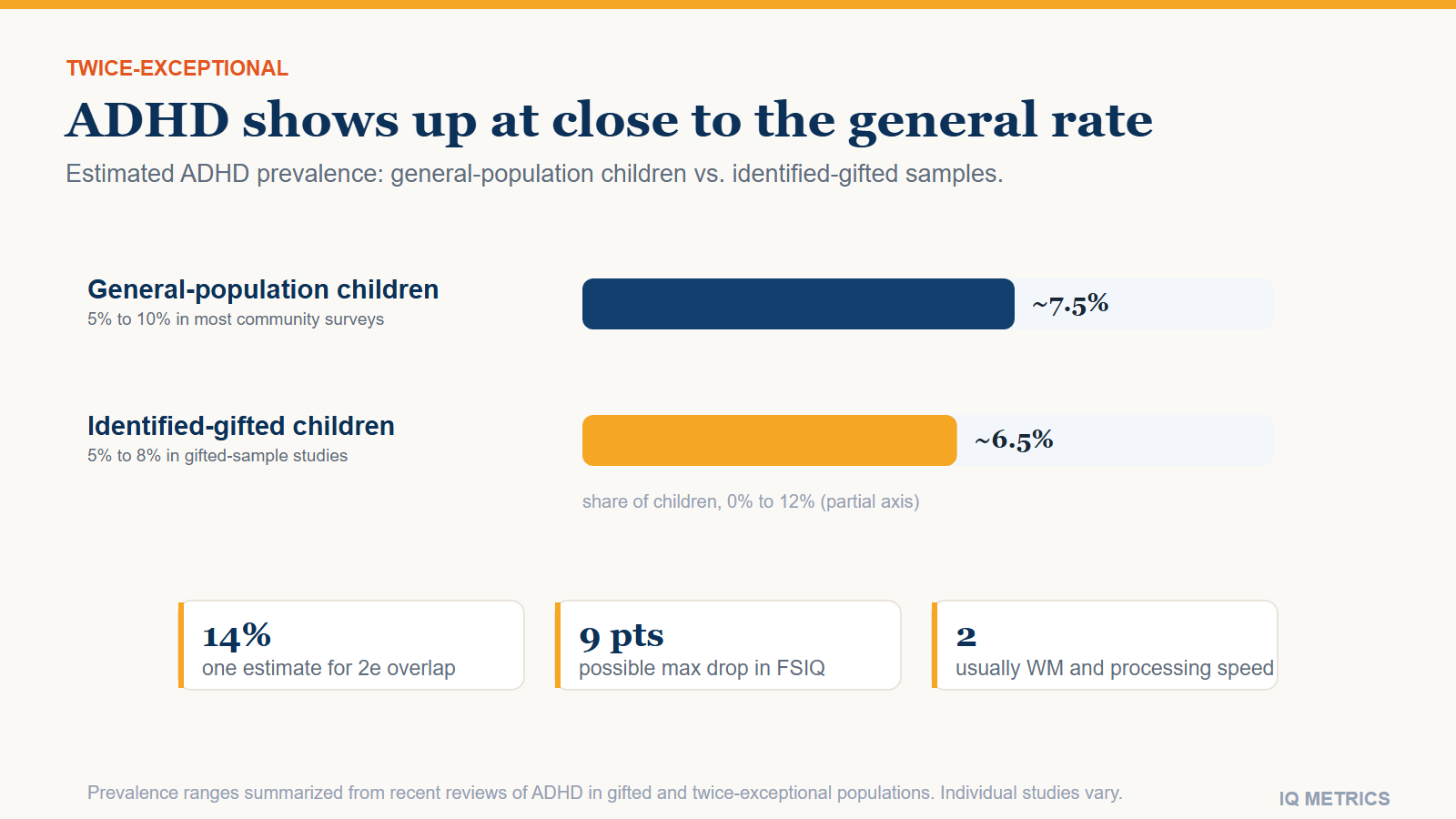
Those numbers carry real uncertainty. Studies define “gifted” differently — some use a single IQ cutoff, others use school identification records that lean toward children whose difficulties never got noticed — and ADHD diagnosis itself depends on who is doing the rating and in what setting. Reviewers describe identifying twice-exceptional students as a genuinely complex process for exactly this reason: giftedness can produce behavior, like restlessness under low-challenge instruction or intense focus on one narrow interest, that overlaps with an ADHD checklist without being ADHD at all.
Why gifted ADHD is so often missed
Two things work against each other here. A gifted child can compensate for attention and organizational weaknesses using raw processing power and vocabulary, scoring well enough on schoolwork that no one looks closer. And an adult who was praised for intelligence throughout childhood rarely gets referred for an ADHD evaluation, because “smart” and “has ADHD” still read as a contradiction to a lot of teachers, parents, and even clinicians.
The result is a child who is seen either as gifted with a discipline problem, or as having ADHD with test scores that “must mean it is not that bad.” Both framings miss the twice-exceptional profile underneath. Girls face this compounding twice over: ADHD in girls is already under-recognized because it presents more often as inattention than the hyperactivity that gets a boy referred, and a gifted girl’s compensating strategies can mask it for years longer.
Can ADHD actually lower an IQ score?
Sometimes, yes — not because ADHD reduces reasoning ability, but because a full-scale IQ score blends several subtests, and two of them, working memory and processing speed, are exactly the areas ADHD most reliably affects. Processing speed and IQ explains why that particular subtest carries less weight as a marker of “true” ability than people assume.
When a twice-exceptional profile pulls down working memory and processing speed while verbal reasoning and perceptual reasoning stay high, the four index scores disagree with each other, and the single full-scale number ends up lower than either of the strong subtests alone would suggest. Research on these mixed profiles has found the gap can run to roughly nine points off the full-scale score compared with what the strongest subtests alone would predict — enough, in some cases, to move a child from qualifying for a gifted program to not qualifying, on a test that was never measuring the thing being screened for.
Where would your own score land?
Take the IIF-certified assessment and get your score with the scale it was measured on, the percentile it corresponds to and the confidence range around it — the three figures most online tests leave out.
Find your IQ score now! →What twice-exceptional looks like day to day
The profile rarely looks like a textbook case of either trait alone. A twice-exceptional student might finish a 400-page novel in a weekend for fun, then lose the permission slip for a field trip three days running. An adult might land a technically brilliant solution to a hard problem at work in ten minutes, then miss the meeting where it was due because the invite got buried in an inbox with thousands of unread messages. Neither example is a contradiction: the reasoning system and the executive-function system that plans, organizes and tracks time genuinely are separate, and giftedness gives the first system nothing to lend the second.
- Big-picture insight that outruns follow-through: a strong grasp of a whole project, paired with real difficulty sequencing the steps to finish it.
- Intense, narrow interests that look like exceptional focus, alongside real trouble sustaining attention on anything outside them.
- Perfectionism that masks avoidance: a task gets endlessly refined, or never started, because starting risks an imperfect result.
- Emotional intensity that gets mistaken for giftedness alone or ADHD alone, when the two are actually compounding each other.
Getting evaluated without over-simplifying either label
- Ask for a full battery, not a single IQ number. A profile that reports subtest and index scores separately, not just the composite, is what actually shows a twice-exceptional pattern.
- Rule out anxiety and boredom first. Both an under-challenged gifted student and an anxious test-taker can produce ADHD-shaped symptoms without having ADHD.
- Expect the picture to look uneven, not uniformly behind. A twice-exceptional child is often ahead on some measures and behind on others in the same session.
- Treat the ADHD component on its own terms. Executive-function support and, where appropriate, medication address ADHD directly; neither is a giftedness problem to be managed away.
The self-diagnosis wave, and where to be careful
Adult ADHD awareness has grown fast over the past few years, partly through social media, and plenty of people who always felt “too smart to have ADHD” are now recognizing the pattern in themselves. That recognition can be a useful first step toward an evaluation, but a video or a checklist is not a diagnosis: a real assessment rules out other explanations — sleep debt, anxiety, depression, an unmanageable workload — that can mimic several ADHD symptoms without being ADHD.
It is also worth separating high IQ and ADHD from a much broader claim people sometimes make, that ADHD-style impulsivity is simply the price of a fast-moving mind. IQ and crime looks at a related version of the same executive-function research from a very different angle — how weak impulse control, independent of intelligence, connects to real-world outcomes — and the short version is the same one: intelligence and self-control are separate systems, and neither substitutes for the other.
The bottom line
A high IQ score and an ADHD diagnosis are not in tension. They measure different things — one a snapshot of reasoning ability across several domains, the other a pattern of attention and self-regulation — and a person can score well on the first while genuinely struggling with the second. Twice-exceptional identification exists precisely because neither label, used alone, describes what is actually going on.
Keep reading
All articles →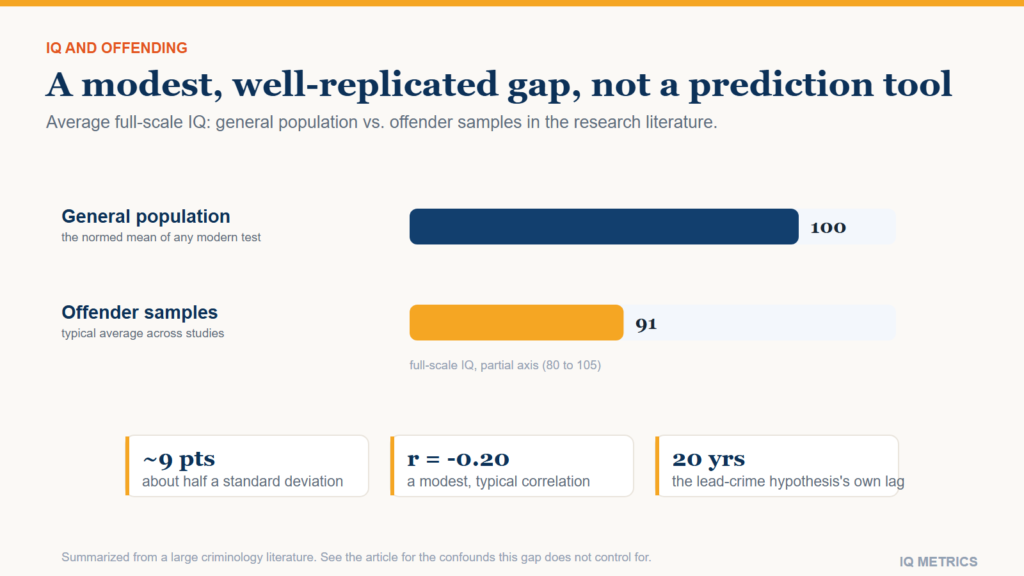 Research & Evidence
IQ and Crime
IQ and crime show a real but modest correlation: offenders average eight to ten points lower than non-offenders. What actually drives the gap, including a specific environmental cause with its own evidence, and what the finding cannot tell you about any one person.
 Taking a Test
ADHD, Autism and Dyslexia in IQ Testing
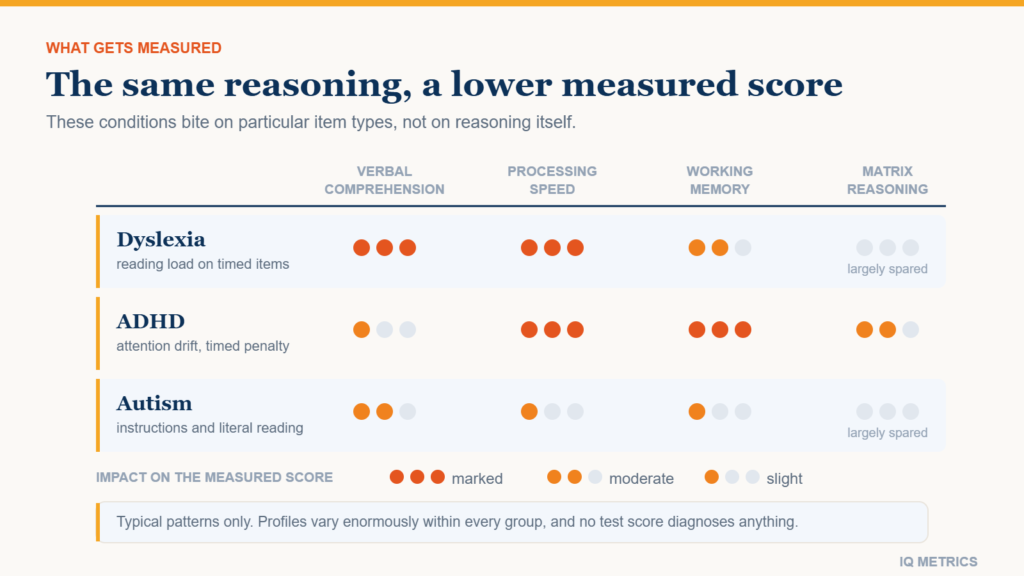
A test score is a measurement, and a measurement can be biased by the conditions under which it is taken. ADHD, autism and dyslexia each depress performance on particular kinds of item without lowering the reasoning underneath. Here is what actually interferes, condition by condition, and what to do next.
 Research & Evidence
Gardner's Multiple Intelligences
Gardner's multiple intelligences theory is one of the most influential ideas in education and almost entirely absent from the tests psychologists use. That gap is not stubbornness. It comes down to one stubborn statistical finding, one missing instrument, and a real insight the theory carries.