IIF Certified Assessment
Start IQ Test
IIF Certified Assessment
Headlines say healthy “wiring” shields the aging mind from gray-matter loss. The study behind them, 459 older adults in India scanned once, found a small link to language only, and it does not claim to have measured cognitive reserve.
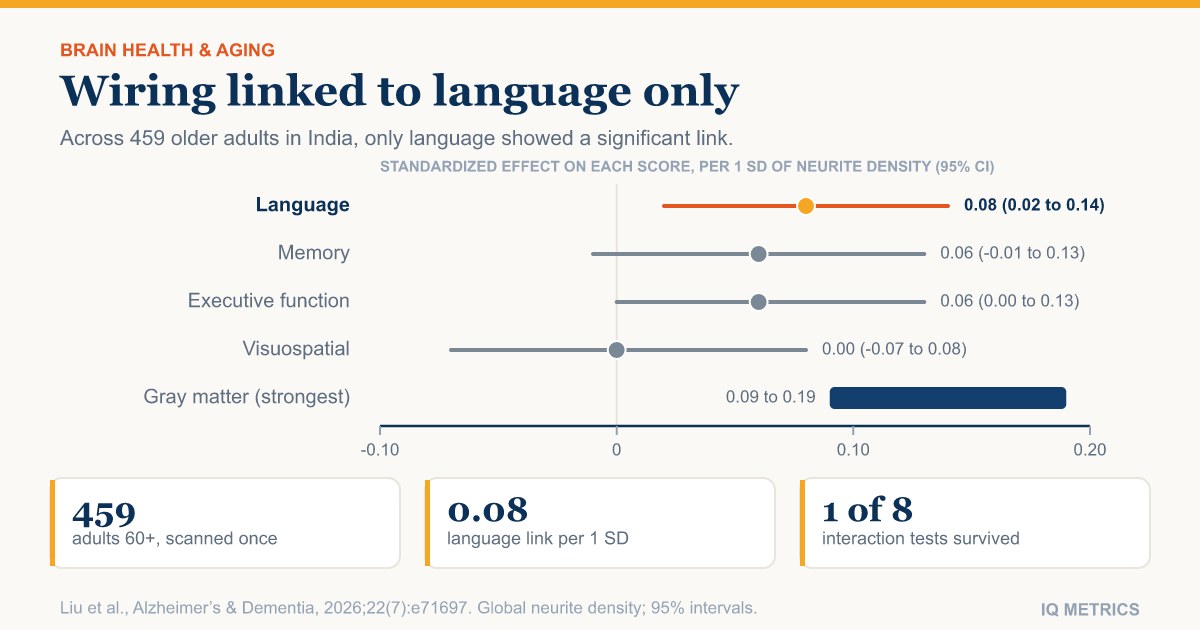
Can the brain’s local “wiring” keep the mind sharp as gray matter shrinks? A 2026 study of 459 older adults in India found a pattern that fits that idea, for language only, as a small effect measured at a single point in time. Headlines have tied it to “cognitive reserve”, which is a different concept. This article separates the finding from the headline.
Cognitive reserve is the idea that people with similar amounts of brain change can differ in how much it affects them. A 2020 consensus white paper from the Alzheimer’s Association (Stern and colleagues) defines it as the adaptability of cognitive processes, in efficiency, capacity and flexibility, that helps explain why brain aging, pathology or injury affects some people’s thinking and daily function more than others’. It separates two neighbors: brain reserve, the structural “capital” such as counts of neurons and synapses, and brain maintenance, less age-related brain change and pathology building up over time. The proxies it lists for cognitive reserve include education, occupation, physical exercise, leisure activities, social engagement and early-life general cognitive ability, that is, IQ. Our articles on schooling in East Germany and multilingualism cover that experience-based side. The 2026 study is about a physical property of the brain.
White matter is the brain’s cabling. Superficial white matter (SWM) is the layer of short fibers just beneath the cortex that connect neighboring folds of cortex, and imaging work describes it as carrying most of the brain’s cortex-to-cortex white-matter connections (Kirilina and colleagues, Science Advances, 2020). It is poorly understood, there is no standard definition of it, and it is hard to separate cleanly from deeper tracts (Van Dyken and colleagues, Imaging Neuroscience, 2024).
The paper, published in Alzheimer’s & Dementia in July 2026 and open access, used the imaging subsample of LASI-DAD, the dementia-assessment study nested in India’s national Longitudinal Aging Study. It analyzed 459 people aged 60 and over.
Higher neurite density in superficial white matter went with better language scores: a standardized effect of 0.08 per standard deviation (95% confidence interval 0.02 to 0.14), with a mirror-image effect for isotropic water (−0.08). That is about half the size of the strongest gray-matter associations, which ranged from 0.09 to 0.19. For memory, executive function and visuospatial ability the whole-brain links were smaller and not significant: 0.06 (95% CI −0.01 to 0.13), 0.06 (0.00 to 0.13) and 0.00 (−0.07 to 0.08). For cognitive impairment, only one region survived correction, the left inferior parietal, with an odds ratio of 1.45 (95% CI 1.17 to 1.79).
To put 0.08 in familiar terms: one standard deviation more neurite density went with 0.08 of a standard deviation better language score. If the scores sat on an IQ-style scale (mean 100, SD 15), that would be about 1.2 points. That is for illustration only, because these scores are standardized within these 459 people and not against any national norm, so no IQ can be read from them. For scale, the cognitively normal group averaged 0.28 on language and the impaired group −0.38, a gap of 0.66 standard deviations, about 10 points on the same illustrative scale. The wiring effect is roughly one-eighth of that gap. The percentile calculator shows how standard-deviation gaps translate on a real IQ scale.
Gray matter stayed the strongest predictor. The wiring result is a modifier of that link, not a replacement for it.
That headline comes from the moderation analysis, which asks whether the link between gray matter and language changes with the health of the wiring. Of eight such tests, one survived correction for multiple comparisons: neurite density by cortical thickness, with a standardized interaction of −0.08 (95% CI −0.14 to −0.03). Splitting people at the median made the pattern easier to see: the gray-matter slope for language was 0.12 to 0.20 in the half with lower neurite density, and not significant in the half with higher density. No interaction was significant for cognitive impairment. That fits a buffer, but everyone was scanned once, so the study cannot say whether wiring protects cognition, whether both reflect one underlying disease process, or whether sicker brains simply score lower on both.
Because half the participants could not read, the meaning of the scores matters. The battery was designed to lean less on schooling and was run in about ten languages, and the language tasks in the battery the authors cite include naming objects, naming animals, repeating a phrase and following commands. Even so, impaired participants were more likely to be illiterate (60.9% against 43.1%), the main models did not adjust for education, and when education was added the neurite-density link held at 0.09 while the isotropic-water link lost significance. The authors report that the wiring–language link looked stronger in subgroups with low literacy, no schooling or rural residence, but none of the 12 formal tests for such an interaction was significant. That is the general lesson for any test score, IQ included: a number reflects the person, the test, the language and the schooling behind both. See how test language changes IQ scores and cultural bias in IQ tests.
The paper’s own vocabulary is “resistance” and “local circuit resilience”, and it suggests that interventions might aim to build reserve against gray-matter loss. It does not claim to have measured cognitive reserve, brain reserve or brain maintenance. On the 2020 consensus map, white-matter microstructure is a structural measure, nearer brain reserve or brain maintenance than the experience-based cognitive reserve the phrase usually points to. A 2026 narrative review in the same journal issue notes that reserve and resilience are widely used concepts whose operationalization remains challenging and often lacks conceptual and methodological consistency.
Nothing in this study, by itself, changes what to do, and the authors point to the need for longitudinal work to sort out cause and consequence. What it does add is a reminder to read a cognitive score as a measurement with a history: how it is built, in which language, on whom. That applies to every number on this site, from a percentile to an IQ. For how scores change across the lifespan, see IQ and age, when intelligence peaks and hearing loss and cognitive test scores.
A test score means something only with its norms: who it was standardized on, in what language, at what age. To see where a result sits, use a test that states its scale and reports a percentile and a confidence range.
Find your IQ score now! →So: does healthy brain wiring keep the mind sharp as gray matter shrinks? In 459 older adults, better superficial white matter went with better language scores and a weaker gray-matter link, a small, single-snapshot pattern in one domain. It adds to the picture of resilience without settling it. To see where your own reasoning sits, try the full IQ test, and see how IQ can change over time.
It is the adaptability of thinking processes that helps explain why people with similar brain aging or damage differ in how well they function. A 2020 consensus separates it from brain reserve (structural capital such as neuron counts) and brain maintenance (less age-related brain change over time).
It is the layer of short nerve fibers just beneath the cortex that connect neighboring folds of the brain’s surface. It is poorly studied and has no standard definition.
A 2026 study found a pattern that fits the idea but cannot show protection. In 459 older adults in India, gray-matter measures tracked language scores more strongly where superficial white matter looked less healthy, but everyone was scanned once.
Language only. One standard deviation higher neurite density went with a 0.08 standard deviation higher language score, about half the strongest gray-matter link. Memory, executive function and visuospatial scores showed no significant whole-brain link.
No. It is a physical property of brain tissue, which the 2020 consensus counts among structural measures. The study speaks of resilience but does not claim to have measured cognitive reserve.
Corrections: spotted an error? Email corrections@iqmetrics.org and we will update this story and note the change here.
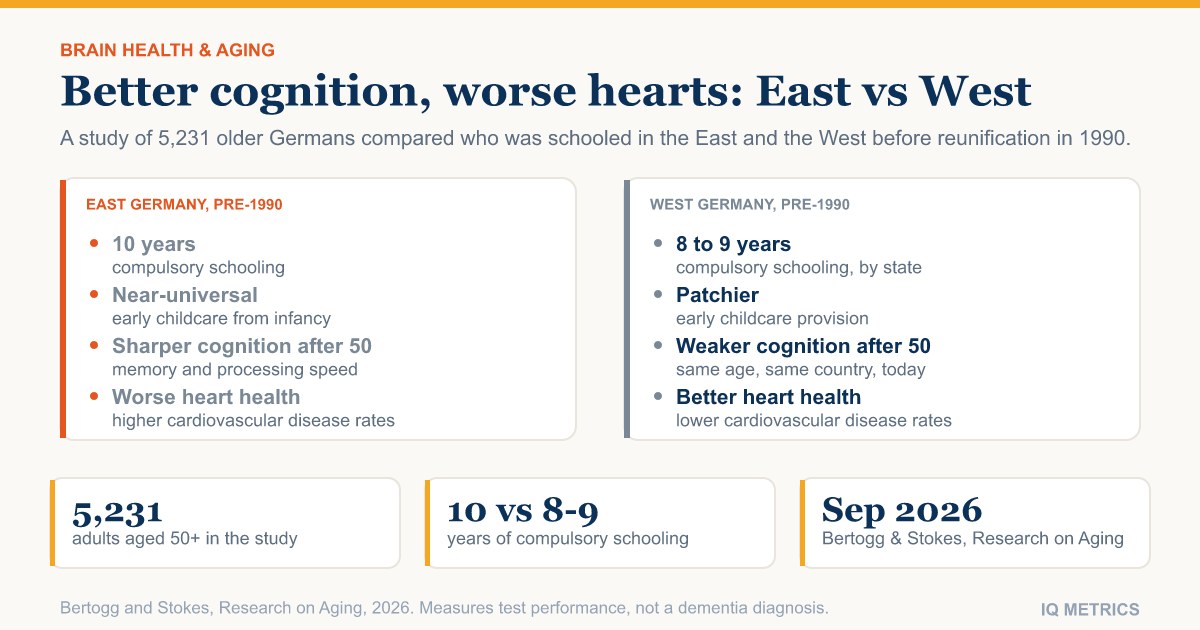
A study of more than 5,000 older Germans found people schooled in the socialist East kept sharper memory and processing speed after 50 than West Germans the same age — despite worse heart health and shorter life expectancy.
Research presented at a European neuroscience meeting in July 2026 used magnetic brain recordings to estimate biological brain age, and found multilingual speakers scoring years below their calendar age. The gradient is striking. The design cannot show that languages caused it.
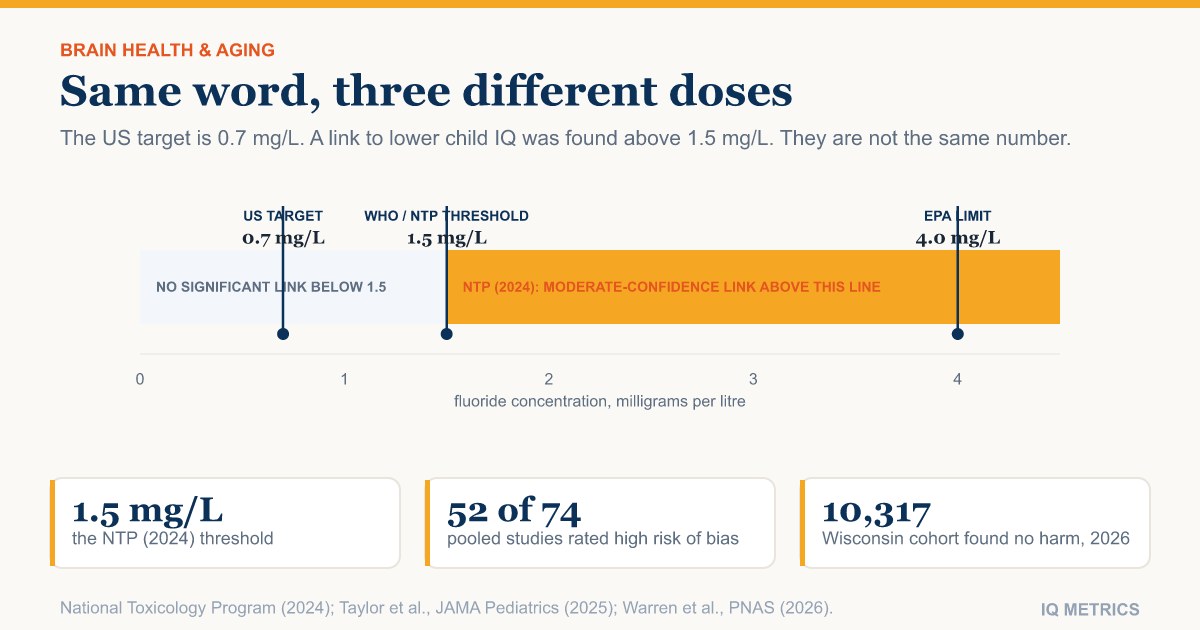
A 2024 US government review linked fluoride above 1.5 mg/L to lower IQ in children. An April 2026 study of 10,317 people found no sign of harm from community fluoridation. The two findings are about different doses, and the dose is the whole argument.
Our IIF-certified assessment reports your score with its scale, percentile and confidence range — and a breakdown of the cognitive domains behind it.
Start IQ Test →