





IQ and Mental Age: What an IQ of 30, 50 or 70 Means in Years
Mental age is the age a typical child scores like, and ratio IQ divides it by real age. See an IQ to mental age chart from IQ 30 to 100, worked examples, and why modern tests dropped the idea for adults.

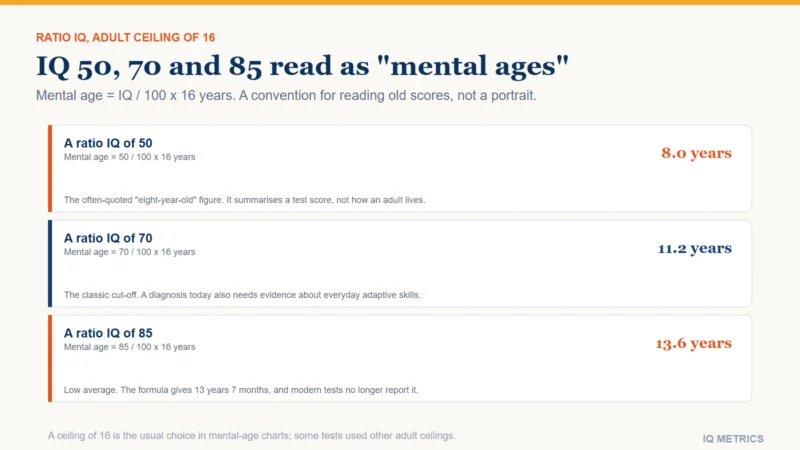
Mental age is the age at which a typical child scores the way you did on an intelligence test. Under the original ratio IQ formula, IQ equals mental age divided by chronological age, times 100 — so a 10-year-old with a mental age of 8 has an IQ of 80. Adults break the formula, because mental age stops rising in the mid-teens, so charts divide by a fixed adult age (usually 16). On that convention an IQ of 50 is a mental age of 8 and an IQ of 70 is about 11. That translation is a rough reading aid for old scores, not a description of how any adult thinks or lives, and modern tests no longer report IQ this way. This article gives the formula, a full IQ-to-mental-age chart for scores from 30 to 100, and the reasons clinicians moved on.
- Formula: ratio IQ = (mental age ÷ chronological age) × 100, introduced by William Stern in 1912 and scaled by Lewis Terman in 1916.
- Adult chart: with an adult divisor of 16, mental age = IQ ÷ 100 × 16 — an IQ of 30 is 4 years 10 months, 50 is 8 years and 70 is 11 years 2 months.
- Why it faded: mental age plateaus in the mid-teens, ratio IQs varied in spread from one age to the next, and Wechsler-style deviation IQ fixed both problems.
- Today: a diagnosis of intellectual disability weighs adaptive functioning as well as a score, which makes “mental age” a poor way to describe any adult.
What is mental age?
Mental age is an age-normed level of performance: it answers the question “which age group does this person’s test performance resemble?” The idea comes from Alfred Binet and Théophile Simon, whose 1905 scale — revised in 1908 — arranged tasks by the age at which most children could pass them. A child who solved everything a typical 8-year-old could, but nothing a typical 9-year-old could, had a mental age of 8, whatever their birth certificate said. In 1912 the German psychologist William Stern proposed dividing mental age by chronological age to get an “intelligence quotient”, and in 1916 Lewis Terman, building the Stanford–Binet, multiplied the result by 100 to remove the decimal point. That one line of arithmetic gave the world the term IQ. For the wider story see the history of IQ testing and the timeline of intelligence testing.
The ratio IQ formula, with worked examples
The formula is IQ = (mental age ÷ chronological age) × 100, with both ages in the same unit. Three children show every case:
- A child at age level: an 8-year-old with a mental age of 8 scores 8 ÷ 8 × 100 = 100, exactly average.
- A child behind: a 10-year-old with a mental age of 8 scores 8 ÷ 10 × 100 = 80.
- A child ahead: a 6-year-old with a mental age of 9 scores 9 ÷ 6 × 100 = 150.
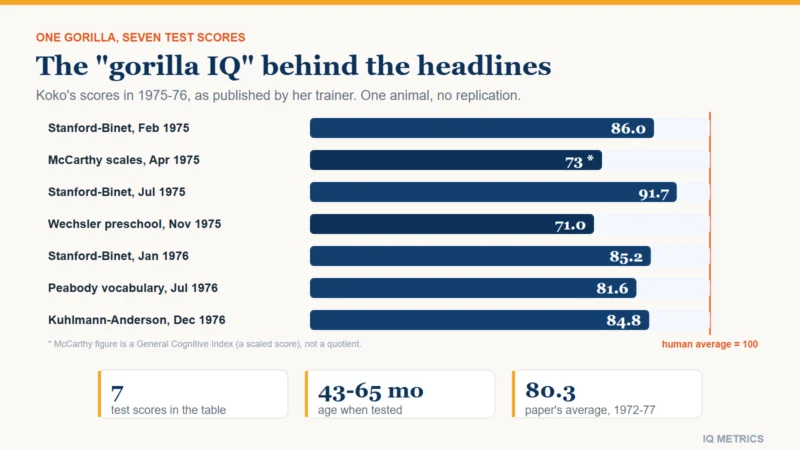
The same arithmetic shows up in the wild. In a 1993 chapter, Francine Patterson and Wendy Gordon published a table of test scores for the signing gorilla Koko, listing her age and mental age in months for each test. On the January 1976 Stanford–Binet, a chronological age of 54 months and a mental age of 46 months give 46 ÷ 54 × 100 = 85.2. What that number does and does not mean is the subject of our gorilla IQ article.
IQ to mental age chart for adults
Adults cannot be divided by their real age, or every birthday would lower their IQ. Mental-age charts therefore pick a ceiling for the adult divisor. This chart uses 16 years, the usual choice, which makes mental age = IQ ÷ 100 × 16. The questions people ask most often — “IQ of 30, what is the mental age?”, “IQ of 49”, “IQ of 68” — are answered directly in the chart.
| Ratio IQ | Mental age in decimal years | Mental age in years and months |
|---|---|---|
| 30 | 4.80 | 4 years 10 months |
| 40 | 6.40 | 6 years 5 months |
| 49 | 7.84 | 7 years 10 months |
| 50 | 8.00 | 8 years 0 months |
| 59 | 9.44 | 9 years 5 months |
| 60 | 9.60 | 9 years 7 months |
| 68 | 10.88 | 10 years 11 months |
| 70 | 11.20 | 11 years 2 months |
| 71 | 11.36 | 11 years 4 months |
| 74 | 11.84 | 11 years 10 months |
| 80 | 12.80 | 12 years 10 months |
| 82 | 13.12 | 13 years 1 month |
| 85 | 13.60 | 13 years 7 months |
| 90 | 14.40 | 14 years 5 months |
| 100 | 16.00 | 16 years 0 months |
Read the chart with three cautions. Ceilings differ: a chart that divided by 15 or 18 instead would move the figures by up to a year or two. It only works for a ratio IQ: a modern deviation IQ of 70 does not translate into 11 years 2 months in the same way, because it is a rank among same-age peers, not a ratio of ages. And no chart says anything about skills, judgment or daily life — only where a score would have landed on a child’s scale.
Why mental age fell out of use
Three problems ended it. First, adults break the formula: mental age stops rising in the mid-teens while chronological age keeps climbing, so any ratio for an adult needs an arbitrary ceiling. As one reference work puts it, adult intelligence does not change from year to year, so the concept of mental age is less meaningful for adults. Second, ratio IQs were not comparable across ages. When Terman and Merrill revised the Stanford–Binet in 1937, ratio IQs had means that varied between age ranges and non-uniform standard deviations, so the manual included a formula to convert them to a mean of 100 and a standard deviation of 16. Third, an age is a poor summary of a profile: two people with the same mental age can be strong and weak in very different places.
David Wechsler’s tests, from 1939, solved the first two problems by dropping mental age altogether. A deviation IQ compares a score with the scores of people of the same age, on a fixed scale with a mean of 100. The mechanics are covered in Deviation IQ vs ratio IQ and, for the choice of spread, in the standard deviation 15 versus 16 explainer.
An IQ of 50 or 70 is not an eight- or eleven-year-old
The chart’s neat numbers invite a harmful shortcut: treating an adult with a low score as a child. An adult with an IQ of 50 has decades of lived experience, adult relationships and often well-developed practical and social skills that no children’s test measures. That is why current diagnostic systems moved the emphasis. The DSM-5 specifies the severity of intellectual disability by adaptive functioning — how well someone manages conceptual, social and practical demands — rather than by IQ bands, and it requires that the difficulties began in the developmental period. A score around 70 is a screening signal, not a verdict. Our pieces on what an IQ of 70 means and low IQ versus learning disability cover the boundary in detail, and the score rules for disability benefits covers how the number is used in practice.
Where would your own score land?
Take the IIF-certified assessment and get your score with the scale it was measured on, the percentile it corresponds to and the confidence range around it — the three figures most online tests leave out.
Find your IQ score now! →Where mental age still shows up
The phrase survives in three places. Age-equivalent scores on some developmental and achievement tests still report that a child reads “at a nine-year-old level”, although psychometricians generally prefer standard scores and percentiles for that job. Comparisons across species borrow it too — “a dog thinks like a two-year-old” is a mental-age claim in disguise (see dog IQ and chimpanzee IQ). And everyday speech uses it as an insult, which is a good reason to avoid it. To see where a score sits on today’s scale, the IQ percentile calculator and the IQ scale by age page use the modern deviation scale, and the site’s kids IQ tests are grouped by age band and report a score rather than a mental age.
How to read a mental-age claim
- Which test? A score from a modern Wechsler scale is a deviation IQ; only older Stanford–Binet-style scores were ratios.
- Which ceiling? An adult mental age depends entirely on the divisor the chart chose.
- Which person? A child’s mental age is a real comparison with same-age peers; an adult’s is a conversion.
- What else was measured? For anything clinical, ask about adaptive functioning, not only the age figure.
Quick answers
- What is the mental age of an IQ of 30? On the adult ratio convention (divisor 16), 4 years 10 months. Standard IQ tests seldom resolve scores this low, so clinicians use other measures.
- What is the mental age of an IQ of 50? 8 years on the same convention.
- What is the mental age of an IQ of 70? 11 years 2 months — the number behind the classic “11-year-old” description, which misleads more than it informs.
- Can an adult have a mental age above their real age? On adult charts the divisor is capped, so an adult IQ above 100 gives a mental age above 16, which is a conversion artefact rather than a finding.
- Does a modern IQ test report mental age? No. Current Wechsler and Stanford–Binet scales report standard scores and percentiles.
The bottom line
Mental age was a clever idea for measuring children in 1905 and a workable one for scoring them in 1916. Applied to adults it becomes a rough conversion, and applied to a person it becomes a stereotype. Use the chart above to decode an old score or answer a curiosity question; use a percentile, a standard score and, where it matters, an assessment of everyday functioning to understand a real person.
Sources
- Mental Age, Encyclopedia.com: definition, Stern 1912 and Terman 1916, the Binet–Simon scales, and why the concept is less meaningful for adults.
- Stanford–Binet Intelligence Scales, Wikipedia: the 1937 revision’s ratio IQs with age-varying means and non-uniform standard deviations, and the later introduction of deviation IQ.
- Patterson, F. and Gordon, W., “The Case for the Personhood of Gorillas”: Table 2 lists age and mental age in months for each test.
- American Psychiatric Association, What is intellectual disability?: DSM-5 criteria, including adaptive functioning.
Keep reading
All articles →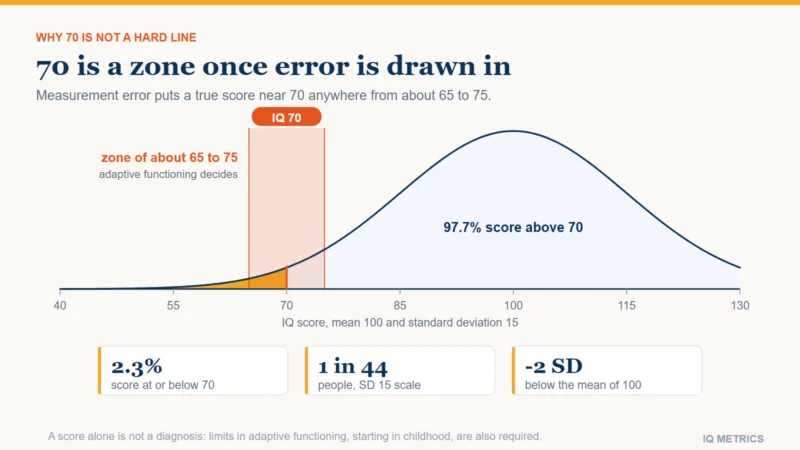 Scores & Scales
What an IQ of 70 Means
An IQ of 70 sits two standard deviations below the mean, at about the 2nd percentile. It is the score most often linked with intellectual disability, but a diagnosis never rests on the number alone: measurement error turns the line into a zone, and adaptive functioning decides who is inside it.
 Taking a Test
What Age is Most Accurate to Take an IQ Test?
Scientists, teachers, and parents have always wondered how intelligence works. Although intelligence tests are widely accepted as credible measures of mental capacity, the scientific community disagrees on the best age to take one.
 Research & Evidence
Gorilla IQ
Gorillas have no IQ. The quoted 70 to 95 comes from tests given to one gorilla, Koko, by her trainer. See her real scores, what wild gorillas have been shown to do, and why brain size alone cannot rank animals.