





Gorilla IQ: What Koko and the Research Actually Show
Gorillas have no IQ. The quoted 70 to 95 comes from tests given to one gorilla, Koko, by her trainer. See her real scores, what wild gorillas have been shown to do, and why brain size alone cannot rank animals.

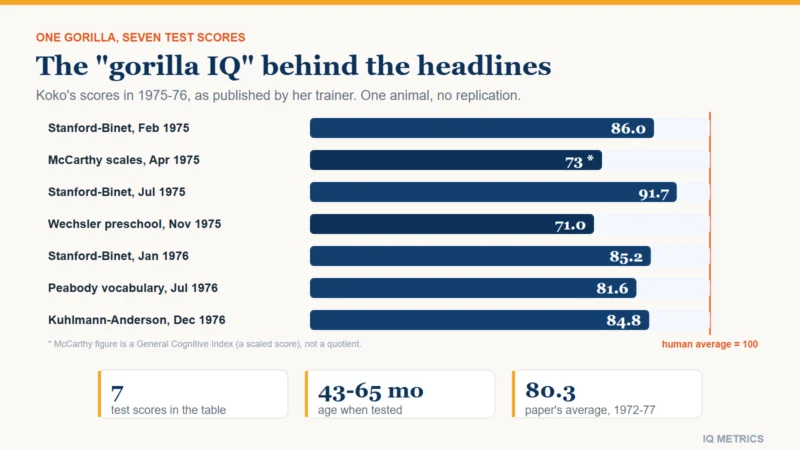
Gorillas do not have an IQ. An IQ is a score on a human test, ranked against a sample of humans, and no gorilla has ever been given one. The figure quoted online — “a gorilla IQ of 70 to 95” — traces back to tests given to a single captive gorilla, Koko, by her own trainer in the mid-1970s. In the trainer’s published table the scores run from 71 to 91.7. What can be studied are behaviours: wild gorillas have been seen using tools, mountain gorillas process stinging nettles with a multi-step routine, and gorilla brains are about a third the size of ours. This article separates what was measured from what was claimed.
- Koko’s numbers: seven scores in Patterson and Gordon’s table, from 71.0 (Wechsler preschool scale) to 91.7 (Stanford–Binet), and an average of 80.3 reported for tests given between 1972 and 1977.
- Why it is not a gorilla IQ: one animal, tested by her trainer, on children’s tests normed on humans, with a mix of scoring methods.
- What is documented: tool use in wild western gorillas (2005), sequenced food processing in mountain gorillas (1993) and a mixed record on the mirror test.
- Brain size: gorilla and orangutan brains are about one third the size of a human brain, though the animals are at least as big as people.
Where the gorilla IQ of 70 to 95 comes from
The number comes from Francine Patterson, who began teaching Koko (1971–2018) a modified form of American Sign Language in the early 1970s. In “The Case for the Personhood of Gorillas” (1993), Patterson and Wendy Gordon reproduce a table of Koko’s test results. Because Koko responded to instructions given in sign or in English, her team could run standard children’s tests, and the table records her age and mental age in months for each one.
| Test | Date | Age when tested | Mental age | Reported score |
|---|---|---|---|---|
| Stanford–Binet | Feb 1975 | 43 months | 37 months | 86.0 |
| McCarthy Scales | Apr 1975 | 45 months | 32 months | 73 (scaled index) |
| Stanford–Binet | Jul 1975 | 48 months | 44 months | 91.7 |
| Wechsler Preschool (WPPSI) | Nov 1975 | 51 months | 37 months | 71.0 |
| Stanford–Binet | Jan 1976 | 54 months | 46 months | 85.2 |
| Peabody Picture Vocabulary | Jul 1976 | 60 months | 49 months | 81.6 |
| Kuhlmann–Anderson | Dec 1976 | 65 months | 56 months | 84.8 |
For the three Stanford–Binet rows and the vocabulary test, the score matches mental age divided by chronological age, times 100 — 46 ÷ 54 × 100 = 85.2. The other three do not reproduce from the ages shown (37 ÷ 51 would give 72.5, not 71.0), which suggests they were scored from each test’s own tables; the McCarthy figure is a General Cognitive Index, a scaled score rather than a quotient. The ratio method is explained in our IQ and mental age guide. The same paper says Koko “achieved scores between 85 and 95” on the Stanford–Binet and reports an average of 80.3 across tests given between 1972 and 1977. Put the 95 together with the lowest figure in the table and you get the “70 to 95” range that circulates online.
Why Koko's score is not a gorilla IQ
- Human norms. IQ is a ranking against people. A gorilla has no place on that curve; the score only says how Koko’s answers compare with those of human children of the same age.
- Language-loaded tests. The team could use these tests only because Koko understood signs and spoken English, and most items assume a child’s life experience. Patterson and Gordon report that her performance did not differ significantly whether instructions came in sign only or in English only.
- One animal, one team. Every score comes from the same gorilla and the group that raised her; the published table does not describe independent or blind scoring.
- Mixed methods. Some figures are 1916-style mental-age ratios that modern tests dropped, others are scaled scores from different instruments, so they do not form one consistent scale.
- Cueing. Critics of ape-language research argued that trainers can unintentionally prompt signs — the “Clever Hans” effect — which matters for any task answered through signs.
What a gorilla brain can and cannot tell us
Gorillas and orangutans are primates at least as large as humans, yet their brains are about one third the size of the human brain. That gap was long used to argue that the human brain is unusually large for a primate. Suzana Herculano-Houzel and Jon Kaas took another route in 2011: they counted cells in the cerebella of orangutans and gorillas, used primate scaling rules to predict how large the whole brain and cortex should be, and found the predictions matched the published sizes. Their reading is that the great apes are the odd ones, having evolved unusually large bodies rather than unusually small brains. The lesson for “gorilla IQ” is that raw brain size cannot rank species; see brain size and IQ for what the human correlation does and does not show.
Tool use in wild gorillas
For years there was no documented tool use in wild western gorillas. Then, in 2005, Thomas Breuer and colleagues reported what they believed to be the first two observations, both at Mbeli Bai, a swampy forest clearing in northern Congo. An adult female used a branch as a walking stick to test the depth of a pool and to help her cross it. Another adult female used a detached shrub trunk as a stabiliser while processing food, then used it as a bridge over a deep patch of swamp. Other great apes mostly use tools to extract food; these gorillas used them to deal with the terrain, which suggests that habitat as well as brain power decides when tools appear. Compare the fuller record in chimpanzee IQ and the toolmakers in crow IQ.
Nettle-eating: a multi-step routine
Richard Byrne and J.M.E. Byrne studied how mountain gorillas deal with the stings, tiny hooks and spines that protect leaves such as stinging nettles. Individual gorillas differed in the small hand movements they used, consistent with trial-and-error learning of those elements. But each animal used only a few structured sequences, and the same sequences appeared across the whole population, with each stage depending on the last. The authors concluded that the logical order of the routine is probably copied from others, which they called program-level imitation. By weaning, at about 3.5 years old, young gorillas already relied on a well-established sequence. That points to planning and learning from others in a species better known for chest-beating.
Where would your own score land?
Take the IIF-certified assessment and get your score with the scale it was measured on, the percentile it corresponds to and the confidence range around it — the three figures most online tests leave out.
Find your IQ score now! →The mirror test: why gorillas are the odd one out
The classic test of self-recognition puts a mark on an animal’s face and sees whether it touches the mark while looking in a mirror. Chimpanzees pass; gorillas have usually struggled. One often-cited explanation is that gorillas avoid eye contact, because a direct stare is a threat, so they never study their reflection long enough to notice the mark. In 2007 Posada and Colell tested that idea on a single western gorilla, first habituating him to the observers and to the mirror as an object. He showed no aversion to eye contact, seemed relaxed with his reflection, and gave a positive response to the mark test. Patterson and Gordon describe Koko making faces and examining her teeth in front of a mirror. One gorilla is an existence proof, not a percentage, and a failed mirror test says little about an animal’s overall intelligence.
So how smart is a gorilla?
| Ability | Best evidence | The catch |
|---|---|---|
| Responds to human signs and speech | Koko (Patterson and Gordon) | One animal; contested by critics of ape-language studies |
| Uses tools in the wild | Two western gorillas at Mbeli Bai (Breuer et al. 2005) | Two observations, not a survey |
| Learns multi-step food routines | Mountain gorillas and nettles (Byrne and Byrne 1993) | Shows learning and sequencing, not a score |
| Recognises itself in a mirror | One male western gorilla (Posada and Colell 2007) | Most gorillas do not pass the standard test |
| Scores on human IQ tests | Koko, 71.0 to 91.7 in the published table | Human norms, one animal, mixed scoring methods |
Nothing here supports ranking gorillas above or below chimpanzees or dogs by IQ. In the large test battery covered in our chimpanzee article — chimpanzees, orangutans and toddlers — gorillas were not included.
Gorilla IQ compared with other animals
The same caveat applies to every “animal IQ” headline: a score needs a human norm group, so what is left are comparisons of behaviour. Our other animal write-ups look at what tests actually measured in dogs, crows, chimpanzees, octopuses and, in the same series, dolphins. If you want a number for yourself rather than a gorilla, the IQ test gives a score on the human scale.
Quick answers
- What is the IQ of a gorilla? There is no valid figure. The commonly quoted 70 to 95 comes from tests given to one gorilla, Koko, by her trainer.
- What was Koko’s IQ? Her trainer’s table lists 71.0 to 91.7 for tests in 1975 and 1976, and the paper reports an average of 80.3 for 1972 to 1977.
- Are gorillas smarter than chimpanzees? Nobody has measured it fairly. Chimpanzees have far more test data, and gorillas were not in the large chimpanzee–orangutan–child battery.
- Can gorillas use tools? Yes. Wild western gorillas have been seen using a stick to test water depth and a trunk as a bridge.
- Can gorillas talk? Koko’s trainers report that she used signs and understood spoken English; critics dispute how much of this counts as language, and no gorilla produces human speech.
The bottom line
A gorilla IQ number is a headline, not a measurement. What the record supports is more interesting: an animal with a human-sized body and a brain a third as large that follows multi-step food routines, improvises with objects and, in at least one individual, recognised itself in a mirror. Koko’s scores are best read as a snapshot of one remarkable gorilla’s answers to children’s tests, not as a rank for her species.
Sources
- Patterson, F. and Gordon, W., “The Case for the Personhood of Gorillas”: Table 2, Koko’s tested IQ 1975–76.
- Herculano-Houzel, S. and Kaas, J.H. (2011), Brain, Behavior and Evolution: gorilla and orangutan brains conform to the primate cellular scaling rules.
- Breuer, T., Ndoundou-Hockemba, M. and Fishlock, V. (2005), PLoS Biology: first observation of tool use in wild gorillas.
- Byrne, R.W. and Byrne, J.M.E. (1993), American Journal of Primatology: complex leaf-gathering skills of mountain gorillas.
- Posada, S. and Colell, M. (2007), American Journal of Primatology: another gorilla recognizes himself in a mirror.
Keep reading
All articles →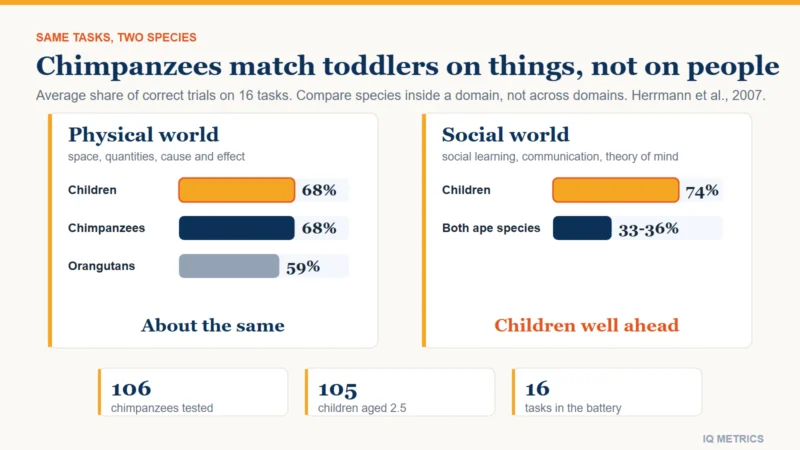 Understanding IQ
Chimpanzee IQ
Chimpanzees have no IQ, but they have been tested. How chimps and 2.5-year-old children scored on the same 16 tasks, what a chimpanzee brain holds, the memory claim that did not survive practice, and whether chimps have a g factor.
 Understanding IQ
Crow and Raven IQ
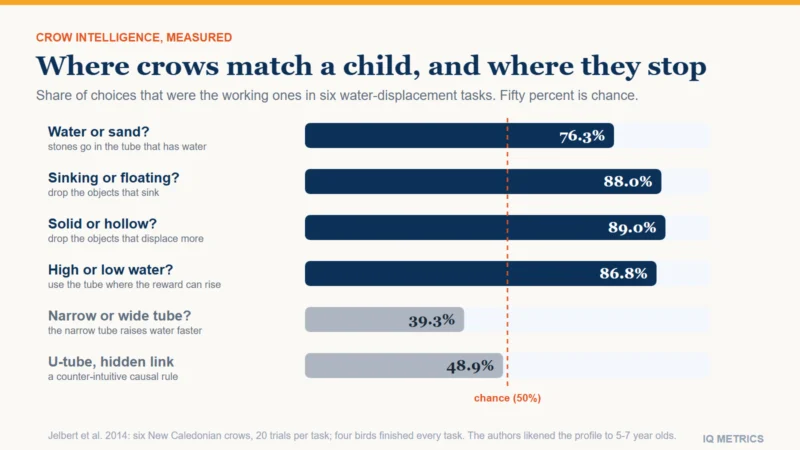
A crow has no IQ, but tests show what corvids can do: bend wire, plan hours ahead, count their own calls. The 7-year-old comparison traces to one 2014 study of six crows, who were at chance on two of six puzzles.
 Research & Evidence
Dolphin IQ
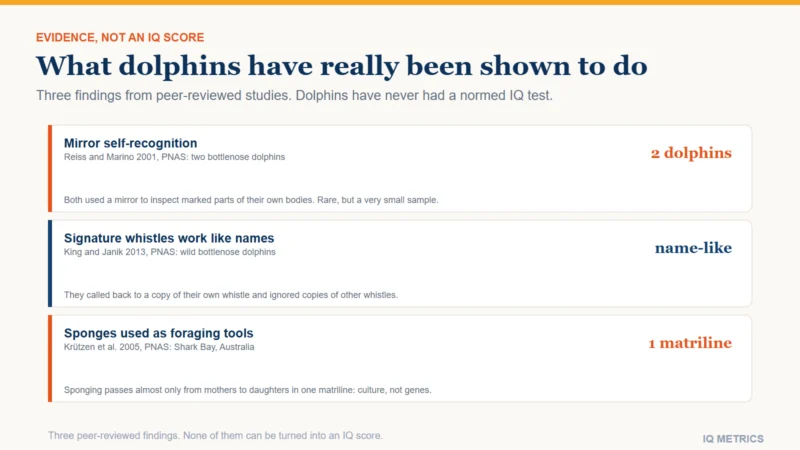
Dolphins have no IQ, but they have passed a mirror test, use signature whistles like names and pass tool use down the female line. See the evidence, the brain data, and the peer-reviewed sceptics who question the hype.