





Chimpanzee IQ: How Smart Are Chimps Compared to Humans?
Chimpanzees have no IQ, but they have been tested. How chimps and 2.5-year-old children scored on the same 16 tasks, what a chimpanzee brain holds, the memory claim that did not survive practice, and whether chimps have a g factor.

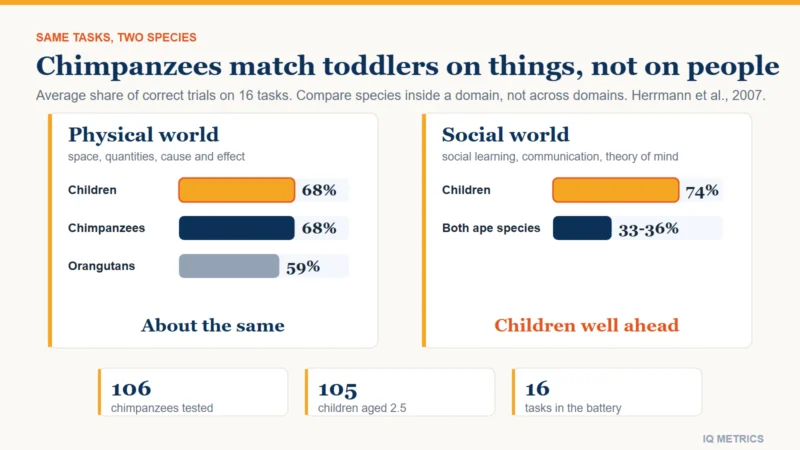
Chimpanzees do not have an IQ. An IQ is your rank against people of your own age on a test built and normed on humans, so no chimpanzee can be given one, and the figures sometimes quoted online, anywhere from the 20s to the 70s, trace back to no published norming study. What researchers can do is give chimpanzees the same tasks as human children and compare the results. On a 2007 battery of 16 tasks, chimpanzees and 2.5-year-old children were each right on about 68% of physical-world trials, while on social trials the children scored about 74% against 33 to 36% for the apes. This article covers those tests, the brain numbers, the chimpanzee that supposedly beat humans at memory, whether chimps have a g factor, and how they compare with crows, dogs and octopuses.
- Brain: about 400 cubic centimetres against about 1,350 in humans, with roughly 6 to 8 billion cortical neurons against about 16 billion.
- Best test: Herrmann and colleagues (2007) gave 106 chimpanzees and 105 children aged 2.5 the same 16 tasks: about 68% correct for both on physical tasks, but 74% for children against 33 to 36% for the apes on social ones.
- Memory claim: the famous chimp-beats-human result did not survive a fair comparison after practice.
- Heredity: in one study of 99 chimpanzees, about half the differences in overall cognitive performance were heritable.
Do chimpanzees have an IQ?
No, and the reason is structural rather than a shortage of testing. An IQ score places a person on a bell curve of people the same age (see how IQ tests work). A chimpanzee has no such curve: the norm samples are human, most items lean on language and culture, and the two species mature on different schedules, so even the old mental-age method (ratio IQ) has nothing sensible to divide by. Numbers such as “chimpanzee IQ 25” or “chimpanzee IQ 70” circulate widely, but no published norming study stands behind them. The same is true of crow IQ and dog IQ. What exists instead is comparative cognition: standard tasks given to many animals and scored against each other.
How do chimpanzees compare with human children on real tests?
The most cited comparison is Herrmann, Call, Hernández-Lloreda, Hare and Tomasello (2007) in Science. They gave 106 chimpanzees (aged 3 to 21, living in sanctuaries in Uganda and the Republic of Congo), 32 orangutans and 105 German children aged 2.5 the same Primate Cognition Test Battery. It has 16 tasks grouped into six scales in two families: physical cognition (space, quantities and cause and effect) and social cognition (social learning, communication and theory of mind, meaning understanding what others want or know). Every participant took all of it, three to five hours in all, and none had seen the tasks before.
| Task family | What was tested | Share of trials correct |
|---|---|---|
| Physical cognition | Space, quantities, and cause and effect, including tool use | Chimpanzees about 68% and children about 68%; orangutans about 59% |
| Social cognition | Social learning, communication, and theory of mind | Children about 74%; the two ape species 33 to 36% |
Inside the physical family the picture was mixed rather than flat. Chimpanzees beat the children on a transposition task, on combining quantities and on the one cause-and-effect task that involved actively using a tool, while the children did better on object permanence and on three cause-and-effect tasks that required a judgment before acting. In the social family the children were consistently ahead. The authors present this as support for the cultural intelligence hypothesis, and as evidence against the idea that humans simply have more general intelligence: what sets us apart early in life is a specialised set of social-learning skills. Two caveats keep it in proportion. The absolute percentages are not comparable across the two families, because chance levels differ from task to task. And the children were 2.5, before schooling and with about a year of language, while the apes were captive, so the result says little about what either does in the wild. It is one battery at one age, not a chimpanzee IQ.
How does a chimpanzee brain compare with a human brain?
A chimpanzee brain is roughly 400 cubic centimetres against about 1,350 for a human, about a third of the volume. In neurons the gap is a little smaller than the volume gap suggests: Suzana Herculano-Houzel and colleagues have counted or estimated roughly 6 to 8 billion neurons in the chimpanzee cerebral cortex (estimates differ) against about 16 billion in humans. The DNA gap is smaller still, about 1.2% in single-letter differences, so the contrast is one of scale and wiring within a shared plan. Within humans, brain size correlates only modestly with IQ, as brain size and IQ: what the correlation really is explains. Across species, neuron count is a better guide than volume but still not a ranking of intelligence: the crow IQ article notes that a 14-gram raven brain holds about 2.2 billion neurons.
What can chimpanzees actually do?
- Make and use tools. Jane Goodall reported termite fishing with stripped twigs at Gombe in 1960, and nut-cracking with stone hammers and anvils is well documented in West African communities. At Fongoli in Senegal, chimpanzees have been seen sharpening sticks to jab bushbabies out of tree hollows (Pruetz and Bertolani, 2007).
- Pass on local traditions. A 1999 Nature analysis of seven long-term field sites found 39 behaviour patterns, from tool use to grooming, that were customary in some communities and absent in others (Whiten and colleagues).
- Recognise themselves. Chimpanzees pass mirror self-recognition tests (Gallup, 1970), a result shared by only a handful of species.
- Learn numerals. A chimpanzee named Ai learned to use Arabic numerals to label and order quantities, and her son Ayumu grew up in the same Kyoto laboratory (Kawai and Matsuzawa, 2000).
- Fall behind dogs at reading people. Hare and colleagues (2002, Science) found that dogs followed a human pointing gesture to hidden food better than chimpanzees did.
Did a chimpanzee really beat humans at memory?
In 2007 Inoue and Matsuzawa reported that Ayumu, a young chimpanzee, outperformed three university students at touching numerals in order after they had been shown briefly on a touchscreen and replaced by white squares. Headlines called it photographic memory. Cook and Wilson (2010) pointed out the mismatch: Ayumu had been trained extensively on the task, while the students had received no practice. When two students were trained comparably, with five digits shown for 650 milliseconds across 300 training blocks, they substantially outperformed the chimpanzee, and there was no evidence that chimpanzees have a superior or different kind of spatial memory. The lesson applies to every animal-versus-human comparison: compare trained with trained. It is also a reminder that working memory is not reasoning, a distinction covered in working memory and reasoning are not the same.
Where would your own score land?
Take the IIF-certified assessment and get your score with the scale it was measured on, the percentile it corresponds to and the confidence range around it — the three figures most online tests leave out.
Find your IQ score now! →Do chimpanzees have a g factor?
Probably, in a modest sense. Hopkins, Russell and Schaeffer (2014) gave 99 chimpanzees aged 9 to 54 a set of 13 cognitive tasks and found that performance shared a general component, much as human test scores do. About half of the differences between individual chimpanzees in overall performance were heritable, and neither sex nor rearing history made a significant difference. As with people, heritability describes a group rather than one animal (see is IQ genetic?), and the sample was captive and small, so treat it as evidence rather than a settled figure. For the human version of the idea, see what is the g factor?.
Chimpanzee IQ versus crow, dog and octopus intelligence
No ranking across species and tasks exists, because each animal is good at different things. In a self-control task, ravens scored 100%, level with chimpanzees, according to the comparison in our crow IQ article. Dogs read human signals better than chimpanzees do, while chimpanzees use tools that dogs do not; dog IQ covers what dog testing can and cannot show. Octopus IQ looks at an invertebrate with about 500 million neurons and a nervous system that evolved separately from ours. The shared lesson is that intelligence has evolved in different lineages by different routes, which is a reason to distrust any single number.
Why a chimpanzee IQ number would mislead
- The tests are human-shaped. Language, pictures, schooling and culture are built into most IQ items.
- Conditions differ. Food rewards, rearing history and familiarity with the tester can move results; Cook and Wilson found practice alone reversed the famous memory result.
- Intelligence is not one line. Chimpanzees do well on some tasks, such as short-term spatial memory and tool use, and poorly on others, such as following a pointing gesture, which is why comparative researchers report profiles instead of a single number.
Quick answers
- What is the IQ of a chimpanzee? There is no chimpanzee IQ. IQ is a rank within humans of the same age.
- Is a chimpanzee smarter than a human child? On a 2007 battery, about level with a 2.5-year-old on physical tasks and behind on social ones.
- What is the average IQ of a chimpanzee? None is published. Figures online have no norming study behind them.
- Are chimpanzees smarter than dogs? It depends on the task. Dogs beat chimpanzees at following a human pointing gesture, and chimpanzees use tools that dogs do not.
- Is chimpanzee intelligence genetic? In one study of 99 chimpanzees, about half the differences in overall performance were heritable.
- How many neurons does a chimpanzee have? Roughly 6 to 8 billion in the cerebral cortex, against about 16 billion in humans.
The bottom line
A chimpanzee has no IQ, but it has been tested. On a 16-task battery it matches a 2.5-year-old child on physical problems and trails on social ones, its brain holds roughly half as many cortical neurons as ours, its overall performance is partly heritable, and its most famous memory feat shrank once the humans were given practice. The useful question is not how high a chimpanzee would score on a human test but what each species does well and why.
Sources
- Herrmann, Call, Hernández-Lloreda, Hare and Tomasello (2007), Science: humans have evolved specialized skills of social cognition.
- Hopkins, Russell and Schaeffer (2014), Current Biology: chimpanzee intelligence is heritable.
- Inoue and Matsuzawa (2007), Current Biology: working memory of numerals in chimpanzees.
- Cook and Wilson (2010), Psychonomic Bulletin & Review: do young chimpanzees have extraordinary working memory?
- Gabi and colleagues (2016), PNAS: no relative expansion of the number of prefrontal neurons in primate and human evolution.
- Also cited: Whiten et al. (1999), Nature 399:682–685; Pruetz and Bertolani (2007), Current Biology 17:412–417; Gallup (1970), Science 167:86–87; Kawai and Matsuzawa (2000), Nature 403:39–40; Hare, Brown, Williamson and Tomasello (2002), Science 298:1634–1636.
Keep reading
All articles →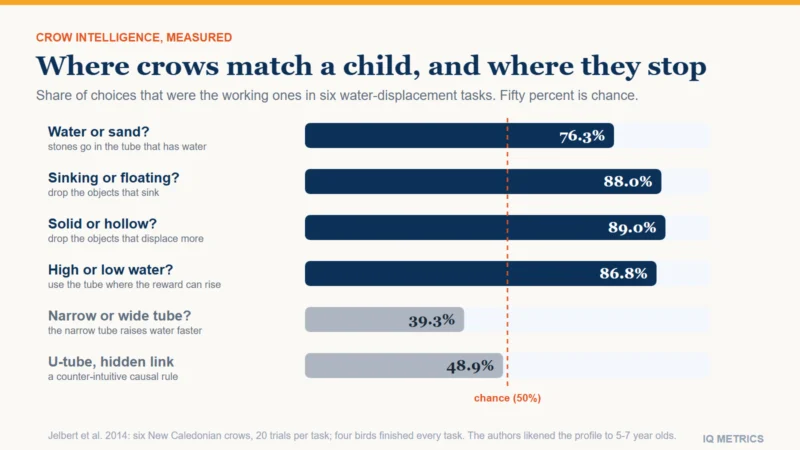 Understanding IQ
Crow and Raven IQ
A crow has no IQ, but tests show what corvids can do: bend wire, plan hours ahead, count their own calls. The 7-year-old comparison traces to one 2014 study of six crows, who were at chance on two of six puzzles.
 Understanding IQ
Dog IQ
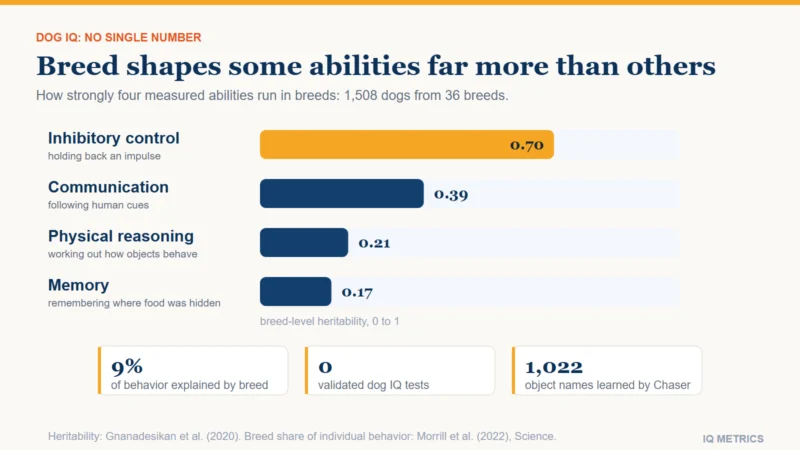
Dogs do not have an IQ: no validated test gives them one. Researchers can measure trainability, memory, self-control and a small general factor, and those results say more about how dogs think than any breed ranking, at-home dog IQ test or "as smart as a toddler" comparison ever could.
 Understanding IQ
Octopus IQ
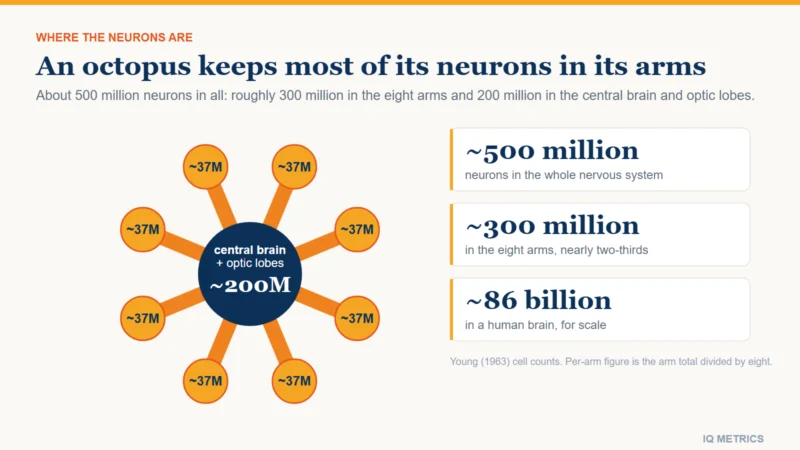
An octopus has no IQ, but it has about 500 million neurons, most of them in its arms. The neuron count, the tool-use and recognition studies, why short lives leave no room for teaching, and why UK law now treats octopuses as sentient.