





Dog IQ: What Canine Intelligence Tests Actually Measure
Dogs do not have an IQ: no validated test gives them one. Researchers can measure trainability, memory, self-control and a small general factor, and those results say more about how dogs think than any breed ranking, at-home dog IQ test or "as smart as a toddler" comparison ever could.

Dogs do not have an IQ score. No validated intelligence test produces one, and the researchers who study canine cognition say plainly that a dog IQ test with good measurement properties still does not exist (Arden, Bensky and Adams, 2016). What they can measure is a set of separate abilities — learning commands, remembering, holding back an impulse, following a human point — and some of those results are genuinely revealing about how dogs think.
The comparison people usually reach for, that an average dog is about as smart as a two-year-old child, comes from a conference talk rather than a study, and it measures something narrower than it sounds. This article covers what dog intelligence research actually shows, how dog IQ compares to human intelligence, which breeds learn fastest, and what an at-home dog IQ test can and cannot tell you.
Is there a real dog IQ test?
Not in the sense a person takes one. A human IQ test is normed on thousands of people, so a score says where someone stands against a representative sample; how IQ tests work explains the method. Nothing equivalent exists for dogs. When Rosalind Arden and her colleagues reviewed the field in 2016, they found only three studies of individual differences in dog cognition published since 1911.
Researchers instead use batteries of separate tasks, such as the citizen-science Dognition games, and report each ability on its own. Any website that gives your dog a single IQ number has invented the scale.
How smart are dogs compared to humans?
The most quoted answer comes from psychologist Stanley Coren, speaking at the American Psychological Association’s 2009 convention. He said the average dog can learn about 165 words, including signals, that the top 20% of dogs can learn about 250, and that dogs’ mental abilities are close to those of a human child aged 2 to 2.5 years. He added that dogs can count to about four or five.
Two cautions apply. It was a talk, not a peer-reviewed study, and other estimates are lower: a Dalhousie University survey of 165 owners found their dogs responded to between 15 and 215 words and phrases, 89 on average. And “as smart as a two-year-old” is a mental-age comparison, the same idea behind the original IQ formula, which psychologists dropped for humans because one age equivalent hides very uneven abilities (see deviation IQ vs ratio IQ). A dog far outperforms a toddler at tracking by smell, and cannot begin to match a toddler’s grammar.
Which dog breeds are the smartest?
The famous ranking comes from Coren’s 1994 book The Intelligence of Dogs, built on a survey of 199 obedience-trial judges from the American Kennel Club and the Canadian Kennel Club. It ranks only what Coren called working and obedience intelligence: how fast a breed learns a new command and how reliably it obeys. Top-tier breeds learn a new command in fewer than five repetitions and obey the first command at least 95% of the time.
| Rank | Breed |
|---|---|
| 1 | Border Collie |
| 2 | Poodle |
| 3 | German Shepherd |
| 4 | Golden Retriever |
| 5 | Doberman Pinscher |
| 6 | Shetland Sheepdog |
| 7 | Labrador Retriever |
| 8 | Papillon |
| 9 | Rottweiler |
| 10 | Australian Cattle Dog |
The judges largely agreed at the top: 190 of the 199 put the Border Collie in their top ten. At the other end Coren placed the Afghan Hound last, with the Basenji, Bulldog, Chow Chow and Borzoi just above it. Because the list measures trainability, it says more about how readily a breed works with a handler than about how well its dogs solve problems on their own.
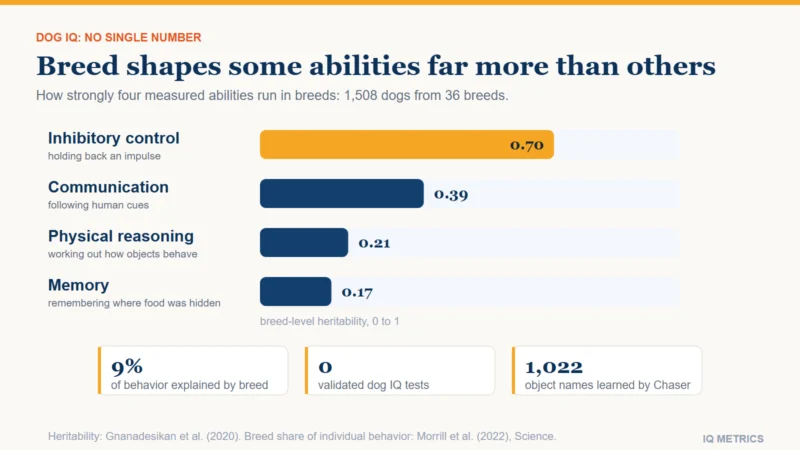
Breed also explains less than any ranking suggests. A 2022 study in Science of 18,385 dogs, 2,155 of them genotyped, found that breed explains just 9% of behavioral variation between individual dogs (Morrill and colleagues). The dog in front of you can sit a long way from its breed’s average.
Some abilities do track breed. Using Dognition data on more than 7,000 purebred dogs from 74 breeds, a 2019 study found that breeds with larger brains did better on short-term memory and self-control, though not on the other tasks, with brain size estimated per breed rather than measured in each dog (Horschler and colleagues). That is a breed-level pattern, not a rule that bigger dogs are smarter; brain size and IQ shows how modest the same link is in humans.
A 2020 study of 1,508 dogs across 36 breeds put numbers on it. Breed-level heritability was 0.70 for inhibitory control, 0.39 for communication, 0.21 for physical reasoning and 0.17 for memory (Gnanadesikan and colleagues). In other words, self-control runs strongly in breeds, while memory barely does.
Do dogs have a g factor?
The most IQ-like result in dog research is a general factor. Rosalind Arden and Mark Adams tested 68 working border collies on farms in Wales, using detour puzzles, following a human point and choosing the larger amount of food (Intelligence, 2016). Dogs that solved the detour tasks quickly also tended to do well on the choice tasks, and the best statistical model placed one general factor above three narrower ones — the same structure psychologists call the g factor in humans.
The caveats keep it modest: one breed, a small sample and no retest data. A 2026 study of 415 puppies and 520 adult dogs found that scores on different tasks were only weakly correlated (Gnanadesikan and colleagues), so a canine g factor, if it holds up, is weaker than the human one.
Where would your own score land?
Take the IIF-certified assessment and get your score with the scale it was measured on, the percentile it corresponds to and the confidence range around it — the three figures most online tests leave out.
Find your IQ score now! →Genius dogs: the gifted word learners
A few dogs learn object names at an extraordinary rate. Chaser, a border collie studied by John Pilley and Alliston Reid, learned the names of 1,022 objects over three years of intensive training (Behavioural Processes, 2011).
Researchers at Eotvos Lorand University in Budapest call dogs like her gifted word learners, and they are rare. In a 2021 study, all 6 gifted dogs found in two years of searching worldwide learned toy names during three months of training, while only 1 of 34 typical family dogs did. In another study, gifted dogs learned 6 new toy names in one week and 12 in the next, and still remembered them two months later. A 2023 survey of 41 gifted dogs from nine countries found they knew 29 toy names on average, and 56% of them were border collies.
Newer work suggests these dogs learn in ways that echo young children. Gifted dogs extend a toy’s name to new toys used the same way rather than toys that merely look alike (Fugazza and colleagues, 2025), and they can learn names by overhearing their owners, a pattern the authors compare to 18-month-old children (Dror and colleagues, Science, 2026).
Dog IQ vs cat IQ: which is smarter?
There is no cat IQ either, and cats are harder to study in a lab, so direct comparisons are thin. The best-known physical comparison is a 2017 neuron count: about 250 million neurons in a cat’s cerebral cortex, against 429 million in a small mixed-breed dog and 627 million in a golden retriever (Jardim-Messeder and colleagues). Only two dogs were counted, and more neurons do not simply mean more intelligence. For scale, the human cerebral cortex holds about 16 billion.
How dogs compare with other animals
Other species have their own headline findings, each on a narrow task:
- Crows: New Caledonian crows solving water-displacement puzzles showed an understanding “rivalling that of 5-7 year old children,” while failing two harder versions (Jelbert and colleagues, 2014).
- Self-control across species: in 36 species, including dogs, wolves and coyotes, absolute brain volume — not brain size relative to the body — best predicted performance on self-control tasks (MacLean and colleagues, 2014).
- Koko the gorilla: her trainer Francine Patterson reported an average IQ of about 80 on children’s tests such as the Stanford-Binet and the Peabody Picture Vocabulary Test. Critics questioned how her handlers interpreted her behavior, and the scores were never independently validated.
Can you test your dog's IQ at home?
You can run informative games, but not an IQ test. Popular at-home dog IQ tests — finding a treat under one of several cups, getting around a barrier to reach food, working a puzzle feeder — echo the kinds of memory, detour and problem-solving tasks researchers use. What they lack is norms: there is no representative sample of dogs to compare your dog’s time against, so the result cannot be turned into an IQ.
Used fairly, the games still show you something real about how your particular dog solves problems. Try them when the dog is calm and interested in the reward, repeat a task on different days instead of scoring one attempt, and remember that a dog trained to wait for cues may look slow on a puzzle it was never encouraged to try alone.
What dog IQ gets wrong about intelligence
The questions people ask about dogs — which breed is smartest, which age of child a dog equals — are the same simplifications that trip people up about human IQ. One number flattens very different abilities, a ranking of trainability gets read as a ranking of brains, and averages say little about an individual. Multiple intelligences theory is one challenge to the single-number view of people; the dog research is a reminder that even a well-measured ability is only one part of a mind.
Keep reading
All articles →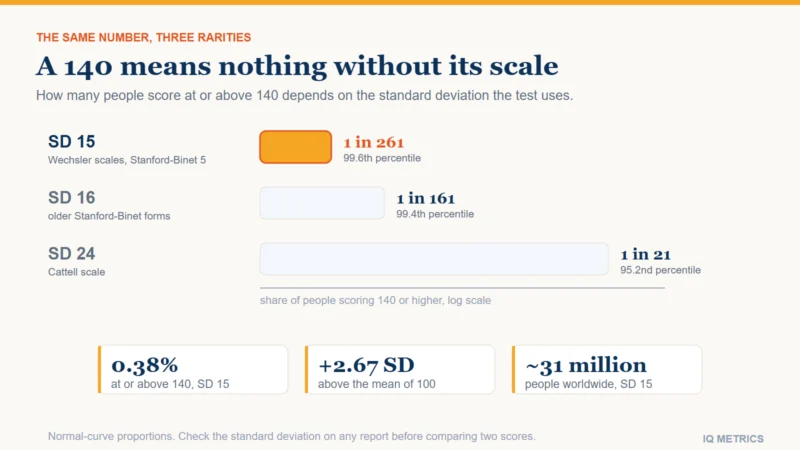 Scores & Scales
What an IQ of 140 Means
An IQ of 140 sits 2.67 standard deviations above the mean, at about the 99.6th percentile: roughly one person in 261 scores that high. It clears the gifted line and most high-IQ society cutoffs, but no current test manual calls it genius, and a single 140 is far less exact than the number suggests.
 Research & Evidence
Gardner's Multiple Intelligences
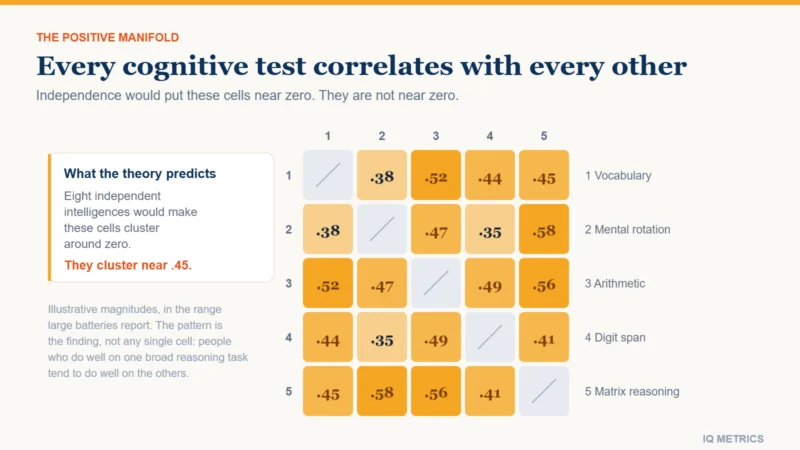
Gardner's multiple intelligences theory is one of the most influential ideas in education and almost entirely absent from the tests psychologists use. That gap is not stubbornness. It comes down to one stubborn statistical finding, one missing instrument, and a real insight the theory carries.
 Understanding IQ
Brain Myths About Intelligence
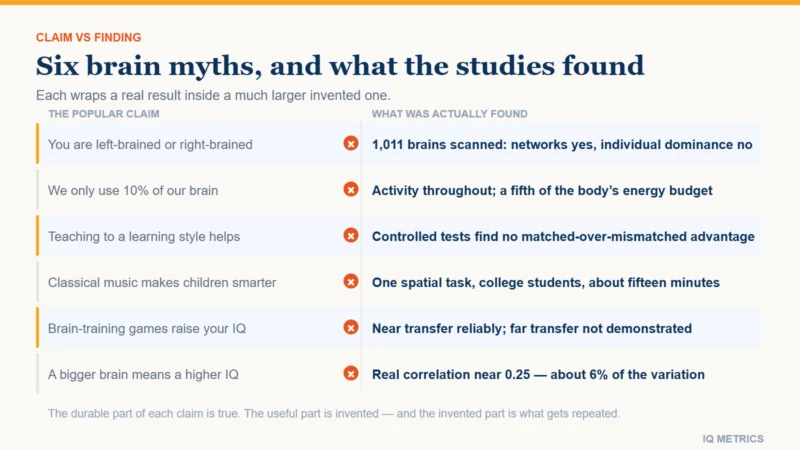
You are not left-brained or right-brained, you do not use ten per cent of your brain, and matching a lesson to your learning style does not help you learn. Six claims about intelligence that almost everyone repeats, what the studies that tested them found, and the smaller true fact hiding inside each one.