





Baby IQ Test: Can You Measure a Baby's IQ?
No test can give a baby an IQ. Bayley scores describe development, not intelligence, looking-time tasks predict later IQ only modestly (r = .36), and real IQ scoring starts at 2 years 6 months. See what each early score means.

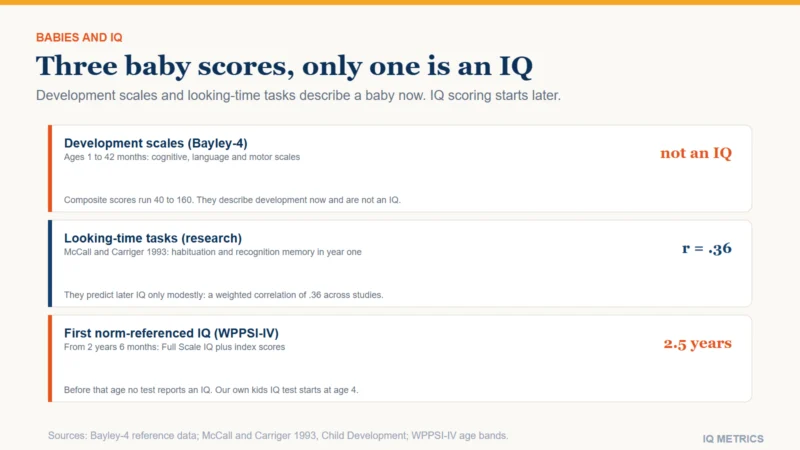
No. There is no valid baby IQ test, and nobody can give a baby an IQ score. What exists is different: developmental scales such as the Bayley-4, which describe what a child aged 1 to 42 months can do now, and research tasks that time how long a baby looks at something new. Norm-referenced IQ scoring starts at about 2 years 6 months, on the WPPSI-IV. This guide sorts the three kinds of early “score” apart, shows how well each predicts later IQ (modestly: a correlation of about .36), explains why a high baby score can be an artefact of a test’s norms, and says what the evidence supports for helping a young child develop.
- Youngest age with a true IQ score: 2 years 6 months (WPPSI-IV).
- Bayley-4: ages 1 to 42 months; composite scores run from 40 to 160 and are not IQs.
- Looking-time tasks in the first year: predict later IQ with a weighted correlation of .36 across studies.
- Our own kids IQ test starts at age 4.
Can you measure a baby's IQ?
IQ places a person against others of the same age on tasks built from language, reasoning, memory and speed. Those tasks assume a child who can follow instructions, point, name objects or arrange blocks. A 6-month-old can do none of that, so anything sold as a baby IQ test has to infer ability from behaviour such as reaching, babbling or where the eyes go. That is a different measurement with a different meaning, and it is the reason this site does not publish a baby test.
The target also moves fast. In a structural MRI study of 98 children scanned at 2–4 weeks, 1 year and 2 years, total brain volume rose 101% in the first year and a further 15% in the second (Knickmeyer and colleagues, 2008). A score from month six describes a brain that will look very different by month twelve. Early twentieth-century tests handled development with a “mental age” (see IQ and mental age); modern tests compare a child with same-age peers instead, which is one more reason they need a child old enough to be tested.
What the Bayley-4 and other baby scales measure
The Bayley Scales of Infant and Toddler Development, Fourth Edition (Bayley-4), is the standard clinical tool for the youngest children. It covers ages 1 to 42 months and reports five domains: cognitive, language and motor scales that a clinician administers, plus social-emotional and adaptive-behaviour scales completed from caregiver reports. Domain scores run from 40 to 160, and each subtest is scaled to a mean of 10 and a standard deviation of 3.
Clinicians use it to see whether a child is developing on schedule, to follow babies born early or unwell, and to document the need for early-intervention services. It was not built to forecast adult intelligence, and its composite score is not an IQ. The table shows how the main tools differ.
| Tool | Ages | What it reports | Best used for |
|---|---|---|---|
| Parent-completed screeners (for example, the Ages and Stages Questionnaires) | Infancy to about 5 years | A flag to monitor or refer | Spotting possible delays |
| Bayley-4 | 1 to 42 months | Composite scores, 40 to 160 (not an IQ) | Clinical assessment of development |
| Looking-time tasks (the Fagan test, research studies) | First year | Preference for the new picture | Research; not a clinical test |
| WPPSI-IV | 2 years 6 months to 7 years 7 months | Full Scale IQ and index scores | The first norm-referenced IQ |
| WISC-V | 6 to 16 years | Full Scale IQ and index scores | School-age IQ testing |
Do baby tests predict adult IQ?
Only weakly. McCall and Carriger’s 1993 meta-analysis in Child Development pooled the looking-time studies. It found that habituation (how fast a baby loses interest in a repeated picture) and recognition memory (how strongly a baby prefers a new picture to a familiar one), measured in the first year, predicted IQ measured between ages 1 and 8. The sample-size-weighted average correlation was .36, with a raw median of .45; habituation measures reached .39 and dishabituation measures .35.
A correlation of .36 explains about 13% of the differences in later scores (.36 × .36 = .13). One follow-up of infants tested at 6–12 months reported a correlation of .34 with adult IQ (Fagan, Holland and Wheeler, 2007). Those are real but modest signals: useful for research on groups, and no basis for predicting any one child. Reviews of one looking-time product, the Fagan Test of Infant Intelligence, have also criticised its small standardisation sample and thin reliability documentation, so treat it as a research tool and not a clinical one.
Two ordinary facts sit behind the weak link. A baby’s performance on any day depends on sleep, hunger and mood, and the abilities that make up IQ later — language, reasoning, working memory — have barely started to develop in year one, so a test cannot sample them directly.
Why a high baby score can mean very little
The norms behind a scale matter as much as the child. In a 2010 study in Archives of Pediatrics & Adolescent Medicine, Anderson and colleagues tested 221 extremely preterm or extremely low-birth-weight 2-year-olds and 220 healthy full-term controls in Victoria, Australia, using the third edition, the Bayley-III. The healthy controls averaged composite scores between 0.55 and 1.23 standard deviations above the published norm. The scale therefore reported far fewer delays than were really present, and the authors concluded that it seriously underestimates developmental delay.
The practical lesson is that a baby score means little without the edition and the norms behind it. On a scale whose norms run high, a composite in the 110s can be an ordinary result for a healthy 2-year-old. Clinicians also interpret scores against corrected age (age counted from the due date for a baby born early), which is why a parent comparing a printout with a forum post learns very little. For the wider picture after an early birth, see our piece on premature birth and IQ.
When can a child take a real IQ test?
The first instrument that reports a norm-referenced Full Scale IQ is the WPPSI-IV, for ages 2 years 6 months to 7 years 7 months. It has two age bands. The younger band (2:6–3:11) reports verbal comprehension, visual spatial and working memory indexes plus a Full Scale IQ; from 4:0 it adds fluid reasoning and processing speed, for five indexes in all. The WISC-V takes over at 6, and the Woodcock-Johnson V covers ages 4 to 90+ (see our Woodcock-Johnson IQ test guide).
Even at two and a half, scores move more between sittings than they do later. Accuracy improves with age, and by adolescence a score predicts adult performance far better than one taken at five; our guide to the best age to take an IQ test covers the stability data, and IQ testing for children compares the batteries. To see what age-4-plus items look like, read IQ test questions for kids.
Where would your own score land?
Take the IIF-certified assessment and get your score with the scale it was measured on, the percentile it corresponds to and the confidence range around it — the three figures most online tests leave out.
Find your IQ score now! →What a baby IQ test app or quiz really measures
Online quizzes and apps that promise a baby IQ score have no way to compare your answers with same-age babies, no trained observer and no norms. Most simply add up milestones you tick. At best that is a developmental checklist; at worst it is a number that flatters or frightens. This site does not publish one.
If the real question is “is my baby on track?”, use the milestone checklists. In February 2022 the CDC and the American Academy of Pediatrics revised them so that each milestone reflects what at least 75% of children can do by that age, and added checklists at 15 and 30 months so there is one for every routine well-child visit up to age five. A parent-completed screener and a conversation with the child’s paediatrician are the ordinary route to a formal developmental assessment.
Can you raise a baby's IQ?
Not with a product. What the evidence supports is ordinary: sleep, nutrition, and responsive talk, play and reading. Our evidence summaries on sleep, nutrition, breastfeeding and preschool each say how much, and how little, can be shown.
Products marketed to babies fare worse. In a 2007 telephone survey of more than 1,000 parents, Zimmerman, Christakis and Meltzoff found that for infants aged 8 to 16 months, every hour a day spent watching baby DVDs and videos went with an average of six to eight fewer words understood on a parent-completed checklist; for 17 to 24 months they found no positive or negative link. The result is correlational, since families that use screens more may differ in other ways, but it gives no support to the idea that baby videos build intelligence. For the music claim, see the Mozart effect.
Quick answers
- What is a normal IQ for a baby? Babies do not have IQ scores. Bayley-4 composites are scaled around 100, but that is a developmental score.
- Can a 1-year-old take an IQ test? No. The youngest test that reports an IQ starts at 2 years 6 months.
- Do baby IQ tests predict adult IQ? Weakly: about .36 for looking-time measures in the first year, which explains roughly 13% of later differences.
- Is a high Bayley score a sign of a high IQ? Not by itself; on the Bayley-III, healthy 2-year-olds averaged well above the published norm.
- How can I tell if my baby is gifted? You cannot from a test at this age. Track milestones, and see signs of a gifted child for what shows up later.
The bottom line
A baby can be assessed but not given an IQ. Development scales describe where a child is now, looking-time tasks carry a modest signal about the future, and neither should be read as a forecast for an individual. If you are worried about a delay, the milestone checklists and a paediatrician come first; if you are curious about the person your child is becoming, read our guides to how autism and ADHD show up in IQ scores once a child is old enough to be tested.
Sources
- Shirley Ryan AbilityLab, Bayley-4 reference entry: age range, domains and score ranges.
- McCall, R.B. and Carriger, M.S. (1993), Child Development 64: 57–79: habituation and recognition memory as predictors of later IQ.
- Fagan, J.F., Holland, C.R. and Wheeler, K. (2007), Intelligence 35: 225–231: the prediction, from infancy, of adult IQ and achievement.
- Anderson, P.J. et al. (2010), Archives of Pediatrics & Adolescent Medicine 164: 352–356: underestimation of developmental delay by the Bayley-III.
- Knickmeyer, R.C. et al. (2008), Journal of Neuroscience 28: 12176–12182: a structural MRI study of brain development from birth to 2 years.
- Zimmerman, F.J., Christakis, D.A. and Meltzoff, A.N. (2007), Journal of Pediatrics 151: 364–368: media viewing and language development under age 2.
- CDC, developmental milestones: the 2022 revised checklists.
- Wechsler Preschool and Primary Scale of Intelligence: age bands and index structure.
Keep reading
All articles →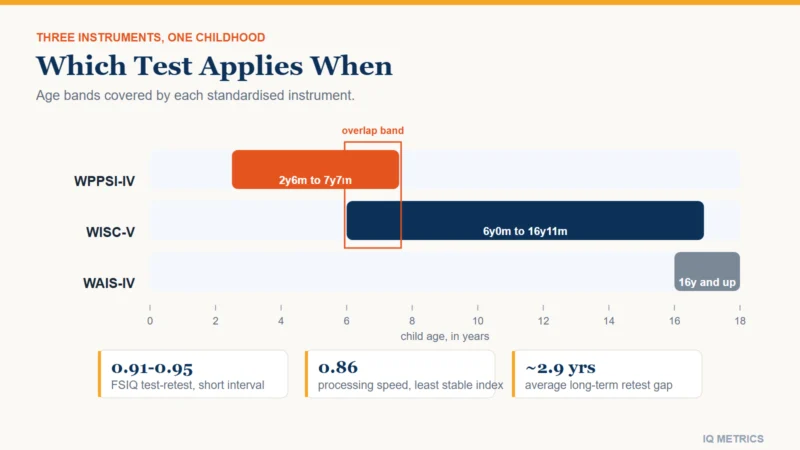 Taking a Test
IQ Testing for Children
Children are not tested on the same instrument as adults, and the test itself changes twice before age eighteen. Here is which one applies when, how reliable an early score really is, and what a parent should and should not conclude from a single number.
 Research & Evidence
Premature Birth and IQ
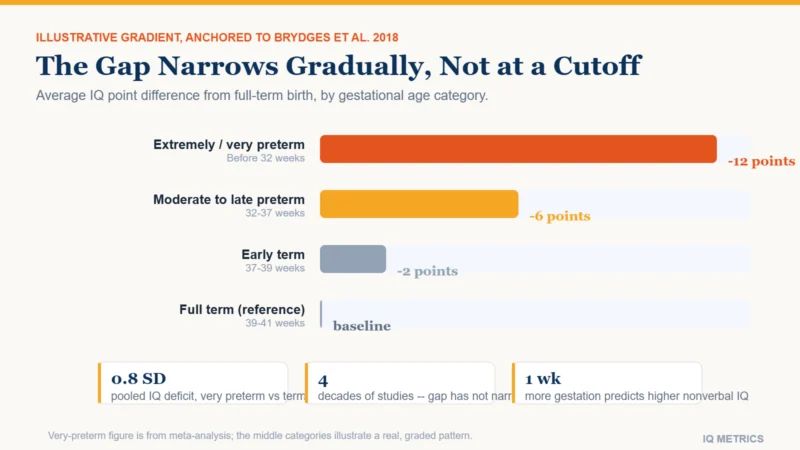
Children born very preterm score, on average, about 0.8 of a standard deviation lower on IQ tests than children carried to term. Here is what a 2018 meta-analysis and the studies since actually found: the gestational-age gradient, what is really driving the gap, and what it does not tell you about one specific child.
 Understanding IQ
Autism and IQ
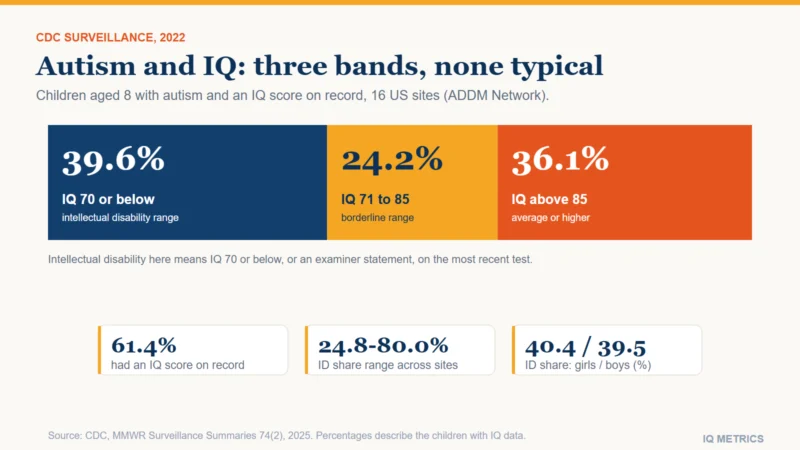
About 40% of 8-year-olds with autism and an IQ score on record had an IQ of 70 or below, and 36% scored above 85. See the CDC figures and their caveats, the Raven's gap of 30 percentile points, and what an IQ number cannot tell you.