





Dolphin IQ: Is There a Score? Brains, Tests and the Sceptics
Dolphins have no IQ, but they have passed a mirror test, use signature whistles like names and pass tool use down the female line. See the evidence, the brain data, and the peer-reviewed sceptics who question the hype.

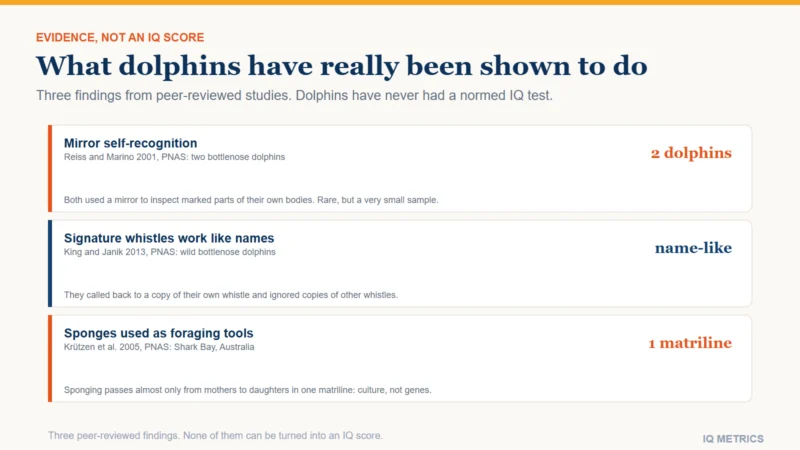
There is no such thing as a dolphin IQ. IQ is a score on a human test, ranked against human norms, and no dolphin has ever been given one, so any specific “dolphin IQ” number you see online has no test behind it. What exists is evidence about behaviour and brains: bottlenose dolphins have passed a mirror test, use individual signature whistles that work like names, and pass a sponge-tool habit down the female line, and some dolphin species are more encephalised than any non-human primate. Sceptics counter that the same behaviours appear across many mammals and that cetaceans do poorly on some standard tasks. This article lays out both sides and what each finding does and does not show.
- No score: dolphins have no IQ because no normed test exists for them; comparisons rest on behaviour and brain measurements.
- Best evidence: mirror self-recognition (2001, two dolphins), name-like signature whistles (2013, wild dolphins) and cultural sponge tool use (2005, Shark Bay).
- Brains: some delphinids are more encephalised than any non-human primate, and the long-finned pilot whale has about 37.2 billion neocortical neurons, almost twice the human count.
- The counter-case: a 2013 review argues the behaviours are common across vertebrates and that cetaceans do not surpass certain benchmark tasks, so “second smartest after humans” is unproven.
Is there a dolphin IQ?
An IQ is not an intrinsic property, like weight. It is a person’s standing relative to a norm group on a specific test, which is why 100 is average by construction (see the IQ bell curve and the average IQ test score). A dolphin cannot take a test written for humans, and no comparable test with a dolphin norm group exists, so a dolphin’s IQ is undefined rather than high or low. Researchers instead compare species through behaviour experiments and brain measures such as encephalisation — brain size relative to what is expected for the body size — which is a rough proxy for cognitive capacity, not a score.
Big brains: what the numbers show
In 1998 Lori Marino compared 21 toothed-whale species with 60 anthropoid primate species using two measures of encephalisation. Humans remain extraordinary, but a subset of dolphin species are significantly more encephalised than the most encephalised primates, narrowing the gap between humans and other animals. Counting cells adds a twist. Mortensen and colleagues (2014) estimated that the long-finned pilot whale — a member of the dolphin family — has about 37.2 billion neurons in its neocortex, almost twice as many as humans, plus 127 billion glial cells. Because pilot-whale neurons are less densely packed, the larger count comes from a larger brain. The authors conclude that the absolute number of neocortical neurons does not explain human cognitive superiority. A bigger tally does not mean a higher IQ, and it does not show that pilot whales out-think people. For the human side of the same question, see brain size and IQ.
Killer whales, neuron counts and the cost of a big brain
The pilot whale is not the only dolphin with a record brain. In a 2019 study, Ridgway and colleagues examined dolphin brains weighing from 783 to 6,215 g and found that average neuron density in four areas of cortex fell as brains got larger, as expected. Even so, the killer whale, the largest dolphin, has more gray matter and more cortical neurons than any mammal in the study, humans included, despite a lower neuron density than smaller dolphins (Ridgway and colleagues, 2019). The table puts the counts people compare next to each other.
| Animal | Cortical neurons | Source |
|---|---|---|
| Human | about 16.3 billion | Herculano-Houzel and colleagues, 2014, quoted in elephant IQ |
| Chimpanzee | roughly 6 to 8 billion | Estimates differ; see chimpanzee IQ |
| Long-finned pilot whale | about 37.2 billion | Mortensen and colleagues, 2014 (neocortex) |
| Killer whale | more than any other mammal measured, humans included | Ridgway and colleagues, 2019 (no total in the abstract) |
The same paper offers a reason big brains are not free. The brain uses an outsized share of the body’s oxygen, with cortex and cerebellar gray matter using the most, and the dolphins studied limit dives to five or ten minutes, while the beaked whale and pygmy sperm whale the authors measured, with smaller brains and fewer cortical neurons, dive for more than an hour and more than half an hour. The authors suggest brain metabolism may limit dolphin dive times, and that the extra neurons must buy dolphins some other advantage, such as catching elusive, high-calorie prey in the upper ocean. It is a hypothesis about physiology, not a measure of intelligence, and it is one more reason a neuron count is not an IQ.
The mirror test
Recognising your own reflection is rare in the animal kingdom. In 2001 Diana Reiss and Lori Marino exposed two bottlenose dolphins to reflective surfaces. Both responded in ways consistent with using the mirror to investigate marked parts of their bodies, which the authors described as a striking example of evolutionary convergence with great apes and humans. It is a very small sample, and because dolphins cannot touch a mark with a hand, the researchers had to interpret body-inspection behaviour instead. That makes the finding suggestive rather than conclusive, but it is among the studies most often cited when dolphins are placed near the top of animal-intelligence lists. Gorillas, by contrast, have usually struggled with the same test (see gorilla IQ).
Signature whistles: do dolphins have names?
Each bottlenose dolphin develops its own signature whistle, an identity signal whose shape encodes who is calling independently of the voice itself. In 2013 Stephanie King and Vincent Janik played wild dolphins copies of their own signature whistles. The animals called back when they heard a copy of their own whistle and did not respond to whistles that were not their own. The authors concluded that this learned identity signal is used as a label when addressing another dolphin, and that bottlenose dolphins appear to be unique among non-human mammals in using learned signals as individually specific labels for social companions in their own natural communication system. Labelling with learned signals is a foundation of human language, although the study does not show that dolphins have language.
Sponge tools and dolphin culture
In Shark Bay, Western Australia, some wild bottlenose dolphins tear off marine sponges and wear them over their beaks while foraging on the seabed. Michael Krützen and colleagues (2005) showed that genetic and ecological explanations for the habit were inadequate. Mitochondrial DNA showed that sponging passes almost exclusively from mothers to female offspring within a single matriline, and the adult spongers appear to descend from one recent “Sponging Eve”. Unlike in apes, tool use in this population is almost entirely limited to one family line that lives inside a large, open social network. The authors call it the first case of an existing material culture in a marine mammal, and a reminder that intelligence in the wild is often social knowledge passed on, not a trait measured in a laboratory.
Where would your own score land?
Take the IIF-certified assessment and get your score with the scale it was measured on, the percentile it corresponds to and the confidence range around it — the three figures most online tests leave out.
Find your IQ score now! →The sceptic's case
Not every neuroscientist accepts that dolphins deserve a special intellectual status. In a 2013 review in Neuroscience, Paul Manger argued that the behaviours cited as evidence for high cetacean intelligence are found commonly across mammals and other vertebrates, and that cetacean brains became relatively large about 32 million years ago and have stayed stable in relative size since, which he takes to mean that sophisticated cognition played no role in their evolution. He also points to reports that cetaceans do not surpass Piaget stage 4/5 on object-permanence tests and could not solve an “if and only if, then” abstract task, and concludes that their general intelligence may be lower than that of other vertebrates. This is a contested position, and researchers who study dolphins read the same evidence differently, but it is a peer-reviewed reminder that big brains and charming behaviour are not the same as a measured intellect.
What each finding can and cannot show
| Question | What is documented | What it cannot show |
|---|---|---|
| Do dolphins recognise themselves? | Two bottlenose dolphins responded to marks in front of mirrors (2001). | How common the ability is, or how it compares with apes. |
| Do dolphins have names? | Wild dolphins answer copies of their own signature whistle (2013). | That whistles are words, or that dolphins have language. |
| Do dolphins use tools? | Sponging in Shark Bay passes down one matriline (2005). | That dolphins in general use tools. |
| Are dolphin brains special? | High encephalisation; pilot whales have 37.2 billion neocortical neurons (2014). | Any IQ, or that more neurons means smarter. |
| Are dolphins overrated? | A 2013 review finds the behaviours common across vertebrates. | That dolphins are unintelligent; it argues the evidence is not special. |
The same logic applies to every animal ranking on the internet. Our write-ups on chimpanzees, crows, octopuses, dogs and gorillas each stop at the same place: behaviours and brain facts, never a valid score.
Are dolphins as smart as a 7-year-old, or smarter than chimpanzees?
Two comparisons dominate the searches, and neither has a measured answer. Dolphins and children: none of the studies described here compares dolphins with children of any age, so a “7-year-old” equivalent has no test behind it in this evidence. Dolphins and chimpanzees: the evidence for each rests on different tests, with mirror recognition, vocal labels and sponge tools for dolphins and a 16-task battery against 2.5-year-old children for chimpanzees (see chimpanzee IQ), so no study has put the two on a common scale. Both are cognitively sophisticated animals, in different ways.
Dolphin IQ vs human IQ
People search for “dolphin IQ vs human” expecting a number. The honest comparison has three parts. Brains: humans remain the most encephalised animals measured, though some dolphin species narrow the gap. Behaviour: dolphins show self-recognition, individual vocal labels and cultural tool use, which humans do too but most animals do not. Tests: humans can be scored on a common scale (see the IQ scale by age and the IQ level chart), whereas dolphins cannot. Human IQ is a useful, standardised measure inside its own norm group; outside it, the word only creates a false sense of precision.
Quick answers
- What is the IQ of a dolphin? Undefined. No normed IQ test exists for dolphins, so any specific dolphin IQ figure lacks a test behind it.
- Are dolphins the second smartest animal? That claim is popular, not established: some dolphins are highly encephalised, but a 2013 review argues their behaviour is not special among vertebrates.
- Are dolphins smarter than chimpanzees? No study has ranked them on a common scale; the evidence for each rests on different tests.
- Do dolphins have names? They have signature whistles that other dolphins answer, which function like individual labels.
- Can dolphins recognise themselves in a mirror? Two bottlenose dolphins did in a 2001 study; the sample was tiny.
- What is the IQ of a bottlenose dolphin? Undefined, like every other dolphin. The mirror, whistle and sponge findings all come from bottlenose dolphins, and none involves an IQ test.
- Are dolphins as smart as a 7-year-old? No study compares them with children, so the figure has no measurement behind it.
- Do dolphins have bigger brains than humans? Some do. In a 2019 study the largest dolphin brain weighed 6,215 g, and the killer whale held more cortical neurons than any mammal measured, humans included, but a neuron count is not an IQ.
The bottom line
Dolphins are cognitively sophisticated animals with large, complex brains, but they cannot be given an IQ, and the popular idea that they rank second only to humans is a claim, not a measurement. The best evidence is specific and interesting — mirror behaviour, name-like whistles, sponge tools passed down a family line — and the best sceptical review argues that none of it sets dolphins apart from other clever vertebrates. Both readings deserve to be held at once.
Sources
- Reiss, D. and Marino, L. (2001), PNAS 98(10): 5937–5942: mirror self-recognition in the bottlenose dolphin.
- King, S.L. and Janik, V.M. (2013), PNAS 110(32): 13216–13221: bottlenose dolphins can use learned vocal labels to address each other.
- Krützen, M. et al. (2005), PNAS 102: cultural transmission of tool use in bottlenose dolphins.
- Mortensen, H.S. et al. (2014), Frontiers in Neuroanatomy 8: 132: quantitative relationships in delphinid neocortex.
- Marino, L. (1998), Brain, Behavior and Evolution: a comparison of encephalization between odontocete cetaceans and anthropoid primates.
- Manger, P.R. (2013), Neuroscience: questioning the interpretations of behavioral observations of cetaceans.
- Ridgway, S.H., Brownson, R.H., Van Alstyne, K.R. and Hauser, R.A. (2019), PLoS ONE 14(12): e0226206: higher neuron densities in the cerebral cortex and larger cerebellums may limit dive times of delphinids.
Keep reading
All articles →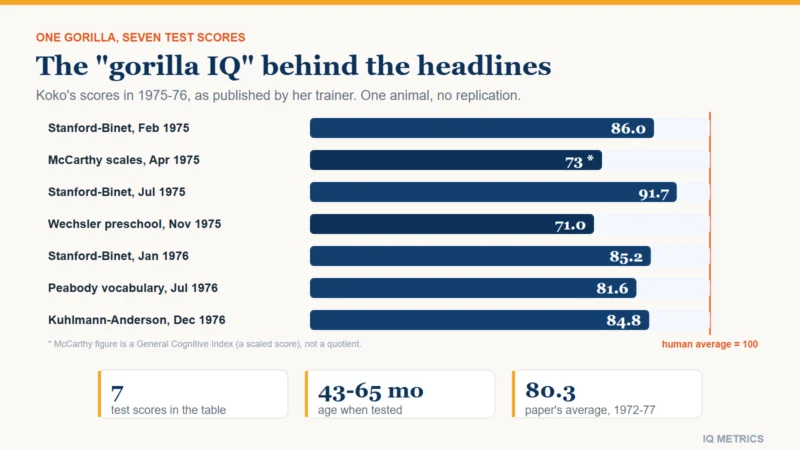 Research & Evidence
Gorilla IQ
Gorillas have no IQ. The quoted 70 to 95 comes from tests given to one gorilla, Koko, by her trainer. See her real scores, what wild gorillas have been shown to do, and why brain size alone cannot rank animals.
 Understanding IQ
Crow and Raven IQ
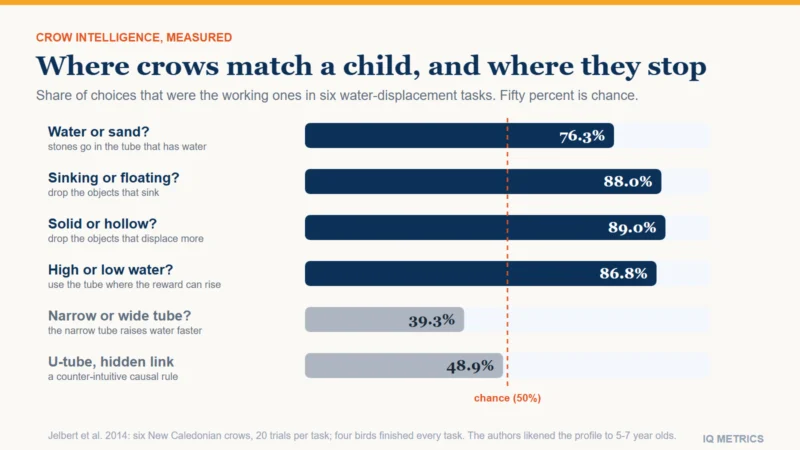
A crow has no IQ, but tests show what corvids can do: bend wire, plan hours ahead, count their own calls. The 7-year-old comparison traces to one 2014 study of six crows, who were at chance on two of six puzzles.
 Understanding IQ
Octopus IQ
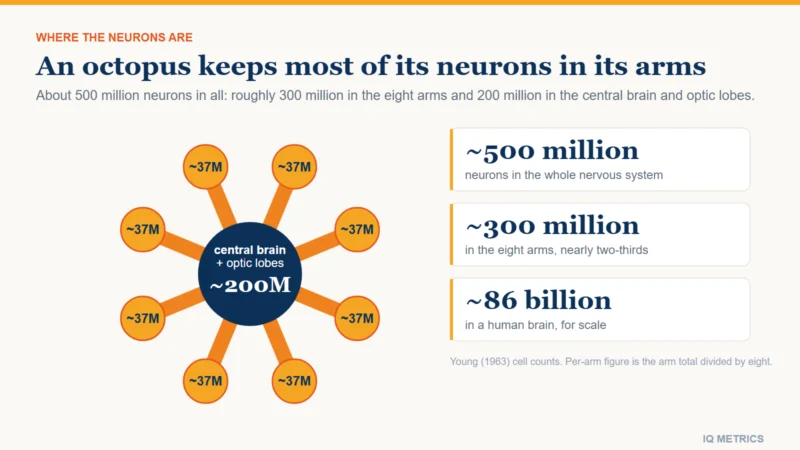
An octopus has no IQ, but it has about 500 million neurons, most of them in its arms. The neuron count, the tool-use and recognition studies, why short lives leave no room for teaching, and why UK law now treats octopuses as sentient.