





Does Preschool Raise a Child's IQ? What the Perry Project Found
The most famous experiment in early-childhood education raised participants' IQ scores by as much as 13 points -- then watched that advantage shrink to almost nothing within a few years. Their income, education and arrest records stayed different for the rest of their lives. Why would outcomes outlast the score that supposedly predicts them?

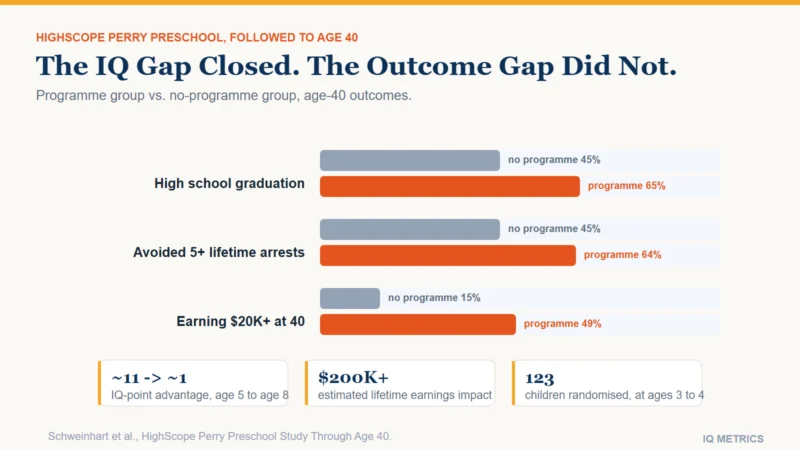
Yes, in the short term, and the size of that boost has been measured about as rigorously as anything in this field: a randomized trial that raised participants’ IQ scores by roughly 13 points. The complication is what happened next. Within a few years the IQ advantage had shrunk to almost nothing. What did not shrink was everything the IQ score was supposedly there to predict.
That combination — the measurable thing fading while the outcomes it was supposed to forecast kept diverging for decades — is the most-cited puzzle in early-childhood research, and it changes what a preschool IQ study can actually tell you. It also means the honest answer to "does preschool raise IQ" depends entirely on which year you ask the question, which is not the kind of nuance that fits in a single headline number.
The experiment that settled the design question
The HighScope Perry Preschool Study began in 1962 in Ypsilanti, Michigan, with 123 children living in poverty, ages 3 and 4, individually assigned to either a high-quality preschool programme or no preschool at all — not assigned by classroom or neighbourhood, which is what makes the results a genuine causal estimate rather than a comparison of whoever happened to enroll. Researchers then did something almost nobody else in this field has managed: they kept following the same 123 people all the way to age 40.
What the programme actually consisted of
It was not a light touch. Children attended a daily 2.5-hour classroom session every weekday morning, taught by certified public-school teachers holding at least a bachelor’s degree, at an unusually low child-to-teacher ratio of about 6 to 1. The classroom followed what became the HighScope curriculum’s "plan-do-review" routine: children planned an activity, carried it out, then reviewed what happened, rather than sitting through passive instruction. Teachers also made a 1.5-hour home visit to each family every week, working directly with mothers on extending the same activities at home. That combination of classroom intensity, low ratios, a specific pedagogy, and weekly direct parent involvement is a considerably heavier intervention than what most children who attend some form of preschool today actually receive, which matters for how far the results can be expected to generalise.
The IQ boost, and how fast it faded
At age 5, right after the programme ended, the treatment group’s IQ advantage measured about 0.75 standard deviations — on some analyses as much as 13 points, a large effect by any standard in psychology. By age 8, that gap had shrunk to roughly 0.08 standard deviations, about a single point, and was no longer statistically distinguishable from zero. The children who attended preschool were, by nearly any IQ test given in elementary school, no longer measurably different from the children who had not.
The outcomes that did not fade
Here is where the study becomes genuinely strange if you expect IQ to be doing the predictive work. Followed to age 40, the preschool group graduated high school at 65 percent versus 45 percent for the no-preschool group. They were arrested five or more times over their lives at 36 percent versus 55 percent. They were earning $20,000 or more annually at 49 percent versus 15 percent. Researchers estimate the programme’s impact on lifetime earnings at upward of $200,000 per participant. Every one of those gaps persisted for decades after the IQ gap that supposedly explained early advantage had already closed in elementary school.
Where would your own score land?
Take the IIF-certified assessment and get your score with the scale it was measured on, the percentile it corresponds to and the confidence range around it — the three figures most online tests leave out.
Find your IQ score now! →Why would outcomes outlast the IQ boost
The leading explanation is not that the IQ tests were wrong, but that IQ was never the actual mechanism of benefit — it was just the easiest thing to measure early. The economist James Heckman and colleagues, reanalyzing this same dataset, argue the programme’s lasting effect ran mainly through non-cognitive skills: self-control, sustained attention, motivation and the ability to work with other children — skills that do not show up on an IQ test at all but that plausibly shape whether a teenager stays in school or a young adult keeps a job. A more recent reanalysis (Garcia, Heckman and colleagues, 2025) goes further, arguing some of the apparent cognitive fadeout was itself a measurement artefact of how later tests were scored, and that real cognitive gains persisted further into adulthood than the original age-8 result suggested. That reanalysis is contested, not settled — but even by the original, more conservative reading, the outcome gap needs an explanation that is not simply "the IQ gap stayed open."
One further piece of evidence favours the soft-skills reading over a purely cognitive one: through elementary and middle school, years after the IQ gap itself had closed, the preschool group was still less likely to be placed in special education and less likely to be held back a grade than the no-preschool group. If the programme’s only lasting effect had been cognitive, those school-progress differences should have closed on the same schedule as the IQ scores. They did not, which is exactly the pattern you would expect if the programme had changed something more durable than a test score — how a child navigated a classroom, not just how they scored on one test.
Head Start's larger, messier evidence
Perry Preschool is a single, small, unusually intensive programme from the 1960s, run at a scale and cost per child that no national system has matched, and its dramatic numbers do not automatically generalize to preschool at national scale. Head Start, the actual federal early-childhood programme serving over a million American children a year, has been studied far more broadly, and its own large-scale evaluation (the national Head Start Impact Study) found a similar shape — an early cognitive boost that fades within a few years of school entry — but with smaller, more debated effects on later life outcomes than Perry’s striking numbers. The honest summary is that intensive, well-resourced early intervention for children in poverty has a real and reasonably well-established effect on adult outcomes; exactly how large that effect is at the scale of an ordinary national programme is a genuinely open, actively studied question, not a settled multiple of the Perry numbers.
How this differs from does school raise IQ
This is a narrower question than whether ordinary schooling raises IQ across the school years, which looks at the general K-12 population. This article is scoped specifically to targeted early-childhood interventions for children growing up in poverty, where the comparison is not "more school versus less school" but "an intensive structured programme versus none, before age 5." The two questions share a family resemblance and not much more.
It also rhymes, more than coincidentally, with the one randomized trial on breastfeeding and IQ: another case where a real, causally established early cognitive advantage shrinks well before adulthood. The through-line in both is the same caution — an IQ score measured in early childhood is a snapshot of that moment, not a fixed prediction of the adult the child will become.
What this means, and does not mean
None of this makes IQ scores meaningless, and it does not mean preschool is pointless — if anything, Perry Preschool is some of the strongest causal evidence available that early intervention for children growing up in poverty changes the trajectory of a life. What it means is narrower and more useful: a single IQ number, especially one measured in early childhood, is an incomplete predictor of how a life turns out, because plenty of what shapes an adult outcome was never going to show up on that test in the first place.
It is also a useful corrective for reading any "programme X raised IQ by Y points" headline, in education research or anywhere else: ask what happened to that gap five years later before deciding how much weight it deserves. Sometimes, as with Perry Preschool, the score itself was never really the point.
Keep reading
All articles →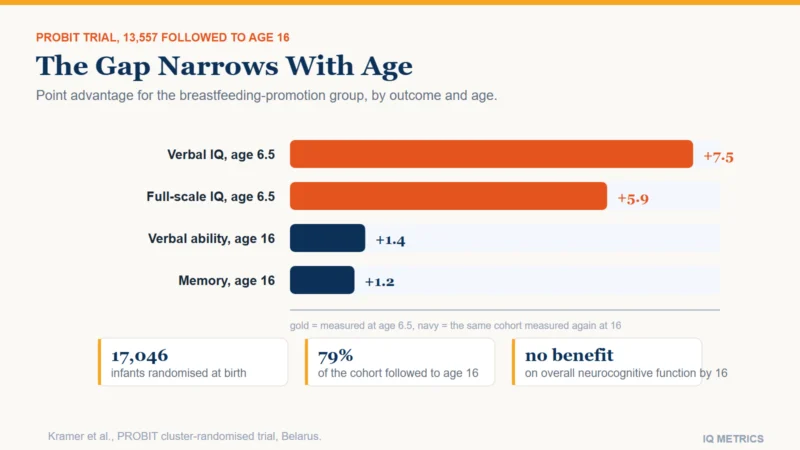 Research & Evidence
Breastfeeding and IQ
The largest randomized trial ever run on breastfeeding found a genuine IQ advantage at age six -- about six points on full-scale IQ. By age sixteen, the gap on most measures had shrunk close to zero. Here is what the trial actually measured, and why it still beats every observational study that came before it.
 Research & Evidence
Does School Raise IQ?
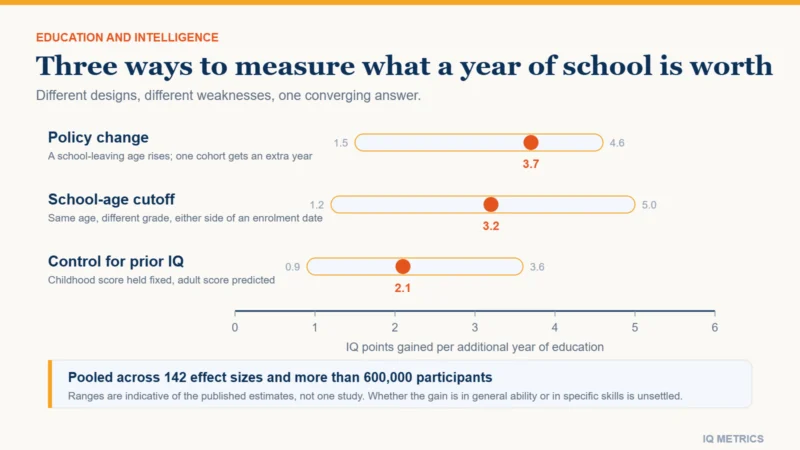
Education is the environmental factor with the strongest evidence for actually raising IQ scores, and the effect is bigger than most people expect. Three independent study designs, pooled across more than 600,000 participants, point the same way. Here is the size of it, and the caveat that gets dropped.
 Research & Evidence
Socioeconomic Status and IQ
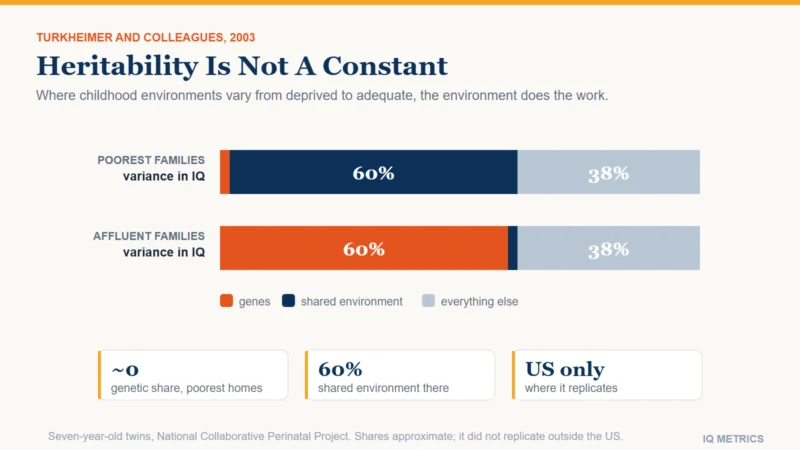
Family circumstances track IQ scores, and the relationship is stranger than a simple gap. In the poorest families studied, genes explained almost none of the variation in childhood scores and shared environment explained most of it. In affluent families the pattern reversed. Here is what that finding does and does not support.