



What was Paul Morphy’s IQ?
Paul Morphy’s estimated IQ rests on a law degree at nineteen, a 7–2 win over Anderssen and ratings computed after he died.
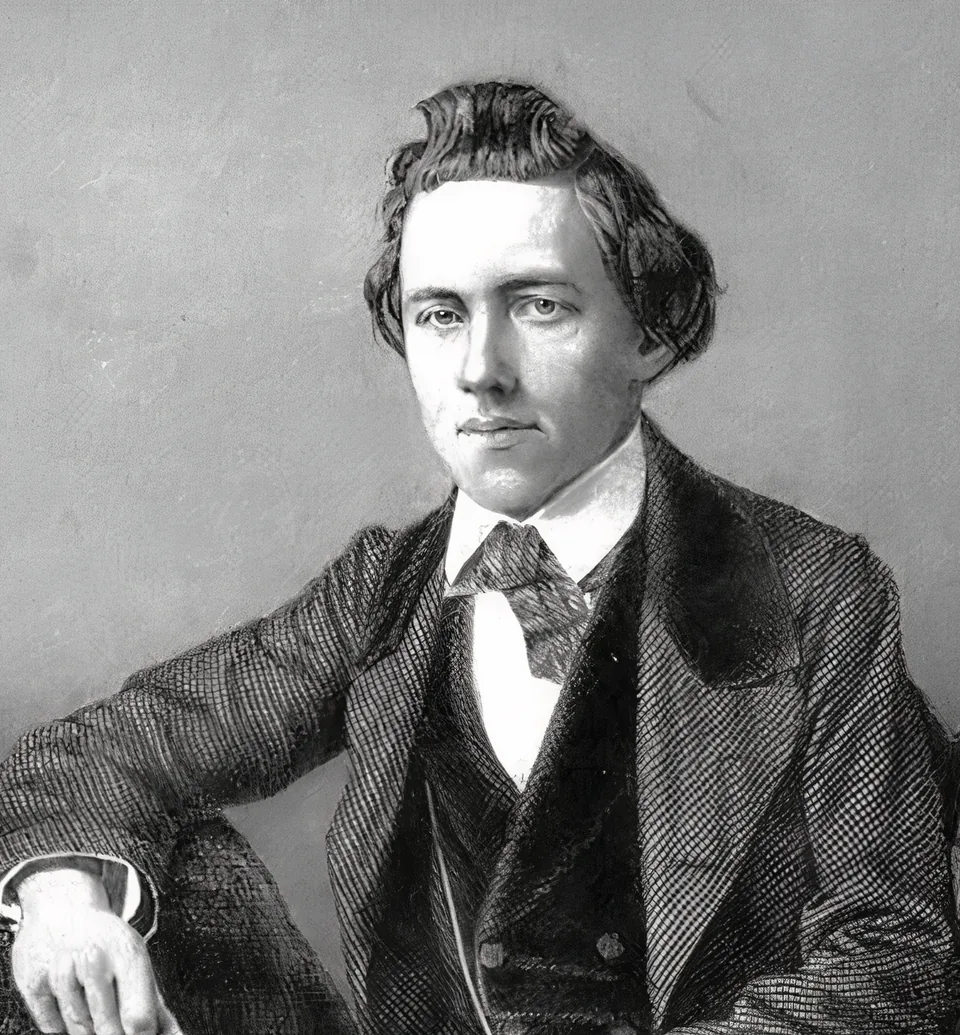
Paul Morphy’s IQ was never measured: he died in 1884, twenty-one years before the first intelligence scale, and no test score for him exists. What is documented is a master’s degree at seventeen, a law degree at nineteen and the strongest chess of the 1850s; the only “Paul Morphy IQ” figure found is one unsourced forum reply.
Paul Morphy’s estimated IQ
- Master’s degree “with the highest honors” from Spring Hill College in Mobile, Alabama, in May 1855, aged seventeen, after a bachelor’s degree there in 1854.
- LL.B. from the University of Louisiana (now Tulane University) in April 1857, aged nineteen.
- Won the First American Chess Congress in New York (October 6 – November 10, 1857), a sixteen-player knockout, beating Louis Paulsen in the final with 5 wins, 1 loss and 2 draws.
- Won the Paris match against Adolf Anderssen in December 1858 by 7 wins to 2 with 2 draws, and the formal matches against Johann Löwenthal (9 wins, 3 losses, 2 draws) and Daniel Harrwitz (5–2, 1 draw).
- Modern reconstructions put him at the top of his era: Chessmetrics lists a highest rating of 2743 (June 1859 list, No. 1 in the world) and Edo Historical Chess Ratings gives 2816 for 1860.
No test, class ranking or contemporary assessment of his intelligence was found in any source opened, and the two chess reconstructions differ by 73 points on scales that are not interchangeable. Chess strength and IQ are different things, so this range is an inference placed beside the site’s other chess profiles, not a measurement.
- Born
- June 22, 1837, New Orleans, Louisiana
- Died
- July 10, 1884, New Orleans, Louisiana
- Education
- Spring Hill College (B.A. 1854; M.A. May 1855, highest honors); LL.B., University of Louisiana (now Tulane), April 1857
- First American Chess Congress
- Winner, New York, October 6 – November 10, 1857
- Match v. Adolf Anderssen
- Won 7–2 with 2 draws, Paris, December 20–28, 1858
- Chessmetrics highest rating
- 2743, June 1859 list (modern reconstruction)
- Edo rating, 1860
- 2816 (modern reconstruction, a different scale)
- Circulating IQ figure
- 172.5, one unsourced comment (chessgames.com, June 2005)
What an IQ of 135–155 actually means
Set the claim aside for a moment. If someone genuinely scored in this range, here is what that would represent.
Average is 100 by construction, and about two-thirds of people fall between 85 and 115. Take the test to place your own score on this scale.
| Score range | Classification | Share of people | What it indicates |
|---|---|---|---|
| 85 – 114 | Average | ~68% | The range most people fall into. |
| 115 – 129 | Above average | ~13.6% | Roughly one person in seven. |
| 130 – 144 | Gifted | ~2% | The threshold most high-IQ societies use. |
| Above 144 | Highly gifted | ~0.1% | Figures above this range are extrapolated from the curve rather than measured. |
Percentages are approximate and describe a normal distribution. The same number means different things on tests with different standard deviations.
Thirty questions gives you a measured position on this exact scale — your score, your percentile and the ability breakdown behind it.
Find out in 30 minutes →Who Paul Morphy was
Paul Charles Morphy was born in New Orleans on June 22, 1837. In 1850, as a boy of about twelve, he played three games against the Hungarian master Johann Löwenthal, who was visiting the city; sources differ on whether Löwenthal drew one or lost all three, but agree Morphy did not lose. His uncle Ernest said no one formally taught him chess and that he learned by watching games. Gisbert Jacoby, who came across games Morphy played at twelve while revising the ChessBase Mega Database 2017, believes he was already the best player in America. He took a bachelor’s degree at Spring Hill College, a Jesuit school in Mobile, Alabama, in 1854, then a master’s degree in May 1855 “with the highest honors”.
In April 1857 he received an LL.B. from the University of Louisiana, now Tulane University, at nineteen, before the age at which he could practice. Biographies, including Charles L. Cutler’s 1972 profile in American Heritage, repeat a story that he memorized nearly all of the state’s civil code; it is an anecdote, not a measurement, and the site’s page on memory and IQ shows how little recall stories prove. That fall he was one of sixteen players invited to the First American Chess Congress in New York (October 6 – November 10, 1857). He won it, beating Louis Paulsen in the final with 5 wins, 1 loss and 2 draws.
In 1858 he crossed to Europe. He won a formal match against Löwenthal in London (9 wins, 3 losses, 2 draws) and one against Daniel Harrwitz in Paris (5 wins, 2 losses, 1 draw), and from December 20 to 28, 1858 beat Adolf Anderssen in Paris by 7 wins to 2 with 2 draws. In the fall of 1858 he played the Opera Game in Paris, a consultation game in an opera-house box in which the Duke of Brunswick and Count Isouard jointly chose Black’s moves; Morphy won in 17 moves, and chessgames.com lists it as “Paul Morphy vs Duke Karl / Count Isouard”. American Heritage describes his blindfold exhibitions against eight opponents at once, with six wins and two draws in Paris.
His chessgames.com record runs from 1848 to 1869: 457 games with +168 −25 =16 (84.2%), a tally that excludes exhibition and odds games. Chessmetrics lists him No. 1 in the world on 39 monthly rating lists between September 1858 and November 1861, with a best performance of 2686 at the Anderssen match (8/11 against 2570-rated opposition). Edo, which rates from recorded match and tournament results, gives 2805 for 1857, 2798 for 1858, 2812 for 1859 and 2816 for 1860. He returned to the United States in 1859. He died in New Orleans on July 10, 1884.
 By Elora Mercer, Celebrity Research WriterFigures checked by Leon Falkner, Data & Research Analyst
Reviewed by Aarav Vardhan, Editor-in-Chief · Last reviewed August 2026

Paul Morphy: the documented record
The estimate above rests on this record. Every entry here is a matter of public fact, which is more than can be said for the number itself.
- June 22, 1837Born in New Orleans, Louisiana.
- 1850As a boy of about twelve, plays three games against Johann Löwenthal in New Orleans and does not lose.
- May 1855Receives a master’s degree “with the highest honors” from Spring Hill College, Alabama, aged seventeen.
- April 1857Receives an LL.B. from the University of Louisiana (now Tulane University), aged nineteen.
- October 6 – November 10, 1857Wins the First American Chess Congress in New York, beating Louis Paulsen in the final.
- 1858In Europe, wins formal matches against Löwenthal (London) and Daniel Harrwitz (Paris).
- Autumn 1858Plays the Opera Game in Paris against the Duke of Brunswick and Count Isouard.
- December 20–28, 1858Beats Adolf Anderssen 7–2 with 2 draws in Paris.
- 1859Returns to the United States after the European tour.
- July 10, 1884Dies in New Orleans, Louisiana.
Where the 172.5 figure came from
Following a claim back to its first appearance is the part almost nobody does — and it is what most people are actually asking.
Paul Morphy’s IQ cannot have been measured: he died on July 10, 1884, the Binet–Simon intelligence test was published in 1905, and the abbreviation “IQ” was coined by William Stern for a scoring method he advocated in a 1912 book. How intelligence testing began explains why nothing earlier is a test result. Any figure attached to Morphy is a guess, and the only one found is “172.5”, a one-word reply to a 2005 question on a chessgames.com comment thread, with no source.
Chess forums treat Morphy’s intelligence as obvious and unmeasured. A 2016 Chess.com thread offers the opinion that he was probably in the genius range, with no score. That is the usual path: celebrity IQ numbers are reasoned backwards from reputation and then repeated until they look like data. “Genius” is a judgment about a life’s work; a score of 172.5 would be a measurement, and none was ever taken.
A Paul Morphy chess IQ, if one is wanted, has to come from the method this site uses for Garry Kasparov and Judit Polgár: published results and ratings. Morphy’s case is weaker, because his ratings are not published ones. FIDE adopted Elo’s system in 1970, eighty-six years after his death, so Morphy’s peak rating and his rating today are both reconstructions. Chessmetrics gives a highest rating of 2743; Edo gives 2816 for 1860. Edo itself says its method can only estimate differences between players, not absolute ratings, and that Elo’s own historical ratings were not computed with the Elo system. For why a rating is a thin proxy, see chess ratings and IQ.
The range of 135–155 starts at an IQ of 135 and is level with Kasparov’s and Polgár’s on this site. It sits below Magnus Carlsen and Bobby Fischer, whose ranges here are 145–160 and 160–180; Fischer’s rests on a different method, a school-record anchor, and Morphy’s record has no counterpart to it. The gap is a gap in evidence, not a ranking of minds.
How we read a number →Dates and places of birth and death; Spring Hill degrees (1854, May 1855); LL.B. on April 7, 1857; First American Chess Congress dates and the Paulsen final; the Löwenthal, Harrwitz and Anderssen results tables; Binet–Simon 1905 and Stern 1912; FIDE adopted Elo’s system in 1970. No IQ figure appears on the Morphy page.
Highest rating 2743 on the June 1859 list; best performance 2686 in the Anderssen match (8/11 against 2570-rated opposition); No. 1 on 39 monthly lists, September 1858 to November 1861. A statistical reconstruction, not a contemporary rating.
Yearly Edo ratings 1849–1869 (2805 in 1857, 2798 in 1858, 2812 in 1859, 2816 in 1860); Anderssen match recorded 8–3, December 20–28, 1858; the explanation page states the method estimates only rating differences, and that Elo’s historical ratings did not use the Elo system.
Birth and death dates and places; 457 games, +168 −25 =16 (84.2%); Anderssen +7 −2 =2; the Opera Game listed as a 1–0 win, Philidor Defense, at 17 moves.
Learned the game by watching; bachelor’s and master’s degrees from the Jesuit college it names St. Joseph’s (now Spring Hill); law school of the University of Louisiana; sixteen invited players at the 1857 Congress; blindfold exhibitions against eight opponents; the civil-code memory story; Anderssen 7–2 with 2 draws.
Master of Arts from Spring Hill College in 1855; law degree from the University of Louisiana in 1857; invited to the first American Chess Congress in 1857.
Reports Gisbert Jacoby’s belief, after finding games Morphy played at age twelve, that he was already the best player in America. Gives no IQ and no rating for Morphy.
A user wonders what Morphy’s IQ was; one reply states “172.5” and cites nothing. The only Morphy IQ number found.
One poster gives the opinion that Morphy was probably in the genius range, with no score.
Searched for a test score, class ranking or contemporary assessment of Morphy’s intelligence and for ranking pages that state a Paul Morphy IQ; found none. Intelligence scales date from 1905, after his death in 1884.
The sources behind our estimate
The figures that circulate for Paul Morphy, what we were able to confirm, and where the two diverge.
“172.5” is given as the answer to a 2005 question about Morphy’s IQ on a chessgames.com comment thread. Chess forums otherwise assert only that he was “genius-level”, with no score. No ranking page or article we found states a Paul Morphy IQ.
The only number found is a one-word reply with nothing behind it. On chessgames.com’s Paul Morphy comment pages, a user wondered in June 2005 what his IQ was and another answered “172.5”, citing nothing. A 2016 Chess.com forum thread offers an opinion that he was probably of genius level, again with no score. Wikipedia and ChessBase’s 2017 article “Paul Morphy: how good was he really?” give his results and ratings opinions but no IQ figure.
The documented side supports a twenty-point range built from a degree and a chess record. The one stated number sits above the top of that range, carries a half-point precision that no inference from games and degrees could justify, and has no test behind it.
Want a number that does hold up? Every figure on this page is somebody’s claim. Take the 30-question test and get a percentile you can check rather than a figure you have to trust.
Paul Morphy — frequently asked
What is Paul Morphy’s IQ?
Paul Morphy’s IQ was never measured: he died in 1884, before IQ tests existed, and no source opened gives a test result. The only number found, 172.5, is an unsourced reply on a 2005 chessgames.com comment thread. His documented record supports an estimated range of 135–155, which is an inference, not a score.
What is Paul Morphy’s estimated IQ?
This site estimates 135–155 from his documented record: a master’s degree at seventeen, a law degree at nineteen, and the strongest chess results of the 1850s. It is a historiometric inference, level with the range given to Garry Kasparov here, and it carries wide error because no test score or class ranking was found.
What was Paul Morphy’s peak chess rating?
There is no official peak, because ratings did not exist in his lifetime. Chessmetrics reconstructs a highest rating of 2743 (June 1859 list, world No. 1) and Edo Historical Chess Ratings gives 2816 for 1860. The two use different scales, so neither can be compared directly with a modern FIDE rating.
What is Paul Morphy’s rating today?
He has none. Paul Morphy died in 1884 and FIDE adopted Elo’s rating system only in 1970, so he never held an official rating. The figures quoted online are modern reconstructions, such as Chessmetrics’ 2743, and they cannot be updated or set directly against today’s players.
Did Paul Morphy take an IQ test?
No record of one exists, and none was available to him. The first modern intelligence scale, by Binet and Simon, appeared in 1905, and the abbreviation “IQ” followed with William Stern’s 1912 book. Morphy died on July 10, 1884, so any Paul Morphy IQ score is a retrospective guess.
Was Paul Morphy a genius?
Later commentators have judged Morphy far ahead of his time as a player, but “genius” is a judgment, not a test score. The record behind the label: a master’s degree at seventeen, a law degree at nineteen, victory at the 1857 American Chess Congress and a 7–2 match win over Adolf Anderssen in 1858.
How does Paul Morphy’s estimated IQ compare with other chess players’?
On this site Morphy’s 135–155 matches the ranges for Garry Kasparov and Judit Polgár and sits below Magnus Carlsen (145–160) and Bobby Fischer (160–180). The differences reflect the evidence available, not a ranking of minds: Morphy has no test or school record to anchor his number.
How does my IQ compare with Paul Morphy?
You can find out in about fifteen minutes. The IQ Metrics assessment is 30 questions, scored on the same 100-mean scale used throughout this page, so your result and the estimate above are at least expressed in the same units — one measured, one inferred. Once you have a number, the leaderboard shows where it would sit, and how we score and norm it explains the benchmarking.
Where does this estimate come from?
From the documented record rather than a test — the method is named above and set out in full under how we read a number. Compare it against the other athletes profiles, starting with Magnus Carlsen.
- Take the 30-question IQ test — get a measured score and percentile of your own
- Average IQ by country — how the scale behaves across populations
- How IQ Metrics scores its assessment — the method behind our own number
- More on how IQ testing works — reliability, error and what a score can and cannot say
- More athletes profiles — same field, same method
More athletes
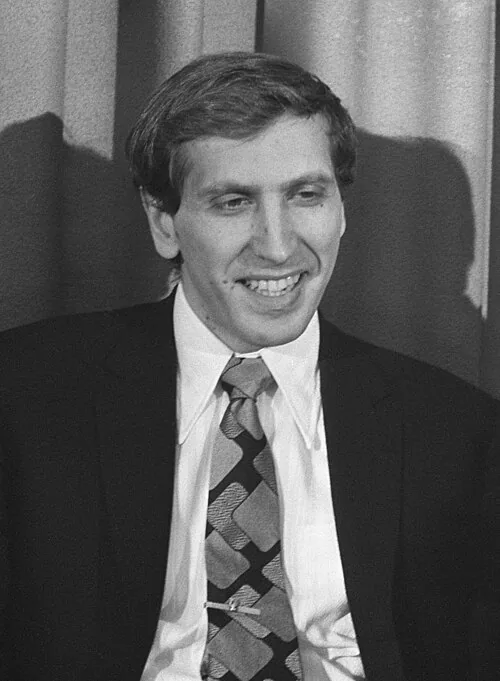

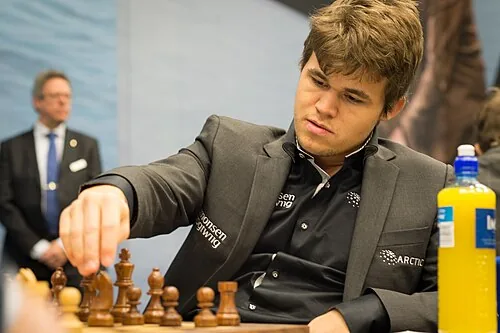
Photograph by Bert Verhoeff for Anefo (1972), CC0. Background removed for the portrait above. · Photograph by Fryta 73 (2015), CC BY-SA 2.0. Background removed for the portrait above. · Portrait © Frans Peeters, CC BY-SA 2.0. The background-removed portrait above is a derivative work and is likewise offered under the same licence.

_(cropped)_2.jpg)

An estimate is an inference.
Yours can be measured.
Thirty questions, scored against general-population benchmarks. Your score, your percentile, your ability breakdown and a printable IIF certificate.
Find your IQ score now! →