





Handwriting and IQ: Is Bad Handwriting a Sign of Intelligence?
Is bad handwriting a sign of a high IQ? We found no study that says so. Handwriting is a motor and attention skill that affects 10 to 30% of school-aged children, gifted children wrote with weaker quality in one small study, and graphology failed two direct tests. Here is the evidence.

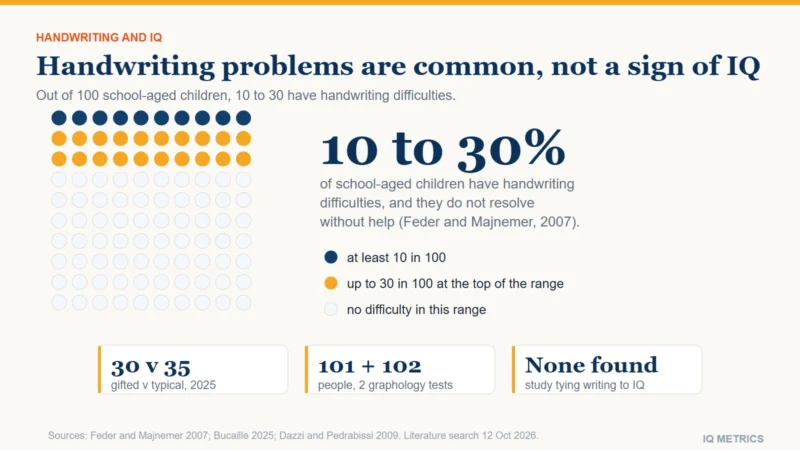
Handwriting and IQ are not linked in any way that lets you read intelligence from penmanship. We found no study showing that neat or messy writing predicts IQ in the general population. What research does show is that handwriting is a motor and attention skill built from fine motor control, visual-motor integration, motor planning and sustained attention, that difficulties affect 10 to 30% of school-aged children, and that handwriting analysis (graphology) failed a direct test of whether it can measure personality. In a small 2025 study, intellectually gifted children had weaker handwriting quality than typical children, which cuts against the “neat equals smart” idea and still does not prove “messy equals smart”. This guide sets out the evidence, claim by claim.
- What handwriting draws on: fine motor control, visual-motor integration, motor planning, in-hand manipulation, proprioception, visual perception and sustained attention (Feder and Majnemer, 2007).
- How common problems are: between 10% and 30% of school-aged children, and the difficulties do not resolve without help.
- Gifted children: 30 children with IQ 130 or higher had weaker handwriting quality than 35 typical children, but no clear motor difficulty overall (Bucaille and colleagues, 2025).
- Graphology: two studies of 101 and 102 people found no evidence that handwriting analysis measures personality (Dazzi and Pedrabissi, 2009).
- Why it matters in school: faster handwriting frees working memory, so children write better essays.
If your question is really about children, the general guides to signs of a gifted child and twice-exceptional (2e) learners cover the wider picture, and processing speed and IQ explains why a pencil task can pull a score down.
Does bad handwriting mean a high IQ?
The idea is popular, helped by stories of brilliant people with illegible notes. The evidence we could find does not support it as a rule. A search of the medical literature for studies that correlate handwriting legibility or speed with IQ in ordinary samples turned up nothing that tested the claim directly, which is itself informative: if penmanship were a good signal of intelligence, it would be an obvious thing to measure. Stories about famous figures are selected, because we remember the genius with scrawl and forget the many with neat hands.
The nearest direct evidence is a small study of 30 intellectually gifted children (IQ 130 or higher) and 35 children of average ability, aged 6 to 16 (Bucaille and colleagues, 2025, Developmental Neuropsychology). The gifted group did not differ from the comparison group on most motor and neuropsychological measures, with one exception: handwriting quality at school age was weaker. The authors also found superior performance on tests that needed planning, and concluded that while a few gifted children may develop handwriting problems, as a group they do not seem to be at risk for motor or praxis difficulties. It is one small study, so treat it as a pointer, not a rule.
Another research group compared verbally gifted students with and without a written-language learning disability. The 27 students with the disability copied handwriting less well and less quickly than the 14 without it (Lyman and colleagues, 2017, Journal of Behavioral and Brain Science). Those groups were chosen for the comparison, so the numbers say nothing about how common the problem is. The lesson is narrower and still useful: high ability does not protect a child from a handwriting disorder, which is why gifted children can be missed when their poor writing is blamed on laziness.
What does handwriting actually measure?
A 2007 review in Developmental Medicine and Child Neurology (Feder and Majnemer) describes handwriting as a complex occupational task whose underlying skills include fine motor control, bilateral and visual-motor integration, motor planning, in-hand manipulation, proprioception, visual perception, sustained attention and sensory awareness of the fingers. Reasoning is not on the list. Poor handwriting may reflect the child's own capabilities (intrinsic factors) or the pen, desk and posture (extrinsic factors).
The same review reports that handwriting difficulties affect between 10% and 30% of school-aged children, that they do not resolve without intervention, and that studies of remediation suggest intervention works. A 2025 randomized trial of 42 children aged 8 to 12 who were at risk of developmental coordination disorder (the condition many people know as dyspraxia) tested an AI-supported occupational therapy program, eight weeks at two sessions a week. The children in the program improved on every subdomain of the Minnesota Handwriting Assessment, including speed, spacing, shape and legibility, while the control group changed little (Demirci and colleagues, 2025). The sample is small and the program specific, but it fits the larger point that handwriting behaves like a learned skill, not a fixed trait.
| Claim | What the evidence shows | Source |
|---|---|---|
| Messy handwriting means high IQ | No study found testing it in the general population; one small study found weaker quality in gifted children without wider motor problems | Bucaille et al., 2025 |
| Neat handwriting means high IQ | No supporting study found; writing quality depends on motor skill and practice | Feder and Majnemer, 2007 |
| Handwriting reveals personality | Two studies, 101 and 102 people: no validity, very low agreement between graphologists | Dazzi and Pedrabissi, 2009 |
| Handwriting problems are rare | 10% to 30% of school-aged children | Feder and Majnemer, 2007 |
| Children grow out of it | Difficulties do not resolve without intervention | Feder and Majnemer, 2007 |
Why handwriting speed matters even though it is not IQ
Handwriting does matter for schoolwork, and the reason is not intelligence but mental bandwidth. A review of adult and child writing research found that handwriting speed is important to the quantity and quality of essays (Peverly, 2006, Developmental Neuropsychology). Faster transcription makes word production more automatic, which lessens the burden on working memory and leaves capacity for the planning and editing that make prose readable. The review adds that even fluent handwriting consumes some working memory.
This is how a child with a high reasoning ability can still write badly: if the hand needs most of the attention, less is available for ideas. The link also runs through attention disorders. In a study of 16 fourth and fifth graders with symptoms of ADHD and 16 matched controls, the ADHD group wrote more slowly and with more variability only when a verbal working-memory task was added (Capodieci and colleagues, 2018). A scoping review of children on the autism spectrum points to fine motor control and visual-motor integration as likely contributors to their handwriting difficulties (Kushki and colleagues, 2011). See our guides to ADHD and IQ, autism and IQ and executive function versus IQ for the cognitive side.
Where would your own score land?
Take the IIF-certified assessment and get your score with the scale it was measured on, the percentile it corresponds to and the confidence range around it — the three figures most online tests leave out.
Find your IQ score now! →Can handwriting analysis reveal personality or intelligence?
Graphology claims that features of writing, such as slant, pressure and size, reveal traits. The cleanest test we found is a two-part study by Dazzi and Pedrabissi (2009, Psychological Reports). In Study 1, 101 university students completed the Big Five Questionnaire and provided a handwriting sample, and two graphologists rated the same dimensions and facets from the writing. Their ratings did not match the questionnaire scores, and agreement between the two graphologists was very low. In Study 2, 102 people supplied autobiographical texts that two other graphologists and two laypeople rated, and the authors again found no evidence that graphology measures personality.
A method that cannot recover traits from a questionnaire the writer has just filled in is not going to estimate something harder to rate, such as IQ. For what personality traits do relate to intelligence, the large meta-analyses are in our guide to introverts and IQ, and the wider debate is in IQ versus personality.
What if your handwriting is much worse than you expect?
Handwriting that is slow, tiring or illegible despite effort is worth a look by an occupational therapist or school psychologist, not a reason to doubt a child's ability. Professionals separate three questions: whether the problem is motor (coordination, grip), perceptual (visual-motor integration) or attentional; whether reading and spelling are also affected; and whether the child has strong verbal reasoning that the page is not showing. A broader evaluation often includes an IQ test, and a pencil-heavy subtest can lower the processing-speed part of the result. Our guide on how to read an IQ test report shows how to spot that pattern.
If you are an adult who dislikes your handwriting, the research gives no reason to treat it as a verdict on your mind. Typing, speech-to-text and plain practice change what you produce, and none of them changes your IQ.
Quick answers about handwriting and IQ
- Is bad handwriting a sign of a high IQ? No evidence supports that as a general rule.
- Do smart people have messy handwriting? In one small study of gifted children, writing quality was weaker on average, but overall motor skills were not.
- Does handwriting reflect intelligence? It reflects motor control, visual-motor skill and attention more than reasoning.
- Can graphology tell your personality? Two studies with 101 and 102 people found no validity.
- Can poor handwriting be fixed? It does not resolve by itself, but remediation studies suggest intervention helps.
Sources
- Feder, K.P. and Majnemer, A. (2007): Handwriting development, competency, and intervention, Developmental Medicine and Child Neurology, 49(4), 312-317.
- Peverly, S.T. (2006): The importance of handwriting speed in adult writing, Developmental Neuropsychology, 29(1), 197-216.
- Bucaille, A. et al. (2025): Motor skills in intellectually gifted children: a neuropsychological investigation, Developmental Neuropsychology, 50(1), 36-54.
- Dazzi, C. and Pedrabissi, L. (2009): Graphology and personality: an empirical study on validity of handwriting analysis, Psychological Reports, 105(3), 1255-1268.
- Lyman, R.D. et al. (2017): Translating interdisciplinary research on language learning into identifying specific learning disabilities in verbally gifted and average children and youth, Journal of Behavioral and Brain Science, 7(6), 227-246.
- Capodieci, A., Lachina, S. and Cornoldi, C. (2018): Handwriting difficulties in children with attention deficit hyperactivity disorder (ADHD), Research in Developmental Disabilities, 74, 41-49.
- Kushki, A., Chau, T. and Anagnostou, E. (2011): Handwriting difficulties in children with autism spectrum disorders: a scoping review, Journal of Autism and Developmental Disorders, 41(12), 1706-1716.
- Demirci, O., Yilmaz, G.G. and Kose, B. (2025): Artificial intelligence-supported occupational therapy program on handwriting skills in children at risk for developmental coordination disorder: randomized controlled trial, Research in Developmental Disabilities, 161, 105009.
Keep reading
All articles →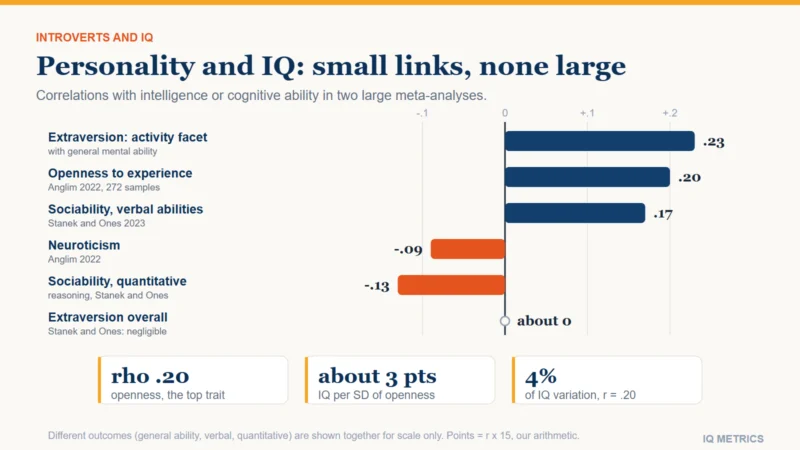 Mind & Everyday Life
Introverts and IQ
Do introverts have a higher IQ? Not in the data. Two large meta-analyses find openness is the Big Five trait most tied to IQ (rho = .20), while overall extraversion is negligible. Here are the numbers, what they mean in IQ points, and where the introvert charts come from.
 Understanding IQ
Twice Exceptional (2e)
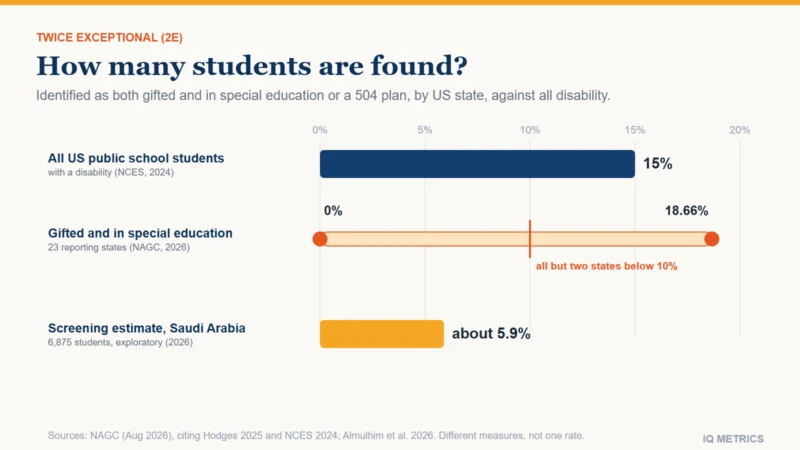
Twice exceptional (2e) means gifted and disabled at the same time, such as high reasoning with dyslexia, ADHD or autism. See the research definition, how one IQ score can hide the pattern, how students are identified and what 2026 data show about how many are found.
 Understanding IQ
Processing Speed and IQ
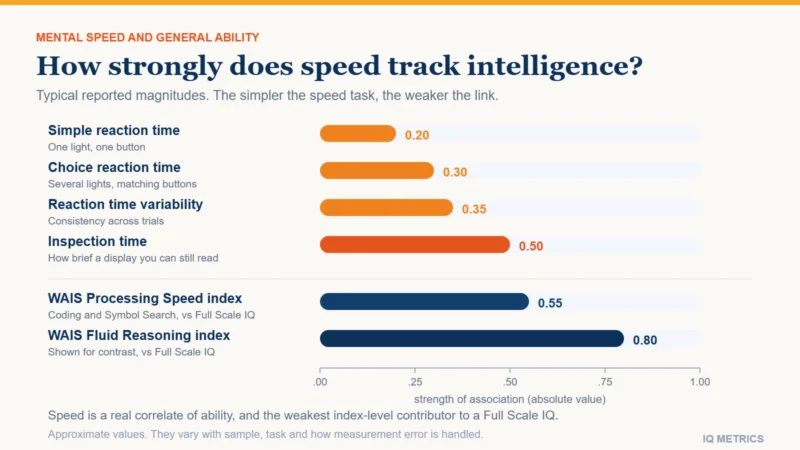
Fast thinkers are assumed to be smart thinkers, and there is a real finding underneath the stereotype: people who score higher on IQ tests do respond faster on tasks with no reasoning content at all. But the link is weaker than the folklore, and on a professional battery the speed index is the least g-loaded.