





Executive Function vs IQ: How They Relate and Where They Differ
Executive function and IQ overlap but are not the same thing. Of the three executive functions, only updating working memory was highly correlated with intelligence in one study of young adults. See the three functions, a twin study, how reliable the tasks are and why training claims fall short.

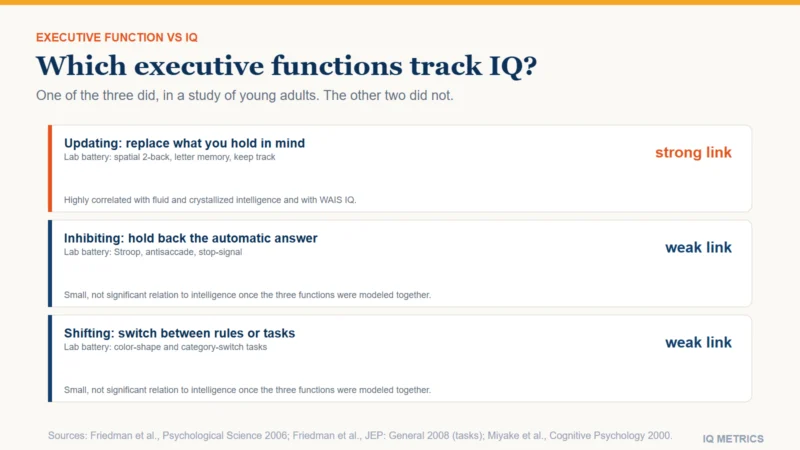
Executive function vs IQ: the two overlap, but they are not the same thing. Executive functions are control abilities: updating what you hold in mind, holding back an automatic response and switching between tasks or rules. In one study of young adults, only the first of those three, updating working memory, was highly correlated with intelligence; inhibiting and shifting showed small relations that were not significant. In a separate analysis of 137 college students the three functions were moderately correlated with one another but clearly separable, and a later twin study found that what they share is a highly heritable common factor that goes beyond general intelligence. This guide explains the three functions, how each relates to IQ, how heritable and reliable they are, and why training claims have not held up.
- What it is: executive functions are the cognitive control processes that regulate thought and action. The standard model has three: shifting, updating and inhibiting (Miyake et al., 2000).
- Unity and diversity: in 137 college students the three were moderately correlated but clearly separable.
- The IQ link: updating was highly correlated with fluid and crystallized intelligence and with WAIS IQ; inhibiting and shifting were not (Friedman et al., 2006).
- Heritability: a common executive-function factor was 99% heritable in a twin analysis and went beyond general intelligence and perceptual speed (Friedman et al., 2008).
- Training: a 2016 review of 87 working-memory training publications found no convincing far transfer against treated controls.
What is executive function?
Executive functions are the cognitive control processes that regulate thought and action. In the model most of this research uses, set out by Miyake and colleagues in 2000, there are three: shifting between mental sets, updating and monitoring information in working memory, and inhibiting prepotent, meaning dominant and automatic, responses. Each is measured with simple laboratory tasks. The table lists the tasks in the battery of the same lab’s later twin study (Friedman et al., 2008).
| Function | What it asks of you | Example tasks in that battery |
|---|---|---|
| Inhibiting | Hold back the dominant response | Antisaccade, stop-signal, Stroop |
| Updating | Replace what you hold in mind with new information | Keep track, letter memory, spatial 2-back |
| Shifting | Switch between task rules | Color-shape and category-switch tasks (three tasks in all) |
Two of those tasks have guides of their own on this site: our news guide to the Stroop test covers inhibition, and the dual n-back task guide covers an updating task and the claim that training it raises IQ.
Are the three executive functions the same thing?
Not quite. Miyake and colleagues (2000) tested 137 college students on simple tasks meant to tap each function, plus several frequently used executive tasks: the Wisconsin Card Sorting Test, the Tower of Hanoi, random number generation, operation span and dual tasking. Confirmatory factor analysis showed that the three functions are moderately correlated with one another but clearly separable. The functions also contributed differently to the complex tasks. Card sorting related most strongly to shifting, the Tower of Hanoi to inhibition, random number generation to inhibition and updating, and operation span to updating. The authors drew the lesson that executive functions show both unity and diversity.
Two results stand out. The Tower of Hanoi puzzle, often treated as a planning task, related most strongly to inhibition. And dual-task performance was not related to any of the three functions, even though doing two things at once is often treated as an executive demand; see our guide to multitasking and IQ.
Which executive functions track IQ?
Friedman and colleagues (2006) examined how fluid intelligence, crystallized intelligence and WAIS IQ relate to the three functions in young adults. Updating was highly correlated with the intelligence measures; inhibiting and shifting were not. In structural equation models that controlled for the correlations among the three functions, updating remained strongly related to intelligence, while the relations of inhibiting and shifting to intelligence were small and not significant. The authors concluded that current intelligence measures do not equally assess the wide range of executive control abilities that many “intelligent” behaviors probably require.
The updating result fits a wider pattern about working memory and reasoning. Schmiedek, Lövdén and Lindenberger (2014) gave nine working-memory tasks to 101 younger and 103 older adults and found that a working-memory factor predicted 71% of the variance in a reasoning factor among younger adults (83% among older adults). Kane and colleagues (2007) found that the n-back task and a verbal span task correlated only weakly, yet each accounted for independent variance in Raven’s matrices. Our news guide to working memory and reasoning and our guide to fluid vs crystallized intelligence cover the neighboring ideas. These are single studies, mostly of young adults, and we did not find a meta-analysis that pools the relations of all three functions with IQ.
How heritable is executive function?
In a multivariate twin study, Friedman and colleagues (2008) modeled the three functions as latent variables. They concluded that the functions are correlated because they are influenced by a highly heritable (99%) common factor that goes beyond general intelligence or perceptual speed, and that they are separable because of additional genetic influences unique to particular functions. That combination, they wrote, places executive functions among the most heritable psychological traits.
Heritability is a statement about variation in a particular sample and population, not about any one person’s fate, and it does not say what a changed environment could do; our guide to what twin studies of IQ show explains how to read such figures.
Where would your own score land?
Take the IIF-certified assessment and get your score with the scale it was measured on, the percentile it corresponds to and the confidence range around it — the three figures most online tests leave out.
Find your IQ score now! →How reliable are executive function tasks?
Less than their fame suggests. Hedge, Powell and Sumner (2018) measured the test-retest reliability of seven classic tasks, including the Stroop, in three studies. Reliabilities ranged from 0 to .82 and were, in their words, surprisingly low for most tasks. The Stroop reaction-time cost came out at .60 and .66 in two studies. Their “reliability paradox” says why: a task becomes a classic because nearly everyone shows the effect, which leaves little difference between people to measure on a retest. Studies like those above use several tasks per function and model what the tasks share, which is the usual way around the problem, and a single online result should not be read as a trait.
Can you train executive function to raise IQ?
The strongest test is the 2016 meta-analysis by Melby-Lervåg, Redick and Hulme: 87 publications and 145 experimental comparisons of working-memory training. Training produced reliable improvements on measures of intermediate transfer (verbal and visuospatial working memory). For far transfer (nonverbal ability, verbal ability, word decoding, reading comprehension, arithmetic) there was no convincing evidence of improvement when training was compared with a treated control condition, and the size of the working-memory gain did not predict the size of any far-transfer effect. Our dual n-back guide covers the best-known training task, and our review of brain-training apps covers the wider market.
What does this mean for IQ tests and for you?
An IQ score summarizes many abilities, and executive control is only partly in it. The twin and factor studies above suggest that updating, the working-memory side, travels with intelligence, while inhibiting and shifting are separate abilities that an IQ score does not track closely. A high score on one therefore does not guarantee a high score on the other. The working-memory side shows up in subtests such as digit span, and the speed side in the processing speed index. For ADHD, where executive control is often discussed, see our guides to ADHD and IQ and high IQ and ADHD.
A real-world window on executive load is walking while doing something else. In a New Zealand cohort of 904 adults, adding a spoken task cut average walking speed from 1.30 to 1.16 meters a second, about 11%; our guide to walking speed and IQ covers what that cohort showed. If what you want is a score on the IQ scale, take our IQ test or read how an official IQ test works.
Quick answers
- What is executive function? The cognitive control processes that regulate thought and action. The standard model has three: shifting, updating and inhibiting.
- Is executive function the same as IQ? No. In one study of young adults, updating was highly correlated with intelligence while inhibiting and shifting were not.
- Which executive function is most related to intelligence? Updating working memory, in that study.
- Are executive functions one ability or several? Both. In 137 college students they were moderately correlated but clearly separable.
- Is executive function genetic? A twin study estimated a common executive-function factor at 99% heritable, going beyond general intelligence and perceptual speed. That describes a sample, not an individual.
- Can brain training improve executive function and IQ? A 2016 review of 87 publications found no convincing far transfer against treated controls.
- Is the Stroop test a good measure of executive function? It is a classic inhibition task, but its reaction-time cost had test-retest reliabilities of .60 and .66 in two studies.
Sources
- Miyake, A. et al. (2000): The unity and diversity of executive functions and their contributions to complex “frontal lobe” tasks: a latent variable analysis, Cognitive Psychology, 41(1), 49-100.
- Friedman, N.P. et al. (2006): Not all executive functions are related to intelligence, Psychological Science, 17(2), 172-179.
- Friedman, N.P. et al. (2008): Individual differences in executive functions are almost entirely genetic in origin, Journal of Experimental Psychology: General, 137(2), 201-225.
- Schmiedek, F., Lövdén, M. and Lindenberger, U. (2014): A task is a task is a task: putting complex span, n-back, and other working memory indicators in psychometric context, Frontiers in Psychology, 5, 1475.
- Kane, M.J., Conway, A.R.A., Miura, T.K. and Colflesh, G.J.H. (2007): Working memory, attention control, and the n-back task: a question of construct validity, Journal of Experimental Psychology: Learning, Memory, and Cognition, 33(3), 615-622.
- Hedge, C., Powell, G. and Sumner, P. (2018): The reliability paradox: why robust cognitive tasks do not produce reliable individual differences, Behavior Research Methods, 50(3), 1166-1186.
- Melby-Lervåg, M., Redick, T.S. and Hulme, C. (2016): Working memory training does not improve performance on measures of intelligence or other measures of “far transfer”: evidence from a meta-analytic review, Perspectives on Psychological Science, 11(4), 512-534.
- Rasmussen, L.J.H. et al. (2019): Association of neurocognitive and physical function with gait speed in midlife, JAMA Network Open, 2(10), e1913123 (the dual-task walking speeds).
Keep reading
All articles →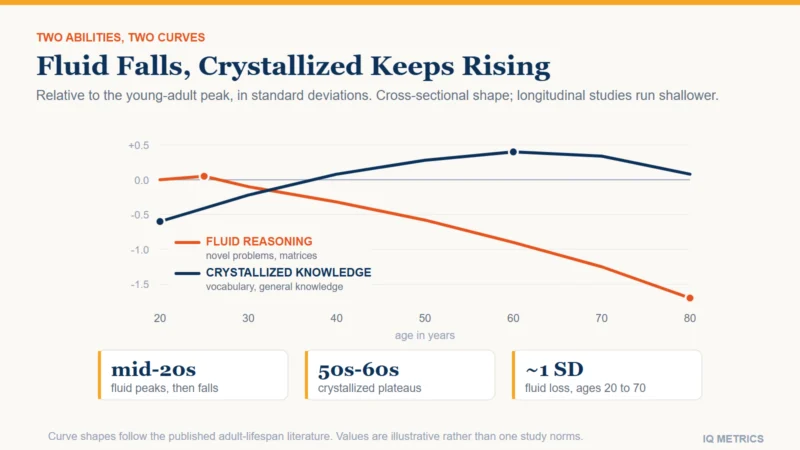 Understanding IQ
Fluid vs Crystallized Intelligence
Fluid intelligence is what you use on a problem you have never seen before. Crystallized intelligence is everything you have already banked. The distinction has survived eighty years of factor analysis because the two halves genuinely behave differently, and the clearest proof is what happens to each one as you get older.
 Understanding IQ
Memory and IQ
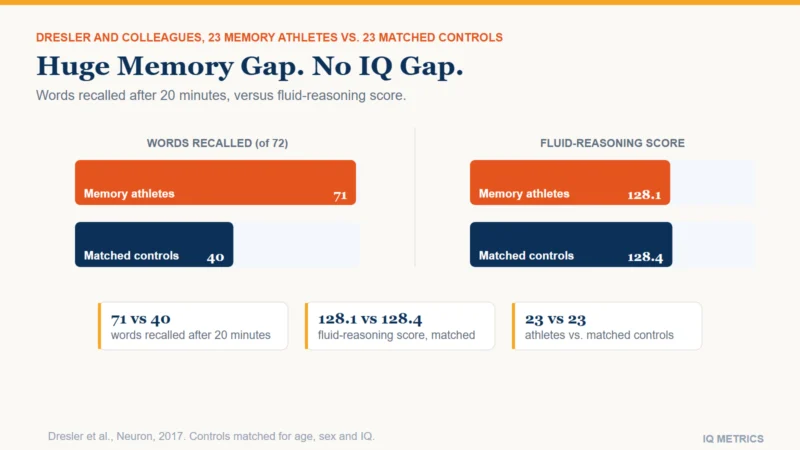
The world's best memory athletes can memorize 71 shuffled words in twenty minutes. Their IQ scores are not measurably different from a matched control group who could only manage 40. If a spectacular memory is not the same thing as a high IQ, what actually is the difference?
 Understanding IQ
Processing Speed and IQ
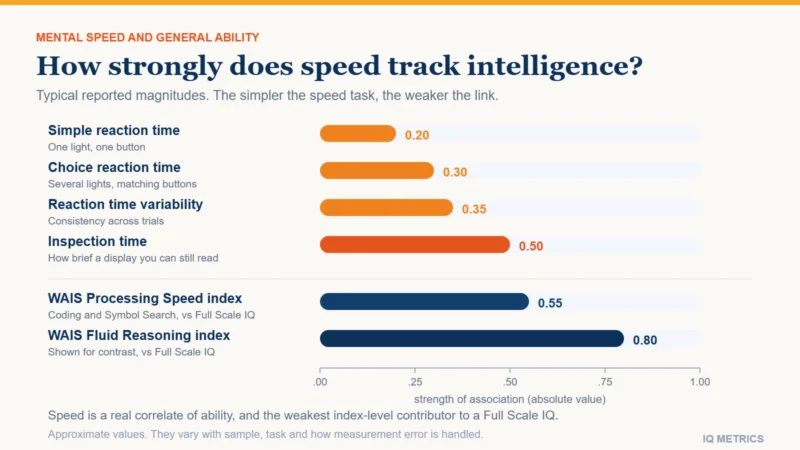
Fast thinkers are assumed to be smart thinkers, and there is a real finding underneath the stereotype: people who score higher on IQ tests do respond faster on tasks with no reasoning content at all. But the link is weaker than the folklore, and on a professional battery the speed index is the least g-loaded.