



Trail Making Test Scores by Age: Normal Times for Part A and Part B
Tombaugh’s norms for 911 adults put the typical Trail Making Test time at 22 seconds on Part A and 47 on Part B at ages 18 to 24, and 52 and 133 at ages 80 to 84. The popular 78 and 273 second cut-offs are not in that paper.


What you need to know
- Trail Making Test scores by age: in Tombaugh's 2004 norms the median time rises from 22 seconds (Part A) and 47 seconds (Part B) at ages 18 to 24 to 52 and 133 seconds at ages 80 to 84. Age explained 34% of the variation in Part A times and 38% in Part B.
- Education matters mostly after 54 and mostly on Part B. At ages 75 to 79 the average Part B time was 131 seconds for people with up to 12 years of schooling and 101 seconds for people with more.
- The often-quoted "over 78 seconds on A, over 273 seconds on B" cut-offs are not in Tombaugh's paper, which says fixed cut-offs were abandoned because age, education and intelligence affect scores.
- The test returns a time, not an IQ. Research on Part B suggests it leans on working memory and task-switching, and the difference between the two parts is the cleaner sign of executive control.
Trail Making Test scores by age start at about 22 seconds on Part A and 47 seconds on Part B for ages 18 to 24. They slow to 52 and 133 seconds at ages 80 to 84. These medians come from Tombaugh's 2004 norms for 911 community-dwelling adults, the Trail Making Test A and B norms most clinics still use. A single time only makes sense next to people of your own age.
Below: the full table by age, what the slowest 10% look like, how education changes the picture after 54, and why the famous 78 and 273 second cut-offs do not come from this paper.
What is the Trail Making Test?
The Trail Making Test (TMT) is a pencil-and-paper test of how fast you can connect circles in order. Part A has 25 circles numbered 1 to 25. Part B alternates between numbers and letters, as in 1, A, 2, B, 3, C. The score on each part is the time in seconds.
It began in the US Army Individual Test Battery in 1944 and later joined the Halstead-Reitan battery of neuropsychologist Ralph Reitan. Tombaugh calls it one of the most popular neuropsychological tests. It gives information on visual search, speed of processing, mental flexibility and executive functions, which are the planning and switching skills that run other thinking.
It is not an IQ test. It reports seconds, not a score on a scale with a mean of 100. It sits in the same family as our guides to the Stroop test, digit span and processing speed and IQ.
What are normal Trail Making Test scores by age?
Typical times start at 22 seconds on Part A and 47 on Part B at ages 18 to 24, and reach 52 and 133 at ages 80 to 84. The Trail Making Test Part B average time (the median) therefore nearly triples across adult life, while Part A more than doubles. The list gives the median (half of the group is faster) and the point where the slowest 10% begin, for each age band in Tombaugh's Table 3.
- Ages 18–24 (n = 155): median 22 s on Part A and 47 s on Part B; the slowest 10% took longer than 31 s and 66 s
- Ages 25–34 (n = 33): median 23 s on Part A and 50 s on Part B; the slowest 10% took longer than 40 s and 67 s
- Ages 35–44 (n = 39): median 26 s on Part A and 58 s on Part B; the slowest 10% took longer than 46 s and 87 s
- Ages 45–54 (n = 41): median 31 s on Part A and 64 s on Part B; the slowest 10% took longer than 50 s and 84 s
- Ages 55–59 (n = 95): median 32 s on Part A and 73 s on Part B; the slowest 10% took longer than 53 s and 104 s
- Ages 60–64 (n = 86): median 32 s on Part A and 68 s on Part B; the slowest 10% took longer than 45 s and 96 s
- Ages 65–69 (n = 97): median 37 s on Part A and 76 s on Part B; the slowest 10% took longer than 53 s and 121 s
- Ages 70–74 (n = 106): median 38 s on Part A and 97 s on Part B; the slowest 10% took longer than 61 s and 159 s
- Ages 75–79 (n = 108): median 46 s on Part A and 115 s on Part B; the slowest 10% took longer than 70 s and 185 s
- Ages 80–84 (n = 118): median 52 s on Part A and 133 s on Part B; the slowest 10% took longer than 93 s and 241 s
- Ages 85–89 (n = 29): median 54 s on Part A and 138 s on Part B; the slowest 10% took longer than 120 s and 296 s
Read it like this. A 52-year-old who finishes Part B in 64 seconds is exactly typical for ages 45 to 54. A 52-year-old who needs 84 seconds is at the edge of the slowest 10% of that group. The same 84 seconds would be an ordinary result at ages 65 to 69.
A Trail Making Test time means nothing alone: 84 seconds on Part B is slow at 52 and ordinary at 67.
How much do age and education change the score?
Age is the big driver. Tombaugh reports that age accounted for 34% of the variance in Part A and 38% in Part B, while education accounted for 3% and 6% and gender for less than 1%. Variance is the share of the differences between people that a factor explains.
Education matters after 54, mostly on Part B. At ages 75 to 79, people with up to 12 years of education averaged 50.8 seconds on Part A and 130.6 on Part B. People with more than 12 years averaged 41.7 and 100.7. The paper split only the groups aged 55 and over by education.
Are 78 and 273 seconds the cut-offs for Part A and Part B?
No, and they are not in Tombaugh's paper. The pair is widely copied as the "deficient" line: over 78 seconds on A and over 273 seconds on B. The earliest source we could open was an undated university handout that lists four references without saying which gives which number.
Tombaugh states the opposite. Fixed cut-offs were proposed early on, he writes, but the practice was soon abandoned when research showed that age, education and intelligence affect performance. His norms are percentiles for each age band instead.
The check is easy. In Tombaugh's table the slowest 10% on Part B begin at 66 seconds for ages 18 to 24 and 241 seconds for ages 80 to 84. A time of 273 seconds is slower than that line in every band except ages 85 to 89, where the line is 296 seconds. So 273 seconds is a very slow result for most adults, not the edge of normal.
What does the Trail Making Test measure?
Part A mostly needs visual scanning and pencil control. Part B adds the switching between numbers and letters. In a study of 41 healthy older adults, Sanchez-Cubillo and colleagues found that Part A needs mainly visuoperceptual ability, Part B reflects working memory first and task-switching second, and the difference between the two (B minus A) is the cleanest indicator of executive control.
Tombaugh adds that age, education and intelligence all affect TMT performance. We did not find a published correlation with IQ that we could verify, so we give none. For a related timing measure see average reaction time by age, and for the memory side see why working memory and reasoning are not the same.
How long can the test run, and what happens in dementia or driving checks?
There is no single time limit. The National Alzheimer's Coordinating Center form stops the clock at 150 seconds on Part A and 300 seconds on Part B. Another clinic handout stops the pair after five minutes. Tombaugh set no limit, and his slowest Part B time was 366 seconds.
For driving, a 2013 review of 47 articles by Roy and Molnar lists research cut-offs for Part B of 90, 133, 147 and 180 seconds, or fewer than three errors. It also notes that continuing medical education articles suggest 3 minutes or 3 errors. These are research suggestions, not rules from a licensing body. The MoCA score guide covers a screening test that is used alongside it.
Trail Making Test interpretation: what should you do with your own result?
Compare it with your age band, not with the whole table, and treat one slow time as a prompt, not a diagnosis. Fatigue, vision, pen control and nerves all add seconds. If a change worries you, ask a doctor for a full assessment. To see where a score sits in a group, use our percentile calculator.
Where would your own score land?
Curious how you do on reasoning and speed together? Take the IQ Metrics test and read your result as a percentile, not a time.
Find your IQ score now! →The short answer: use Tombaugh's age-band medians and 10th percentiles, ignore the 78 and 273 second rule, and remember that the test measures speed and switching, not IQ. To see an IQ-style percentile instead, take the IQ Metrics test.
Common questions
What is a normal Trail Making Test time for Part A and Part B?
It depends on age. In Tombaugh's norms the median is 22 seconds on Part A and 47 seconds on Part B at ages 18 to 24, 31 and 64 seconds at ages 45 to 54, and 52 and 133 seconds at ages 80 to 84.
Is over 78 seconds on Part A and over 273 seconds on Part B abnormal?
Those numbers are widely quoted but are not in Tombaugh's norms, which say fixed cut-offs were abandoned. A time of 273 seconds is slower than the 10th percentile for every age band up to 84.
What does Trail Making Test Part B measure?
Part B alternates numbers and letters. Research on 41 healthy older adults suggests it reflects working memory first and task-switching second, and that the difference between Part B and Part A isolates executive control.
Is the Trail Making Test an IQ test?
No. It reports a time in seconds, not a score with a mean of 100. Tombaugh notes that age, education and intelligence all affect TMT performance, so the time is read against norms for your age.
Sources for this story
- Trail Making Test A and B: normative data stratified by age and education, Archives of Clinical Neuropsychology 19:203-214 (2004) — Tombaugh, T. N.
- Construct validity of the Trail Making Test, Journal of the International Neuropsychological Society 15:438-450 (2009) — Sanchez-Cubillo et al.
- Systematic review of the evidence for Trails B cut-off scores in assessing fitness-to-drive, Canadian Geriatrics Journal 16:120-142 (2013) — Roy and Molnar
- Uniform Data Set version 3, Form C2: neuropsychological battery (time caps of 150 and 300 seconds) — National Alzheimer’s Coordinating Center
- Trail Making Test (TMT) Parts A and B, clinic handout (the 78 and 273 second figures) — University of Louisville
Corrections: spotted an error? Email corrections@iqmetrics.org and we will update this story and note the change here.
Related stories
All news →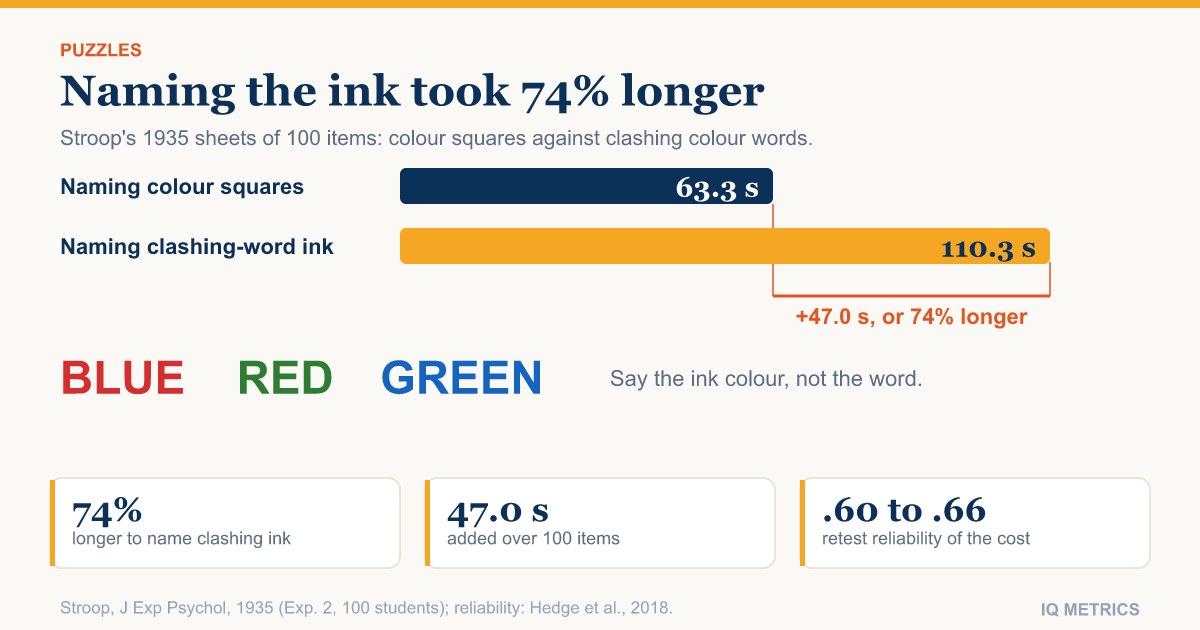
Stroop Test Explained: What It Measures and the IQ Link
In Stroop's 1935 study, naming the ink colour of 100 conflicting colour words took 47 seconds longer than naming coloured squares. The effect is among the most reliable in psychology, yet one person's score is not, and it tracks IQ only weakly.

Average Reaction Time by Age (in Milliseconds) and What It Says About IQ
A typical simple reaction time is roughly 215 to 240 milliseconds in a calibrated lab and 273 ms on Human Benchmark's online test. Age adds about 0.55 ms a year, and the link to IQ is about -.3.
How Much of Our Brain Do We Use? The 10% Myth and What Scans Show
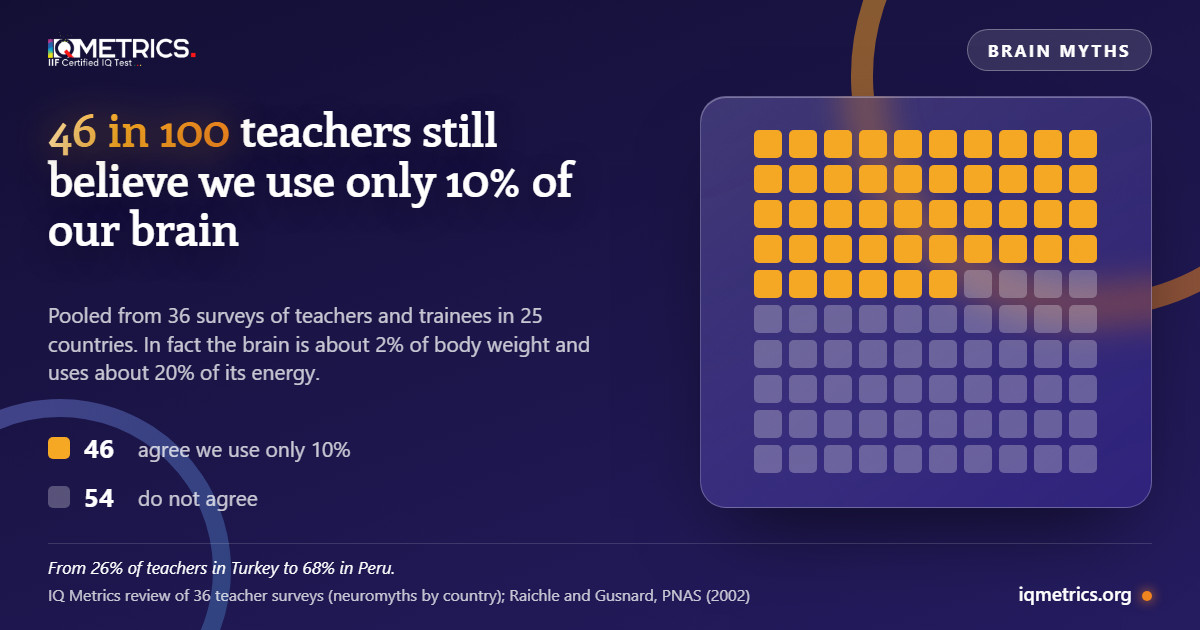
We use virtually all of our brain over a day. The 10% figure has no scientific source: it grew out of a 1907 essay that never mentioned brain tissue, yet about half of teachers in 36 surveys still agree with it.
Read the research.
Then find your own number.
Our IIF-certified assessment reports your score with its scale, percentile and confidence range — and a breakdown of the cognitive domains behind it.
Start IQ Test →