





MoCA Score: What the Ranges Mean and How It Differs From IQ
A MoCA score is a number out of 30 from a 10-minute screen for mild cognitive impairment. See the four publisher score bands, why the 26 cut-off flags many healthy adults, what changes the score, what to do with a result and why a MoCA is not an IQ.

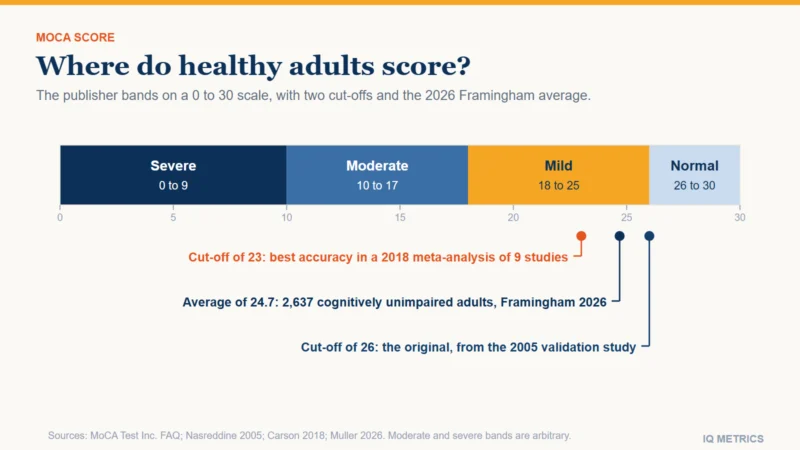
A MoCA score is a number out of 30 from the Montreal Cognitive Assessment, a 10-minute screening test for mild cognitive impairment. The publisher’s ranges are 26 to 30 normal, 18 to 25 mild, 10 to 17 moderate and 0 to 9 severe. But newer research shows that the usual cut-off of 26 flags many healthy people: in a 2026 study of 2,637 cognitively unimpaired adults, the average MoCA score was 24.7. And a MoCA score is not an IQ score. This guide explains the ranges, how the cut-off debate works, what moves the score and how it differs from an IQ test.
- The ranges: 26 to 30 normal; 18 to 25 mild; 10 to 17 moderate; 0 to 9 severe, according to the publisher. Only the normal cut-off and the mild range trace to the original validation work; the publisher says the moderate and severe bands are arbitrary.
- The cut-off: the 2005 validation used 26; a 2018 meta-analysis found 23 gave the best diagnostic accuracy; a 2026 study found average scores of healthy people over 60 below 23.
- Education: one point is added for 12 or fewer years of formal education, up to a maximum of 30.
- Not IQ: the MoCA is a screen for impairment, scored in raw points, with no validated conversion to an IQ.
- What to do: a score is a prompt for a clinical evaluation, not a diagnosis.
What is the MoCA and what does it test?
Nasreddine and colleagues developed the Montreal Cognitive Assessment (MoCA) in 2005 as a 10-minute screening tool to help first-line physicians detect mild cognitive impairment (MCI), a state that often progresses to dementia. It is scored out of 30 and covers seven areas:
| Area | Points | What the points come from |
|---|---|---|
| Visuospatial and executive | 5 | a trail-making task, copying a cube and drawing a clock |
| Naming | 3 | naming three animals |
| Attention | 6 | repeating digits forward and backward, tapping to a letter, serial subtraction |
| Language | 3 | repeating two sentences and a one-minute fluency task |
| Abstraction | 2 | saying what two pairs of words have in common |
| Delayed recall | 5 | five words learned earlier, recalled without cues |
| Orientation | 6 | date, month, year, day, place and city |
The fluency item is a one-minute letter F task, scored 1 point for 11 or more words; our guide to the verbal fluency test explains how those words are counted, and the digit task is related to the digit span test. We describe the sections only in general terms, not the actual items, because publishing them would weaken the test for the people who need to take it. Version 8.1 is the most recent form, and alternate versions (8.2 and 8.3) exist to reduce learning effects when the test is repeated. A MoCA-Blind version exists for people with visual impairments.
As of December 2025, the publisher says certification is optional for healthcare professionals who use the MoCA only for screening, triage or referral based on the total score, and remains required for anyone who interprets individual sections or domain-specific impairments.
What do the MoCA score ranges mean?
The publisher’s FAQ gives four bands, and it is open about where they come from: the MCI ranges were defined using Petersen criteria in the 2005 validation study, while the moderate and severe groups were arbitrarily defined by default.
| Score | Label | Where the band comes from |
|---|---|---|
| 26 to 30 | Normal | The cut-off used in the 2005 validation study |
| 18 to 25 | Mild impairment | MCI range from the 2005 validation, using Petersen criteria |
| 10 to 17 | Moderate impairment | Arbitrary, per the publisher |
| 0 to 9 | Severe impairment | Arbitrary, per the publisher |
The publisher also says a score of 18 is usually considered the line between MCI and Alzheimer’s disease, with overlap, because the diagnosis depends on the presence of cognitive and functional impairment and not on a number. That is the key limit of any band: a test score is evidence, not a verdict.
Is 26 the right cut-off?
In the 2005 validation, 94 patients with MCI, 93 with mild Alzheimer’s disease and 90 healthy older controls took both the MoCA and the Mini-Mental State Examination (MMSE). At a cut-off of 26, the MoCA detected 90% of the MCI patients and 100% of the mild Alzheimer’s patients, against 18% and 78% for the MMSE. Specificity was 87% for the MoCA and 100% for the MMSE. In other words, the MoCA caught far more impairment, at the price of flagging more healthy people. Our guide to whether an IQ test can detect dementia compares the MoCA and the MMSE in more detail.
Later work found the price was higher than first thought. Carson, Leach and Murphy (2018) pooled nine studies, chosen from 304, and found that a cut-off of 23 out of 30 gave the best diagnostic accuracy, with fewer false positives than 26. Then Muller and colleagues (2026) looked at 2,637 cognitively unimpaired adults in the Framingham Heart Study (average age 53.6, 64% college-educated). The average MoCA score was 24.7 (SD 3.0). Participants over 60 averaged below 23, and people over 70 scored below 23 regardless of education. Only college-educated people under 40 averaged near the old cut-off, at 26.3 (SD 2.4).
| Group | Average MoCA score | Reading |
|---|---|---|
| All 2,637 participants | 24.7 (SD 3.0) | Close to the revised cut-off of 23 |
| Over age 60 | Below 23 | Healthy group average under the revised cut-off |
| Over age 70 | Below 23, at any education level | The cut-off flags many healthy people |
| Under age 40, college-educated | 26.3 (SD 2.4) | Near the original cut-off of 26 |
The authors conclude that a cut-off of 26 produces a high rate of false positives, that 23 may also be set too high, and that clinicians and researchers need demographically appropriate, population-based norms. The practical lesson is that the same score can mean different things at 35 and at 75.
What changes a MoCA score?
- Education. The standard scoring adds one point for 12 or fewer years of formal education, counted from after kindergarten, and never above 30. The Framingham norms are split by age and education, which is a reason to ask which norms a clinician is using.
- Age. In the Framingham sample, averages fell below the revised cut-off after 60 even among cognitively unimpaired adults.
- Repeat testing. The publisher provides alternate versions to reduce learning effects, which is why a repeat test should not reuse the same one.
- Vision and physical limits. A MoCA-Blind version exists for visual impairments, and the publisher says scoring out of 25 and converting back to 30 (for example, for a person with hemiplegia) has not been validated.
- Who scores it. Interpreting individual areas requires trained and certified users, per the publisher.
Where would your own score land?
Take the IIF-certified assessment and get your score with the scale it was measured on, the percentile it corresponds to and the confidence range around it — the three figures most online tests leave out.
Find your IQ score now! →How is a MoCA score different from an IQ score?
They answer different questions. An IQ score compares a person with a norm group of the same age and has a mean of 100 and a standard deviation of 15. The MoCA is a raw score out of 30 built to separate people with cognitive impairment from those without it. Healthy younger adults cluster in the upper part of the scale, so the test has little room to tell a person with a high IQ from one with an average IQ. A 30 does not mean a high IQ, and a 24 does not mean a low one. The lower averages in the Framingham study track age and education, not intelligence.
For these reasons there is, to our knowledge, no validated way to convert a MoCA score to an IQ. The IQ score converter translates between IQ scales and percentiles, and our guide to how IQ tests work explains what norming means, but neither can do anything with a MoCA total. If you want a reasoning score, take the IQ test; if you want to know whether memory or thinking has changed, the right next step is a clinician, as described next.
What should you do with a MoCA result?
Treat it as a screening result. A score below the cut-off is a reason to ask for a fuller evaluation, which usually looks at history, daily functioning and other tests, and a score above it does not rule out a problem. Because averages differ so much by age and education, ask the clinician which norms or cut-off they use. Scoring in the 18 to 25 range does not mean a person has dementia; the publisher labels it “mild impairment,” and the Framingham data show healthy adults land there often.
Quick answers
- What is a normal MoCA score? The publisher says 26 to 30. In a 2026 study of 2,637 cognitively unimpaired adults the average was 24.7, and adults over 60 averaged below 23.
- Is a MoCA score of 22 bad? It falls in the publisher’s mild band, but the average of healthy adults over 60 in one large study was itself below 23; it is a reason to discuss norms and follow-up, not a diagnosis.
- What MoCA score indicates dementia? None by itself. The publisher says 18 is usually considered the line between MCI and Alzheimer’s disease, with overlap.
- Does education change the score? Yes: one point is added for 12 or fewer years of education.
- Is the MoCA an IQ test? No. It is a 30-point screen for impairment with no validated IQ conversion.
- How long does it take? About 10 minutes.
Sources
- Nasreddine, Z.S. et al. (2005): The Montreal Cognitive Assessment, MoCA: a brief screening tool for mild cognitive impairment, Journal of the American Geriatrics Society, 53(4), 695-699.
- Carson, N., Leach, L. and Murphy, K.J. (2018): A re-examination of Montreal Cognitive Assessment (MoCA) cutoff scores, International Journal of Geriatric Psychiatry, 33(2), 379-388.
- Muller, E. et al. (2026): The Montreal Cognitive Assessment at the Framingham Heart Study: a re-examination of the norms, Brain and Behavior, 16(5), e71487.
- MoCA Test Inc.: frequently asked questions (score bands, education adjustment, versions and certification), accessed October 2026.
Keep reading
All articles →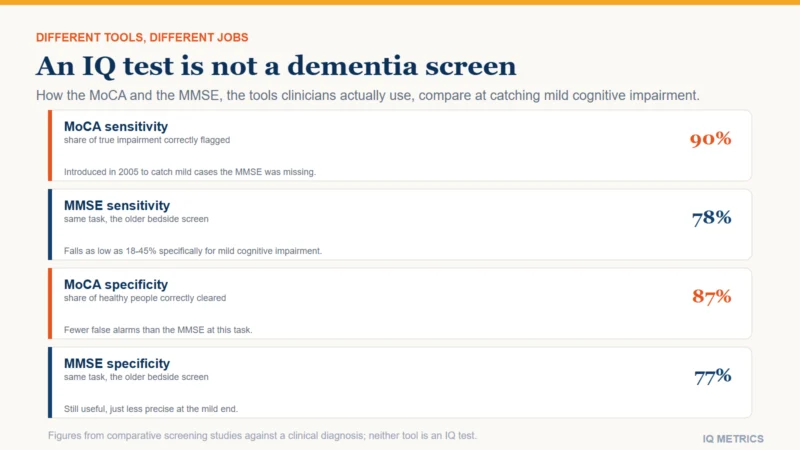 Taking a Test
Can an IQ Test Detect Dementia?
A standard IQ test cannot diagnose dementia; it has no personal baseline and was not built to screen for decline. How the MMSE and the more sensitive MoCA compare, why a normal score can hide early decline, and what actually helps catch it.
 Taking a Test
Verbal Fluency Test
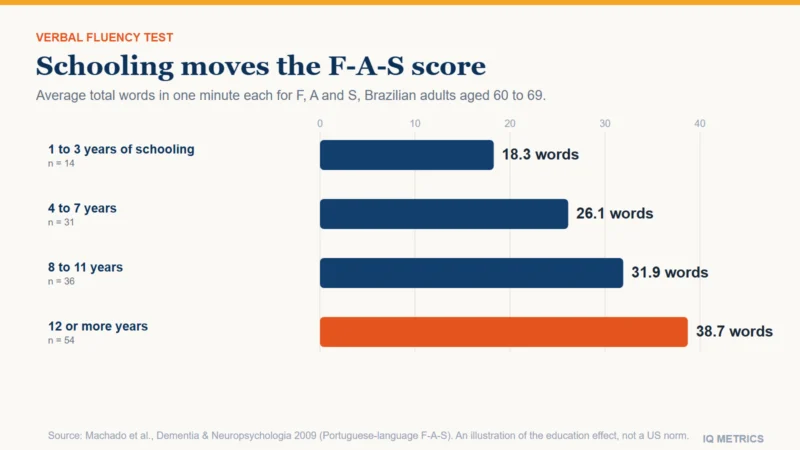
A verbal fluency test asks you to name as many words as you can in 60 seconds, by letter (F-A-S) or category (animals). See how it is scored, why education can move the score by about 20 words, what the task really measures and what a low count can and cannot tell you.
 Taking a Test
IQ Testing for Children
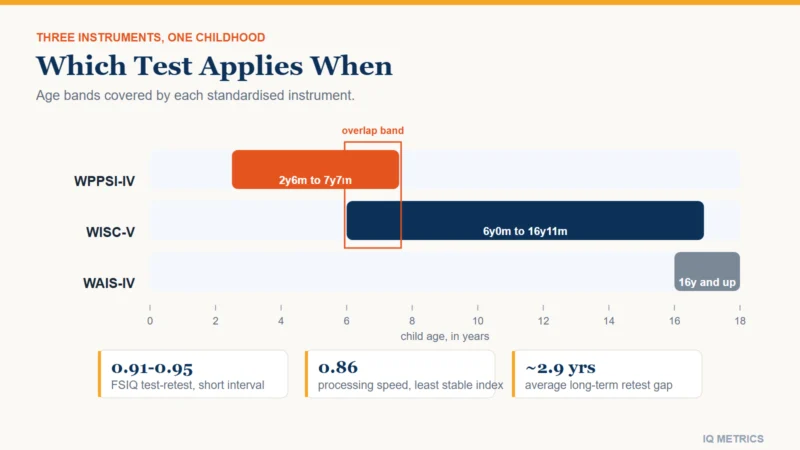
Children are not tested on the same instrument as adults, and the test itself changes twice before age eighteen. Here is which one applies when, how reliable an early score really is, and what a parent should and should not conclude from a single number.