





Numerical Reasoning Test: Example Questions, Scores and Who Uses Them
A numerical reasoning test asks you to read tables and charts against the clock. Five worked example questions with answers, the mistakes that cost the most points, what a good score means, and the 13 big employers in our study of 124 that name a numerical test.

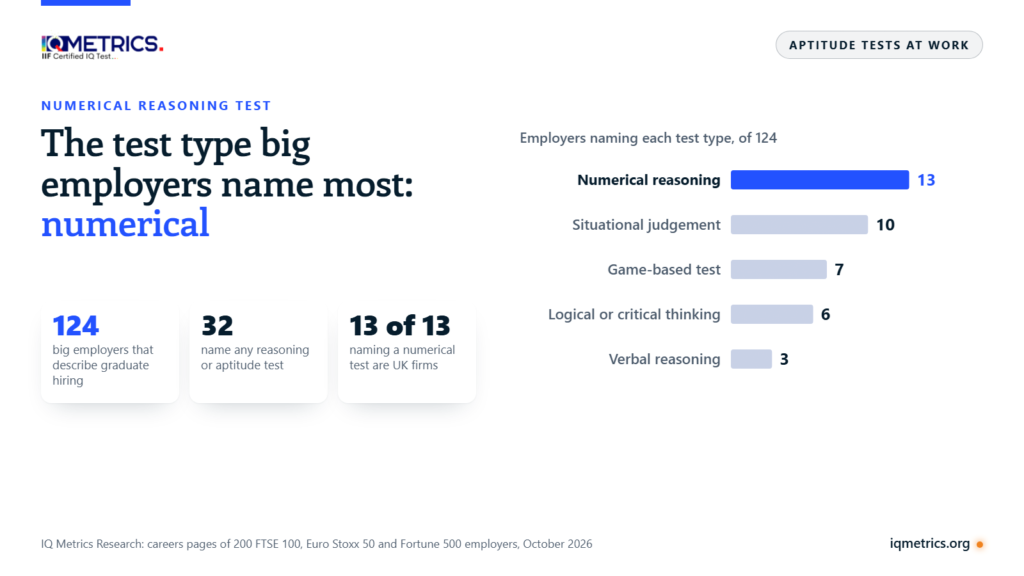
A numerical reasoning test checks how well you use numbers you are given: tables, charts, percentages and ratios, usually against the clock. It is not a maths exam. Most questions need only school arithmetic; the hard part is picking the right figures fast. In our study of 124 big employers that describe their graduate hiring, numerical reasoning was the test type they named most often: 13 employers, all of them in the UK.
Below: five example questions with worked answers, what a good score means, which employers use these tests, and how to practise.
What is a numerical reasoning test?
It is a timed test of reading and using data. You see a short table or chart, then answer multiple-choice questions about it. Typical tasks are percentage change, ratios, shares of a total, averages and currency conversion.
Employers use it to check that applicants can handle the numbers a job puts in front of them, such as a sales report or a budget. Banks, insurers and consumer-goods companies in our study all name one. You will also see it called a numerical reasoning assessment or a numerical aptitude test.
It is not the same as a numerical IQ test. Our numerical IQ test mixes number series and arithmetic puzzles to estimate a reasoning ability. A numerical reasoning test at work uses business data instead, and it is scored against other job applicants.
What do numerical reasoning test questions look like?
Here are five examples in the usual style, with answers. They all use one small table, as real tests do. The figures are made up for practice. Try each question before you read the answer.
| Region | 2024 | 2025 |
|---|---|---|
| North | 240 | 300 |
| South | 180 | 171 |
| East | 150 | 165 |
| West | 200 | 214 |
| Total | 770 | 850 |
Question 1: By what percentage did North's sales rise from 2024 to 2025?
Answer: 25%. The rise is 300 – 240 = 60. Divide the change by the starting value: 60 / 240 = 0.25, or 25%. The most common slip is dividing by the new value (60 / 300 = 20%), which is why 20% is often one of the options.
Question 2: Which region's sales fell, and by how much?
Answer: South, by 5%. Sales went from 180 to 171, a fall of 9. Then 9 / 180 = 0.05, or 5%.
Question 3: What share of 2025 total sales came from East?
Answer: about 19.4%. Divide the part by the total: 165 / 850 = 0.194. Read the right column: using the 2024 total would give the wrong share.
Question 4: If West grows at the same rate in 2026 as it did in 2025, what will its 2026 sales be?
Answer: about $229,000. West grew from 200 to 214, which is 7%. Apply the same rate to 214: 214 x 1.07 = 228.98, so about 229 thousand.
Question 5: The question gives an exchange rate of 0.92 euros per dollar. What are North's 2025 sales in euros?
Answer: about 276,000 euros. Multiply 300 thousand by 0.92. Watch the direction of the rate: dividing by 0.92 instead gives about 326 thousand, a classic wrong option.
Notice what the five have in common. None needs more than one or two steps. What costs time is finding the right row and column and spotting the trap answer.
What are the most common mistakes on numerical reasoning tests?
Most wrong answers come from a handful of slips, and test writers build the wrong options around them. The five worth checking every time:
- Dividing by the wrong base: percentage change always divides by the starting value, not the new one.
- Reading the wrong row, column or year: the question about 2025 sits next to the 2024 figure.
- Ignoring units: a table in thousands or millions changes the answer by a factor of a thousand.
- Turning an exchange rate the wrong way: multiply or divide depending on which currency the rate starts from.
- Rounding too early: keep the full figure until the last step, then round once.
A quick habit catches most of them: before you pick an option, ask whether the size of your answer makes sense. A 25% rise on 240 cannot be 6,000.
Where would your own score land?
Take the IIF-certified assessment and get your score with the scale it was measured on, the percentile it corresponds to and the confidence range around it — the three figures most online tests leave out.
Find your IQ score now! →What is a good numerical reasoning test score?
There is no universal pass mark. Your result is usually a percentile: the share of a comparison group you beat, such as graduates who applied for finance jobs. The employer chooses that group and sets its own minimum.
SHL, one of the largest test publishers, says it does not set passing scores; the employer sees the results and decides. Its sample reports describe the 46th to 68th percentile as average. Prep sites quote cut-offs such as the “top 20%”, but the ones we checked cite no SHL document. Our article on what a good SHL score is goes through the reports in detail.
Two more things matter. A count of correct answers does not convert to a percentile on its own, because candidates may get different questions. And speed counts: an answer you never reach scores zero, so a steady pace beats getting the first five perfect.
Which employers use numerical reasoning tests?
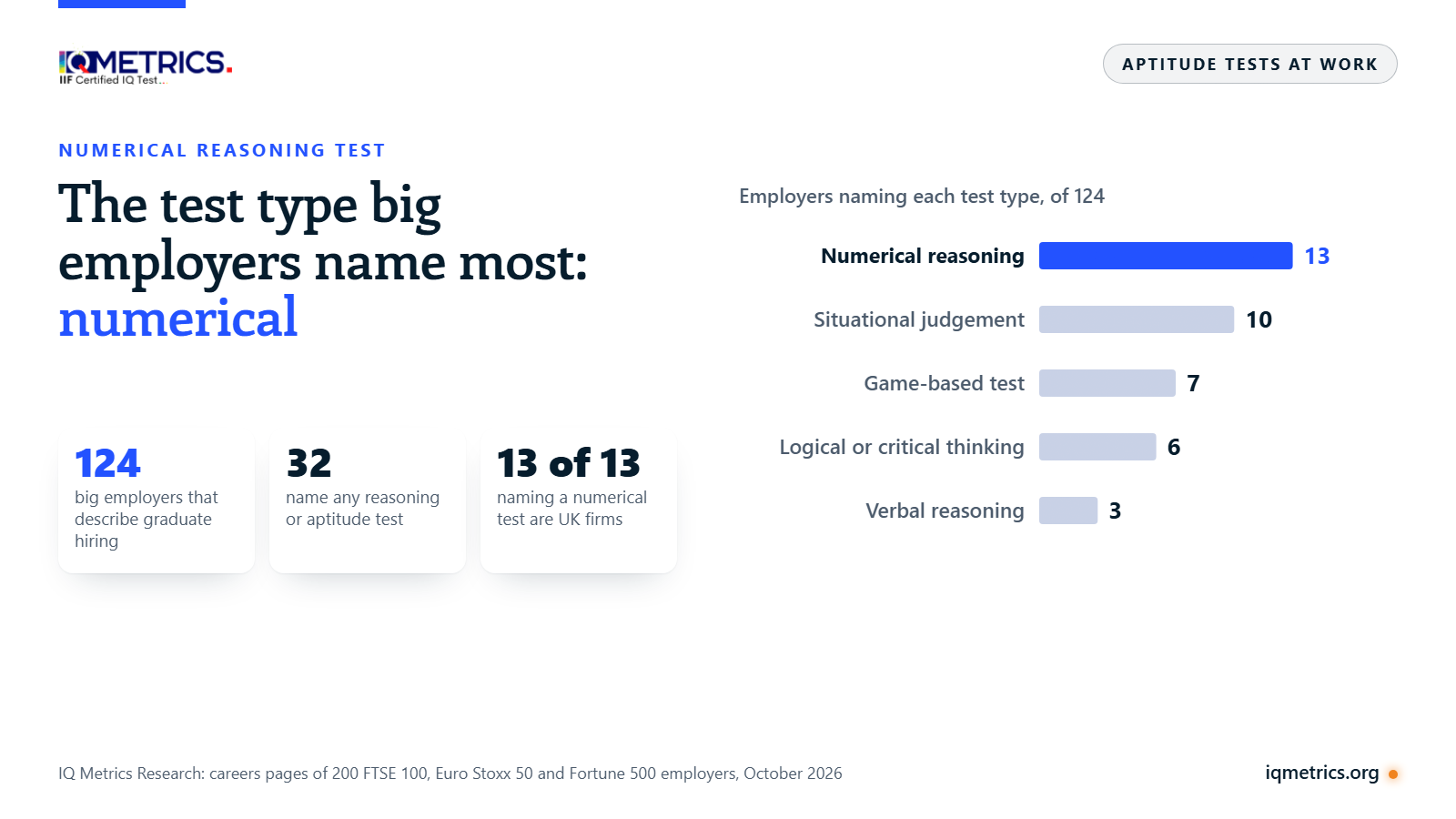
In October 2026 we read the careers pages of 200 large employers in the FTSE 100, the Euro Stoxx 50 and the top 50 of the Fortune 500. 124 of them describe how they select graduates or interns. Of those, 32 (26%) name a reasoning or aptitude test. Only 16 say which type, and numerical reasoning leads.
| Test type named | Employers | Share of 124 |
|---|---|---|
| Numerical reasoning | 13 | 10.5% |
| Situational judgement | 10 | 8.1% |
| Game-based test | 7 | 5.6% |
| Logical or critical thinking | 6 | 4.8% |
| Verbal reasoning | 3 | 2.4% |
All 13 employers that name a numerical test are UK companies: Admiral Group, Aviva, British Land, GSK, Legal & General, Lloyds Banking Group, Reckitt, Rio Tinto, Sainsbury’s, SSE, Standard Chartered, Unilever and United Utilities. US careers pages in our sample mostly describe interviews instead. A page that names no test does not prove there is none, so treat these as minimum counts.
The full method, the data file and the other steps employers list, such as video interviews and assessment centres, are in our study which employers use aptitude tests.
Is a numerical reasoning test an IQ test?
No, although the two overlap. Both reward quick, accurate reasoning, and ability tests at work do predict job performance on average. How strongly is debated, as our report on what a work ability test predicts explains.
The differences are practical. A numerical reasoning test uses business data, compares you with job applicants and gives a percentile. An IQ test samples several abilities and places you on a scale with an average of 100. The SHL documents we read never use the word IQ.
How can you prepare for a numerical reasoning test?
- Make percentage change automatic: (new – old) / old. Most questions turn on it.
- Read the question first, then find the one figure you need. Do not study the whole table.
- Check the units in every heading: thousands, millions, percentages or a currency.
- Estimate before you calculate. If the options are far apart, a rough answer is enough to pick one.
- Use a calculator if the test allows it, and practise with one so you are fast.
- Practise under a time limit. Familiarity with the format raises scores most on a first retest, as our piece on the practice effect shows.
Practise the common formats rather than one publisher’s test, because employers rarely say whose test they use. Our aptitude test, logical reasoning test and situational judgement test cover the other formats you may meet, and our guide to spatial reasoning covers the picture-based items. For number puzzles of the IQ kind, see our guide to number sequence questions.
If you want to see where your overall reasoning sits on the standard IQ scale, take the IQ test.
Keep reading
All articles → Taking a Test
What Are The Type of Questions Asked On IQ Test?
IQ tests ask a small set of question types: pattern and matrix reasoning, verbal reasoning, number series, spatial puzzles, working memory and speed tasks. See what each looks like, how many questions a test has and which tests are multiple choice.
 Taking a Test
How to Prepare for an IQ Test?
You cannot revise for an IQ test like a school exam, but preparation helps: know the question types, practise on similar items, pace yourself and sleep. Retesting raises scores by about 4 points on average. See what to practise and what to skip.
 Understanding IQ
Spatial Reasoning
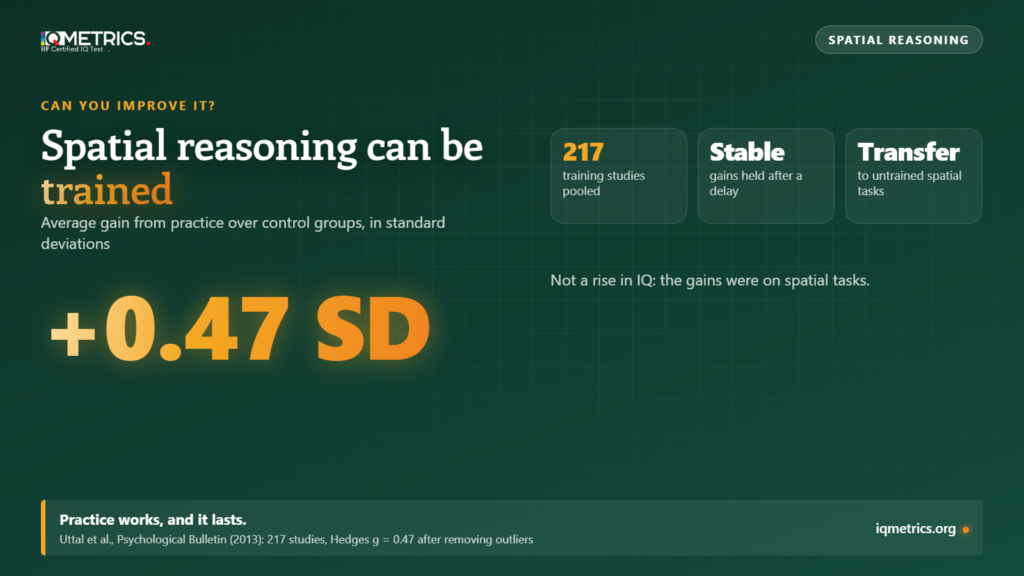
Spatial reasoning is the skill of picturing and turning shapes in your mind. What it means, everyday examples, how the Wechsler IQ tests measure it with Block Design and Visual Puzzles, why it predicts careers in science and engineering, and why 217 training studies say you can improve it.