





Piaget's Stages of Cognitive Development and the IQ Tests That Fit Each Age
Piaget's four stages of cognitive development with their ages, object permanence, conservation and what modern studies say, set against the age bands of the IQ tests that fit each stage: WPPSI-IV from 2 years 6 months, WISC-V from 6 to 16 and WAIS-5 from 16. Includes everyday examples.

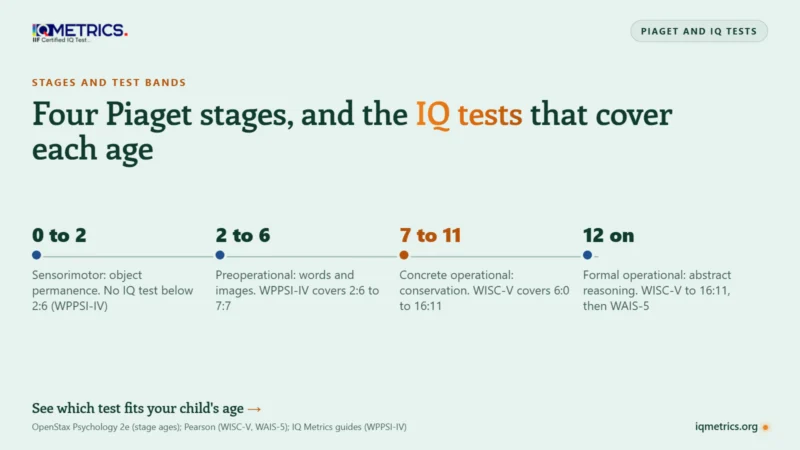
Piaget’s stages of cognitive development are four phases of how children think: sensorimotor (birth to about 2), preoperational (about 2 to 7), concrete operational (about 7 to 11) and formal operational (about 12 on). Piaget thought every child moves through them in order. IQ tests work differently. They do not describe stages; they compare one child with other children of the same age.
Below: the four stages with their ages, what object permanence and conservation mean, where Piaget and IQ testing meet, which IQ test fits each age, and what newer research says about his stages.
What are Piaget's four stages of cognitive development?
The Swiss psychologist Jean Piaget described four stages, each with its own way of making sense of the world. The ages are approximate. The OpenStax psychology textbook prints them as 0 to 2, 2 to 6, 7 to 11 and 12 and over, while other sources run the preoperational stage to age 7 and start the formal stage at 11.
| Stage | About age | How a child thinks |
|---|---|---|
| Sensorimotor | 0 to 2 | Learns through senses and actions |
| Preoperational | 2 to 6 (some sources say 7) | Uses words and images to stand for things, but lacks logical reasoning |
| Concrete operational | 7 to 11 | Reasons logically about concrete events; can do arithmetic |
| Formal operational | 12 and over (some sources say 11) | Uses abstract reasoning |
Read the ages as bands, not deadlines. A child may show a skill a little earlier or later than the ages above.
What are object permanence, conservation and egocentrism?
Three ideas show up in nearly every description of the stages:
- Object permanence: “the understanding that even if something is out of sight, it still exists”. It develops in the sensorimotor stage.
- Conservation: “the idea that even if you change the appearance of something, it is still equal in size”. A child who has it knows the water has not changed after it is poured into a taller glass. It belongs to the concrete operational stage.
- Egocentrism: in the preoperational stage, children find it hard to see things from other people’s point of view.
What do the stages look like in everyday life?
A few familiar examples show what each idea means. They illustrate the textbook definitions and are not test results.
- Sensorimotor: a baby who looks for a toy that has been covered with a cloth is showing object permanence.
- Preoperational: a four-year-old who uses a box as a car is using one thing to stand for another, and may still assume that everyone sees what they see.
- Concrete operational: an eight-year-old who knows the same amount of water is still there after it is poured into a taller glass has conservation.
- Formal operational: a teenager who can reason about “what if” questions with no object in front of them is using abstract reasoning.
Notice how each example is about how a child thinks, not how much they know. That is why a six-year-old can know a great many facts and still reason like a preoperational child.
Did Piaget invent IQ testing?
No, but he met it early. Piaget worked at the Binet Institute in the 1920s. There he became intrigued by the reasons children gave for their wrong answers, more than by whether the answers were right.
That difference sets the two fields apart. By one account, Piaget did not want to grade children’s IQ. He wanted to know how their thinking worked. An IQ test ranks a child against peers on a score. Our history of intelligence testing and guide to how IQ tests work cover the second approach.
Which IQ test fits each stage?
The tests are chosen by age, not by Piaget stage. Here is how the age bands line up:
| Piaget stage (about) | Wechsler and other tests at that age | Age band |
|---|---|---|
| Sensorimotor (0 to 2) | No Wechsler test; the youngest, the WPPSI-IV, starts at 2 years 6 months. The Stanford-Binet 5 starts at age 2. | From 2:6 (WPPSI-IV) |
| Preoperational (2 to 7) | WPPSI-IV; Stanford-Binet 5; KBIT-2 from age 4 | WPPSI-IV 2:6 to 7:7 |
| Concrete operational (7 to 11) | WISC-V; Stanford-Binet 5; KBIT-2 | WISC-V 6:0 to 16:11 |
| Formal operational (12 on) | WISC-V up to 16:11, then WAIS-5 | WAIS-5 from 16 to 90:11 |
Look at the WISC-V row. One test covers ages 6 to 16, which takes in the whole concrete operational stage and the start of the formal one. A child of 7 and a teenager of 15 sit in different Piaget stages but sit the same test, scored against children their own age. At 16, the WISC-V and the WAIS-5 overlap.
That is the finding to keep: stages describe how thinking changes inside a child, while an IQ score places a child among peers. A score of 100 means average for the age, whatever stage the child is in.
For the ages, see the guides to the WPPSI-IV, the Stanford-Binet and the KBIT-2. For infants, see the baby IQ test guide. For school-age choices, see IQ testing for children and the IQ scale by age.
Where would your own score land?
Take the IIF-certified assessment and get your score with the scale it was measured on, the percentile it corresponds to and the confidence range around it — the three figures most online tests leave out.
Find your IQ score now! →What do modern studies say about Piaget's ages?
Many researchers now think children reach some milestones earlier than Piaget said. The OpenStax textbook notes that “many others suggest that children reach cognitive milestones earlier than Piaget describes”, citing work by Baillargeon (2004) and de Hevia and Spelke (2010). One of Baillargeon’s best-known papers, from 1985, was titled “Object permanence in five-month-old infants”.
The same textbook adds that “several contemporary studies support a model of development that is more continuous than Piaget’s discrete stages”, citing Courage and Howe (2002) and Siegler (2005, 2006). In plain terms, children do not jump from one stage to the next. Skills appear gradually.
So use the stages as a map, not a timetable. They are still taught because they describe real changes, such as learning that objects persist and that quantities stay the same. They are not a test, and we found no study in our research that links a child’s stage to an IQ score.
How can parents use stages and IQ results together?
- Use Piaget’s stages to understand why a child thinks the way they do: a five-year-old’s logic is not a lower-IQ version of a ten-year-old’s.
- Use an IQ test only when there is a question it can answer, and have it given by a trained examiner. Our kids IQ test pages for ages 4 to 7, 8 to 12 and 13 to 17 are not a clinical assessment.
- Remember that scores move. A score at age 5 behaves differently from one at 14, even on the same scale.
If you want to see where a teen or adult sits against a norm sample, take the IQ test and read the percentile beside the score. For what an adult average looks like, see the average IQ in the USA.
Quick answers
- What are Piaget’s four stages? Sensorimotor, preoperational, concrete operational and formal operational.
- At what age is each stage? About 0 to 2, 2 to 7, 7 to 11 and 12 on; sources differ by a year or so at the edges.
- Is Piaget’s theory still accepted? The sequence of skills is widely taught, but many studies find children reach milestones earlier and develop more gradually.
- Does a Piaget stage predict IQ? We found no study showing it does. IQ tests rank children against peers of the same age.
The bottom line
Piaget’s stages describe how thinking changes from birth to adolescence. IQ tests compare a child with same-age peers, and one test, the WISC-V, covers the ages of two of his stages. Use the stages to understand a child and the test only for the question it can answer.
Sources
- OpenStax, Psychology 2e, section 9.2 Lifespan Theories: the four stages, definitions and the two criticism sentences quoted above.
- Simply Psychology, Piaget’s theory and stages of cognitive development: the Binet Institute work, egocentrism and alternative stage ages.
- Baillargeon, Spelke and Wasserman (1985), Cognition 20(3): Object permanence in five-month-old infants.
- Pearson, WAIS-5 overview: ages 16 through 90:11.
- Pearson, WISC-V product page: children aged 6:0 to 16:11. Age bands for the WPPSI-IV, Stanford-Binet 5 and KBIT-2 are taken from our own guides to those tests.
Keep reading
All articles →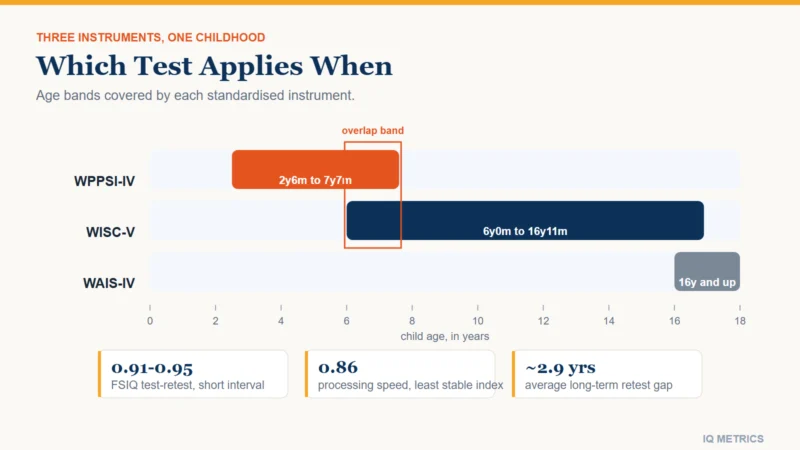 Taking a Test
IQ Testing for Children
Children are not tested on the same instrument as adults, and the test itself changes twice before age eighteen. Here is which one applies when, how reliable an early score really is, and what a parent should and should not conclude from a single number.
 Scores & Scales
IQ Scale By Age
The IQ scale is the same at every age, with an average of 100, but the test changes: the WPPSI-IV covers ages 2.5 to 7.5, the WISC-V ages 6 to 16 and the WAIS-IV and WAIS-5 ages 16 to 90. See which test fits each age, how a child's IQ was once calculated and how stable IQ is over a lifetime.
 Scores & Scales
IQ and Mental Age
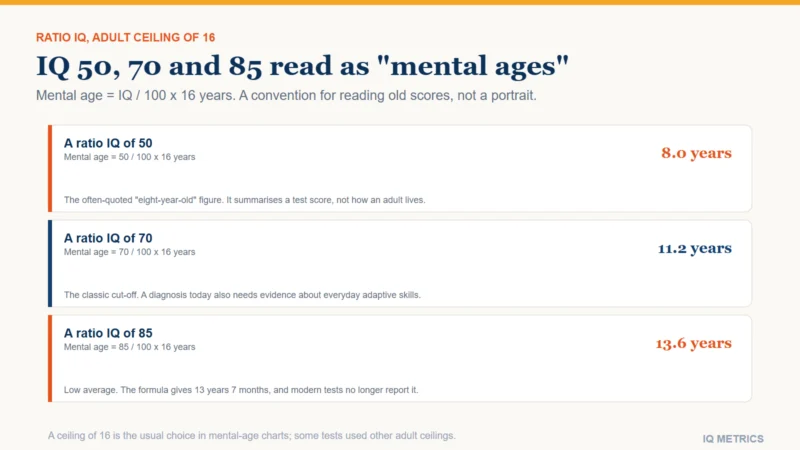
Mental age is the age a typical child scores like, and ratio IQ divides it by real age. See an IQ to mental age chart from IQ 30 to 100, worked examples, and why modern tests dropped the idea for adults.