





Verbal Reasoning Test: Question Types, Worked Examples and Scores
A verbal reasoning test asks whether a passage supports a statement: True, False or Cannot Say. Three worked examples with answers, the time per question on the UCAT (30 seconds) and the SHL fact sheet (38), how scores work and what the UK police recruitment process uses.

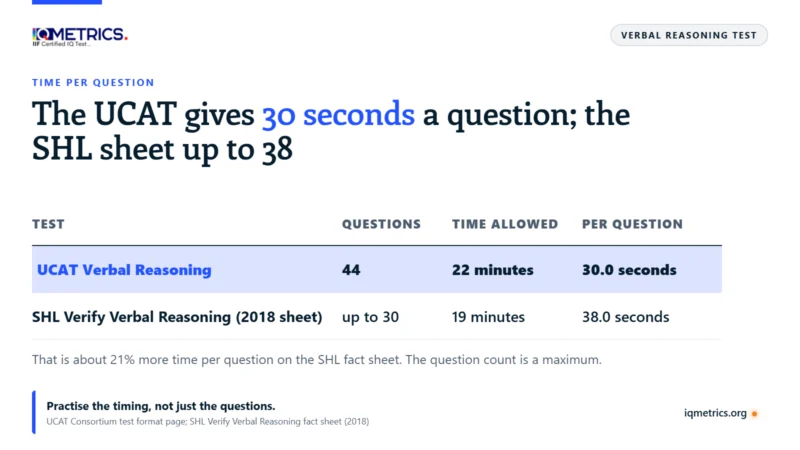
A verbal reasoning test checks how well you read a short passage and decide what it supports. The classic format gives a passage and a statement, and you answer True, False or Cannot Say. SHL, a large employer test publisher, says its test measures “a candidate’s ability to evaluate written statements”. The UCAT gives 44 questions in 22 minutes, about 30 seconds each.
Below: the question types, three worked examples with answers, how much time the UCAT and SHL tests allow, how scores work, what the police recruitment process uses, and how to practise.
What is a verbal reasoning test?
It is a timed test of reading and logic, not of vocabulary. You read a passage, then judge statements about it using only what the passage says. SHL describes the task as “reading a passage of text, and using that information to decide whether a given statement is True, False, or if you Cannot Say”.
Employers use it for jobs that need people to draw conclusions from written evidence. The UCAT, an admissions test for medical and dental schools in the UK, has a verbal reasoning section too. A school or clinical IQ test uses a different, wider idea of verbal ability; our guides to verbal fluency and verbal and non-verbal IQ scores cover it.
What are the question types?
- True / False / Cannot Say: the standard format. Decide from the passage alone whether the statement is true, false, or not settled by it.
- Conclusions that can be drawn: the UCAT asks you to “determine whether specific conclusions can be drawn from information presented”.
- Choose the best answer: some tests give a question and four options. You pick the one the passage supports best.
What does a verbal reasoning question look like?
Here are three practice questions on one passage. We wrote them for this guide; they are not real SHL or UCAT items.
Passage: A city library moved to a new building in March. Since the move, weekday visits have risen by a fifth, while weekend visits are unchanged. The library has not changed its weekday opening hours.
| Statement | Answer | Why |
|---|---|---|
| Weekday visits are higher since the move. | True | The passage says weekday visits rose by a fifth. |
| The library is open longer on weekdays than before. | False | The passage says weekday hours have not changed. |
| Visitors prefer the new building. | Cannot Say | The passage gives no reason for the rise, so preference is not settled. |
The rule behind all three: ignore what you know and what seems likely. “Cannot Say” is not a guess. It means the passage does not give enough information either way.
How much time do you get per question?
Less than you expect, and it varies by test. The UCAT test-format page lists Verbal Reasoning as 44 questions in 22 minutes. Its 44 questions come as eleven passages of four. That is 30 seconds a question, or 2 minutes for each passage and its four questions.
The SHL Verify Verbal Reasoning fact sheet lists 19 minutes and a maximum of 30 questions, with an average testing time of 17 to 19 minutes. That is up to 38 seconds a question, about 21% more time per question than the UCAT gives. The SHL sheet is dated 2018 and the question count is a maximum, so check the instructions for the test you are sitting.
| Test | Questions | Time allowed | Seconds per question |
|---|---|---|---|
| UCAT Verbal Reasoning | 44 | 22 minutes | 30.0 |
| SHL Verify Verbal Reasoning (2018 fact sheet) | up to 30 | 19 minutes | 38.0 |
How is a verbal reasoning test scored?
By converting your raw score into a score on a fixed scale. The UCAT does this openly: “raw marks are therefore converted to scaled scores for each subtest that share a common range from 300 to 900”. Applicants receive a total score of 900 to 2700 and a separate Situational Judgement Band, according to the UCAT site.
Employer tests usually report where you stand against a comparison group, so the same raw score can mean different things for different jobs. Our guides to what a good SHL score is, Watson-Glaser scores and UCAT scores explain percentiles and norm groups, and our guide to the average IQ in the USA shows how a norm sample defines the average. The percentile calculator turns a percentile into an IQ-scale position: IQ percentile calculator.
Where would your own score land?
Take the IIF-certified assessment and get your score with the scale it was measured on, the percentile it corresponds to and the confidence range around it — the three figures most online tests leave out.
Find your IQ score now! →Is there a police verbal reasoning test?
For police constable recruitment through the College of Policing, we did not find one. Its candidate guidance from September 2024 says “the online assessment process consists of” a competency-based interview, a written exercise and a briefing exercise. The guide describes them as “mandatory assessments designed specifically for initial police recruitment”.
Before that, candidates complete “either an in-force sift or the national sift”, depending on the force. A force may use its own steps, so read your force’s recruitment page. The College of Policing guide itself lists no verbal, numerical or logical reasoning test.
How can you practise verbal reasoning?
- Read each passage once for the main point, then check each statement against the exact words.
- Mark an answer “Cannot Say” only when the passage truly leaves the question open, not when you are unsure.
- Practise the timing. At about 30 to 38 seconds a question, there is no time to re-read the whole passage every time.
- Practise related skills on our verbal IQ test, logical reasoning test and critical thinking test.
For the other main employer test, see our guide to the numerical reasoning test, or browse the aptitude tests and our study of which employers use aptitude tests. To see where your overall reasoning sits on the IQ scale, take the IQ test.
Quick answers
- What is verbal reasoning? Judging what a passage of text supports, usually as True, False or Cannot Say.
- How many questions are on the UCAT verbal reasoning section? 44, in 22 minutes, in eleven passages of four.
- How long is the SHL verbal reasoning test? Its 2018 fact sheet lists 19 minutes and up to 30 questions.
- Is there a police verbal reasoning test? The College of Policing online assessment uses an interview, a written exercise and a briefing exercise, not a reasoning test.
The bottom line
A verbal reasoning test rewards careful reading and sticking to the passage. The time is tight: about 30 seconds a question on the UCAT and up to 38 on the SHL fact sheet. Practise the format and the timing, and read the instructions for your specific test.
Sources
- SHL, Verify Verbal Reasoning Test assessment fact sheet (2018): purpose, True/False/Cannot Say format, time and question limits.
- UCAT Consortium, test format: Verbal Reasoning questions, timing and scoring.
- College of Policing, Online assessment process: candidate guidance (September 2024).
Keep reading
All articles →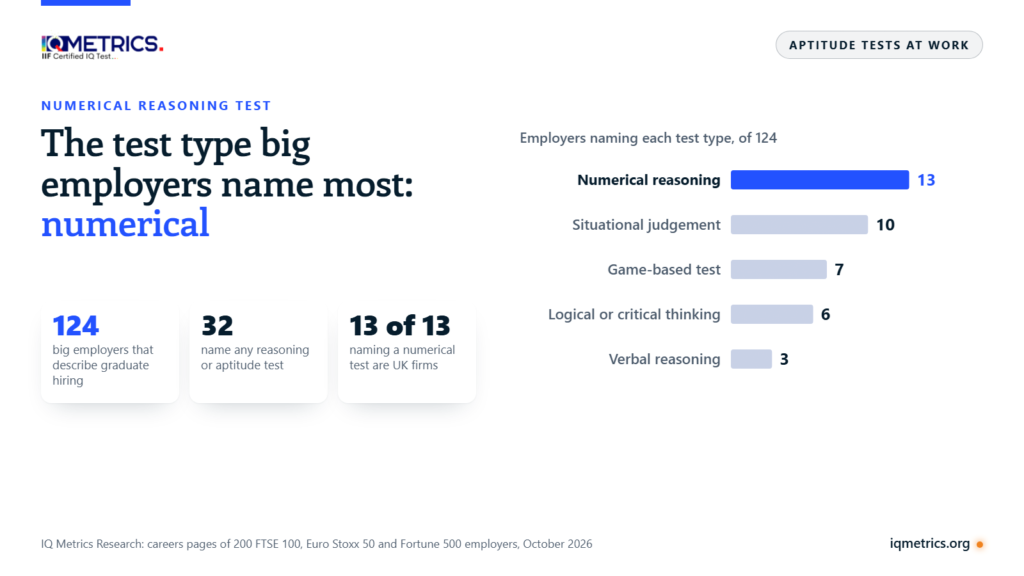 Taking a Test
Numerical Reasoning Test
A numerical reasoning test asks you to read tables and charts against the clock. Five worked example questions with answers, the mistakes that cost the most points, what a good score means, and the 13 big employers in our study of 124 that name a numerical test.
 Taking a Test
Verbal Fluency Test
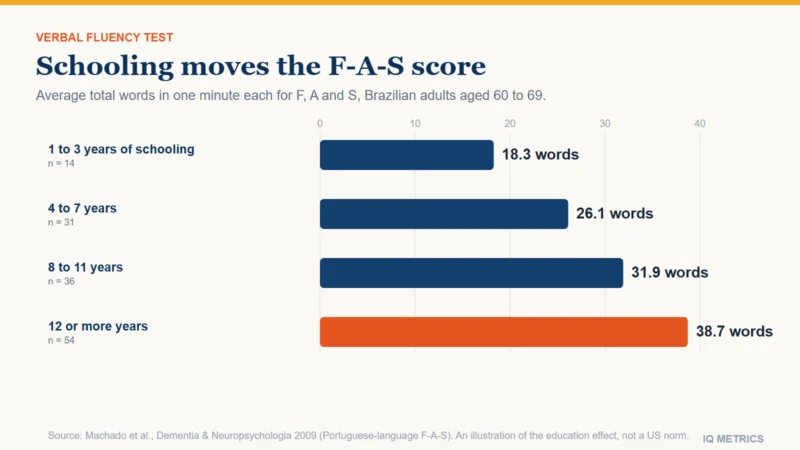
A verbal fluency test asks you to name as many words as you can in 60 seconds, by letter (F-A-S) or category (animals). See how it is scored, why education can move the score by about 20 words, what the task really measures and what a low count can and cannot tell you.
 Taking a Test
What Are The Type of Questions Asked On IQ Test?
IQ tests ask a small set of question types: pattern and matrix reasoning, verbal reasoning, number series, spatial puzzles, working memory and speed tasks. See what each looks like, how many questions a test has and which tests are multiple choice.