





Verbal Fluency Test: How It Is Scored and What Scores Mean
A verbal fluency test asks you to name as many words as you can in 60 seconds, by letter (F-A-S) or category (animals). See how it is scored, why education can move the score by about 20 words, what the task really measures and what a low count can and cannot tell you.

A verbal fluency test asks you to produce as many words as you can in 60 seconds, either words that start with a letter (usually F, A and S) or items in a category such as animals. The score is the number of valid words. It is a short neuropsychological screen, not an IQ test, and what counts as a normal score depends heavily on age, education and language. This guide covers how the two forms work, how scoring rules differ, what published norms show, what the task actually measures and what a low score can and cannot tell you.
- Two forms: letter (phonemic) fluency, such as F-A-S, and category (semantic) fluency, such as animals. Each is timed at one minute per letter or category.
- Scoring: count valid words; repeats and words that do not fit the rule are errors. The MoCA gives its fluency item 1 point for 11 or more words beginning with F.
- Norms: in a large normative study, education explained more of the F-A-S score than age (18.6% vs 11.0%), and the reverse held for animal naming (23.4% for age, 13.6% for education).
- What it measures: vocabulary, speed of retrieval, working memory and executive control together, which is why researchers call it a hybrid task.
- What it can tell you: low counts go with broader cognitive problems, but they do not identify which condition is responsible.
What is a verbal fluency test?
In a letter fluency test, the examiner names a letter and you say as many words as you can that begin with it before time runs out, usually 60 seconds. The classic version uses three letters, F, A and S, and adds up the totals; it is often called the FAS test, and in some versions the Controlled Oral Word Association Test (COWAT). In a category fluency test, you name members of a category, most often animals, in 60 seconds. A normative study by Tombaugh and colleagues (1999) reported norms for both and found that the total number of words across F, A and S correlated at r = .52 with the number of animals named, so the two forms overlap but are not the same skill.
The tests are quick, cheap and need no equipment, which is why they appear inside longer batteries and inside brief screens such as the MoCA. They are not core subtests of the WAIS-IV or WISC-V. For where fluency sits next to the abilities IQ tests do measure, see our guides to executive function vs IQ and processing speed and IQ.
How is a verbal fluency test scored?
The basic score is the number of correct words in the time limit. The rules for what counts differ a little between versions, so a score is only comparable to norms collected with the same rules. Two examples from published sources:
- MoCA letter F item: any kind of word is allowed except proper nouns (like Bob or Boston), numbers, and words that begin with the same sound but have a different suffix, such as love, lover, loving. One point is given for 11 or more words in 60 seconds.
- A Brazilian normative study of F-A-S (2009): only correct answers counted. Errors included intrusions (a valid word for the wrong letter) and perseverations (the same word said two or more times).
Researchers can also score how the words come out. In 1997, Troyer and colleagues described clustering (producing runs of related words, such as farm animals) and switching (moving to a new group), a method that a 2014 paper by Ledoux and colleagues modified to capture more about how words are organized. These extra scores are used in research and some clinics, but the raw word count is what most norms are built on.
What is a normal score on a verbal fluency test?
There is no single number. Two things move the score more than anything else: how many years of schooling the person has, and (for animal naming) how old they are. Tombaugh and colleagues tested 1,300 cognitively intact community residents aged 16 to 95, and published norms split into three age bands and three education bands. For F-A-S, education explained 18.6% of the variance and age 11.0%; for animal naming, age explained 23.4% and education 13.6%. Gender explained under 1% of either.
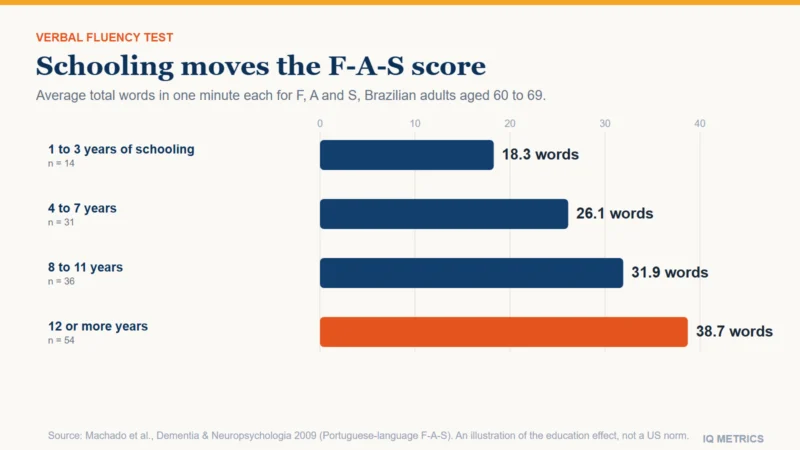
A 2009 study of 345 cognitively healthy Brazilian adults aged 60 to 93 shows how large the education effect can be. The average F-A-S total for the whole group was 28.3 words (SD 11.5), but it ran from about 18 words for people with 1 to 3 years of schooling to 32 to 39 for those with 12 or more years, depending on the age band.
| Years of schooling | Age 60-69 | Age 70-79 | Age 80+ |
|---|---|---|---|
| 1 to 3 | 18.3 | 18.3 | 20.6 |
| 4 to 7 | 26.1 | 26.0 | 26.2 |
| 8 to 11 | 31.9 | 28.8 | 28.9 |
| 12 or more | 38.7 | 32.0 | 34.0 |
Read the table as an illustration, not as cut-offs. The sample is Brazilian, the test used Portuguese words, and some cells are small: only 5 people aged 80 or over had 12 or more years of schooling. The words and letters differ across languages, so these averages should not be applied to English. What does transfer is the lesson: a clinician comparing a score with the wrong norm group can read a normal result as a problem, or the reverse. Language background matters too: the meta-analysis summarized in our guide to bilingual advantage and IQ found a small disadvantage for bilinguals on verbal fluency specifically.
What does a verbal fluency test measure?
On the surface it measures vocabulary, but several studies show it draws on more. Shao and colleagues (2014) tested 82 older adults on letter and category fluency along with vocabulary size, lexical access speed, updating and inhibition. The number of words produced was predicted by updating ability, while the speed of the first response was predicted by vocabulary size (and, for category fluency only, lexical access speed). The authors called both tasks hybrids, which limits their value for research and clinical use. Unsworth, Spillers and Brewer (2011) reached the same kind of conclusion with latent-variable analysis, comparing fluency with working memory capacity, inhibition, vocabulary and processing speed, and describing a two-stage search in which people first look for a higher-order category and then for words inside it.
In plain terms, doing well takes a big enough vocabulary, quick retrieval, enough working memory to keep track of what you have already said, and enough control to avoid repeating or drifting off the rule. That combination is why fluency is treated as an executive-function task, and why it is more useful as a broad indicator than as a precise one. Because it leans on attention and working memory, fluency has been included among the outcomes of training studies; a four-session mindfulness study tested it alongside working memory (see our guide to meditation and IQ), though small studies like that say little about lasting change. For related timed tasks, see our guides to the digit span test and the reaction time test.
Where would your own score land?
Take the IIF-certified assessment and get your score with the scale it was measured on, the percentile it corresponds to and the confidence range around it — the three figures most online tests leave out.
Find your IQ score now! →What do low scores mean?
A low score tells you the person produced fewer words than people of the same age, education and language typically do. It does not tell you why. In a study of 33 healthy controls and 139 patients with six neurodegenerative conditions (Alzheimer’s disease, behavioral variant frontotemporal dementia, non-fluent and semantic variants of primary progressive aphasia, progressive supranuclear palsy and corticobasal syndrome), Henderson and colleagues (2023) found that total word count separated controls from every patient group. For letter fluency the area under the curve was 94.3%, and for category fluency 99.0%. But neither word count nor the properties of the words separated the patient groups from each other, and word counts tracked overall severity on a general cognitive exam.
A 2023 review of Alzheimer’s research adds that fluency tasks have been especially useful for catching early changes in semantic processing. The balanced reading is that the test is an efficient sign that something about cognition is off, not a way to say what. Education, age, language background, vocabulary and retrieval speed can all lower a count, and a meta-analysis summarized in our guide to fetal alcohol spectrum disorder and IQ put verbal fluency among the larger executive-function deficits in that condition (0.87 standard deviations below average). Children who are both gifted and struggling, covered in our guide to twice exceptional students, can be given tasks like this beyond the IQ battery. For the broader question of what IQ-style testing can and cannot say about decline, see our guide to whether an IQ test can detect dementia.
Can you try a verbal fluency test at home?
You can try the task for curiosity: set a timer for 60 seconds, pick a letter and list words. But a home count cannot be compared with published norms, because norms depend on standardized instructions, scoring rules, the language and an examiner who can judge borderline words. If you are worried about your memory or a relative’s, the useful step is a clinical evaluation, not a self-score. If what you want is a measure of reasoning, the IQ test on this site covers that, and the guide to how IQ tests work explains how scores are built.
Quick answers
- What is a verbal fluency test? A timed task in which you name words that begin with a letter (F-A-S) or belong to a category (animals), usually for 60 seconds each.
- How is it scored? By counting valid words; repeats and words that break the rule are errors. The MoCA gives 1 point for 11 or more F words in 60 seconds.
- What is a normal score? It depends on age, education and language. In a Brazilian study the F-A-S average ran from about 18 words (1 to 3 years of schooling) to 39 (12 or more years) in ages 60 to 69.
- Is it an IQ test? No. It draws on vocabulary, speed, working memory and executive control, and is not a core subtest of the Wechsler IQ batteries.
- Can it diagnose dementia? No. Low counts go with broader problems but do not separate conditions from each other.
- Does gender matter? In the large normative study it explained under 1% of the variance.
Sources
- Tombaugh, T.N., Kozak, J. and Rees, L. (1999): Normative data stratified by age and education for two measures of verbal fluency: FAS and animal naming, Archives of Clinical Neuropsychology, 14(2), 167-177.
- Machado, T.H. et al. (2009): Normative data for healthy elderly on the phonemic verbal fluency task - FAS, Dementia & Neuropsychologia, 3(1), 55-60.
- Shao, Z., Janse, E., Visser, K. and Meyer, A.S. (2014): What do verbal fluency tasks measure? Predictors of verbal fluency performance in older adults, Frontiers in Psychology, 5, 772.
- Unsworth, N., Spillers, G.J. and Brewer, G.A. (2011): Variation in verbal fluency: a latent variable analysis of clustering, switching, and overall performance, Quarterly Journal of Experimental Psychology, 64(3), 447-466.
- Henderson, S.K. et al. (2023): Verbal fluency tests assess global cognitive status but have limited diagnostic differentiation: evidence from a large-scale examination of six neurodegenerative diseases, Brain Communications, 5(2), fcad042.
- Wright, L.M., De Marco, M. and Venneri, A. (2023): Current understanding of verbal fluency in Alzheimer’s disease: evidence to date, Psychology Research and Behavior Management, 16, 1691-1705.
- Troyer, A.K., Moscovitch, M. and Winocur, G. (1997): Clustering and switching as two components of verbal fluency: evidence from younger and older healthy adults, Neuropsychology, 11(1), 138-146.
- Ledoux, K. et al. (2014): Capturing additional information about the organization of entries in the lexicon from verbal fluency productions, Journal of Clinical and Experimental Neuropsychology, 36(2), 205-220.
- MoCA Test Inc.: frequently asked questions, and the MoCA administration and scoring instructions (letter F fluency item).
Keep reading
All articles →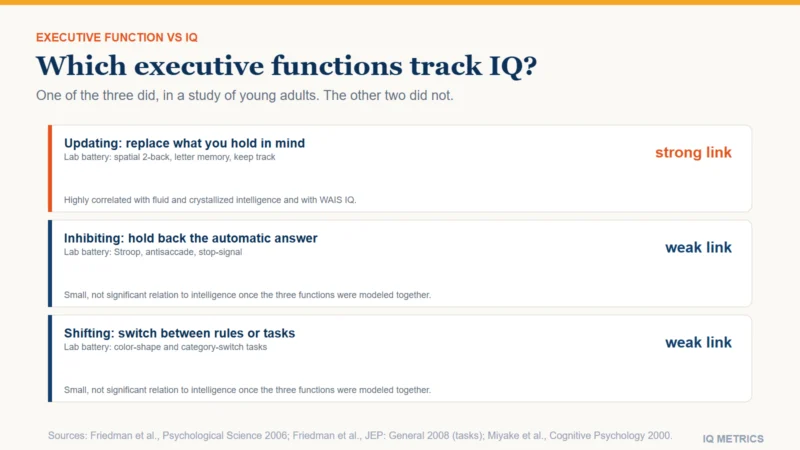 Understanding IQ
Executive Function vs IQ
Executive function and IQ overlap but are not the same thing. Of the three executive functions, only updating working memory was highly correlated with intelligence in one study of young adults. See the three functions, a twin study, how reliable the tasks are and why training claims fall short.
 Taking a Test
Can an IQ Test Detect Dementia?
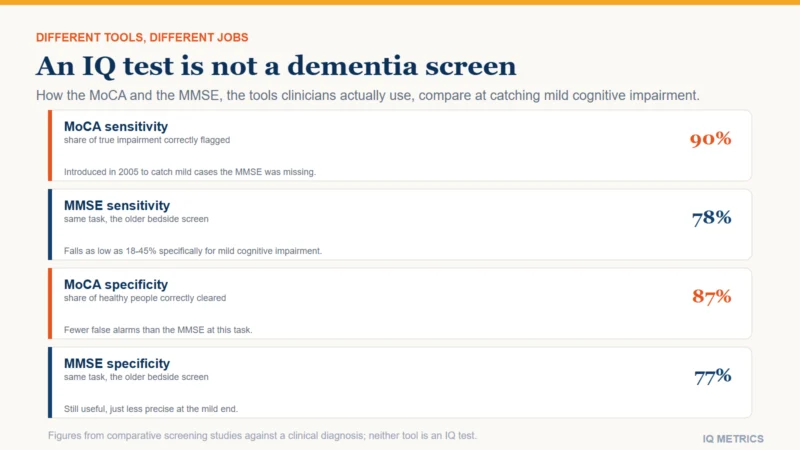
A standard IQ test cannot diagnose dementia; it has no personal baseline and was not built to screen for decline. How the MMSE and the more sensitive MoCA compare, why a normal score can hide early decline, and what actually helps catch it.
 Scores & Scales
MoCA Score
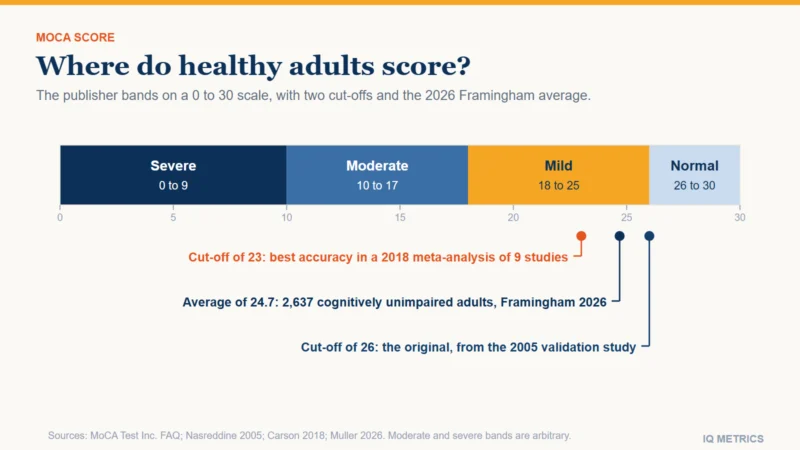
A MoCA score is a number out of 30 from a 10-minute screen for mild cognitive impairment. See the four publisher score bands, why the 26 cut-off flags many healthy adults, what changes the score, what to do with a result and why a MoCA is not an IQ.