





What Is the Average IQ in Japan? What the Figures, PISA and Adult Skills Show
The average IQ in Japan is 100 on a Japanese-normed test. The circulating national figures are 107.01 (compiled) and 106.30 (online), only 0.7 points apart. See where each comes from, what PISA 2025 and the adult-skills survey show, and how Japan compares with South Korea, China and the US.

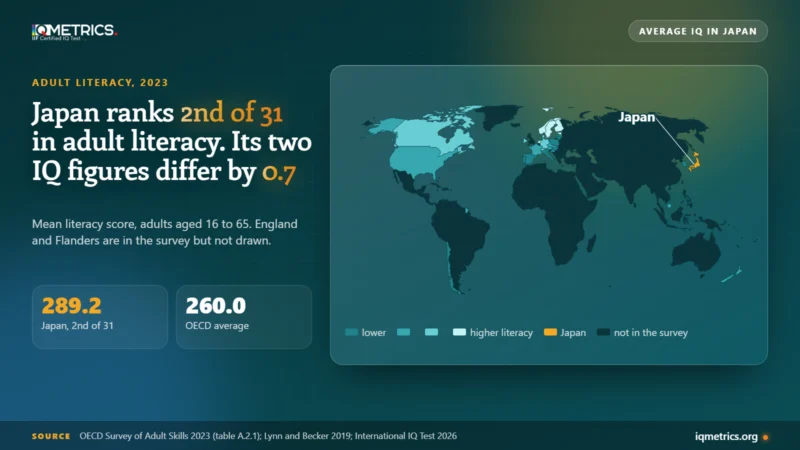
The average IQ in Japan is 100 on any test normed in Japan, because every IQ test sets its own average at 100. No national IQ sample exists for Japan. The figures that circulate are 107.01 from a compiled estimate (3,207 people in 6 studies) and 106.30 from a 2026 online table (55,994 takers). Japan’s real strength shows in skills data: it ranked 2nd of 31 in adult literacy in 2023.
Below: where each figure comes from, what PISA 2025 and the Survey of Adult Skills show, and how Japan compares with South Korea, China and the US. New here: Japan’s two IQ figures sit only 0.7 points apart, while India’s sit 22.2 apart, and the OECD skills data put Japan near the top as well. This page covers country-level data only. It says nothing about any group of people.
Key takeaways
- A Japanese-normed IQ test averages 100 by design. Comparing countries needs other data.
- Two numbers circulate: 107.01 (compiled, 6 studies, 3,207 people) and 106.30 (online, 55,994 volunteers). Neither is a national sample.
- The OECD data are stronger. PISA 2025 ranked Japan 5th of 90 in maths (525.4). The 2023 Survey of Adult Skills ranked it 2nd of 31 in literacy (289.2) and numeracy (290.8).
- Only 10.4% of Japanese adults scored at Level 1 or below in literacy, against 26.1% across the OECD average.
What is the average IQ in Japan?
On a test normed in Japan, the average is 100 by construction. A norm group is a large sample of people who took the test. Its mean is set to 100, with a standard deviation (SD) of 15 points. A person in Japan who scores 100 is average among people in Japan. That says nothing about Japan against another country.
Four kinds of number get called the average IQ of Japan. They answer different questions, and none is an IQ test of everyone in the country. As far as we found, no nation’s IQ has been measured on one test given to a random sample of the whole population. Japan is no exception. Searches for the Japan average IQ, the Japanese average IQ, the average IQ Japan or just Japan IQ all lead to the same few numbers.
| Source | Japan | Sample | What it measures |
|---|---|---|---|
| Compiled national estimate (Lynn and Becker 2019, on our average IQ by country page) | 107.01, 1st of 201 | 3,207 people in 6 studies | Published studies on different tests, averaged |
| Online test (International IQ Test 2026 table) | 106.30, 3rd of 137 | 55,994 volunteers | People who chose to take one website’s test |
| PISA 2025 (OECD), maths | 525.4, 5th of 90 | 15-year-olds in 183 schools | School maths skill, not IQ |
| Survey of Adult Skills 2023 (OECD), literacy | 289.2, 2nd of 31 | Adults aged 16 to 65 | Adult reading skill, not IQ |
Where do the 105, 106 and 107 figures for Japan come from?
The 107.01 is the compiled estimate in Lynn and Becker (2019), which we read in the original workbook. A plain 105 appears on many pages. We could not trace it to a source we can open, so we do not use it.
Our average IQ by country page calls Japan the entry with the least controversy attached: long compulsory schooling, near-universal literacy and decades of well-documented testing. It also notes that the widely copied version of the table prints Japan at 106.48, from a mis-transcribed copy. That is 0.53 points under the workbook value, small next to the error of a single IQ test.
The 106.30 comes from the International IQ Test’s 2026 table, built from 55,994 people in Japan who took its online test in 2025. Our report on the 2026 online ranking shows that table counts whoever chose to take the test, not a sample of the country.
Why do country IQ tables disagree?
Each number is built from different people. The compiled figure rests on 6 published studies and 3,207 people. The online figure rests on volunteers. Both are tiny next to a whole country.
The choice of studies can move a national figure a long way. For sub-Saharan Africa, one review found 67.4 or 80.4 depending on which studies were counted (Wicherts, Dolan and van der Maas, Intelligence, 2010, as summarised on our country page). Our report on why country IQ rankings are weaker than the charts suggest sets out the wider problem.
What do PISA and the adult-skills survey show for Japan?
They show a country near the top of the world on school and adult skills. PISA 2025 ranked Japan 5th of 90 in maths and 4th of 90 in reading, and 5th of 91 in science. PISA tests 15-year-olds in school, and our guide to whether PISA is an IQ test explains why it is not one.
| Subject | Japan | Japan's rank | South Korea | OECD average |
|---|---|---|---|---|
| Maths | 525.4 | 5th of 90 | 522.3 | 463.0 |
| Reading | 502.7 | 4th of 90 | 500.6 | 460.9 |
| Science | 537.6 | 5th of 91 | 526.1 | 481.9 |
The adult data tell a similar story for people aged 16 to 65. In the OECD’s Survey of Adult Skills 2023, Japan ranked 2nd of the 31 countries and regions in literacy, numeracy and adaptive problem solving, behind only Finland. Fewer Japanese adults scored at the lowest levels too: 10.4% at Level 1 or below in literacy, against 26.1% across the OECD average.
| Country | Literacy | Numeracy | Adaptive problem solving |
|---|---|---|---|
| Japan | 289.2 | 290.8 | 276.3 |
| Finland | 296.5 | 293.8 | 276.5 |
| Germany | 266.1 | 272.8 | 261.0 |
| United States | 258.2 | 248.8 | 247.5 |
| South Korea | 249.0 | 252.7 | 237.6 |
| OECD average | 260.0 | 263.0 | 250.6 |
China did not take part in this survey, so it has no adult-skills figure. Read both tables with care. They measure what people have learned and can do, and schooling raises those scores. A literacy score of 289 is not an IQ. Our post on the smartest European country runs the same comparison for Europe.
Where would your own score land?
Take the IIF-certified assessment and get your score with the scale it was measured on, the percentile it corresponds to and the confidence range around it — the three figures most online tests leave out.
Find your IQ score now! →How does Japan compare with South Korea, China and the US?
On the compiled estimate Japan leads these four countries. On the online table South Korea does. Japan’s two sources sit 0.7 points apart, while the other three differ by 2.4 to 4.6 points.
| Country | Compiled estimate (2019) | People and studies | Online table (2026) | Online minus compiled |
|---|---|---|---|---|
| Japan | 107.01 | 3,207 in 6 | 106.30 | -0.7 |
| South Korea | 102.35 | 3,586 in 4 | 106.97 | +4.6 |
| China | 104.10 | 51,500 in 6 | 106.48 | +2.4 |
| United States | 97.43 | 62,649 in 58 | 101.04 | +3.6 |
Japan is the only one of the four where the online table comes out lower than the compiled estimate. A small gap means two weak sources roughly agree. A big one means at least one is a poor guide: for India the gap is 22.2 points, as our post on the average IQ in India shows.
For the same two-source comparison on other countries, read our posts on the average IQ in South Korea and the average IQ in China. Our smartest countries study ranks the PISA and adult-skills data directly.
Did Japanese IQ scores rise over the decades?
Probably, but we found no national IQ series for Japan that we could read. The Flynn effect, the rise in raw test scores through the 20th century, was seen in many countries. Wikipedia’s summary lists Japan and South Korea among them. We did not read the original studies, so we give no size.
What can be read is school skills. Japan’s PISA maths score stayed between 523 and 536 across eight rounds from 2003 to 2025. Its science score stayed between 529 and 547 across seven rounds from 2006.
| Year | Maths | Science |
|---|---|---|
| 2003 | 534.1 | not tested |
| 2006 | 523.1 | 531.4 |
| 2009 | 529.0 | 539.4 |
| 2012 | 536.4 | 546.7 |
| 2015 | 532.4 | 538.4 |
| 2018 | 527.0 | 529.1 |
| 2022 | 535.6 | 546.6 |
| 2025 | 525.4 | 537.6 |
The 2025 maths score is 10.2 points below 2022, with a standard error of 5.3. A flat line over 22 years is not a rising IQ, and it is not a falling one. For why raw scores climbed and then stalled, read our report on why the Flynn effect stalled.
How can you check your own score?
- Treat 100 as the average IQ in Japan on any Japanese-normed test, and nothing more.
- Read 107.01 as six studies, 106.30 as web volunteers, and PISA and the adult survey as school and adult skills, not IQ.
- For a score of your own, take the IQ test, then place it with the IQ percentile calculator. Our IQ bell curve shows what a score means on the scale.
Quick answers
- What is the average IQ in Japan? The average IQ in Japan is 100 on any Japanese-normed test. The circulating national figures are 107.01 (compiled, 6 studies) and 106.30 (online, 55,994 takers).
- What is the IQ of Japan compared with the world? No fair world ranking exists. PISA 2025 puts Japan 5th of 90 in maths, and the Survey of Adult Skills puts it 2nd of 31 in literacy.
- Is the 105 figure for Japan real? We could not trace a plain 105 to a source we can open, so we do not use it.
- Is the average Japanese IQ rising? Nobody can say from a national series. Japan’s PISA maths score stayed between 523 and 536 from 2003 to 2025.
- Does PISA measure IQ? No. It tests the school skills of 15-year-olds.
Sources
- Lynn R, Becker D (2019). The Intelligence of Nations. Ulster Institute for Social Research (NIQ-DATASET V1.3.2), as reproduced on our average IQ by country page.
- International IQ Test 2026 country table (updated 1 January 2026), as read and recomputed in our 2026 online ranking report.
- OECD (2026). PISA 2025 Results (Volume I), Table I.B1.2: student performance in PISA 2025, tables I.B1.2a.1 to I.B1.2a.3, I.B1.2a.25, I.B1.2a.36 and I.B1.2a.38 (version of 8 September 2026).
- OECD (2024). Do Adults Have the Skills They Need to Thrive in a Changing World? Survey of Adult Skills 2023, Annex A tables A.2.1 and A.2.2.
- Wicherts JM, Dolan CV, van der Maas HLJ (2010). A systematic literature review of the average IQ of sub-Saharan Africans. Intelligence 38(1), 1-20.
- Flynn effect, Wikipedia (summary only; the original studies were not read).
Keep reading
All articles →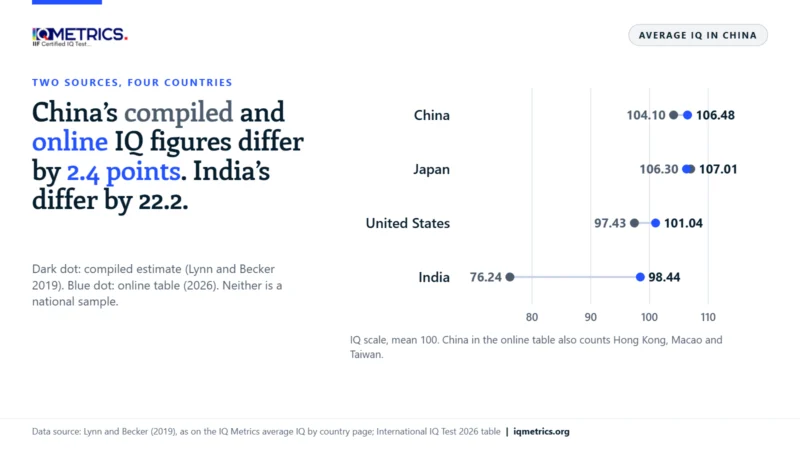 Scores & Scales
Average IQ in China
The average IQ in China is 100 on a China-normed test. The circulating national figures are 104.10 from a compiled estimate and 106.48 from an online table that also counts Hong Kong and Taiwan. See where each comes from, what PISA's four-region result covers, and how China compares with Japan and the US.
 Scores & Scales
Average IQ in South Korea
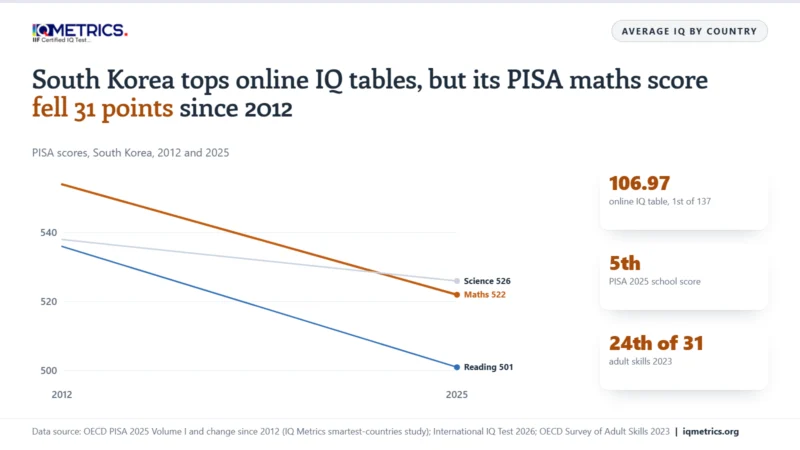
Average IQ in South Korea is 100 on a Korean test. The 106.97 online is 26,996 volunteers. Korean teenagers rank 5th on PISA 2025, yet adults rank 24th of 31 in adult skills. See why, and what we know about North Korea.
 Understanding IQ
PISA Test vs IQ Test
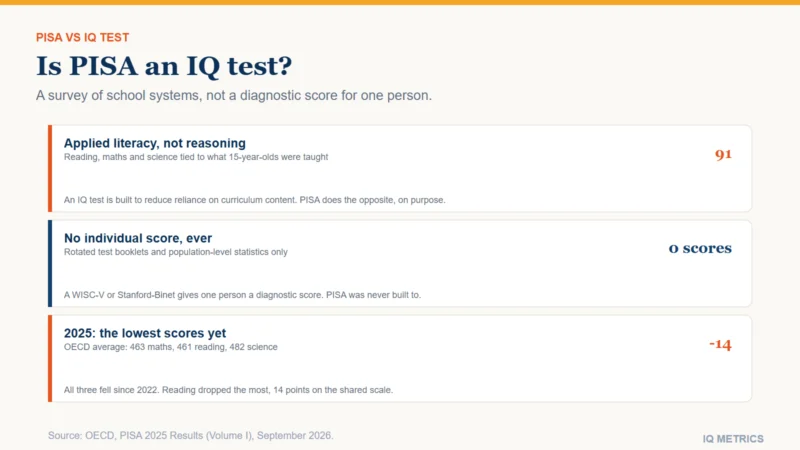
Is PISA an IQ test? No. PISA surveys applied school literacy across whole education systems and returns no individual score, while an IQ test diagnoses one person. See the new PISA 2025 results, published September 2026, and the real debate over using PISA as a national IQ proxy.