



How Do You Convert a Ruler Drop Test Into Reaction Time?
A ruler drop test turns the distance you catch a falling ruler into reaction time with t = √(2d/g): 20 cm is 202 ms and 30 cm is 247 ms. Here is the chart in centimetres and inches, and what one drop can and cannot tell you.


What you need to know
- A reaction time ruler drop test turns the distance a ruler falls before you catch it into time: t = √(2d/g). A 10 cm catch is 143 ms, 20 cm is 202 ms and 30 cm is 247 ms.
- Each extra centimetre adds about 5 ms near 20 cm, and a 30 cm ruler cannot record anything slower than 247 ms, so a ruler that hits the floor means you were slower than that.
- A falling-stick test averaged 202.0 ms (SD 25.0) in 2,584 US college athletes, the same figure as a 20 cm catch on our chart (Caccese 2020, Journal of Athletic Training). It is a landmark, not a norm.
- One drop is noisy: in 51 older adults tested a week apart, the simple ruler drop had a reliability of 0.57 and a minimal detectable change of 10.75 cm (Ferreira 2024).
A reaction time ruler drop test turns the distance a ruler falls before you catch it into milliseconds with t = √(2d/g), where g is 9.80665 m/s². Catch it at 10 cm and your time is 143 ms. At 20 cm it is 202 ms, and at 30 cm it is 247 ms. The figure includes the time your fingers take to close, so it is a rough guide, not a lab measurement.
Below: the full chart in centimetres and inches, how to run the test, what a good result looks like, and why a single drop is noisy. Every conversion on this page is our own arithmetic, checked by script on 13 November 2026.
What is the ruler drop test?
The ruler drop test measures simple reaction time with a ruler and a second person. One person holds the ruler upright. The other holds a thumb and finger open around the zero mark, without touching it. The holder lets go without warning, and the catcher grabs the ruler as fast as possible. The mark level with the top of the catching fingers is the distance fallen.
Clinicians use versions of it. One version is a falling stick in a weighted rubber disk. It was studied as a reaction time test for athletes after a concussion that needs no computer (Eckner, Kutcher and Richardson, Journal of Athletic Training, 2011). Sri Lanka's guideline for examining a person suspected of drunkenness includes a ruler drop. A 2023 study of 903 adults set a reference cut-off of more than 40 cm (Rajapaksha and colleagues, Journal of Forensic and Legal Medicine).
How do you convert ruler drop centimetres to reaction time?
Use t = √(2d/g), where d is the distance in metres and g is 9.80665 m/s², the standard acceleration of gravity (NIST). The ruler starts from rest, so a longer fall means a slower reaction. Because time depends on the square root of distance, each extra centimetre adds less time the further the ruler drops.
Here is a worked example for a catch at 15 cm. Put d = 0.15 m into 2d/g and you get 0.30 ÷ 9.80665 = 0.0306. The square root of that is 0.175 seconds, or 175 ms. Our ruler drop test chart does this sum for you:
- 5 cm (2.0 in): 101 ms
- 8 cm (3.1 in): 128 ms
- 10 cm (3.9 in): 143 ms
- 12 cm (4.7 in): 156 ms
- 15 cm (5.9 in): 175 ms
- 18 cm (7.1 in): 192 ms
- 20 cm (7.9 in): 202 ms
- 22 cm (8.7 in): 212 ms
- 25 cm (9.8 in): 226 ms
- 28 cm (11.0 in): 239 ms
- 30 cm (11.8 in): 247 ms
A 40 cm catch is 286 ms and a 50 cm catch is 319 ms, for longer rulers. A 12-inch ruler is 30.48 cm long, which gives 249 ms. Our reaction time test guide prints a similar table and explains why online scores run slower than a ruler.
How do you run the ruler drop test at home?
Run it with the same ruler, the same hand and a random release time, then record every catch. Here are the steps for how to measure reaction time with a ruler:
- Rest the catcher's forearm on a table edge, with the hand open past the edge and the thumb and finger a few centimetres apart
- Hold the ruler upright with its zero mark level with the top of the catcher's fingers
- Say "ready", then drop the ruler after a different wait each time, such as 2, 3, 4 and 6 seconds, so the catch cannot be timed
- Read the mark at the top of the catching fingers and write it down
- Repeat 5 times and use the middle value, then convert it with the chart
The random wait matters. If the catcher can predict the release, the catch is anticipation, not reaction. The 2024 study we cite below dropped the ruler 2, 3, 4, 4 and 6 seconds after "ready", in a mixed order, using a metronome the dropper heard through earbuds.
What is a good ruler drop test result?
There is no single norm for a plain ruler, but about 20 cm (202 ms) is a fair landmark for young adults. The largest dataset we found tested 2,584 US college athletes, whose ages averaged 19.0 years, with a falling stick. They averaged 202.0 ms with a standard deviation of 25.0 ms (Caccese and colleagues, Journal of Athletic Training, 2020).
One standard deviation either side, 177 to 227 ms, is about 15 cm to 25 cm on our chart. In their model, women were 8.6 ms slower than men. Group means ran from 195.0 ms for men in contact sports to 212.1 ms for women in limited-contact sports, or about 18.6 to 22.1 cm.
Treat that as a landmark, not a pass mark. The athletes used a purpose-built stick, not a wooden ruler.
In the general adult sample from Sri Lanka, with a mean age of 41.6 years, 95% caught the ruler at 40.0 cm or less, which is 286 ms. In 51 older adults, the average catch was about 32 cm in one session and 30 cm a week later, or roughly 255 and 249 ms. Speed also changes with age: in our analysis of 756,948 adults, processing speed peaked at 25, as the guide on at what age IQ peaks explains.
Why is one ruler drop test so noisy?
One drop is noisy because the test has a wide margin of error. In 51 older adults tested a week apart, the simple ruler drop had an intraclass correlation of 0.57, with a 95% interval of 0.26 to 0.75. The study is by Ferreira and colleagues (Aging Clinical and Experimental Research, 2024). The paper's table calls that moderate, while its abstract calls it poor.
The paper also gives the minimal detectable change: 10.75 cm, or 34.5% of the mean. A change smaller than that between two sessions cannot be told apart from noise. On our chart 10.75 cm is roughly the gap between a 20 cm catch (202 ms) and a 31 cm catch (250 ms).
In 51 older adults, a change of less than 10.75 cm between two ruler drop sessions could be pure noise.
Three more things add noise. Each extra centimetre adds about 5 ms near 20 cm, so a slip of 2 cm in reading the ruler is about 10 ms. The time includes closing the fingers, so it is longer than a pure reaction. And a 30 cm ruler cannot record anything slower than 247 ms: if it hits the floor, you were slower than that.
How does a ruler differ from an online reaction time test?
A ruler has no screen, mouse or keyboard delay, so it reads shorter than an online test, but it adds the time to close your fingers. Online tests add lag from the display and the input device, which our guide to how to measure reaction time breaks down with published figures.
Neither number is a pure reaction time, and the two are not interchangeable. A reaction time ruler test at 20 cm and an online click at 202 ms measure different chains of events. Compare your own results across days on the same method. For published averages by age, see our guide to the average reaction time by age, and for how fast humans think see our research on human speed of thought.
Does a ruler drop result say anything about IQ?
Only a little, and a ruler cannot estimate your IQ. Our guide to average reaction time reports that simple reaction time correlates about −.31 with IQ in 900 people aged about 56, which is under 10% of the variance. A 20 cm catch and a 30 cm catch say far less about intelligence than they do about hand, vision and alertness on the day.
If you want to compare a quick reaction with a task that adds a decision, try our Stroop test game and read what the Stroop test measures. For a memory task, try the sequence memory test. To turn an IQ score into a percentile, use our IQ percentile calculator.
Where would your own score land?
A ruler gives a rough reaction time. For a score on the standard IQ scale with its percentile, take the IQ Metrics test.
Find your IQ score now! →To see how your reasoning compares with other adults, take the IQ Metrics test.
Common questions
How do you convert ruler drop test centimetres to milliseconds?
Use t = √(2d/g), with d in metres and g = 9.80665 m/s². A catch at 10 cm is 143 ms, at 20 cm 202 ms and at 30 cm 247 ms. The result includes the time your fingers take to close.
How far should a ruler fall for a 200 ms reaction time?
About 19.6 cm. A 200 ms reaction time means the ruler falls 0.5 × 9.80665 × 0.2² = 0.196 m, or about 20 cm, before you catch it.
Is the ruler drop test accurate?
It is a rough test. In 51 older adults tested a week apart, the simple ruler drop had a reliability (ICC) of 0.57 and a minimal detectable change of 10.75 cm (Ferreira 2024). One drop is one noisy number, so average several.
What is a good ruler drop test result?
There is no universal norm. A falling-stick test averaged 202.0 ms (about 20 cm) in 2,584 US college athletes, and 95% of 903 adults in Sri Lanka caught a ruler at 40.0 cm or less (286 ms). Compare your own results over time on the same method.
Sources for this story
- Standard acceleration of gravity, 9.806 65 m s-2, CODATA value (NIST Reference on Constants, Units and Uncertainty), read 13 November 2026 — NIST
- Caccese JB, Eckner JT, et al. Clinical Reaction-Time Performance Factors in Healthy Collegiate Athletes. Journal of Athletic Training 55(6):601-607 (2020), doi 10.4085/1062-6050-164-19; abstract read — National Athletic Trainers' Association
- Eckner JT, Kutcher JS, Richardson JK. Between-Seasons Test-Retest Reliability of Clinically Measured Reaction Time in NCAA Division I Athletes. Journal of Athletic Training 46(4):409-414 (2011), doi 10.4085/1062-6050-46.4.409; abstract read — National Athletic Trainers' Association
- Ferreira S, et al. Validity and reliability of a ruler drop test to measure dual-task reaction time, choice reaction time and discrimination reaction time. Aging Clinical and Experimental Research 36:61 (2024), doi 10.1007/s40520-024-02726-6; full text read — Springer
- Rajapaksha S, et al. The establishment of a population-specific reference value for the ruler drop test for the clinical assessment of reaction time. Journal of Forensic and Legal Medicine 96:102525 (2023), doi 10.1016/j.jflm.2023.102525; abstract read — Elsevier
- IQ Metrics computation, 13 November 2026: t = √(2d/g) for every catch distance, the inverse for 200 and 202 ms, and the unit conversions — IQ Metrics
Corrections: spotted an error? Email corrections@iqmetrics.org and we will update this story and note the change here.
Related stories
All news →
Average Reaction Time by Age (in Milliseconds) and What It Says About IQ
A typical simple reaction time is roughly 215 to 240 milliseconds in a calibrated lab and 273 ms on Human Benchmark's online test. Age adds about 0.55 ms a year, and the link to IQ is about -.3.
Stroop Test Explained: What It Measures and the IQ Link
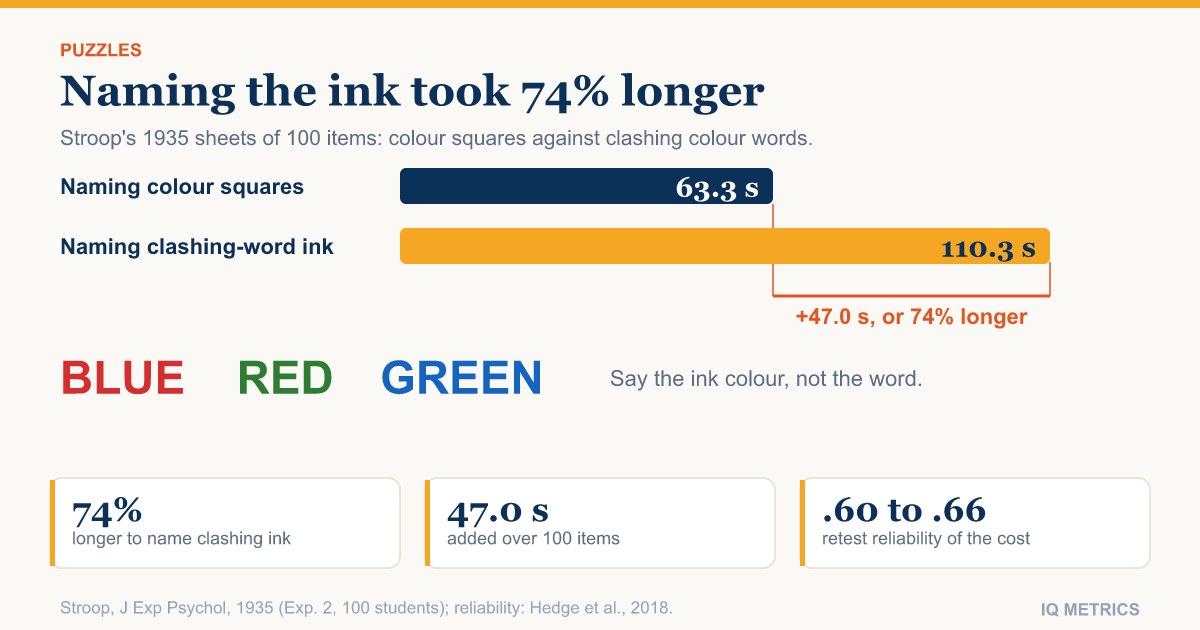
In Stroop's 1935 study, naming the ink colour of 100 conflicting colour words took 47 seconds longer than naming coloured squares. The effect is among the most reliable in psychology, yet one person's score is not, and it tracks IQ only weakly.

Do Crossword Puzzles Prevent Dementia? What the Bronx Aging Study Showed
No trial shows that crosswords prevent dementia. The best-known study found a 2.54-year delay in memory decline among 17 crossword players who still developed dementia. One 2022 trial in mild cognitive impairment favoured crosswords over computer games.
Read the research.
Then find your own number.
Our IIF-certified assessment reports your score with its scale, percentile and confidence range — and a breakdown of the cognitive domains behind it.
Start IQ Test →