





What Is the Average IQ in Pakistan? Where the Figures Come From and What Learning Surveys Show
No measured average IQ exists for Pakistan. The 2002 figure of 81 was copied from India, a 2019 table prints 80.00 from 8 studies, and an online table prints 96.93 from 464 takers. See where each comes from and what ASER learning surveys show.

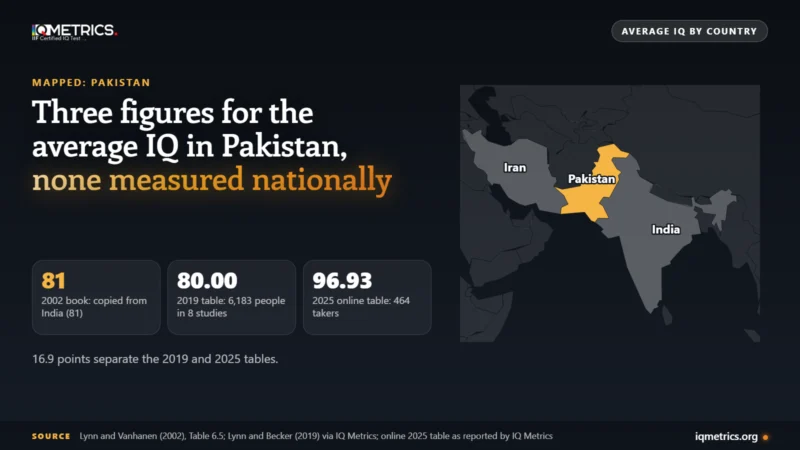
The average IQ in Pakistan has not been measured. The Pakistan average IQ that circulates is an estimate, and three figures are in use: 81 from a 2002 book, 80.00 from a 2019 compiled table (6,183 people in 8 studies) and 96.93 from a 2025 online table (464 takers). They sit up to 17 points apart. We could not confirm a nationally representative sample behind any of them.
New here: the 81 was not tested in Pakistan at all. The 2002 book marks it as an estimate and copies it from India, whose 81 averaged four Indian data sets (7,974 children). Pakistan’s own national learning survey, ASER 2023, found that 50% of rural Class 5 children could read an Urdu story at Class 2 level. That measures schooling, not IQ. Every number here describes samples and sources, not people.
Key takeaways
- The 2002 table’s 81 for Pakistan carries an asterisk: it is an estimate, with India’s 81 as its comparison country. No Pakistani test sample sits behind it.
- India’s 81 is the mean of four adjusted Indian data sets: 5,607, 1,050, 569 and 748 children.
- Our hub prints 80.00 for Pakistan from 8 studies and 6,183 people (rank 121 of 201). An online table prints 96.93 from 464 takers. The gap is 16.9 points.
- We found no Pakistan result in the TIMSS 2023, PIRLS 2021, PISA 2025 or Survey of Adult Skills tables we searched.
- In ASER 2023, 50% of rural Class 5 children read an Urdu story at Class 2 level, down from 59% in 2019 and 55% in 2021.
What is the average IQ in Pakistan, and is any figure measured?
The average IQ in Pakistan has not been measured for the whole country. The three figures in use are estimates built from different kinds of samples.
The average IQ of Pakistanis, as a single number, would need a test given to a sample that represents every region, age group and school background. We could not confirm such a sample behind any of the three figures, and we did not open the 8 studies behind the 2019 one. Any Pakistan IQ 2026 figure should come with its source, so the table lists the three we could trace and the one direct measure of learning.
| Source | Figure | Who was measured | What it is |
|---|---|---|---|
| Lynn and Vanhanen, IQ and the Wealth of Nations (2002), Table 6.5 | 81 | No Pakistani test sample. Copied from India (81) | An estimate, marked with an asterisk |
| Lynn and Becker, The Intelligence of Nations (2019), as printed on our hub | 80.00 | 6,183 people in 8 studies | A compiled estimate |
| An online IQ-test table, 2025 edition, as reported by us | 96.93 | 464 people who chose to take the test | A self-selected online sample |
| ASER Pakistan 2023 (provisional, rural) | 50% read an Urdu story | 200,987 rural children aged 5 to 16 | A school learning survey, not an IQ test |
Where does the commonly quoted number come from?
The commonly quoted 81 comes from Table 6.5 of Lynn and Vanhanen’s 2002 book, where it is an estimate and not a test result. The book marks every estimated country with an asterisk.
Pakistan’s row reads 81 with an asterisk and one comparison country: India, 81. The book explains the method. Where a country has no test data, it takes the IQ of neighbouring countries, and it averages them when there are two or more. Its own example is Afghanistan, from India (81) and Iran (84), which gives 83. Averages are rounded toward 100.
So the next question is where India’s 81 comes from. The book’s appendix lists four Indian data sets, each adjusted for the years between the test’s norms and the sample.
| Data set | Children | Ages | Raw mean | After adjustment |
|---|---|---|---|---|
| Sinha (1968), nine studies, Coloured Progressive Matrices | 5,607 | 9 to 15 | 77 | 81 |
| Rao and Reddy (1968), Andhra Pradesh, Coloured Progressive Matrices | 1,050 | 5 to 10 | 80 | 82 |
| Delhi, 1992, Standard Progressive Matrices (Raven, Court and Raven 1996) | 569 | 11 to 15 | 84 | 82 |
| Afzal (1988), WISC-R | 748 | 9 to 12 | 82 | 78 |
| Mean of the four, which the book gives as India | 7,974 in all | 81 |
Pakistan’s estimate is therefore India’s estimate: no child in these four data sets is described in the book as Pakistani. The adjustments run both ways, from plus 4 to minus 4 points, and each depends on a choice about the age of the test norms. Scores from different tests also sit on different scales, so the same number can mean a different rarity, as our page on an IQ of 134 shows.
The 2019 table is a separate compilation. Our hub, average IQ by country, prints Pakistan at 80.00 from 8 studies and 6,183 people, rank 121 of 201. The hub itself says an exactly round 80.00 is a warning sign and should be read as an order of magnitude, not a measurement. We did not open the 8 studies, so we cannot say who was tested.
Does Pakistan take PISA or TIMSS?
We found no Pakistan result in the international school and adult tests we searched. That is a statement about those tables, not about every year or every test.
We searched the IEA’s TIMSS 2023 mathematics exhibits for grades 4 and 8, its PIRLS 2021 reading exhibit, the OECD’s PISA 2025 result tables and the three annex tables of the OECD Survey of Adult Skills 2023. None has a row for Pakistan. We did not check earlier cycles, or whether Pakistan sat any of these tests in the past. So these tables give no common-scale comparison for Pakistani pupils. Our report on what country IQ rankings cannot support explains why this matters.
What do learning surveys such as ASER Pakistan show?
ASER Pakistan shows how well children can read and count, not their IQ. Its 2023 round found that 50% of rural Class 5 children could read an Urdu story at Class 2 level.
ASER is a household survey run by Idara-e-Taleem-o-Aagahi. Its 2023 provisional national report, dated 8 March 2024, covers 151 rural and 123 urban districts and reached more than 272,370 children aged 3 to 16. In rural Pakistan, 200,987 children aged 5 to 16 were assessed with a simple Class 2 level tool.
| Year | Share of Class 5 children |
|---|---|
| 2014 | 46% |
| 2019 | 59% |
| 2021 | 55% |
| 2023 | 50% |
The report puts 2023 above 2014 (50% against 46.4%) and below 2019, with a fall of 9 points since then. It also gives 46.3% for two-digit division in 2023 against 40.4% in 2014. It notes that 24% of children from the poorest quarter of households could read a simple Urdu story, against 43% from the richest quarter.
These figures are about teaching and access, and they cover rural children. The final report was not opened for this page, so we cite the provisional one. Tests of schooling differ from IQ tests: they depend on what children were taught and in which language. For a measure built to reduce that dependence, see our culture-fair IQ test.
Where would your own score land?
Take the IIF-certified assessment and get your score with the scale it was measured on, the percentile it corresponds to and the confidence range around it — the three figures most online tests leave out.
Find your IQ score now! →How do India, Iran and the US compare?
The IQ of Pakistan vs India depends on which table you read. In the 2019 compiled table Pakistan is 3.8 points above India. In the 2025 online table it is 1.5 points below.
| Country | 2019 compiled table | Rank of 201 | 2025 online table | Rank of 137 | Gap between the tables |
|---|---|---|---|---|---|
| Pakistan | 80.00 (6,183 in 8 studies) | 121 | 96.93 (464 takers) | 70 | 16.9 |
| India | 76.24 (20,299 in 20 studies) | 144 | 98.44 (8,340 takers) | 50 | 22.2 |
| Iran | 80.01 (6,517 in 3 studies) | 119 | 104.80 (10,538 takers) | 4 | 24.8 |
| United States | 97.43 (62,649 in 58 studies) | 29 | 101.04 (22,605 takers) | 18 | 3.6 |
The two kinds of table do not agree for any of the four. The gap is 3.6 points for the United States and 17 to 25 points for the other three, and the order of Pakistan and India flips. Our pages on the average IQ in India, the average IQ in Iran and the average IQ in the USA set out each country’s sources.
Why can one number not stand for a country?
Because each number depends on who was tested, with which test, against which norms, and how long ago. A national average is only as good as the sample behind it.
The online figure for Pakistan rests on 464 takers, about 1 for every 533,000 residents (World Bank population, 2023). Our report puts its standard error at about 0.7 points, before any question of who chose to take the test. The 2019 figure rests on 6,183 people in 8 studies, about 1 for every 40,000 residents, collected over many years. In the 2002 book, no Pakistani sample was used at all.
None of this says anything about the abilities of people in Pakistan. It says the evidence is thin. For how to read any country’s figure, see our average IQ by country hub and the research on the smartest countries in the world, which uses school and adult-skills tests where they exist. To see where your own score falls, take the IQ test and check it with the percentile calculator.
Quick answers
- What is the average IQ in Pakistan? No measured figure exists. The circulating numbers are 81 (2002 estimate), 80.00 (2019 compiled table) and 96.93 (2025 online table).
- Where does the 81 come from? The 2002 book copied it from India, whose 81 averaged four Indian data sets of 7,974 children.
- Does Pakistan take PISA or TIMSS? We found no Pakistan row in the TIMSS 2023, PIRLS 2021, PISA 2025 or adult-skills tables we searched.
- What do learning surveys show? ASER Pakistan 2023: 50% of rural Class 5 children read an Urdu story at Class 2 level.
- How does Pakistan compare with India? 3.8 points higher in the 2019 table and 1.5 lower in the 2025 online table.
Sources
- Lynn, R. and Vanhanen, T. (2002). IQ and the Wealth of Nations. Praeger. Table 6.5 and Appendix 1 (Internet Archive scan, read on 18 November 2026).
- Idara-e-Taleem-o-Aagahi. ASER Pakistan 2023, National (Rural), provisional report, 8 March 2024 (read on 18 November 2026).
- Lynn and Becker (2019) as printed on our average IQ by country hub, and the online table as reported in our average IQ by country 2026 report (both read on 18 November 2026).
- TIMSS 2023 and PIRLS 2021 exhibits (IEA), PISA 2025 tables and Survey of Adult Skills 2023 annexes (OECD): searched for a Pakistan row on 18 November 2026. World Bank population 2023.
Keep reading
All articles →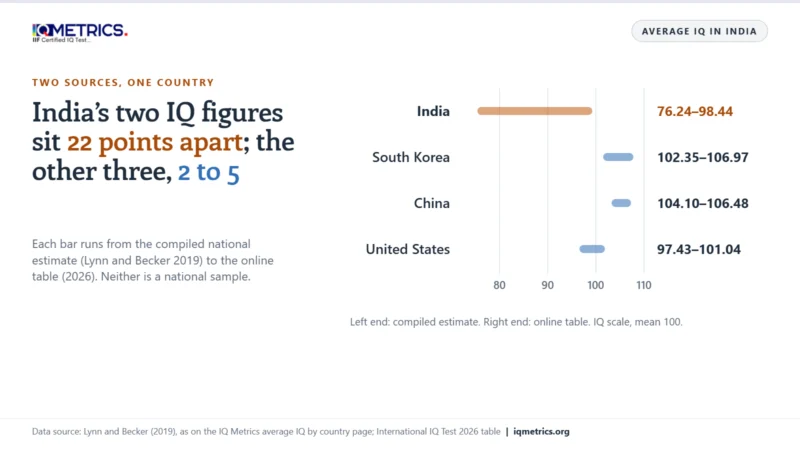 Scores & Scales
Average IQ in India
The average IQ in India is 100 on an Indian-normed test. The circulating national figures are 76.24 from a compiled estimate and 98.44 from an online table, 22 points apart. See where each comes from, what PISA 2009+ and ASER 2024 show, and how India compares with China, the US and South Korea.
 Scores & Scales
What Is the Average IQ in Iran?
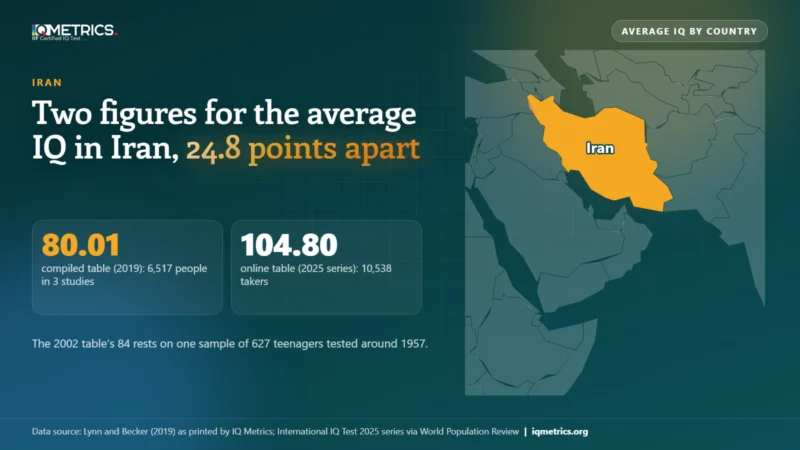
The average IQ in Iran is an estimate, not a test result: 80.01 in a 2019 compiled table of 3 studies and 104.80 in a 2025 online series of 10,538 takers, 24.8 points apart. The older figure of 84 rests on one sample. See where each number comes from and what TIMSS and PIRLS show.
 Scores & Scales
What Is the Average IQ in Nigeria?
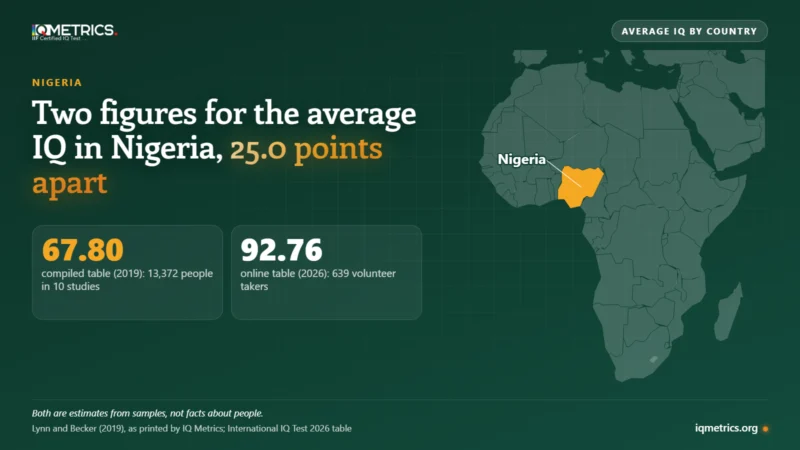
The average IQ in Nigeria is an estimate, not a test result: 67.80 in a 2019 compiled table of 10 studies and 92.76 in a 2026 online table of 639 takers, 25.0 points apart. The older figure of 67 rests on two samples. See where each number comes from and what school data show.