





What Is the Average IQ in the Philippines? What the Figures, PISA and TIMSS Show
The average IQ in the Philippines is 100 on any local test. Two national figures circulate, 81.64 and 95.68, 14.0 points apart, and neither is a national sample. PISA 2025 maths is 370.6 against an OECD average of 463.0, up 15.9 since 2022.

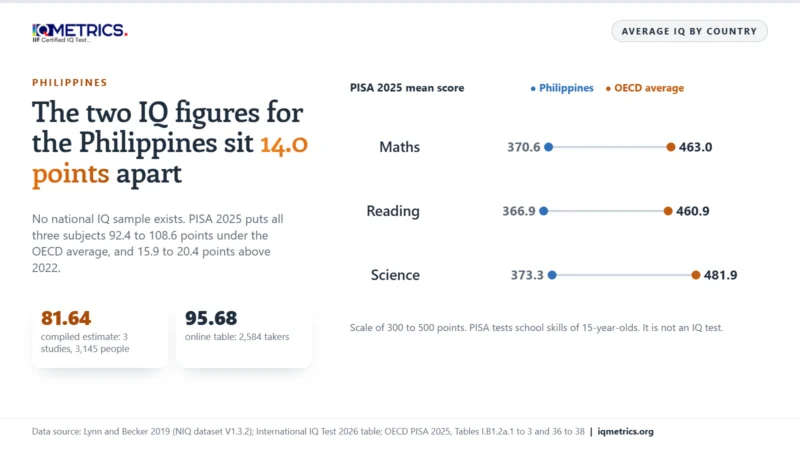
The average IQ in the Philippines is 100 on any test normed in the Philippines, because every IQ test sets its own average at 100. No national IQ sample exists. The two figures that circulate are 81.64 from a compiled estimate (3,145 people in 3 studies) and 95.68 from a 2026 online table (2,584 takers). They sit 14.0 points apart.
New here: that 14-point gap is the second widest of the four countries we compare, and the school data point somewhere else again. In PISA 2025 the Philippines scored 370.6 in maths against an OECD average of 463.0. That is 15.9 points above its 2022 result. Below: where each figure comes from, what PISA and TIMSS show, and how the Philippines compares with Japan, India and the US. This page covers country-level data only. It says nothing about any group of people.
Key takeaways
- A Philippines-normed IQ test averages 100 by design. Comparing countries needs other data.
- Two numbers circulate: 81.64 (compiled, 3 studies, 3,145 people) and 95.68 (online, 2,584 volunteers). Neither is a national sample, and they differ by 14.0 points.
- PISA 2025 (OECD) gives the Philippines 370.6 in maths, 366.9 in reading and 373.3 in science. The OECD averages are 463.0, 460.9 and 481.9.
- All three PISA scores rose from 2022: by 15.9 in maths, 20.4 in reading and 17.2 in science. Each rise is roughly four to five times its standard error.
- TIMSS 2019 (IEA, fourth grade) gave 297 in maths and 249 in science. The Philippines is not on the TIMSS 2023 participant list.
What is the average IQ in the Philippines?
On a test normed in the Philippines, the average is 100 by construction. A norm group is a large sample of people who took the test. Its mean is set to 100, with a standard deviation (SD) of 15 points. A person in the Philippines who scores 100 is average among people in the Philippines. That says nothing about the country against another country.
Four kinds of number get called the average IQ of the Philippines. They answer different questions, and none is an IQ test of everyone in the country. As far as we found, no nation’s IQ has been measured on one test given to a random sample of the whole population. Searches for the Philippines average IQ, the average IQ of Philippines, the IQ of Filipinos or the Filipino IQ all lead to the same two numbers.
| Source | Philippines | Sample | What it measures |
|---|---|---|---|
| Compiled national estimate (Lynn and Becker 2019, on our average IQ by country page) | 81.64 | 3,145 people in 3 studies | Published studies on different tests, averaged |
| Online test (International IQ Test 2026 table) | 95.68 | 2,584 volunteers | People who chose to take one website’s test |
| PISA 2025 (OECD), maths | 370.6 | 15-year-olds in 208 schools | School maths skill, not IQ |
| TIMSS 2019 (IEA), fourth-grade maths | 297 | Fourth-grade students | School maths skill, not IQ |
Where do the 81.64 and 95.68 figures for the Philippines come from?
The 81.64 is the compiled estimate in Lynn and Becker (2019), as printed on our average IQ by country page. It rests on 3 studies and 3,145 people. We reproduce that dataset as published. We did not open the three studies behind it, so we cannot say which tests they used or whom they sampled.
The 95.68 comes from the International IQ Test’s 2026 table, built from 2,584 people in the Philippines who took its online test in 2025. Our report on the 2026 online ranking shows that the table counts whoever chose to take the test, not a sample of the country.
Why do the two IQ figures for the Philippines differ by 14 points?
Because each is built from different people on different tests. One rests on 3 published studies. The other rests on web volunteers. Both are tiny next to a whole country, and neither was designed to represent it.
The gap is large next to other countries. For Japan the online figure is 0.7 points below the compiled one. For the US it is 3.6 above. For India it is 22.2 above. A small gap means two weak sources roughly agree. A big one means at least one is a poor guide. Our report on why country IQ rankings are weaker than the charts suggest sets out the wider problem.
What was the Philippines' PISA score in 2025?
The Philippines PISA score in 2025 was 370.6 in maths, 366.9 in reading and 373.3 in science. The OECD averages were 463.0, 460.9 and 481.9. PISA tests 15-year-olds in school, and our guide to whether PISA is an IQ test explains why it is not one.
| Subject | 2018 | 2022 | 2025 | OECD average 2025 | Gap to OECD average, 2025 |
|---|---|---|---|---|---|
| Maths | 352.6 | 354.7 | 370.6 | 463.0 | 92.4 |
| Reading | 339.7 | 346.5 | 366.9 | 460.9 | 94.0 |
| Science | 356.9 | 356.2 | 373.3 | 481.9 | 108.6 |
The OECD’s trend tables list Philippines results for 2018, 2022 and 2025 only. Between 2022 and 2025 the maths score rose 15.9 points (standard error of the difference about 3.1), reading rose 20.4 (about 4.1) and science rose 17.2 (about 3.9). Those changes come from the unrounded scores, and each is roughly four to five times its standard error. The tables do not say why.
The OECD also reports how many students reach Level 2 in maths, which starts at 420.07 points. In the Philippines 21.1% did, against 65.1% across the OECD average. Counting all 15-year-olds, the OECD reports that 82.8% in the Philippines were not in secondary school, were excluded from PISA or scored below Level 2, against 42.6% on the OECD average (Table I.B1.2a.47).
What did TIMSS show for the Philippines?
TIMSS tested fourth graders in 2019 and found a mean of 297 in maths and 249 in science. The IEA’s TIMSS scale has a centerpoint of 500, and 58 countries took part.
| Year | Maths | Science |
|---|---|---|
| 2003 | 358 (standard error 8.0) | 332 (standard error 9.6) |
| 2019 | 297 (standard error 6.4) | 249 (standard error 7.5) |
We found no TIMSS result after 2019. In 2023, 59 countries took part at the fourth grade, and the Philippines is not on the IEA’s participant list. TIMSS and PISA test different ages and different material, so a 2019 fourth-grade score and a 2025 PISA score for 15-year-olds are not the same measure and are not comparable.
Where would your own score land?
Take the IIF-certified assessment and get your score with the scale it was measured on, the percentile it corresponds to and the confidence range around it — the three figures most online tests leave out.
Find your IQ score now! →How does the Philippines compare with India, Japan and the US?
The two sources do not agree on the order. On the compiled estimate the Philippines figure is above India’s and below the US’s. On the online table it is below both. The gap between the sources is the more useful number: it shows how far each pair disagrees, and the OECD data exist only for some countries.
| Country | Compiled estimate (2019) | Online table (2026) | Online minus compiled | PISA 2025 maths |
|---|---|---|---|---|
| Philippines | 81.64 | 95.68 | +14.0 | 370.6 |
| India | 76.24 | 98.44 | +22.2 | not in the PISA 2025 table |
| Japan | 107.01 | 106.30 | -0.7 | 525.4 |
| United States | 97.43 | 101.04 | +3.6 | 462.8 |
For the same two-source comparison on other countries, read our posts on the average IQ in India and the average IQ in Japan. Our average IQ in the USA page covers the United States, and our smartest countries study ranks the PISA and adult-skills data directly.
How smart are Filipinos, going by these figures?
These figures cannot say. A compiled estimate of 3 studies, a web audience and school tests of 15-year-olds each describe something narrower than a country’s people. No number on this page measures how smart any person or group is.
What the data do show is plain. School skills in the Philippines, as PISA measures them, were below the OECD average in 2025 and higher than in 2022. The IQ figures are too weak to add anything to that. Our post on the PISA 2025 results explains what the scores do not show about IQ.
How can you check your own score?
- Treat 100 as the average IQ in the Philippines on any Philippines-normed test, and nothing more.
- Read 81.64 as three studies, 95.68 as web volunteers, and PISA and TIMSS as school skills, not IQ.
- For a score of your own, take the IQ test, then place it with the IQ percentile calculator. Our IQ bell curve shows what a score means on the scale, and our posts on an IQ of 127 and an IQ of 129 show what a high score means.
Quick answers
- What is the average IQ in the Philippines? The average IQ in the Philippines is 100 on any Philippines-normed test. The circulating national figures are 81.64 (compiled, 3 studies) and 95.68 (online, 2,584 takers).
- Is there an official IQ for the Philippines? No. No national IQ sample exists. Both figures are compilations or web samples.
- What is the Philippines’ PISA score? In PISA 2025 it was 370.6 in maths, 366.9 in reading and 373.3 in science, against OECD averages of 463.0, 460.9 and 481.9.
- Did the Philippines take part in TIMSS? At the fourth grade it has results for 2003 and 2019, with means of 297 in maths and 249 in science in 2019. It is not on the 2023 participant list.
- Does PISA measure IQ? No. It tests the school skills of 15-year-olds.
Sources
- Lynn R, Becker D (2019). The Intelligence of Nations. Ulster Institute for Social Research (NIQ-DATASET V1.3.2), as reproduced on our average IQ by country page.
- International IQ Test 2026 country table (updated 1 January 2026), as read and recomputed in our 2026 online ranking report.
- OECD (2026). PISA 2025 Results (Volume I), Table I.B1.2: tables I.B1.2a.1 to I.B1.2a.3, I.B1.2a.12, I.B1.2a.25, I.B1.2a.36 to I.B1.2a.38 and I.B1.2a.47 (version of 8 September 2026).
- IEA, TIMSS 2019 International Results in Mathematics and Science: average achievement, fourth grade (exhibit workbooks read 14 November 2026).
- IEA, TIMSS 2023 results: participating countries (page read 14 November 2026).
Keep reading
All articles →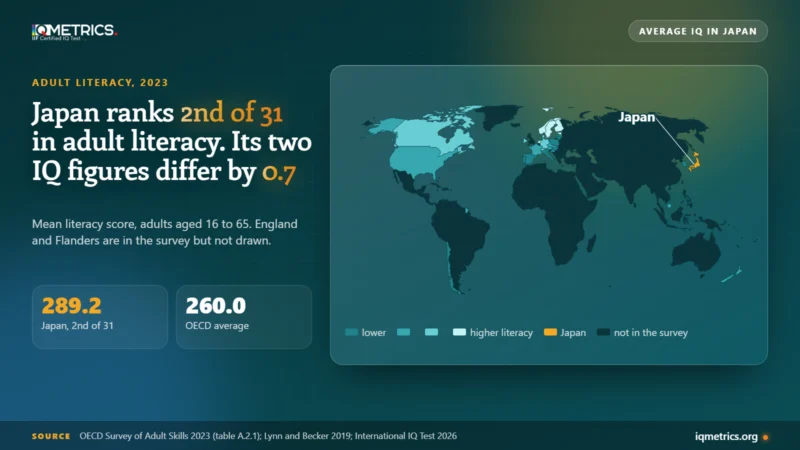 Scores & Scales
Average IQ in Japan
The average IQ in Japan is 100 on a Japanese-normed test. The circulating national figures are 107.01 (compiled) and 106.30 (online), only 0.7 points apart. See where each comes from, what PISA 2025 and the adult-skills survey show, and how Japan compares with South Korea, China and the US.
 Scores & Scales
Average IQ in India
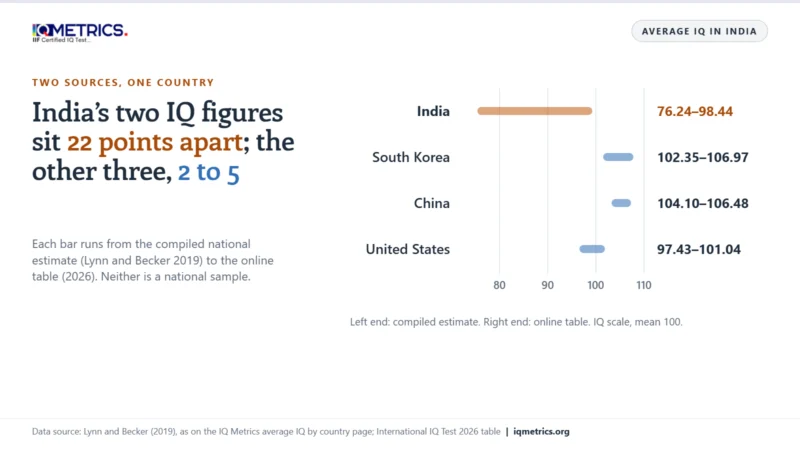
The average IQ in India is 100 on an Indian-normed test. The circulating national figures are 76.24 from a compiled estimate and 98.44 from an online table, 22 points apart. See where each comes from, what PISA 2009+ and ASER 2024 show, and how India compares with China, the US and South Korea.
 Scores & Scales
Average IQ in China
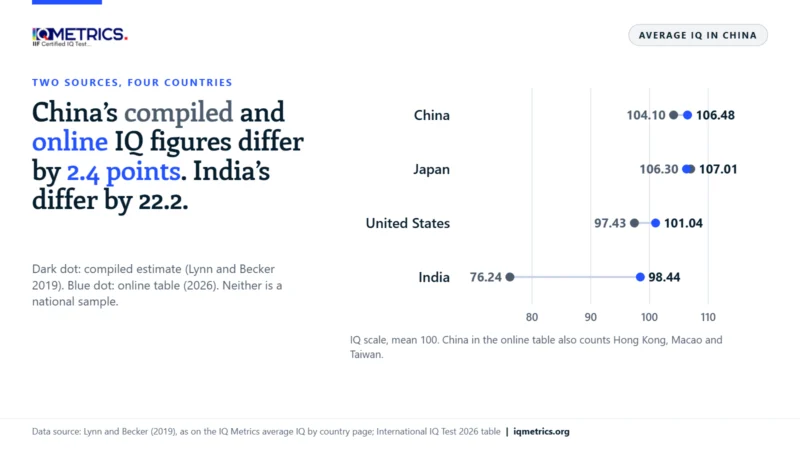
The average IQ in China is 100 on a China-normed test. The circulating national figures are 104.10 from a compiled estimate and 106.48 from an online table that also counts Hong Kong and Taiwan. See where each comes from, what PISA's four-region result covers, and how China compares with Japan and the US.