



What was Carl Sagan’s IQ?
The National Academy of Sciences weighed his record twice: it declined him membership in 1992, then gave him its own Public Welfare Medal two years later.
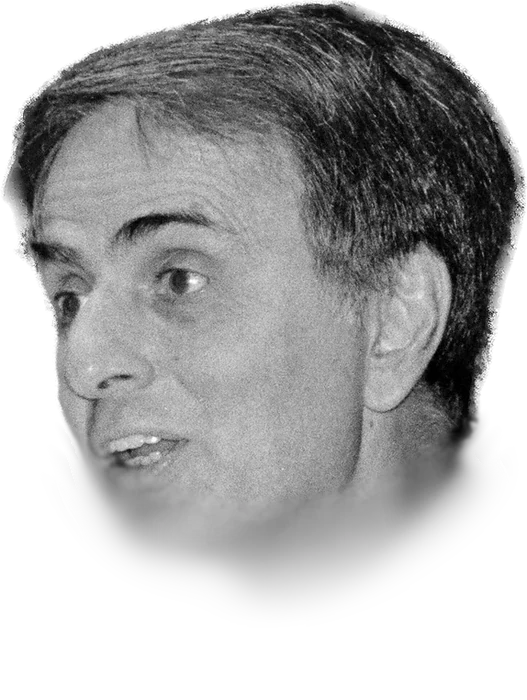
No IQ test result has ever been published for Carl Sagan, and the 170 that headlines two aggregator pages traces to no test of any kind. What is documented is a University of Chicago doctorate in astronomy and astrophysics (1960), a Cornell professorship, a 1978 Pulitzer Prize for The Dragons of Eden, and two Emmy Awards for Cosmos — a research and teaching record built well before any number attached itself to his name.
Carl Sagan’s estimated IQ
- AB (1954), SB (1955) and SM in physics (1956), then a Ph.D. in astronomy and astrophysics (1960), all from the University of Chicago, the last under planetary astronomer Gerard Kuiper — he entered the university on a full scholarship at 16.
- Director of Cornell’s Laboratory for Planetary Studies from 1968, full professor in 1971, and the endowed David Duncan Professor of Astronomy and Space Sciences from 1977 until his death in 1996.
- Science-team roles on NASA’s Mariner, Viking and Voyager missions — among three scientists who picked the 1976 Viking lander sites, and the team leader who assembled the Voyager Golden Record (1977) — across more than 300 published papers.
- The 1978 Pulitzer Prize for General Nonfiction, for The Dragons of Eden (1977), and two Emmy Awards plus a Peabody Award for the series Cosmos: A Personal Voyage (1980).
- A 1992 nomination for National Academy of Sciences membership that fell short of the two-thirds vote required, followed two years later by the Academy’s own Public Welfare Medal (1994).
This is an inference from documented achievement, not a test result. Sagan effectively invented his own subfield — planetary science and exobiology barely existed as careers before him — so there is no comparable cohort of prize juries to benchmark him against the way a Fields Medal or a Nobel committee allows, and much of the record here is writing and broadcasting skill, not the axis a psychometric test measures. The circulating 170 sits at the very top of this range or just past it, resting on aggregator pages that cite each other rather than a test.
- Born
- November 9, 1934, Brooklyn, New York
- Died
- December 20, 1996, Seattle, Washington, aged 62
- Field
- Planetary science, astronomy and science communication
- Education
- AB (1954), SB physics (1955), SM physics (1956) and Ph.D. astronomy and astrophysics (1960), all University of Chicago
- Known for
- Cosmos: A Personal Voyage (1980); the Voyager Golden Record (1977); The Dragons of Eden (1977), winner of the 1978 Pulitzer Prize
- Career
- Harvard astronomy faculty to 1968; Cornell faculty 1968–1996, David Duncan Professor of Astronomy and Space Sciences from 1977
- Honors
- Pulitzer Prize for General Nonfiction (1978); two Emmy Awards and a Peabody Award for Cosmos; National Academy of Sciences Public Welfare Medal (1994)
- Circulating figure
- 170 on two aggregator sites; no published test result
What an IQ of 145–165 actually means
Set the claim aside for a moment. If someone genuinely scored in this range, here is what that would represent.
Average is 100 by construction, and about two-thirds of people fall between 85 and 115. Take the test to place your own score on this scale.
| Score range | Classification | Share of people | What it indicates |
|---|---|---|---|
| 85 – 114 | Average | ~68% | The range most people fall into. |
| 115 – 129 | Above average | ~13.6% | Roughly one person in seven. |
| 130 – 144 | Gifted | ~2% | The threshold most high-IQ societies use. |
| Above 144 | Highly gifted | ~0.1% | Figures above this range are extrapolated from the curve rather than measured. |
Percentages are approximate and describe a normal distribution. The same number means different things on tests with different standard deviations.
Thirty questions gives you a measured position on this exact scale — your score, your percentile and the ability breakdown behind it.
Find out in 30 minutes →Who Carl Sagan was
How smart is Carl Sagan, judged only by what can be checked? He was born Carl Edward Sagan in the Bensonhurst neighborhood of Brooklyn, New York, on November 9, 1934, and moved with his family to Rahway, New Jersey, where he graduated from Rahway High School. In 1951 the University of Chicago admitted him on a full scholarship at age 16 — one of the few colleges that would take a student that young — and he joined its “great books” curriculum. He earned an AB with general and special honors in 1954 and an SB in physics in 1955, both from the University of Chicago; for how a physics major compares with other fields, see average IQ by college major. He added an SM in physics in 1956 and completed a Ph.D. in astronomy and astrophysics in 1960, advised by planetary astronomer Gerard Kuiper, with a thesis on the physics of the planets that modeled the greenhouse effect later confirmed to explain Venus’s surface temperature.
After postdoctoral work at Stanford University and, as a Miller Fellow, the University of California, Berkeley, Sagan joined Harvard’s astronomy faculty as an assistant professor, teaching a popular lecture course nicknamed “Planets are Places” while some colleagues objected to his interest in subjects outside the traditional curriculum. Told he would not receive tenure, he left for Cornell University in 1968, where he was named director of the Laboratory for Planetary Studies that same year, made full professor in 1971, and appointed the endowed David Duncan Professor of Astronomy and Space Sciences in 1977, a chair he held until his death. He remained on the Cornell faculty for the rest of his career.
Sagan served on the science teams for the Mariner, Viking and Voyager missions, was one of three scientists who chose the landing sites for the 1976 Viking probes, and led the team that assembled the Voyager Golden Record (1977), a phonograph disc of Earth’s sounds and images carried into interstellar space. He edited Icarus, the field’s leading research journal, through the 1970s and into the 1980s, and published more than 300 scientific papers, roughly ten a year, alongside a shelf of best-selling books: The Cosmic Connection (1973), The Dragons of Eden (1977) — the 1978 Pulitzer Prize for General Nonfiction — Broca’s Brain (1979), the novel Contact (1985), later filmed in 1997 with Jodie Foster, and Pale Blue Dot (1994).
Sagan co-wrote and narrated Cosmos: A Personal Voyage (1980), a 13-part PBS series watched by more than 500 million people in 60 countries and winner of two Emmy Awards and a Peabody Award; the companion book spent 70 weeks on the New York Times bestseller list. In 1980 he co-founded The Planetary Society with Bruce Murray. In 1992 the National Academy of Sciences considered him for membership; the nomination did not receive the two-thirds vote required. Two years later, in 1994, the Academy awarded him its prestigious Public Welfare Medal, which honored his popularization of science as well as his research, and he received more than 20 honorary degrees over his career. He died of pneumonia, a complication of the bone-marrow disease myelodysplasia, on December 20, 1996, in Seattle, Washington, at 62. What counts as genius-level intelligence is a separate question from what a test would show, even for a record this dense with institutions, dates and named work.
 By Elora Mercer, Celebrity Research WriterFigures checked by Leon Falkner, Data & Research Analyst
Reviewed by Aarav Vardhan, Editor-in-Chief · Last reviewed August 2026

Carl Sagan: the documented record
The estimate above rests on this record. Every entry here is a matter of public fact, which is more than can be said for the number itself.
- 1934Born November 9 in Brooklyn, New York.
- 1951Enters the University of Chicago at 16 on a full scholarship.
- 1960Earns a Ph.D. in astronomy and astrophysics from the University of Chicago, advised by Gerard Kuiper.
- 1968Denied tenure at Harvard; joins Cornell as director of the Laboratory for Planetary Studies.
- 1976Helps select the landing sites for NASA’s Viking Mars probes.
- 1977Leads the Voyager Golden Record project and publishes The Dragons of Eden.
- 1978Wins the Pulitzer Prize for General Nonfiction for The Dragons of Eden.
- 1980Cosmos: A Personal Voyage airs on PBS; co-founds The Planetary Society with Bruce Murray.
- 1992Nominated for National Academy of Sciences membership; the vote falls short of the two-thirds required.
- 1994The Academy awards him its own Public Welfare Medal.
- 1996Dies December 20 in Seattle, Washington, at 62.
Where the 170 figure came from
Following a claim back to its first appearance is the part almost nobody does — and it is what most people are actually asking.
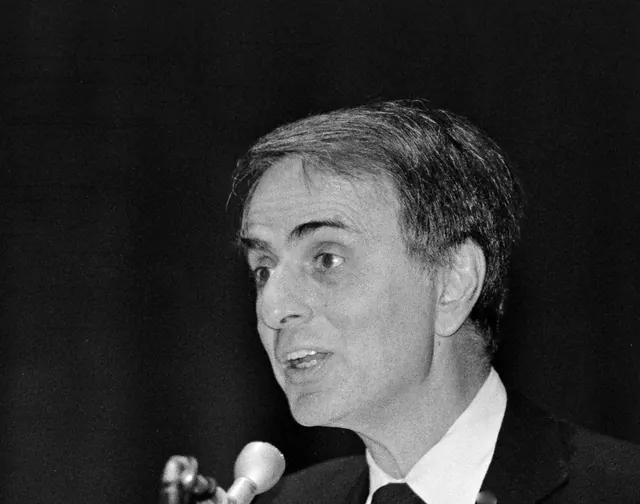
Pages that promise a Carl Sagan IQ level cluster into two camps. check-iq.org and celebrityiqs.com both headline 170; corebrain.app estimates 160; lifescoretest.com offers “150+” inside a stated 135–160 range. None cites a test Sagan is known to have taken, and one pair of these pages turns out to be closer than they look.
The 170 has the most paperwork behind it, and the paperwork loops back on itself. check-iq.org states its figure comes from three sources — IQ-test.net, Past Factory and “Celebrity IQs” — and rates all three, plus its own resulting number, “Low” confidence, even though every one of them already reads 170. “Celebrity IQs” appears to be celebrityiqs.com, a page checked separately for this record: it gives the same 170 with no citation of any kind and calls its own numbers “for entertainment purposes only.” An aggregator citing another aggregator as independent confirmation is the usual pattern for a celebrity IQ number — a figure appears somewhere without a source, other pages repeat it, and the repetition starts to look like corroboration.
The lower figures are more honest about being guesses. corebrain.app and lifescoretest.com both reach for the same tool, Catharine Cox’s 1926 historiometric study of three hundred historical geniuses, applying it retroactively to Sagan’s biography rather than to any test he sat, and both say outright that no verified or primary test report exists. That is the same method this site uses for figures who left no test behind at all, including Albert Einstein, and the honesty is worth crediting even where the number itself — 160, or “150+” inside a 135–160 range — is still not a measurement.
Sagan taught two of the scientists this site also profiles, which makes the comparison easier to draw honestly than most. Neil deGrasse Tyson was a 17-year-old college applicant when Sagan wrote to him in November 1975 and hosted him at Cornell during a snowy visit; Tyson chose Harvard instead, but has credited the encounter for decades, and in 2014 he hosted Cosmos: A Spacetime Odyssey, the direct successor to Sagan’s own series. Bill Nye took Sagan’s Astronomy 102 class at Cornell as an undergraduate and talked Sagan into putting “Johnny B. Goode” on the Voyager Golden Record instead of “Roll Over Beethoven.” Neither story is a test score, but the documented range here, 145–165, sits above the 140–155 this site estimates for Tyson and well above the 120–135 it estimates for Nye — the professor outranks the one he taught and the one he tried to recruit, on paper at least.
How we read a number →No score report, school record or clinician’s account for Sagan turned up in Wikipedia, his National Academy of Sciences biographical memoir, Cornell University’s own coverage, the Bulletin of the American Astronomical Society, or any of the aggregator pages below.
check-iq.org (published August 21, 2024; updated August 27, 2024) credits three sources for its 170 figure — IQ-test.net, Past Factory and “Celebrity IQs” — and rates all of them, and its own resulting number, “Low” confidence. “Celebrity IQs” appears to be celebrityiqs.com, checked separately: it gives the same 170 with no source and discloses that its numbers are “for entertainment purposes only.”
Both apply Catharine Cox’s 1926 historiometric method retroactively to Sagan’s biography rather than to any test. corebrain.app states “no verified clinical test result” exists; lifescoretest.com gives a 135–160 “working range” and states “no primary standardized test report is available.”
States “He received his A.B. in 1954, his S.B. in 1955, his S.M. in 1956 and his Ph.D. in 1960” from the University of Chicago.
Confirms the Kuiper-advised 1960 astronomy doctorate, the 1968 Cornell move after Harvard denied him tenure, the David Duncan Professorship and Laboratory for Planetary Studies directorship, the Viking landing-site role, the Voyager Golden Record, more than 300 published papers, the 1978 Pulitzer Prize, Cosmos, the unsuccessful 1992 National Academy of Sciences membership nomination and the 1994 Public Welfare Medal, and the December 20, 1996 death from complications of myelodysplasia.
Confirms the AB/SB/SM/PhD years (1954, 1955, 1956, 1960), the Miller Fellowship at UC Berkeley (1960–62), the Harvard assistant professorship, and the Cornell titles and years: director of the Laboratory for Planetary Studies (1968–96) and David Duncan Professor of Astronomy and Space Sciences (1977–96).
Confirms he joined Cornell in 1968, became a full professor in 1971, and held the David Duncan Professorship; confirms the December 20, 1996 death in Seattle.
Confirms Bill Nye took Sagan’s Astronomy 102 class at Cornell and persuaded Sagan to put “Johnny B. Goode” on the Voyager Golden Record instead of “Roll Over Beethoven.”
Orientation for birth/death details, the Voyager Golden Record and Pioneer plaque, Cosmos viewership, and confirms The Dragons of Eden listed under “1978” in the Pulitzer Prize for General Nonfiction winners list. The Spacetime Odyssey article confirms the 2014 series was hosted by Neil deGrasse Tyson as “a follow-up to the 1980 television series” with Ann Druyan, Sagan’s widow, as an executive producer. Wikidata Q410 identifies the American astrophysicist (1934–1996), employer Cornell University, doctoral advisor Gerard Kuiper.
Confirms Sagan’s November 12, 1975 letter to the 17-year-old Tyson, Tyson’s snowy visit to Cornell, and Tyson’s April 30, 1976 reply explaining his choice of Harvard over Cornell.
The sources behind our estimate
The figures that circulate for Carl Sagan, what we were able to confirm, and where the two diverge.
Two pages give a Carl Sagan IQ figure of 170, and one of them is the source for the other. check-iq.org credits “Celebrity IQs” as one of three sources for its 170 average, and celebrityiqs.com — which appears to be that same site — gives 170 with no source of its own at all. corebrain.app separately estimates 160, and lifescoretest.com gives a “150+” estimate inside a stated 135–160 range.
No published IQ test result exists for Carl Sagan. check-iq.org (published August 21, 2024; updated August 27, 2024) puts his IQ at 170, citing three sources — IQ-test.net, Past Factory and “Celebrity IQs” — that each already show 170, and still rates its own resulting figure “Low” confidence. “Celebrity IQs” appears to be celebrityiqs.com, a page checked separately for this record: it gives the identical 170 with no source, date or test cited, and discloses at the foot of the page that “the IQ scores posted on this website are not guaranteed” and exist “for entertainment purposes only.” corebrain.app takes a different approach, applying Catharine Cox’s 1926 historiometric method retroactively to Sagan’s biography to reach 160, and states plainly that “no verified clinical test result” exists. lifescoretest.com uses the same method for a “150+” estimate inside a stated 135–160 “working range,” adding that “no primary standardized test report is available.” We also checked myiqscores.com, which a search listing had indexed for Sagan; the live page no longer carries an entry under his name.
Read left to right: 145 is the floor of the range this site’s record of a University of Chicago doctorate and a NASA-mission research career supports; 160 is corebrain.app’s historiometric guess, sitting inside that range; 165 is the ceiling of the estimated range; 170 is the number two aggregator pages headline — one of which turns out to be the other’s own cited source. The circulating figure sits at the edge of the documented record, not comfortably inside it.
Want a number that does hold up? Every figure on this page is somebody’s claim. Take the 30-question test and get a percentile you can check rather than a figure you have to trust.
Carl Sagan — frequently asked
What is Carl Sagan’s IQ?
No published IQ test result exists for Carl Sagan, so no verified score can be reported. The figures that circulate — 170 on two aggregator sites, 160 on another, “150+” on a fourth — all admit they are guesses. This site’s estimated range, 145–165, is inferred from his University of Chicago doctorate and career record, not from a test.
Is Carl Sagan a genius?
By documented measure, yes in the ordinary sense of the word: a University of Chicago doctorate completed at 25, a Cornell professorship, more than 300 published papers and a Pulitzer Prize. “Genius” has no fixed IQ threshold, and Sagan’s own field never produced a Fields Medal or Nobel Prize to anchor a number the way some peers on this site have.
Did Carl Sagan ever take an IQ test?
No test result is public. In the sources checked for this page — Wikipedia, a National Academy of Sciences biographical memoir, Cornell University and the Bulletin of the American Astronomical Society — Sagan never published or discussed a personal IQ score, and even the aggregator sites guessing at a number cite no test behind it.
Where does the 170 IQ figure for Carl Sagan come from?
It traces to two aggregator pages that turn out to be closely related. check-iq.org lists “Celebrity IQs” as one of three sources for its 170 figure, and celebrityiqs.com — apparently that same site — gives the identical 170 with no source of its own, calling its numbers “for entertainment purposes only.” Neither page cites a test.
What degrees did Carl Sagan earn?
Sagan earned four degrees from the University of Chicago: an AB with general and special honors (1954), an SB in physics (1955), an SM in physics (1956), and a Ph.D. in astronomy and astrophysics (1960) under planetary astronomer Gerard Kuiper. He entered the university on a full scholarship at age 16.
How does Carl Sagan’s estimated IQ compare with Neil deGrasse Tyson’s?
This site estimates 145–165 for Sagan and 140–155 for Tyson, whom Sagan personally mentored as a 17-year-old Cornell applicant in 1975. Both ranges rest on a completed doctorate and a science-communication career rather than a test; Sagan’s sits slightly higher, reflecting a longer research record and a Pulitzer Prize that Tyson’s record does not include.
What is Carl Sagan famous for?
Sagan is best known for Cosmos: A Personal Voyage (1980), the PBS series watched by hundreds of millions of people worldwide, and for leading the Voyager Golden Record project (1977). He also won the 1978 Pulitzer Prize for General Nonfiction for The Dragons of Eden and helped choose the landing sites for NASA’s 1976 Viking Mars probes.
How does my IQ compare with Carl Sagan?
You can find out in about fifteen minutes. The IQ Metrics assessment is 30 questions, scored on the same 100-mean scale used throughout this page, so your result and the estimate above are at least expressed in the same units — one measured, one inferred. Once you have a number, the leaderboard shows where it would sit, and how we score and norm it explains the benchmarking.
Where does this estimate come from?
From the documented record rather than a test — the method is named above and set out in full under how we read a number. Compare it against the other scientists profiles, starting with Albert Einstein.
- Take the 30-question IQ test — get a measured score and percentile of your own
- Average IQ by country — how the scale behaves across populations
- How IQ Metrics scores its assessment — the method behind our own number
- More on how IQ testing works — reliability, error and what a score can and cannot say
- More scientists profiles — same field, same method
More scientists
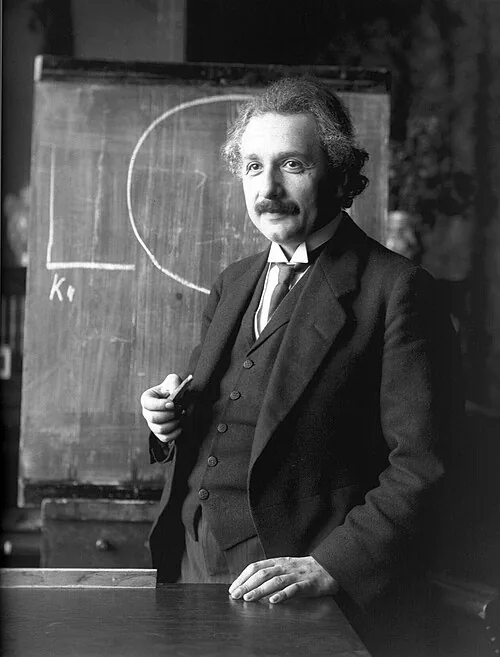
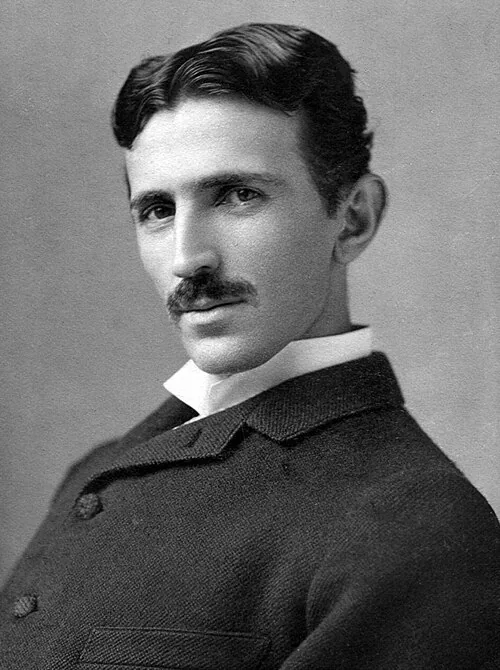

Portrait by Ferdinand Schmutzer (1921), public domain. Background removed for the portrait above. · Photograph by Napoleon Sarony (c. 1890), public domain. Background removed for the portrait above. · Los Alamos National Laboratory badge photograph, via Wikimedia Commons, CC0. Background removed for the portrait above.


An estimate is an inference.
Yours can be measured.
Thirty questions, scored against general-population benchmarks. Your score, your percentile, your ability breakdown and a printable IIF certificate.
Find your IQ score now! →