



What is Dexter Holland’s IQ?
A finished virology PhD — and an IQ number borrowed from Stephen Hawking’s own unverified one.

Dexter Holland’s academic record is documented at every stage — valedictorian of his high school class, a bachelor’s and master’s in the biological sciences, and a Ph.D. in molecular biology, all from the University of Southern California, the doctorate finished after a gap of more than two decades. The IQ figure attached to him, 160, traces to an uncredited fan site whose only stated justification for the number is a comparison to Stephen Hawking.
Dexter Holland’s estimated IQ
- Graduated valedictorian of Pacifica High School in Garden Grove, California, in 1984, then earned a B.S. in Biological Sciences (1988) and an M.S. in Molecular Biology (1990), both from the University of Southern California.
- Paused doctoral studies in virology for roughly two decades after the Offspring’s 1994 album Smash — which sold more than eleven million copies worldwide, making it the best-selling album ever released on an independent label — turned the band into a full-time commitment.
- First author, with his eventual doctoral advisor Suraiya Rasheed and two co-authors, on a peer-reviewed 2013 paper in PLoS ONE identifying microRNA-like sequences embedded within HIV’s own protein-coding genome.
- Completed and defended a 175-page Ph.D. dissertation in Molecular Biology at USC, “Discovery of Mature MicroRNA Sequences within the Protein-Coding Regions of Global HIV-1 Genomes: Predictions of Novel Mechanisms for Viral Infection and Pathogenicity,” graduating on 11 May 2017 under Rasheed, director of the Keck School of Medicine’s Laboratory of Viral Oncology and AIDS Research.
No IQ test result for Holland has ever been published by any testing body, biographer, or outlet that covered his doctorate. This range credits a genuinely completed hard-science Ph.D. and a first-author peer-reviewed publication rather than a measured score, and it sits below the more decorated academic records elsewhere on this site — a Harvard doctorate, a Cambridge Wrangler’s degree — because a state-university science Ph.D. and a public high school valedictorianship are real but different-tier documentary evidence.
- Born
- 29 December 1965, Garden Grove, California
- Education
- B.S. Biological Sciences, USC (1988); M.S. Molecular Biology, USC (1990); Ph.D. Molecular Biology, USC (2017)
- Dissertation
- “Discovery of Mature MicroRNA Sequences within the Protein-Coding Regions of Global HIV-1 Genomes,” USC, 11 May 2017
- Also known for
- Frontman of the Offspring; first-author HIV research in PLoS ONE (2013)
- Documented IQ test
- None on record — “160” traces to an uncredited fan site
What an IQ of 130–145 actually means
Set the claim aside for a moment. If someone genuinely scored in this range, here is what that would represent.
Average is 100 by construction, and about two-thirds of people fall between 85 and 115. Take the test to place your own score on this scale.
| Score range | Classification | Share of people | What it indicates |
|---|---|---|---|
| 85 – 114 | Average | ~68% | The range most people fall into. |
| 115 – 129 | Above average | ~13.6% | Roughly one person in seven. |
| 130 – 144 | Gifted | ~2% | The threshold most high-IQ societies use. |
| Above 144 | Highly gifted | ~0.1% | Figures above this range are extrapolated from the curve rather than measured. |
Percentages are approximate and describe a normal distribution. The same number means different things on tests with different standard deviations.
Thirty questions gives you a measured position on this exact scale — your score, your percentile and the ability breakdown behind it.
Find out in 30 minutes →Who Dexter Holland is
Born Bryan Keith Holland on 29 December 1965 in Garden Grove, California, he graduated valedictorian of Pacifica High School in 1984 — the same year he and cross-country teammate Greg Kriesel formed the band Manic Subsidal, renamed the Offspring in 1986 after guitarist Noodles joined. He enrolled at USC as a biological sciences major, where Professor Bob Baker’s molecular biology courses were, in Holland’s own words, “very inspirational”; he earned his B.S. in 1988 and an M.S. in Molecular Biology in 1990, then began doctoral studies. The Offspring’s 1994 album Smash sold more than eleven million copies worldwide, and touring behind it put the Ph.D. on hold.
He returned to it roughly two decades later, working under Professor Suraiya Rasheed, director of the Keck School of Medicine’s Laboratory of Viral Oncology and AIDS Research. In March 2013 he was first author, with Rasheed and two co-authors, on a peer-reviewed paper in PLoS ONE identifying microRNA-like sequences embedded in HIV’s own genome. He defended his dissertation on the same subject and graduated on 11 May 2017. In 2022 he returned to Keck as commencement speaker for its PhD, DNAP, MPH and MS graduates, and has since endowed a memorial scholarship in Bob Baker’s name at USC Dornsife. Outside the lab, he co-founded the punk label Nitro Records in 1994 and the hot-sauce brand Gringo Bandito in 2004, and holds a pilot’s license.
 By Elora Mercer, Celebrity Research WriterFigures checked by Leon Falkner, Data & Research Analyst
Reviewed by Aarav Vardhan, Editor-in-Chief · Last reviewed August 2026

Where the 160 figure came from
Following a claim back to its first appearance is the part almost nobody does — and it is what most people are actually asking.
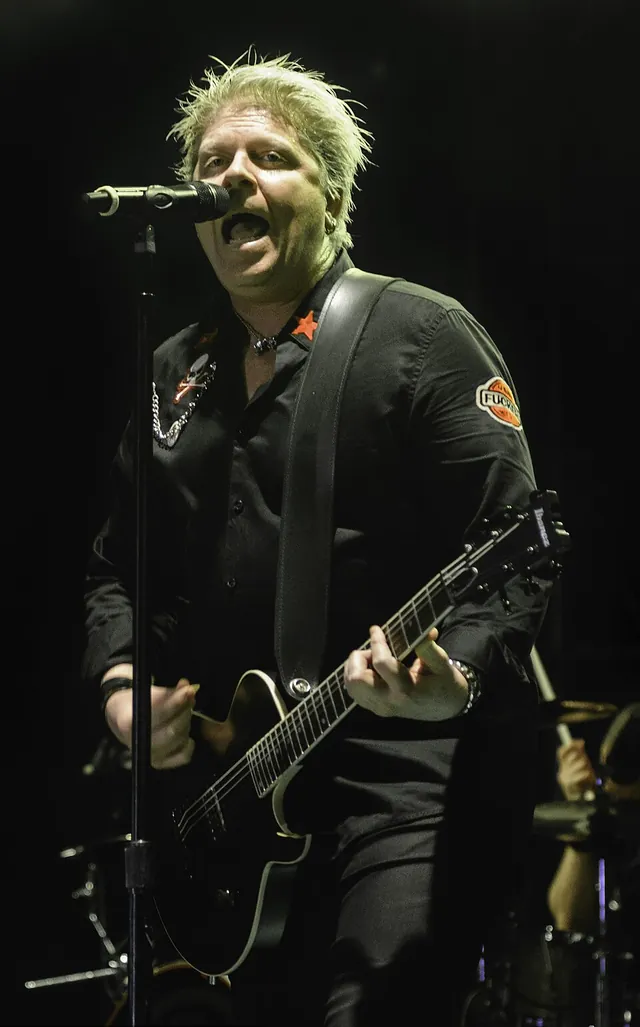
Holland’s page follows the same rule as every profile in this section: audit the number, not the person. His record outside music is unusually easy to check — a defended dissertation, a named advisor, a peer-reviewed paper with his name on it — and none of it produces 160. The only visible source for that figure is sociosite.net, an uncredited fan site that states, with no citation: “With Dexter Holland’s I.Q. score of 160, he is on par with Stephen Hawking.” The comparison is doing the work an actual source should do — and it does not hold up on its own terms, because Hawking’s own IQ was never tested or disclosed either. Sociosite.net’s 160 for Holland is anchored to another number that is itself just reputation, not a record.
The figure also survives by being copied rather than checked. celebrityiqs.com and historythings.com repeat 160 with no source of their own, filing Holland alongside Sylvester Stallone, Matt Damon, Ashton Kutcher and Taylor Swift under the identical round number. One aggregator, check-iq.org, is unusually candid about its method: it states it “averaged the IQ scores from two sources … namely Daily Choices and SocioSite,” and rates both inputs “Low Confidence” on its own page. Averaging two unsourced guesses does not produce a more reliable third one — it launders the same absence of evidence into a number that looks calculated. A fourth site, iqtests.com, drops the number entirely and instead asserts, without evidence, that Holland is a Mensa member.
Holland’s arc — a hard-science doctorate set aside for a famous band and finished decades later — has one close parallel on this site: Brian May shelved his own Imperial College astrophysics PhD for Queen in 1974 and did not complete it until 2007, thirty-three years later. Both men’s degrees are entirely checkable; neither man’s popular IQ figure is. Art Garfunkel’s two Columbia mathematics degrees make an instructive contrast rather than a parallel: no celebrity-IQ site checked for that profile assigns him a number at all — the opposite failure mode from Holland’s, where a number exists and simply has nothing under it.
How we read a number →Source of the circulating 160 figure and the “on par with Stephen Hawking” comparison; states both with no citation or methodology.
States its own method on the page: an average of two unsourced figures, “Daily Choices” and “SocioSite,” both rated “Low Confidence.”
Confirms Hawking’s 2004 New York Times interview reply and that his own IQ was never tested or disclosed — undercutting the comparison sociosite.net uses to support Holland’s figure.
Peer-reviewed paper confirming Holland’s published, first-author HIV research underlying his doctorate.
Confirms his 1988 bachelor’s and 1990 master’s degrees and his 2017 Ph.D., all from USC.
The sources behind our estimate
The figures that circulate for Dexter Holland, what we were able to confirm, and where the two diverge.
“160” is the figure most often attached to Holland on celebrity-IQ ranking sites and quiz blogs, several of which add that it puts him “on par with Stephen Hawking.”
Sociosite.net states, with no citation: “With Dexter Holland’s I.Q. score of 160, he is on par with Stephen Hawking.” No testing body, biography, or primary document is cited anywhere on the page — and the comparison does not hold up on its own terms either, because Hawking’s own IQ was never tested or disclosed. Asked directly by The New York Times in 2004, his reply was “I have no idea. People who boast about their IQ are losers.” The same 160 repeats, similarly unsourced, on celebrityiqs.com and historythings.com, both of which group Holland with Sylvester Stallone, Matt Damon, Ashton Kutcher and Taylor Swift under the identical round number. One aggregator, check-iq.org, is unusually candid about its method: it says it “averaged the IQ scores from two sources … namely Daily Choices and SocioSite,” and rates both inputs “Low Confidence” on its own page. A fourth site, iqtests.com, skips the number entirely and instead asserts, without evidence, that Holland is a Mensa member. No version of the claim points to an actual test.
The documented record supports a lower ceiling than the number in circulation — and even the sites repeating 160 do not agree on how they got there, from a straight copy, to a self-described average of two low-confidence guesses, to an unverified Mensa claim standing in for a number at all.
Want a number that does hold up? Every figure on this page is somebody’s claim. Take the 30-question test and get a percentile you can check rather than a figure you have to trust.
Dexter Holland — frequently asked
What was Dexter Holland’s IQ?
No test result has ever been published. The 160 that circulates for him traces to an uncredited fan site, sociosite.net, whose only stated justification is a comparison to Stephen Hawking — whose own IQ was never tested or disclosed either. What is real is his academic record: a Ph.D. in Molecular Biology from USC (2017), following a B.S. (1988) and M.S. (1990) in the biological sciences, also from USC.
Did Dexter Holland really earn a Ph.D.?
Yes. He earned a Ph.D. in Molecular Biology from the University of Southern California on 11 May 2017, after a B.S. in Biological Sciences (1988) and an M.S. in Molecular Biology (1990), both also from USC.
What was Dexter Holland’s dissertation about?
HIV. His 175-page dissertation, “Discovery of Mature MicroRNA Sequences within the Protein-Coding Regions of Global HIV-1 Genomes: Predictions of Novel Mechanisms for Viral Infection and Pathogenicity,” examined microRNA-like sequences within HIV’s own genome and their possible role in helping the virus evade the immune system.
Did Dexter Holland pause his degree to be in the Offspring?
Yes. He began his doctoral studies not long after his 1990 master’s, then set them aside once the Offspring’s 1994 album Smash — which sold more than eleven million copies worldwide — turned the band into a full-time commitment. He returned to finish the degree roughly two decades later.
Has Dexter Holland published scientific research?
Yes. He was first author, with his doctoral advisor Suraiya Rasheed and two co-authors, on a peer-reviewed 2013 paper in PLoS ONE identifying microRNA-like sequences embedded within HIV’s protein-coding genes.
Where does the “on par with Stephen Hawking” comparison come from?
A single uncredited fan site, sociosite.net, which states Holland’s IQ as 160 and adds the Hawking comparison with no source for either number. Hawking never publicly disclosed a tested IQ score; asked directly by The New York Times in 2004, he said, “I have no idea. People who boast about their IQ are losers.”
How does my IQ compare with Dexter Holland?
You can find out in about fifteen minutes. The IQ Metrics assessment is 30 questions, scored on the same 100-mean scale used throughout this page, so your result and the estimate above are at least expressed in the same units — one measured, one inferred. Once you have a number, the leaderboard shows where it would sit, and how we score and norm it explains the benchmarking.
Where does this estimate come from?
From the documented record rather than a test — the method is named above and set out in full under how we read a number. Compare it against the other musicians profiles, starting with Brian May.
- Take the 30-question IQ test — get a measured score and percentile of your own
- Average IQ by country — how the scale behaves across populations
- How IQ Metrics scores its assessment — the method behind our own number
- More on how IQ testing works — reliability, error and what a score can and cannot say
- More musicians profiles — same field, same method
More musicians

Portrait by Barbara Krafft (1819), public domain. Background removed for the portrait above. · Photograph by the Junta de Andalucía (2023), CC BY-SA 2.0. Background removed for the portrait above. · Photograph by iHeartRadioCA, CC BY 3.0. The background-removed portrait above is a derivative work offered under the same licence.
.jpg)
02.jpg)
.png)
An estimate is an inference.
Yours can be measured.
Thirty questions, scored against general-population benchmarks. Your score, your percentile, your ability breakdown and a printable IIF certificate.
Find your IQ score now! →